What does "first pressing" olive oil actually mean?
"First pressing" on its own is not a term defined in Turkish food law. Two expressions are defined — "first cold press" and "cold extraction" — and they describe different production methods. Using the text of the regulation itself, this piece explains the difference and what on the label is actually binding.
When you see "first pressing" on a bottle, the question that follows is reasonable: does it mean the oil is better?
The short answer is no — because "first pressing" on its own is not a term defined in Turkish food law. Two expressions are defined in the Turkish Food Codex, and neither of them is "first pressing": "first cold press" and "cold extraction". And those two do not describe the same thing either.
What the regulation actually says
The governing text is the Turkish Food Codex Communiqué on Olive Oil and Olive Pomace Oil (No. 2017/26), published in the Official Gazette of 17 September 2017, issue 30183. Article 14, on labelling, lists one by one the optional statements that may appear on the product. The two relevant sub-paragraphs read:
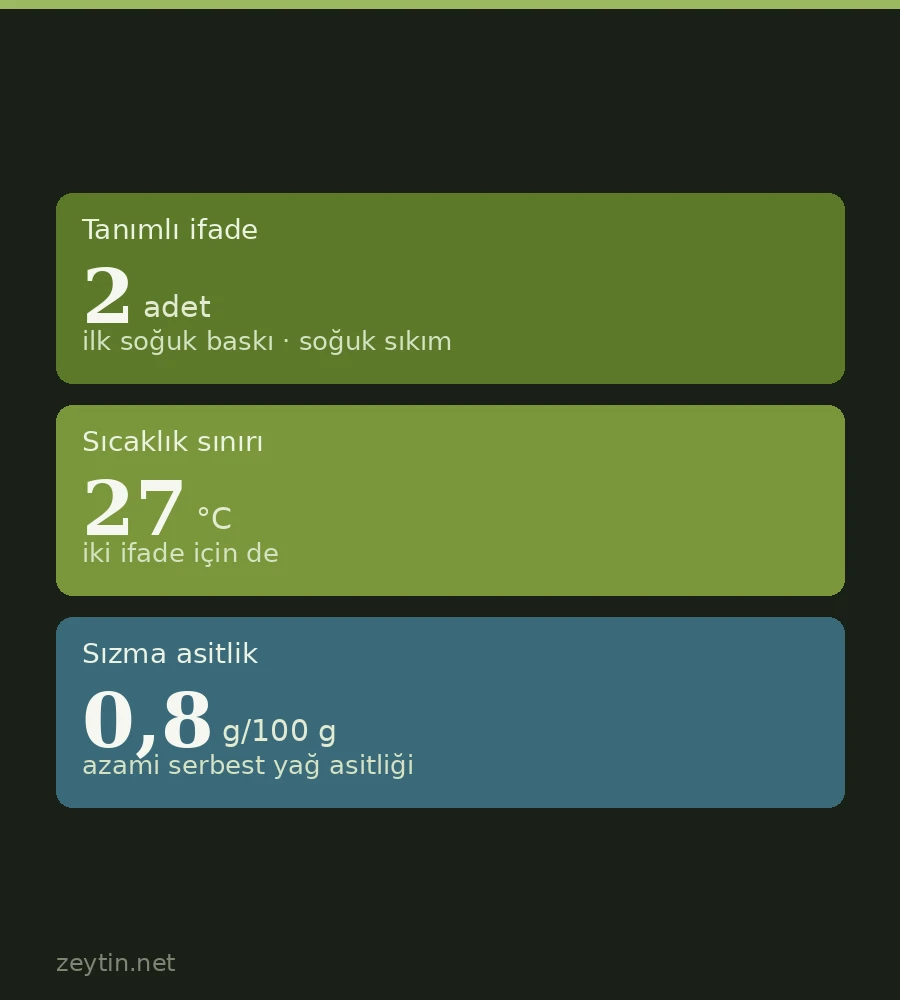
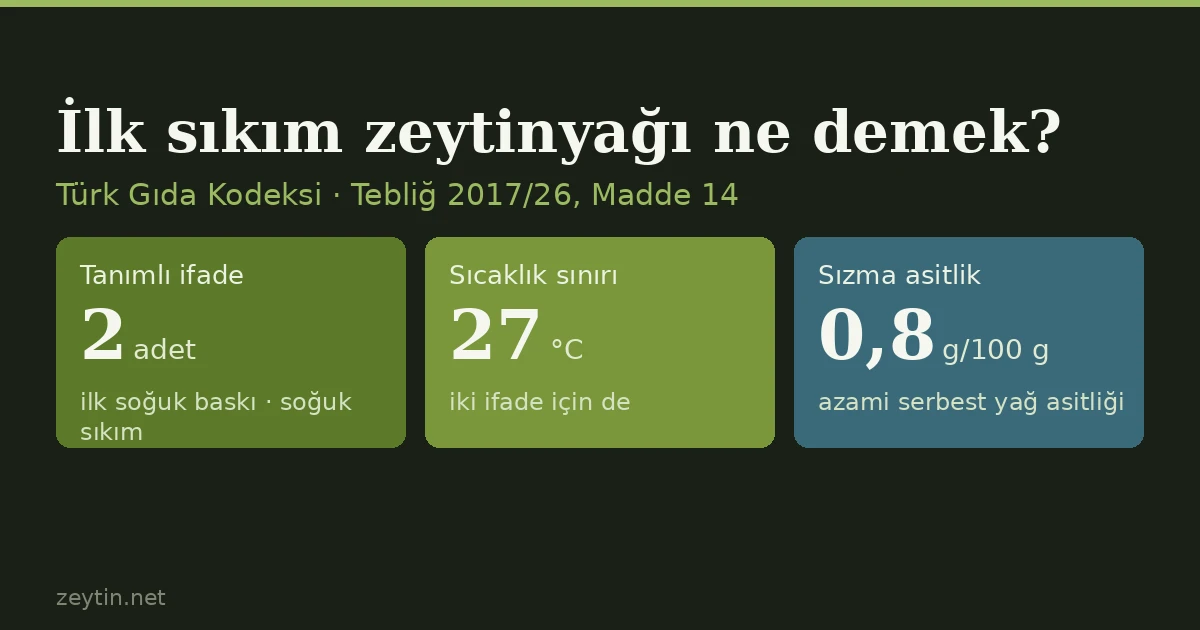
t; (d) The expression "first cold press" may only be used for extra virgin and virgin olive oils obtained below 27 °C from the first mechanical pressing of the olive paste using a hydraulic press.
t; (e) The expression "cold extraction" may be used for extra virgin or virgin olive oils obtained by percolation or centrifugation of the olive paste below 27 °C.
The difference between those two sentences explains the whole issue.
Press or centrifuge
| Expression | Method required | Temperature | Applies to |
|---|---|---|---|
| First cold press | Hydraulic press · first mechanical pressing | below 27 °C | Extra virgin, virgin |
| Cold extraction | Percolation or centrifugation | below 27 °C | Extra virgin, virgin |
| First pressing | — | — | Not defined |
"First cold press" requires a hydraulic press. In a press-based mill the olive paste is spread onto mats, the mats are stacked, and the stack is squeezed under pressure. The word "first" is meaningful there, because the old press arrangement involved a second pressing: hot water was added to the remaining pomace and it was squeezed again, and the oil that came out was not the same oil. "First" existed precisely to draw that line.
"Cold extraction" requires no press at all; it says percolation or centrifugation. The overwhelming majority of mills operating in Turkey today run continuous systems — horizontal centrifuges, or decanters. Nothing is pressed there; the phases are separated by spinning.
Why "first pressing" is an outdated phrase
A continuous system has no second pressing stage. The paste is malaxed once, passes through the decanter once, and that is the end of it. We covered the detail in what is a malaxer and how cold-pressed olive oil is made.
So saying "first pressing" about a centrifuge-produced oil amounts to saying "this oil is not from the second pressing" — when no second pressing exists at that plant. The phrase implies superiority by ruling out an alternative that is not on the table.
The second problem is more concrete. Because "first pressing" is not a defined expression, it has no verifiable counterpart. A producer printing "first cold press" must be able to show that a hydraulic press was used and that the 27 °C limit was respected. A producer printing "first pressing" has nothing to show, because no rule-bound claim has been made.
Has the press disappeared entirely
No — and the regulation itself tells us so. If the 2017 communiqué had stopped defining "first cold press", one could assume no hydraulic-press mills were left. The definition is still there, which means the production method that earns the phrase is still there too.
In practice the press survives mostly in small and village mills and in some boutique production. It is slower than a continuous system, and the cleanliness of the mats feeds straight into the quality of the oil — which is why "it came off a press" is not by itself a measure of quality. We gathered what to check when choosing a mill in what to check when having olives pressed.
Why 27 °C keeps appearing
Both defined expressions share the same condition: the paste must not exceed 27 °C. The limit is not arbitrary. As malaxing temperature rises, yield improves but the oil's aroma compounds and phenolic content begin to disappear. Temperature is where the trade between quantity and quality is negotiated, and the regulation puts a ceiling on that negotiation.
The framework is not specific to Turkey either. Article 18 of the communiqué states plainly that the text was prepared taking into account Commission Implementing Regulation (EU) No 29/2012 on marketing standards for olive oil and Regulation (EEC) No 2568/91 on the characteristics of olive oil.
So what should you read on the label
What determines an oil's class is not the extraction method but its category and free fatty acidity. Article 4 of the same communiqué sets the limits:
| Category | Maximum free acidity |
|---|---|
| Extra virgin olive oil | 0.8 g / 100 g |
| Virgin olive oil | 2.0 g / 100 g |
| Refined olive oil | 0.3 g / 100 g |
| Riviera (olive oil blend) | 1.0 g / 100 g |
| Olive pomace oil | 1.0 g / 100 g |
We explained what acidity measures in what does acidity mean in olive oil, and the difference between the categories in extra virgin, virgin and riviera explained.
The rules on the label that do bind
The same Article 14 also imposes several hard requirements alongside the free marketing language:
- A geographical indication may appear only on the label of extra virgin and virgin olive oil.
- Olive pomace oil may under no circumstances be called olive oil. We covered what pomace oil is in what is riviera olive oil.
- If acidity or maximum acidity is stated on the label, the peroxide value, wax content and specific absorbance in ultraviolet light must be stated too, in the same percentage and the same size. Printing "acidity 0.3%" alone and withholding the rest breaks the rule.
- Product offered to the final consumer may not be placed on the market without being prepacked.
- Sensory descriptors of taste and smell may be used only for extra virgin and virgin oil, and only where they have been assessed by the defined tasting method.
Breaches are subject to administrative sanctions under Law No. 5996 on Veterinary Services, Plant Health, Food and Feed.
Other phrases confused with "first pressing"
A few more expressions circulate on labels that sound technical but carry different weight:
- "Early harvest" — not a defined term in the communiqué, but it does have a measurable counterpart: fruit picked early yields less oil and more phenolic content. We weighed the value and the price side in is early harvest expensive or valuable.
- "Unfiltered" — a production choice, not a quality class. Cloudiness signals suspended sediment, not freshness.
- "Virgin" used alone is incomplete; what carries meaning in the regulation are the full terms "extra virgin" and "virgin".
Which oil actually counts as the best is a separate question, taken up in which olive oil is best quality.
What to do in practice
An oil labelled "first pressing" is not a bad oil; the phrase is usually written in good faith by someone who means "cold extraction". But on its own it guarantees nothing.
When the bottle is in your hand, read in this order:
1. Category — does it say "extra virgin olive oil"? That expression binds.
2. Acidity — if stated, the peroxide and other values must be stated beside it.
3. Harvest year and best-before date — freshness shows up here.
4. "Cold extraction" or "first cold press" — these are defined expressions. "First pressing" is not.
To work through the whole label line by line, see how to read an olive oil label.
One rating per visitor; you can change yours at any time. Ratings are real reader votes — no seeded or default scores.
Related
 Article
Does olive oil solidify in the fridge?
Olive oil solidifies in the fridge, but this is not a purity test: sunflower and canola oil do the same. The rate depends on variety and fatty acid composition.
Article
Does olive oil solidify in the fridge?
Olive oil solidifies in the fridge, but this is not a purity test: sunflower and canola oil do the same. The rate depends on variety and fatty acid composition.
 Article
Extra Virgin, Virgin, Riviera: Olive Oil Grades Explained
What do 'extra virgin', 'riviera' and 'refined' mean on the label? The difference lies in the production method and acidity.
Article
Extra Virgin, Virgin, Riviera: Olive Oil Grades Explained
What do 'extra virgin', 'riviera' and 'refined' mean on the label? The difference lies in the production method and acidity.
 Article
How much olive oil comes from one kilo of olives?
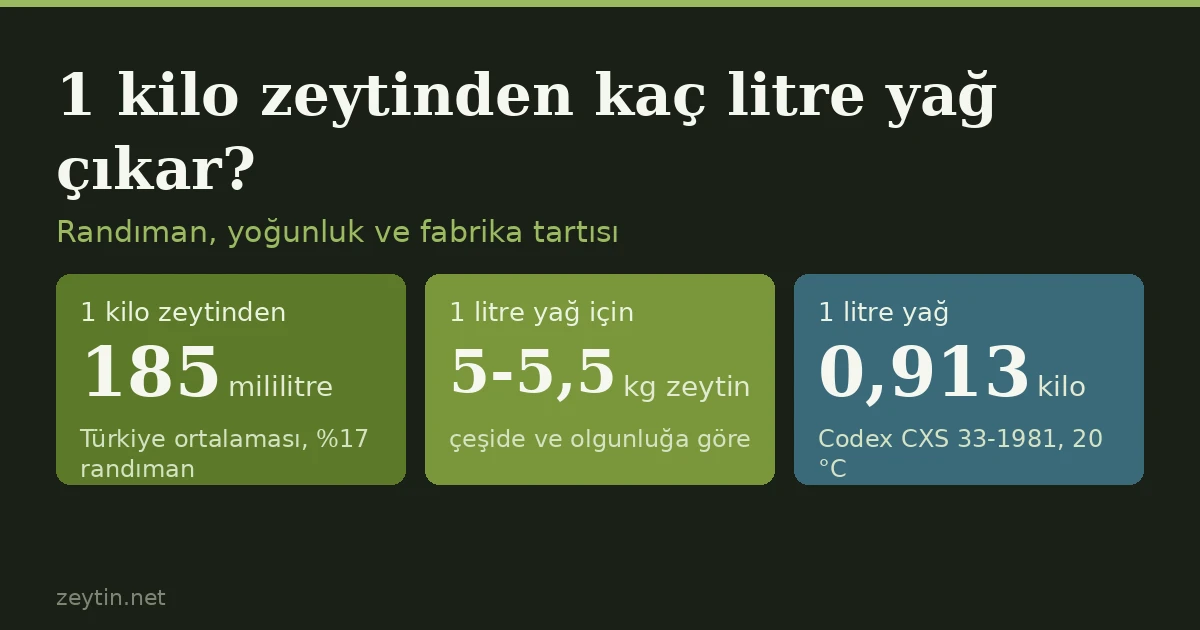
On the Turkish average, one kilo of olives gives around 170 grams of oil — about 185 millilitres. Put the other way round: a litre of oil needs 5 to 5.5 kilos of olives. Almost all the confusion in the calculation comes from treating kilos and litres as the same thing.
Article
How much olive oil comes from one kilo of olives?
On the Turkish average, one kilo of olives gives around 170 grams of oil — about 185 millilitres. Put the other way round: a litre of oil needs 5 to 5.5 kilos of olives. Almost all the confusion in the calculation comes from treating kilos and litres as the same thing.
 Article
Which olive oil is the best quality?
The three measures that decide olive oil quality: grade, acidity and harvest year, plus how to read a label.
Article
Which olive oil is the best quality?
The three measures that decide olive oil quality: grade, acidity and harvest year, plus how to read a label.