Samanlı olive: characteristics, oil content and growing areas
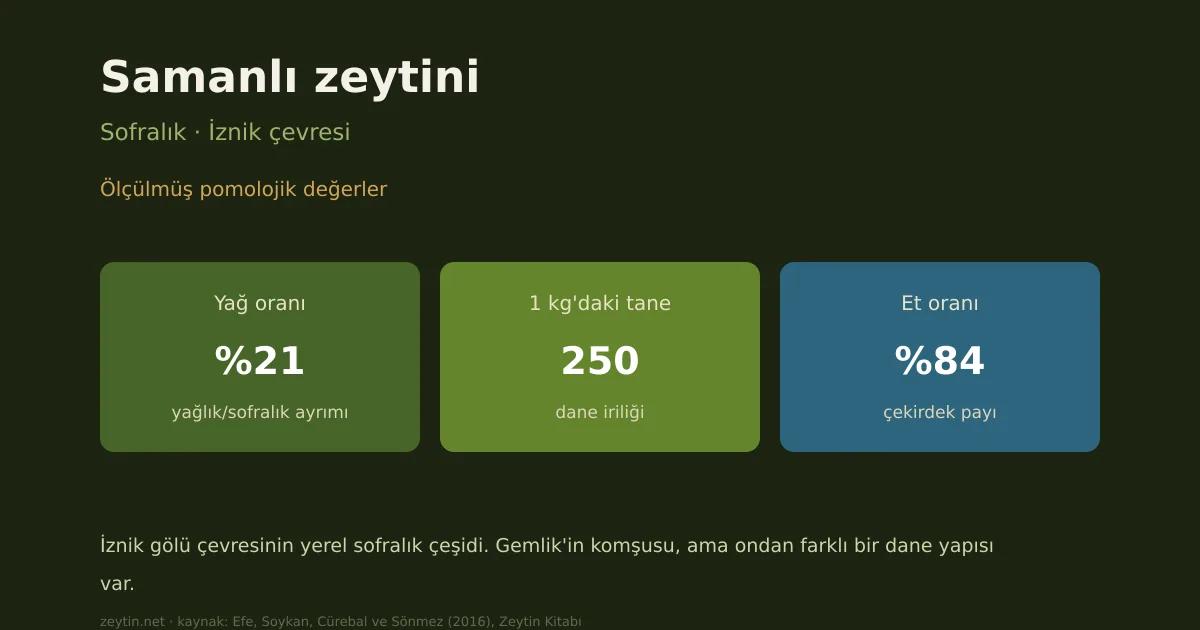
The local table variety around Lake İznik — Gemlik's neighbour, with a different fruit structure.
Samanlı is the table variety of the area around Lake İznik — grown right next to Gemlik, in what counts as Türkiye's black table-olive heartland.
Samanlı in numbers
| Oil content | 21% |
| Fruits per kilo | 250 |
| Flesh ratio | 84% |
| Use | Table |
| Main areas | Around İznik |
Source: Efe, Soykan, Cürebal and Sönmez (2016), Zeytin Kitabı. Fields the source leaves blank are shown as "—"; nothing has been estimated.
The right combination for the table
The three properties described for Samanlı — fleshy fruit, thin skin, small stone — are precisely the combination table olive growing looks for.
As the stone gets smaller the flesh-to-stone ratio rises, and in table olives that ratio is value directly. Much of Gemlik's reputation rests on its flesh-to-stone ratio of 6.4, and Domat's on its flesh share.
Thin skin lets the brine salt penetrate the fruit quickly. In thick-skinned cultivars processing takes longer.
Two cultivars from one district
Karamürsel is a district that has given its name to two local olive cultivars on its own: Samanlı and Karamürsel Su. The second produced the trial's largest fruit at 9.44 g.
That says something about the variety of the Marmara region: it is known for Gemlik, yet other cultivars are established there too — Samanlı, Karamürsel Su, Eğriburun, Edincik Su and İznik's Çelebi.
On the region's olive growing and price data: olive growing in Marmara.
What a narrow distribution means
A cultivar confined to a single district points to one of two things: either it does not perform elsewhere, or no commercial reason to spread it has arisen.
Since Samanlı's yield is described as “good”, the second is more likely. Three cultivars account for three quarters of Turkish production — Memecik 45%, Ayvalık 19%, Gemlik 11% — and against that background, spreading a local cultivar requires nursery production, market demand and promotion. None of these happens on its own.
Where it stands among measured cultivars
Its position on each axis is shown live in the comparison strip on this page, against every cultivar with a published figure. For the full ranking — and how that ranking is built — see olive variety rankings.
In short
With 250 fruits per kilo and 84% flesh, Samanlı is Marmara's local table variety. It sits in Gemlik's shadow: more than 80% of Marmara's olives are processed as black table olives, and most of that is Gemlik.
For the regional picture, see olive growing in Marmara.
Registered names built on this variety
The registration covers the product of a defined area — not this variety wherever it is grown.
- Karamürsel Samanlı Zeytini geographical indication · reg. no 1622
Where it stands among measured varieties
Zeytin Kitabı — Efe, Soykan, Cürebal, Sönmez (2016), Kitabevi Yay. s.37-80 — bu çeşidin ölçüm takımı bu çalışmadan (2 kaynak arasından)
Zeytin Kitabı — Efe, Soykan, Cürebal, Sönmez (2016), Kitabevi Yay. s.37-80
Zeytin Kitabı — Efe, Soykan, Cürebal, Sönmez (2016), Kitabevi Yay. s.37-80
Zeytin Kitabı — Efe, Soykan, Cürebal, Sönmez (2016), Kitabevi Yay. s.37-80
Zeytin Kitabı — Efe, Soykan, Cürebal, Sönmez (2016), Kitabevi Yay. s.37-80 — bu çeşidin ölçüm takımı bu çalışmadan (2 kaynak arasından)
Values are those published on each variety's own page; the comparison covers only varieties with a measured figure, so it is a comparison of what is known — not of every Turkish variety. See the full ranking and how it is built →
One rating per visitor; you can change yours at any time. Ratings are real reader votes — no seeded or default scores.
Related
 Article
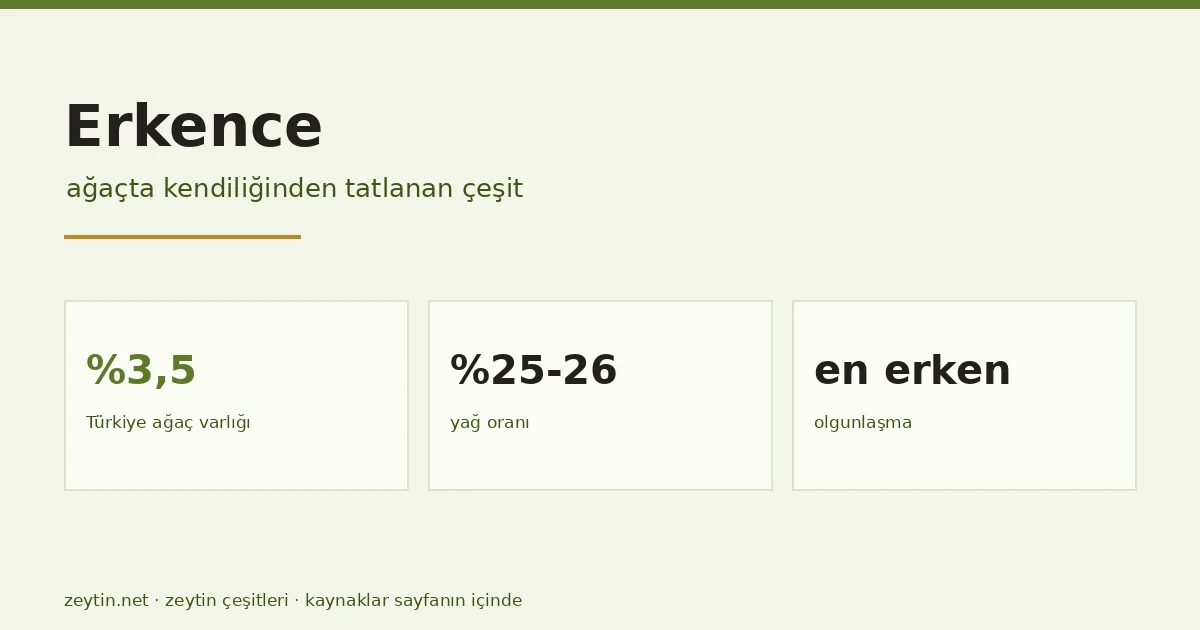
The Erkence olive: the cultivar that sweetens on the tree
Erkence accounts for 3.5% of Turkey's olive trees. It is the Aegean's earliest-ripening cultivar and has a property with few equivalents anywhere: the fruit loses its bitterness on the tree, without brine.
Article
The Erkence olive: the cultivar that sweetens on the tree
Erkence accounts for 3.5% of Turkey's olive trees. It is the Aegean's earliest-ripening cultivar and has a property with few equivalents anywhere: the fruit loses its bitterness on the tree, without brine.
 Article
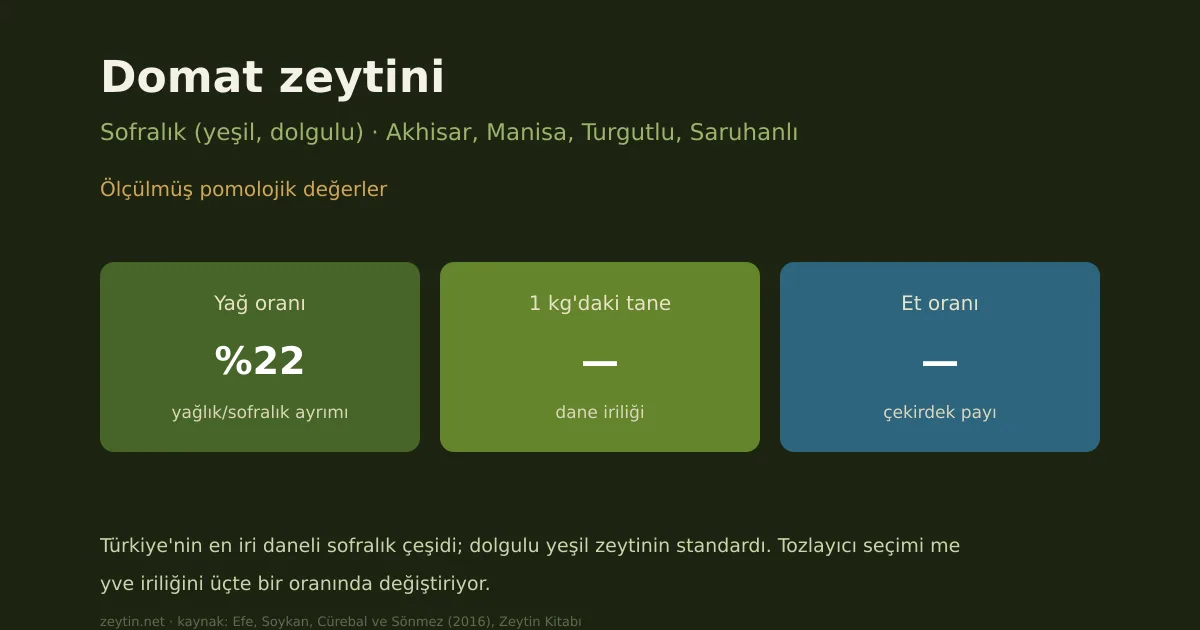
The Domat olive: the cultivar behind stuffed olives, in numbers
Domat, Turkey's largest table cultivar: 7.96 g fruit, 89% flesh, a 552-hour chilling requirement. Why stuffed olives are always made from it, the disagreement over oil content, and why it is never planted alone.
Article
The Domat olive: the cultivar behind stuffed olives, in numbers
Domat, Turkey's largest table cultivar: 7.96 g fruit, 89% flesh, a 552-hour chilling requirement. Why stuffed olives are always made from it, the disagreement over oil content, and why it is never planted alone.
 Article
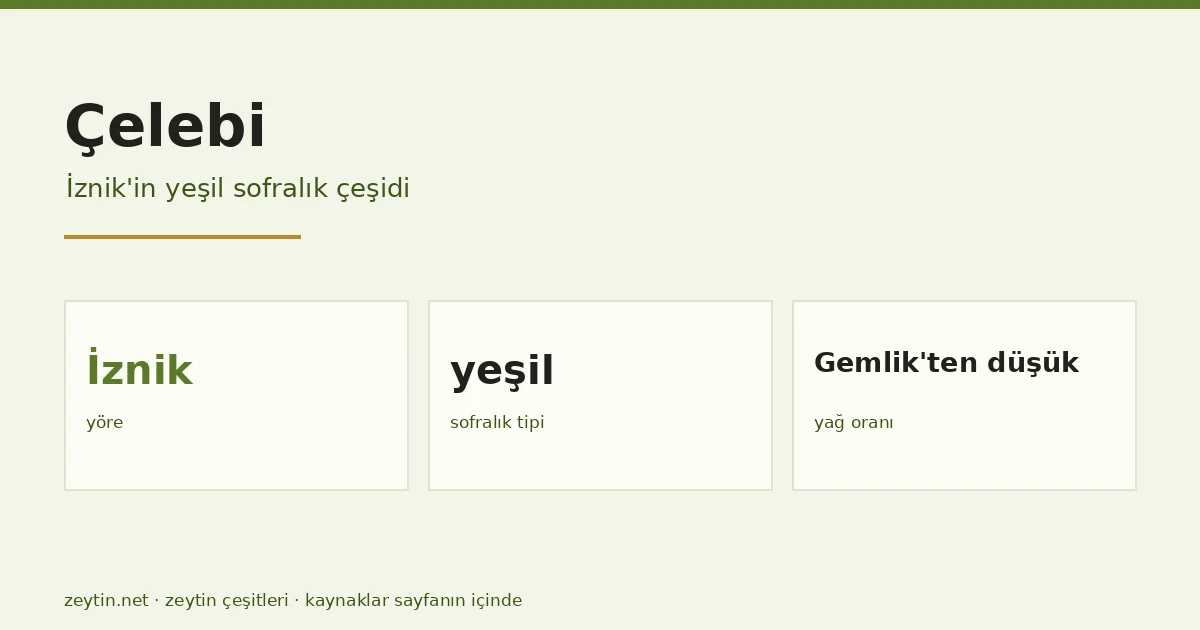
The Çelebi olive: the green table cultivar of İznik
Grown around İznik in Bursa, Çelebi is a green table cultivar. Its oil content is lower than Gemlik's — which is no drawback for a table olive.
Article
The Çelebi olive: the green table cultivar of İznik
Grown around İznik in Bursa, Çelebi is a green table cultivar. Its oil content is lower than Gemlik's — which is no drawback for a table olive.
 Article
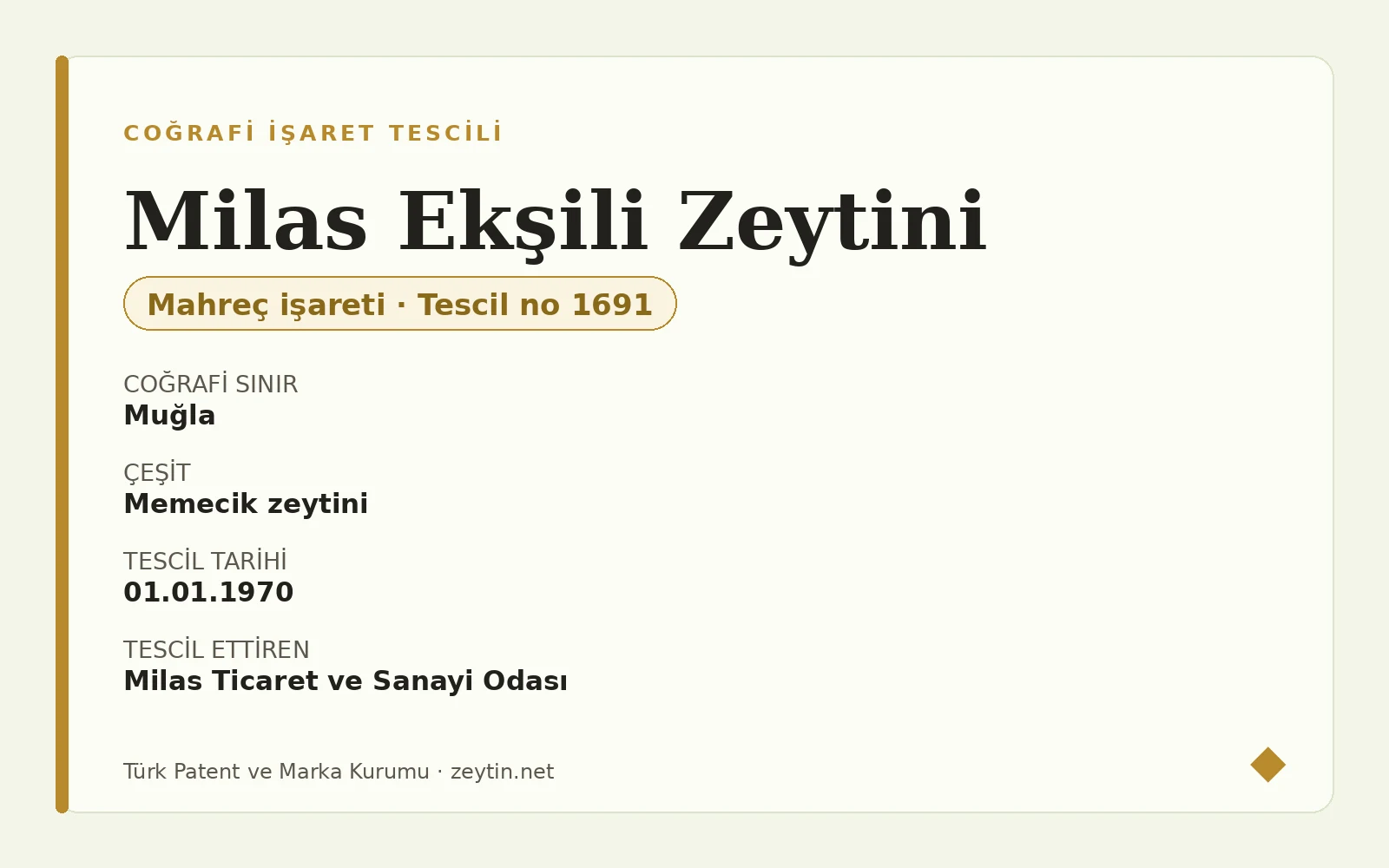
Milas Ekşili Olive: a table olive lightened with lemon
Registered in 2024. The aroma of lemon and olive oil is pronounced, and the astringency of other table olives is absent. Total phenols at least 135.38 mg/100 g.
Article
Milas Ekşili Olive: a table olive lightened with lemon
Registered in 2024. The aroma of lemon and olive oil is pronounced, and the astringency of other table olives is absent. Total phenols at least 135.38 mg/100 g.