Where is quality lost in table olives?
Variety choice, harvest technique, fermentation control, sterilisation and the pre-packing check are each a separate point of loss. The structural problem is scale and inspection.
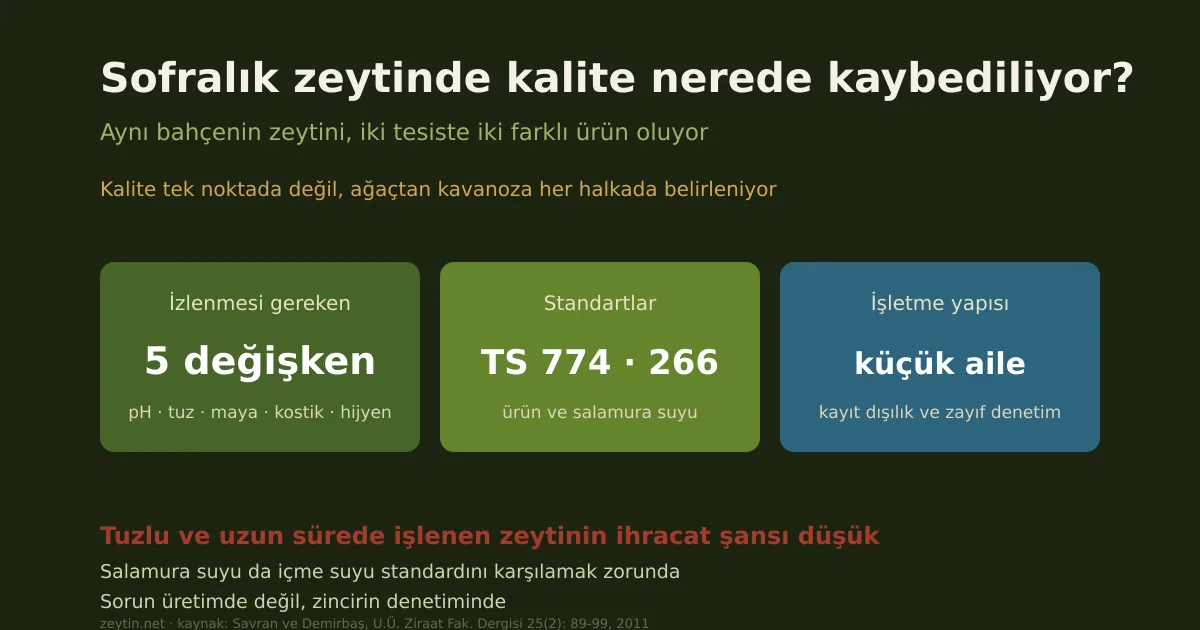
Olives from the same grove become two different products when processed at two different plants. In table olives, quality is won or lost not at one step but at every link from tree to jar.
A joint assessment by the Olive Research Institute and Ege University separates Türkiye's problems link by link. This page sets out that framework.
Where does the problem start? With variety choice
The most basic mistake is made when the grove is planted: choosing a variety whose adaptation to the region has never been tested.
A variety performing well elsewhere says nothing about how it will do on your ground. Chilling requirement, heat tolerance and the ripening calendar are variety-specific — see chilling requirement in olives.
The second mistake is even more common: growing an adapted variety with the wrong practices. The right variety, badly pruned and badly irrigated, can lose the qualities that made it a table olive.
Fruit size translates directly into price; on that, see the economics of calibre.
Harvest: timing and method both decide
Harvest is far more delicate for table olives than for oil. Three things must hold together:
- Timing — green, rose-streaked and black maturity are different products, each with its own window.
- Method — beating with poles leaves bruises on table fruit, and a bruised olive is an open door to spoilage in fermentation.
- Technique — picked fruit must go for processing without waiting.
For the oil-side equivalent of harvest timing: is early harvest expensive or valuable?
Processing: five variables that must be controlled
Whatever the method — lye-treated green, natural brine, dry salt — the same five variables must be monitored continuously:
| Variable | Why |
|---|---|
| pH | Sets the direction of fermentation; if it rises, spoilage begins |
| Salt | Both preservative and flavour; wrong level and the product either spoils or is inedible |
| Yeast / lactic culture | The organism driving fermentation; uncontrolled microflora produces defects |
| Lye concentration | Debittering in green olives; too much destroys texture |
| Hygiene and circulation | Brine movement and cleanliness; sediment build-up derails fermentation |
Once fermentation is complete, the product must be checked again before packing. Skip that step and defective fruit goes straight into the jar.
Canning carries a further risk: insufficient heat treatment. If sterilisation falls short, the product stays open to spoilage throughout its shelf life. The signs on the consumer's side: are my olives spoiled? mould, bulging lids and softening.
The salt habit: normal at home, a barrier abroad
Table olives in Türkiye are traditionally produced with heavy salt. That is not a defect but an established taste.
Still, the assessment is explicit: heavily salted olives processed over long periods have poor export prospects. Foreign markets want lower salt and shorter processing.
It also aligns with the health side — what limits table olives is not their fat but their salt: how many olives should you eat a day?
Given that two-thirds of Türkiye's exports are table olives, this is no small detail: two-thirds of our exports are table olives.
The structural problem: the scale of the businesses
One of the decisive lines in the assessment: most table olive businesses in Türkiye are small, family-scale operations.
The consequences chain together:
- Laboratories, measurement and food safety systems are expensive at small scale.
- Informality is widespread, and unregistered production cannot be inspected.
- With weak inspection, non-compliant product stays on the market.
- Branding is obstructed, and unbranded product is priced by the kilo rather than by its quality.
The standards exist; the application does not
Table olives in Türkiye are not unregulated:
| TS 774 | Table Olives — product characteristics, classification, storage, transport and marketing conditions |
| TS 266 | Water Intended for Human Consumption — the requirements the brine must meet |
The second is often overlooked: brine is part of the product and has to meet drinking water standards.
What is improving
The assessment is not pessimistic. Several recent developments have pushed quality upward:
- More land under table varieties and more processing businesses → competition
- The EU alignment process and mandatory application of standards
- Rising health awareness among consumers
The pressure comes from both the market and the regulator, and both push the same way.
The recommendation: fund the research
The study's closing recommendation is clear: better quality outcomes require increased support from both the private sector and public institutions for table olive research.
Every heading on this page — variety adaptation, harvest technique, fermentation control, salt reduction — is a research subject whose payoff shows up directly in the export figures.
In short
Quality in table olives is not lost at one point: the wrong variety, poor husbandry, rough harvesting, uncontrolled fermentation, incomplete sterilisation and a skipped pre-packing check are each a separate loss.
The structural problem is scale: small family businesses, informality and weak inspection leave the standards on paper. Türkiye's olive resource is among the world's largest; the problem is not production but control of the chain.
One rating per visitor; you can change yours at any time. Ratings are real reader votes — no seeded or default scores.
Related
 Article
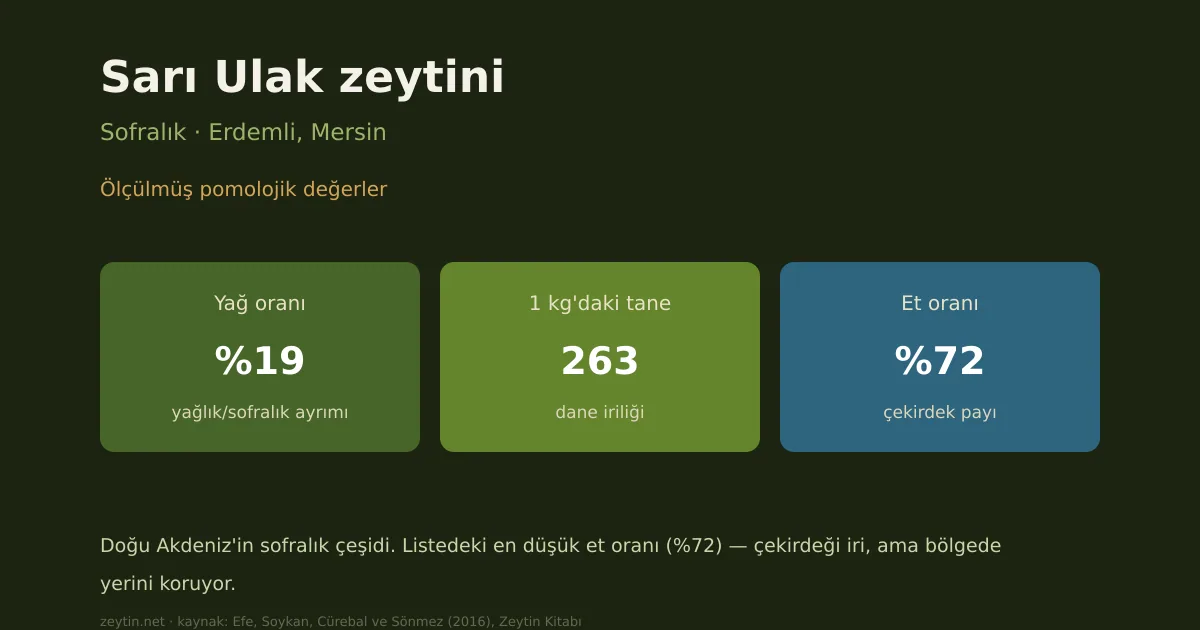
Sarı Ulak olive: characteristics, oil content and growing areas
The eastern Mediterranean's table variety. The lowest flesh ratio on the list (72%) — a large stone, yet it holds its ground.
Article
Sarı Ulak olive: characteristics, oil content and growing areas
The eastern Mediterranean's table variety. The lowest flesh ratio on the list (72%) — a large stone, yet it holds its ground.
 Article
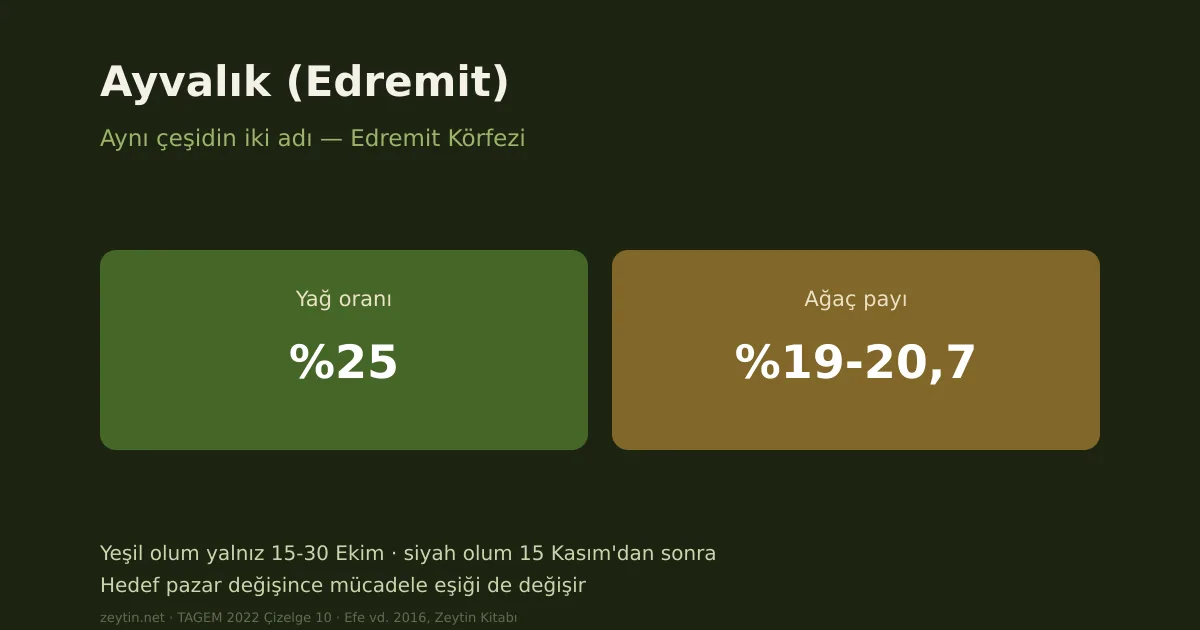
The Ayvalık (Edremit) olive: one variety, two names
19-20.66% of the tree stock, second after Memecik. 25% oil. Green maturity only between 15 and 30 October; black maturity after 15 November, among the latest.
Article
The Ayvalık (Edremit) olive: one variety, two names
19-20.66% of the tree stock, second after Memecik. 25% oil. Green maturity only between 15 and 30 October; black maturity after 15 November, among the latest.
 Article
Mavi olive
Mavi is a recorded variety of south-eastern Anatolia. No measured pomological data published.
Article
Mavi olive
Mavi is a recorded variety of south-eastern Anatolia. No measured pomological data published.
 Article
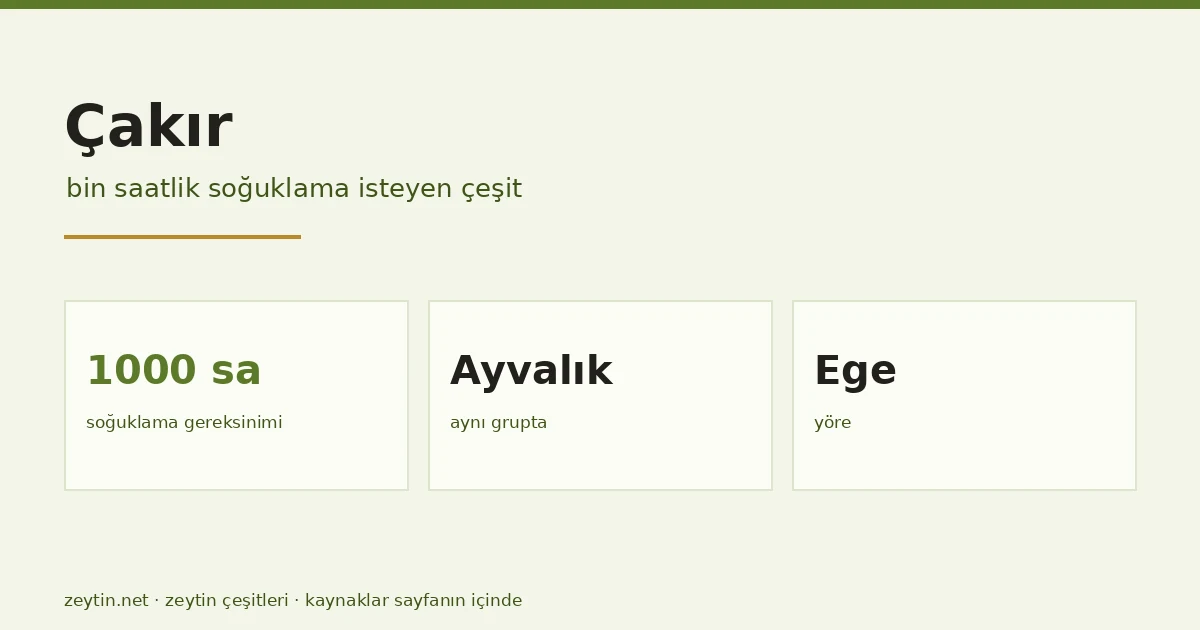
The Çakır olive: a cultivar that asks for a thousand hours of cold
Reported alongside Ayvalık and Domat with a 1000-hour chilling requirement — the group most at risk as winters warm.
Article
The Çakır olive: a cultivar that asks for a thousand hours of cold
Reported alongside Ayvalık and Domat with a 1000-hour chilling requirement — the group most at risk as winters warm.