Orhangazi's crop is doubling: the oil olive share climbs from 10% to 40%
According to figures from the Orhangazi District Directorate of Agriculture and Forestry, last season's crop of roughly 35,000 tonnes could double this year. But in Türkiye's table olive heartland the real shift is in the split: the share pressed for oil is expected to rise from 10% to 40%. Mills are already in maintenance, and the grower's income now depends on fruit size.
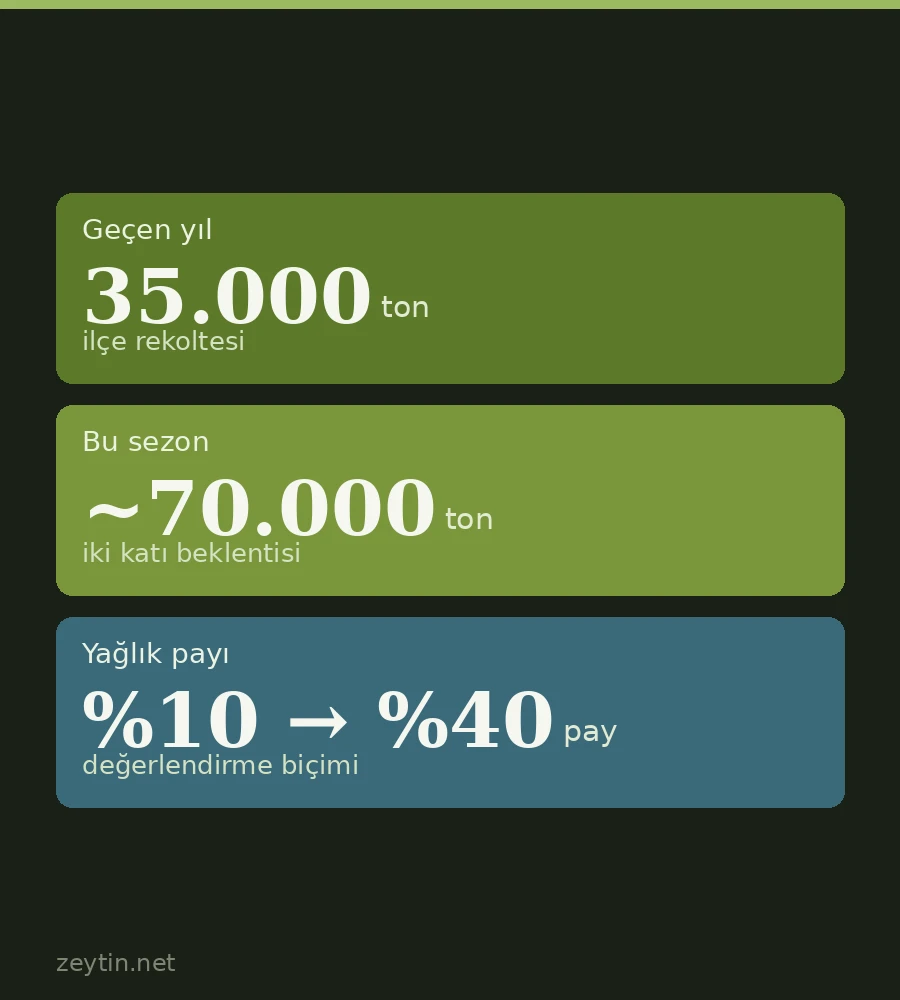
In Türkiye's table olive heartland, the new season stands out not only for how much fruit is on the trees but for where that fruit will end up. In the Orhangazi district of Bursa, figures from the Orhangazi District Directorate of Agriculture and Forestry indicate that a crop of roughly 35,000 tonnes last season could double this year. The second number is the more striking one, because it is a ratio rather than a volume: last season only 10 percent of total output was pressed for oil, and this season that share is expected to rise to 40 percent.
Orhangazi is the main production basin of the Gemlik olive. Gemlik is a table variety carrying both a Turkish geographical indication and European Union registration, and the district's whole olive economy is built around table fruit. That is why a fourfold jump in the oil share says more than a routine crop report.
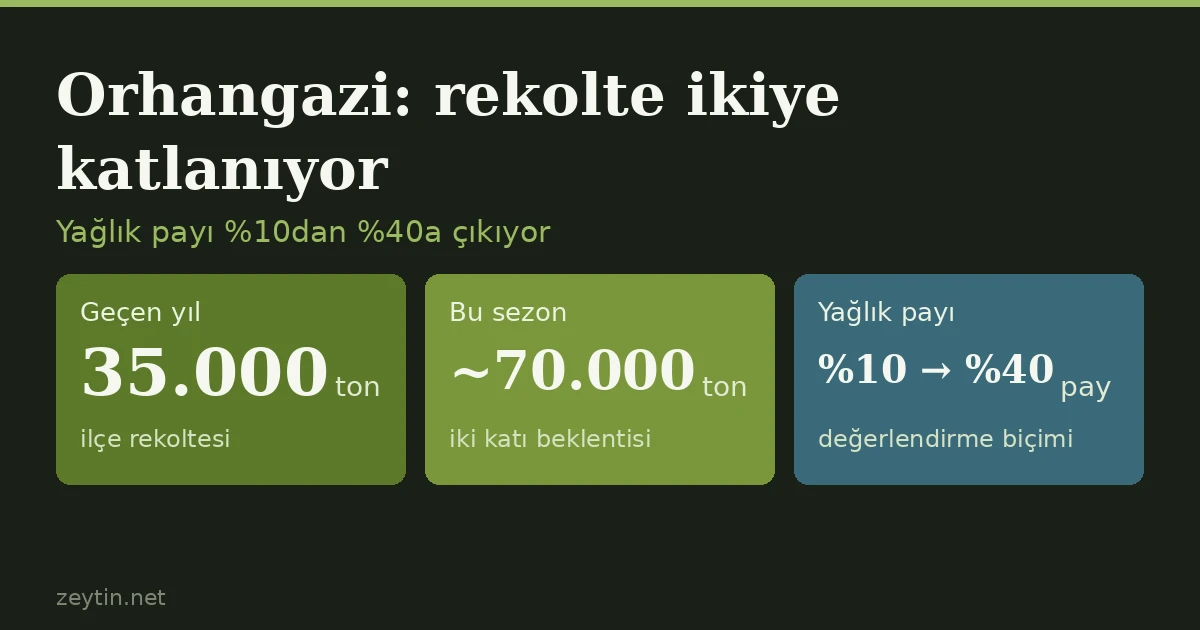
The figures
| Item | Value |
|---|---|
| Last season's crop | ~35,000 t |
| Expectation for this season | up to double (~70,000 t) |
| Share pressed for oil last season | 10% |
| Expected oil share this season | 40% |
| Nature of the season | an "on" year |
The figures come from the Orhangazi District Directorate of Agriculture and Forestry. The 70,000-tonne number is what the stated "double" expectation implies when applied to last season's crop, not a separately published estimate.
An "on" year does not deliver large fruit
An olive tree loads one year and rests the next, a pattern known as alternate bearing. Orhangazi is in an "on" year this season. But that abundance carries a cost: the tree divides the same nutrients and water among far more fruit, so the individual olives stay small.
For table olives this is not a cosmetic matter, it is an income matter. Price per kilogram is largely set by fruit size, or calibre. Fruit that fails to reach the required calibre cannot enter the table grades, and the only remaining outlet is the oil mill. That is the mechanism behind the jump from 10 to 40 percent: what the district faces is not simply more olives, but more olives that will not qualify as table fruit.
Growers across South Marmara have also noted that fruit has stayed smaller than in previous years. The shift toward oil is therefore not a marketing choice peculiar to one district; it is the regional signature of an "on" year.
Mills are in maintenance
Unwilling to be caught unprepared by the volume heading their way, olive oil mills in Orhangazi have accelerated maintenance and preparation work. This is the most tangible sign of the change in the split: table fruit goes to brining facilities, while oil fruit demands milling capacity.
Capacity matters here for a specific reason. Once olives leave the branch they heat up in the heap, fermentation begins and the free acidity of the resulting oil rises. In a season when the crop doubles, the queue that forms outside the mill is written directly into oil quality. As we set out in what to check when having olives pressed at a mill, the interval between harvest and pressing is the single most important quality variable still in the grower's hands.
Why Gemlik can go both ways
Gemlik is registered as a table variety, but it is not an olive with a low oil content. That is the technical reason for the district's flexibility: when fruit fails to reach calibre, it is not left on the grower's hands, it goes to the mill.
Table and oil olives are not harvested at the same ripeness, however. Table fruit is picked while it is firm and has not yet turned colour; oil fruit is left until colour change and oil accumulation are complete. If the decision to shift toward oil is taken at the start of the season, the harvest calendar can be built around it. If it comes late, fruit picked early by table standards but rejected from the grades reaches the mill with a low oil yield, and the grower loses twice: on the table price and on the oil return. We covered ripeness timing in when to harvest olives and the maturity index and the cost-value balance of early picking in is early harvest expensive or valuable.
An "on" year has a further effect on the table side: under a heavy fruit load the olives do not merely shrink, they also become less uniform. As the calibre spread from a single tree widens, the sorting burden at the brining plant grows. We examined the factors that determine table olive quality in quality problems in table olives.
The grower's arithmetic
Shifting fruit to oil raises volume without raising income in the same proportion. The price gap between table and oil olives has worked against growers for years; we examined how the same raw material sells at very different prices depending on processing and marketing in the same olive, six times the price and seven years of the table olive gap.
A second factor is tightening the picture this season: cost. As harvest opens in South Marmara, growers report production costs reaching around 60 lira per kilogram while the price for oil olives is expected to settle in a band of 35 to 40 lira. These figures come from individual farm accounts rather than an official cost study, so they should be read as indicative. Even so, they show that every kilogram diverted to oil narrows the grower's margin. The background is in our piece on costs and carry-over stock before the harvest.
Why it matters beyond Orhangazi
What is happening in Orhangazi is a small-scale version of a national pattern. Table olives are the backbone of Turkish olive exports, a structure we examined in two-thirds of our exports are table olives. When fruit in the table olive heartlands is diverted to oil, the volume of large-calibre fruit available for export can tighten.
Another calendar is running in the same basin today: Marmarabirlik opened crop declarations on 21 September, and members who do not declare cannot deliver their fruit. In an "on" year that declaration is not a formality but the basis of the cooperative's purchasing plan.
The official number is still on its way. Türkiye's 2026 crop survey is under way in 41 provinces, and until the provincial commissions finish their fieldwork every figure in circulation remains an expectation. For why trading volumes reported in the market are not a substitute for a crop estimate, see exchange volume is not the harvest. How the season opened nationally is covered in the 2026/27 olive season opens.
One rating per visitor; you can change yours at any time. Ratings are real reader votes — no seeded or default scores.
Related
 Article
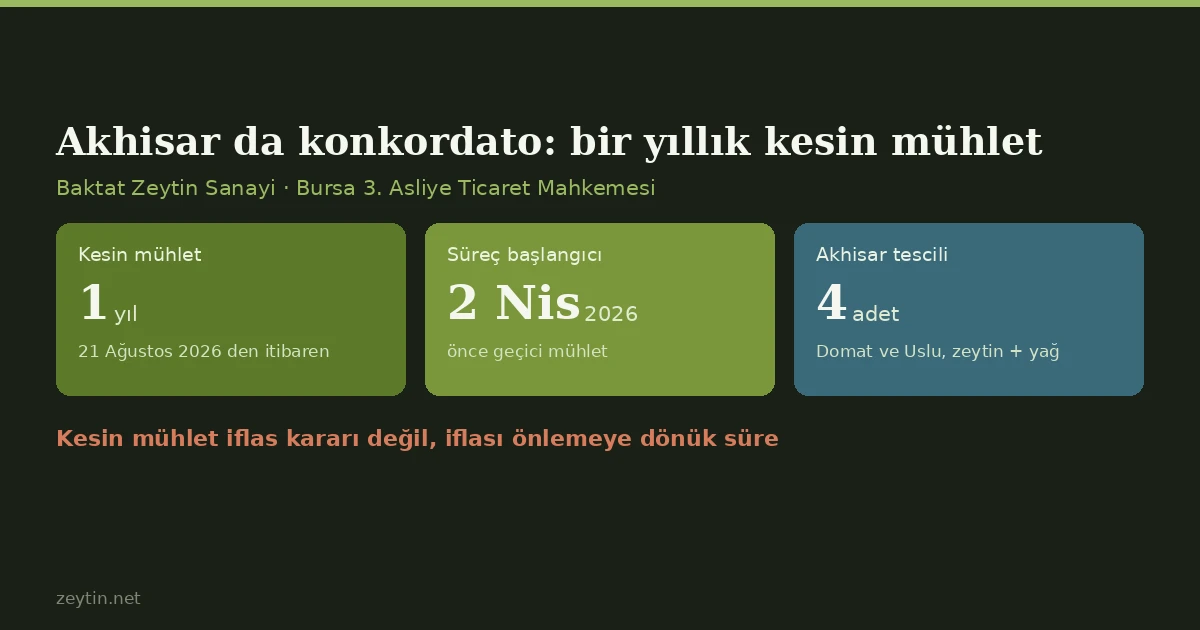
Concordat in Akhisar: a one-year moratorium for Baktat Zeytin
A Turkish commercial court has granted a one-year definitive moratorium to Baktat Zeytin, a table-olive processor in Akhisar. We set out what the ruling means and why it matters for the sector.
Article
Concordat in Akhisar: a one-year moratorium for Baktat Zeytin
A Turkish commercial court has granted a one-year definitive moratorium to Baktat Zeytin, a table-olive processor in Akhisar. We set out what the ruling means and why it matters for the sector.
 Article
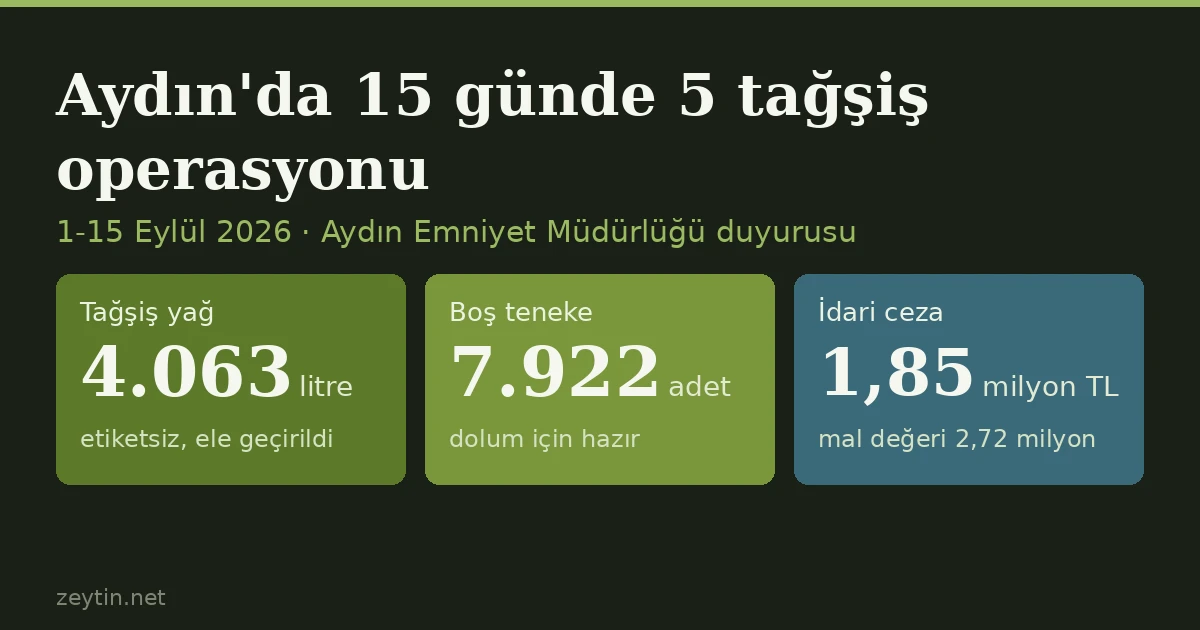
Five adulteration raids in 15 days in Aydın: 4,063 litres of oil, 7,922 empty tins
Police in Aydın say five operations between 1 and 15 September 2026 seized 4,063 litres of unlabelled adulterated oil and 7,922 empty tins. The goods were valued at about 2.72 million lira and the administrative fines totalled 1.85 million lira. The number of empty tins was nearly double the litres of oil seized.
Article
Five adulteration raids in 15 days in Aydın: 4,063 litres of oil, 7,922 empty tins
Police in Aydın say five operations between 1 and 15 September 2026 seized 4,063 litres of unlabelled adulterated oil and 7,922 empty tins. The goods were valued at about 2.72 million lira and the administrative fines totalled 1.85 million lira. The number of empty tins was nearly double the litres of oil seized.
 Article
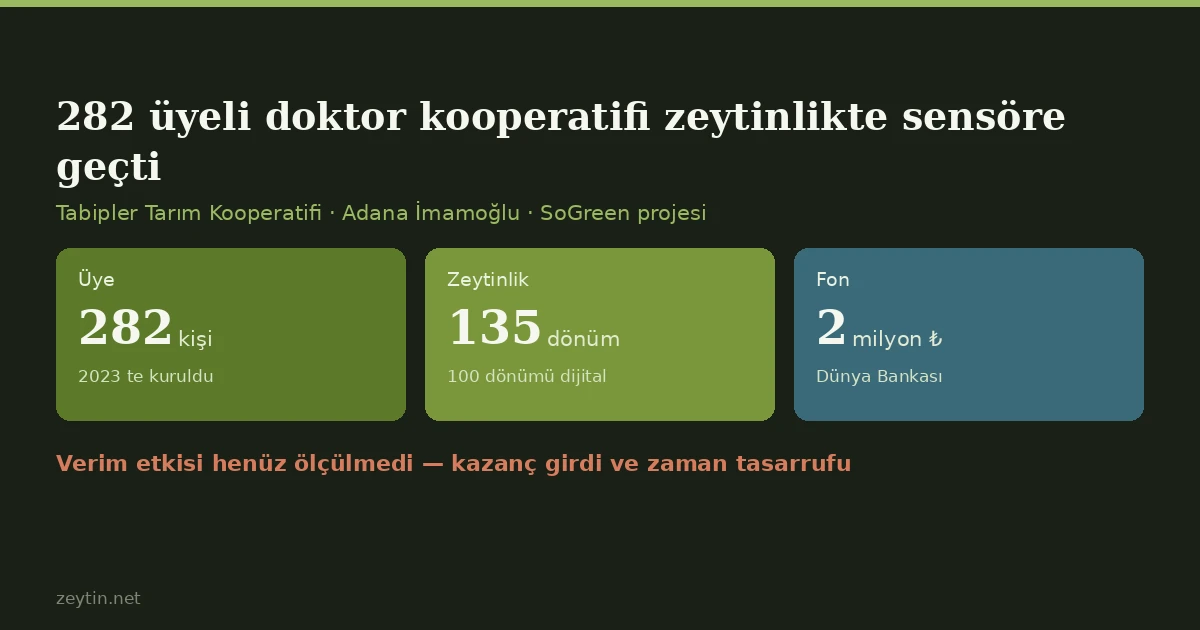
A 282-member doctors' cooperative puts sensors in the olive grove
A cooperative founded by doctors in Adana is monitoring water and fertiliser with buried sensors across 100 of its 135 dönüm of bearing olive grove, funded with 2 million lira.
Article
A 282-member doctors' cooperative puts sensors in the olive grove
A cooperative founded by doctors in Adana is monitoring water and fertiliser with buried sensors across 100 of its 135 dönüm of bearing olive grove, funded with 2 million lira.
 Article
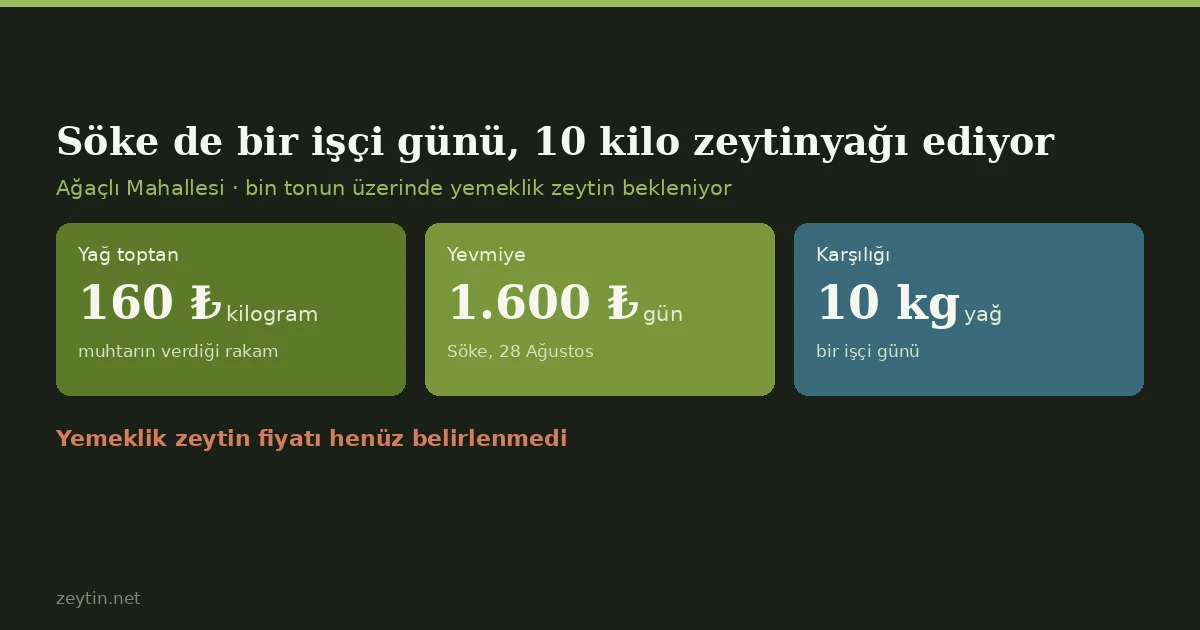
In Söke, one day's wage costs ten kilos of olive oil
Over 1,000 tonnes of table olives are expected in Söke's Ağaçlı. Two figures given by the headman sum up the season: oil at 160 lira wholesale, a day's wage at 1,600.
Article
In Söke, one day's wage costs ten kilos of olive oil
Over 1,000 tonnes of table olives are expected in Söke's Ağaçlı. Two figures given by the headman sum up the season: oil at 160 lira wholesale, a day's wage at 1,600.