How war destroys an olive grove: denial of access does more than the bomb
An olive grove is not an annual field: first fruit takes 4-8 years, full yield 20-25. War's damage is therefore generational, not seasonal. We read the picture in Lebanon and Palestine through the tree's own biology.
The olive branch is one of the symbols humanity agrees on most readily. It is in the beak of the dove returning after the flood; it is Athena's gift to Athens; in Rome, to sue for peace was to hold out an olive branch. We have written elsewhere on why the olive branch became the emblem of peace and on the olive in mythology.
The same tree is today among the most concrete targets of war in the eastern Mediterranean.
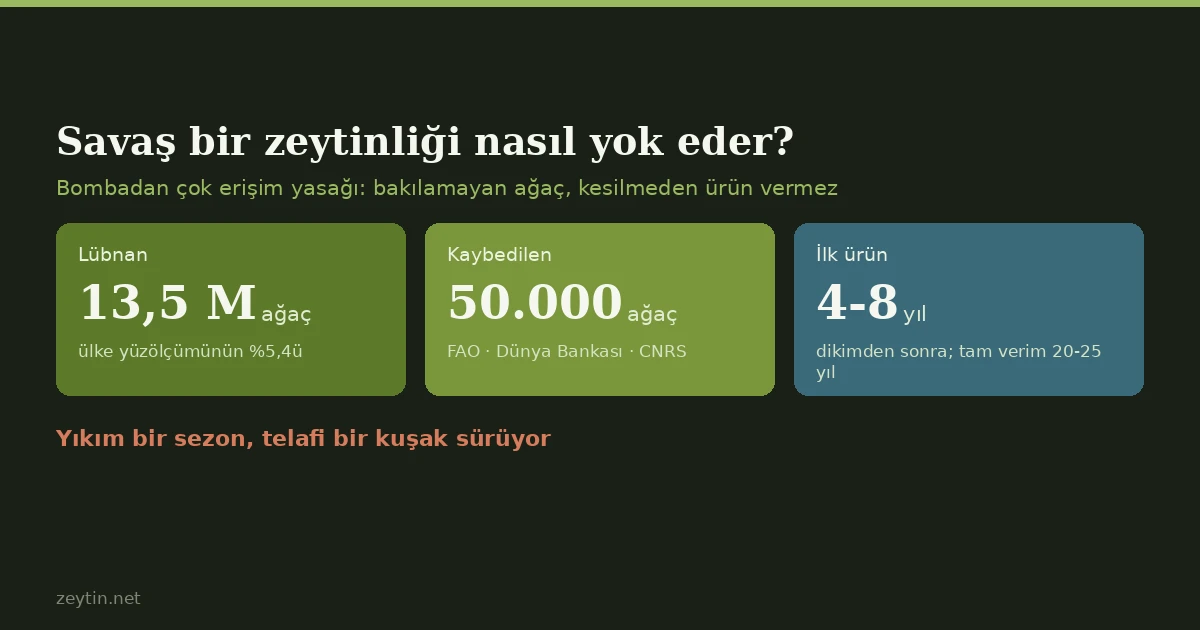
This article is not written to announce that contradiction but to open up the mechanism behind it. The questions are these: why is an olive grove peculiarly fragile? By what distinct routes does war damage it? What are the social, cultural and political dimensions of that damage? And why is it not repaired in a season?
I. The tree's calendar
A grove is not an annual field
War damage to farming is usually shown in a single image: a burned field, a wrecked store. For an olive grove that image is misleading, because the real loss is often invisible and occurs without a single tree falling.
A wheat field is sown in one season and harvested in one season; if it burns, it is sown again the following year. A grove does not work that way. As set out on our olive tree page, a newly planted sapling takes 4 to 8 years to bear its first fruit and 20 to 25 years to reach full yield.
A tended tree, by contrast, lives for centuries. Islamic Relief's summary gives an average lifespan of 300 to 600 years, notes that some olive trees have lived for thousands of years, and puts the oldest in the world at an estimated 2,000 to 4,000 years. This is not abstract: among the monumental olive trees we measured in Edremit, the oldest is estimated from its trunk circumference at 1,100 years.
That asymmetry is what makes groves peculiarly fragile in war: destruction takes a day, recovery takes a generation. A grove can be neither moved nor hurried; it is as fixed as the ground beneath it.
Why longevity becomes a political fact
The tree's lifespan turns it from an agricultural asset into a witness. In Islamic Relief's words, the long lives of olive trees "reflect the history of Palestinian communities on land where the trees have stood through centuries of political change and upheaval."
That has a direct consequence: the presence of the trees is a practical rebuttal of the claim, advanced by settler movements in the 19th and 20th centuries, that Palestine was "a land without a people". A grove that has been planted, pruned and harvested for generations is evidence that the land was not empty. Here the tree functions as a document.
II. The four channels of war
Damage to a grove is not of one kind. Four separate mechanisms operate, and only one of them is visible.
1. Direct destruction. Shelling, fire, uprooting by bulldozer. This is the countable, photographable damage. Islamic Relief reports that cultivated land in Gaza has been destroyed in military attacks.
2. Denial of access. The tree stands; its owner cannot reach it. For olive growing this is the heaviest channel, and it has its own section below.
3. Soil damage. Ground that has been dug up, compacted by heavy vehicles or left with chemical residue hinders root growth and complicates replanting even where trees survive. The damage remains after the tree has gone.
4. Trees burned as fuel. This is the most indirect and most tragic consequence. Islamic Relief reports that in Gaza, families in the grip of fuel shortages have been forced to take an axe to their own trees to heat their homes and cook. An aid worker's note from November 2024 puts it this way:
t; "I cannot forget how, when there was no fuel, the olive trees gave us firewood and leaves to keep warm and to cook. We keep taking, they keep giving. Even when there was no shelter, their outstretched branches sheltered us."
In that sentence the tree is at once livelihood, shelter and fuel of last resort. Groves disappear without anyone bombing them.
III. The invisible channel: neglect kills the crop
This section covers the mechanism least present in the news and most decisive for olive growing.
The olive shows alternate bearing — a heavy crop is followed by a light one. As our growing guide explains, what dampens that swing is regular pruning. A tree left unpruned, unwatered and untreated does two things: it deepens the swing and loses its canopy structure.
The result can be put in one hard sentence: a grove that cannot be tended for two years stops yielding without a single tree being cut.
The owner returns to find the trees standing but no harvest. And bringing them back into bearing is not one season's work either: pruning, feeding and disease control take several years, and through that period there is no income.
That is exactly what growers returning to southern Lebanon describe. Hasan Ali Zehra, the headman of Kfar Shuba, attributes two fruitless years directly to the impossibility of tending the trees, and says grove owners who once lived on 20 to 25 drums of olive oil (20 litres each) lost that income. Kasım Kadri of the Arkoub union of municipalities describes the loss as "two consecutive harvest seasons". The farmer Muhammed el-Kadri described returning after two years to find the trees burned and the soil dug up.
Visam Yahya, head of the agricultural cooperative in Kfar Shuba, says dozens of hectares of olive land along the border strip were scraped bare, and that entering those areas was prohibited.
Um Hudur Zehra in Bastra described a four-hundred-year-old tree that bore no fruit at all that year, and years of labour left with nothing to show. The tree is standing, four centuries old — and there is no crop: the two mechanisms compound.
IV. Sociology: the harvest is not a job, it is a season
Anyone who does not know how the olive harvest is organised in the Mediterranean cannot see why access restrictions are so destructive.
Collective, time-bound, many-handed work
The harvest is collective work carried out in October and November. According to Islamic Relief, families in Palestine come together for it, and universities and schools give students leave; people sing and tell stories as they work. The harvest is therefore not only a productive activity but the most intense social event of the year and a fixed point in the family calendar.
That structure depends on three conditions: being in the grove at the right time, all together, and for long enough. Olives are picked when they ripen; waiting costs oil quality. The whole job is compressed into a few weeks and demands many hands.
The permit regime breaks all three
According to Islamic Relief, access to land is heavily restricted by Israeli controls, and an inconsistently applied permit system seriously impedes growers' ability to tend their trees. Two details are decisive:
- Permits are issued to individuals. Families therefore cannot work together, which directly means a smaller harvest.
- Checkpoints open only at certain hours. The time a grower can spend on the land shrinks, and with it the crop that can be gathered.
The result is a harvest that shrinks without the trees being touched at all. Islamic Relief sums up the picture: because olive trees survive without continuous cultivation, families can still draw income from them — "but the effect of separating growers from their land and their trees is great."
In Lebanon the restriction worked more sharply. Farmland within five kilometres of the Israeli border was long prohibited or restricted. A three-day temporary permit granted on 18 October 2025 let growers enter their groves for the first time in two years, under the protection of UNIFIL and the Lebanese army. A harvest that can be done in three days is not the same as a harvest done over a season.
What is cut is not only income, but transmission
Knowledge of olive growing is largely learned by transmission: which branch to cut, when to pick, which tree will rest in which year — none of it comes from a book, all of it from standing beside someone in the grove. The loss of two harvest seasons is therefore as much a break in generational transmission as a loss of income. Where schools give leave for the harvest, a harvest that cannot happen also cuts children off from that knowledge.
V. Economics: how many families, how much income
The figures collected by Islamic Relief take the question out of the symbolic register:
- Olives are a primary or secondary income source for 80,000 to 100,000 families in the Occupied Palestinian Territories.
- Before October 2023 these trees supplied 70 per cent of fruit production in the territories.
- 93 per cent of the annual harvest goes to olive oil; the rest becomes soap, table olives and pickles.
- Most produce is consumed locally, though exports to the region and internationally are becoming more common.
That distribution also shows how the loss spreads. If 93 per cent of the harvest goes to oil, a season that cannot be harvested affects not only the grower but the miller, the bottler, the soap maker and the local consumer at once. In from tree to shelf: the olive oil value chain we examined those links separately; in war conditions, when the first link breaks, the whole chain stops.
VI. Culture and identity: why is the tree so heavily laden?
In this geography the olive is more than a crop. As we showed in the olive in scripture and folk narrative, its symbolic weight belongs to no single religion or period but to the shared memory of the Mediterranean.
From the kitchen to the liturgy
Islamic Relief's summary lists what that weight amounts to in daily life. Most olives are pressed for oil used in cooking, from making za'atar to stews and pastries; but the olive is also raw material for soap and for some medicines and cosmetics. Because Muslims and Christians regard olive oil as a sacred or symbolic substance and use it in their rites, some oils serve a directly religious purpose.
A single tree, in other words, feeds cooking, cleaning, medicine and worship at once. The loss of a grove touches all four.
A tree tended like a family member
Islamic Relief's observation is that many Palestinians form a strong emotional bond with trees they have tended "for years and decades, almost as a member of the family". The language of that bond is clearest in the words of an aid worker who had to leave the country:
t; "I wish I had had the chance to say goodbye by embracing my own trees. It is a feeling so many of us share… We have a deep connection with these trees and with the soil they grew in. They are an inseparable part of our heritage, our food and even our proverbs — an inheritance accumulated through a bond lasting centuries."
The same note closes with a line from the Palestinian poet Mahmoud Darwish: "As long as thyme and olives remain, we will remain here."
In art and poetry
With painters as well as poets such as Darwish and Tawfiq Ziyad drawing on its symbolism, the olive tree and its fruit appear prominently in Palestinian art. The tree here is not scenery but an image of permanence.
That symbolism has an agronomic basis too. As Islamic Relief notes, the olive is drought-resistant and grows even in poor soil. The tree does not merely represent the idea of holding on in hard conditions; it biologically does so. The symbol is derived from the tree's actual behaviour.
VII. Politics and law
Planting is itself an act
The tree's identity load makes it a direct object of politics. According to Islamic Relief, beyond symbolism olive trees play "a material role in resistance to illegal occupation and land seizure": their presence makes it harder to claim that land is desolate or unused, which is why planting and tending them constitutes an act of defiance under occupation.
The symmetrical consequence is that the tree becomes a target precisely because of that function.
The measure of the attacks
Islamic Relief reports that olive trees and the growers who tend them become targets of attack particularly just before and during the harvest season, and that this is seen especially in the West Bank, where trees are uprooted, burned and broken by settlers.
The scale has been measured. The UN humanitarian office OCHA reported that in 2025 more than 4,000 trees were damaged in 126 incidents across 70 towns and villages — the highest level since 2020.
Local communities and civil society organisations take steps to protect trees and growers during the harvest and to replant what has been destroyed; but Islamic Relief's emphasis is plain: OCHA's figures show the problem getting worse.
The legal frame
The source refers to two distinct normative frames. The first is religious: some Jewish groups point out that the Torah forbids the destruction of trees, including in wartime. The second is international law: the destruction of trees in conflict is described as violating Articles 54 and 55 of the Geneva Convention in particular. Those articles concern the protection of objects indispensable to the survival of the civilian population, and of the natural environment.
A state-led repair effort
In Lebanon there is a state repair programme. According to agriculture minister Nizar Hani, a report prepared jointly with the FAO, the World Bank and the National Council for Scientific Research established that the country had lost 50,000 trees to Israeli attacks. In May 2025 the ministry launched a campaign to replant 50,000 olive trees.
Kasım Kadri of the Arkoub union of municipalities asked that the army's and UNIFIL's protection not be limited to the days of entry but continue throughout the harvest.
VIII. Scale
The figures below are not commentary; they come from named institutions.
| Where | What | Source |
|---|---|---|
| Lebanon | ~13.5 million olive trees; ~5.4% of the country's area; 100,000-200,000 t of olives a year | AA, October 2025 |
| South Lebanon | 39% of the country's groves | AA, October 2025 |
| Lebanon | 50,000 trees lost | FAO · World Bank · National Council for Scientific Research |
| Lebanon | Campaign to replant 50,000 trees; 2,000 planted as of October 2025 | Lebanese agriculture ministry |
| Palestine | Primary or secondary income for 80,000-100,000 families | Islamic Relief |
| Palestine | 70% of fruit production before October 2023; 93% of the harvest goes to oil | Islamic Relief |
| West Bank | More than 4,000 trees in 126 incidents in 2025 — the highest since 2020 | UN OCHA |
| General | Average olive tree lifespan 300-600 years; oldest estimated at 2,000-4,000 years | Islamic Relief |
IX. What does "50,000 trees are being planted" mean?
News of replanting reads as positive. Read against the tree's calendar, its meaning changes.
The 50,000 saplings planted do not replace the 50,000 trees lost; they begin to replace them. Applying the timings from the opening section:
- first crop: 2029-2033
- full yield: around 2045-2050
A sapling planted today will match what it replaced only once today's children are adults. That the campaign stood at 2,000 saplings as of October 2025 says something further about the scale: four per cent of the target.
Nor is the calculation only about time. Producing 50,000 saplings is a separate task: olive propagation is done by cuttings, grafting or tissue culture, and each method has its own timescale, cost and failure rate. Planting the sapling is the middle of the story, not the end: it needs watering, protection and tending to take — which is to say, it needs access. Without solving the access problem, replanting alone is not enough.
And one further detail: some of the trees lost were old trees. Planting a sapling where a four-hundred-year-old tree stood restores the number, not the tree.
X. Seen from Turkey: the same arithmetic, a different cause
This mechanism is not peculiar to war. A grove is also uprooted for mining, construction or energy projects, and the arithmetic does not change. In cutting down a grove is a ten-year decision we ran that calculation: the cost of an uprooted tree is not the value of this year's crop but of everything it would have yielded over the rest of its life.
Turkey's legislative history on the subject is a product of the same awareness. Across the path from Law 3573 to Law 7554, the tension between protecting groves and accommodating investment has repeatedly produced amendments. The reason is simple: restoring an uprooted grove is not as easy as revoking a permit.
The conclusion is structural rather than regional:
Tree stock is strategic infrastructure. A grove is as immovable as the ground it stands on and cannot be built as quickly as a factory. What appears in the statistics as one year's fall in output may in reality be the loss of decades.
Destroying a grove takes a season; restoring one takes a generation. To understand why the tree that symbolises peace is so often a target in war, it helps to look at that asymmetry: to destroy what represents permanence is to attempt to destroy the claim to permanence itself.
One rating per visitor; you can change yours at any time. Ratings are real reader votes — no seeded or default scores.
Related
 Article
Early harvest: expensive or valuable? The arithmetic of yield
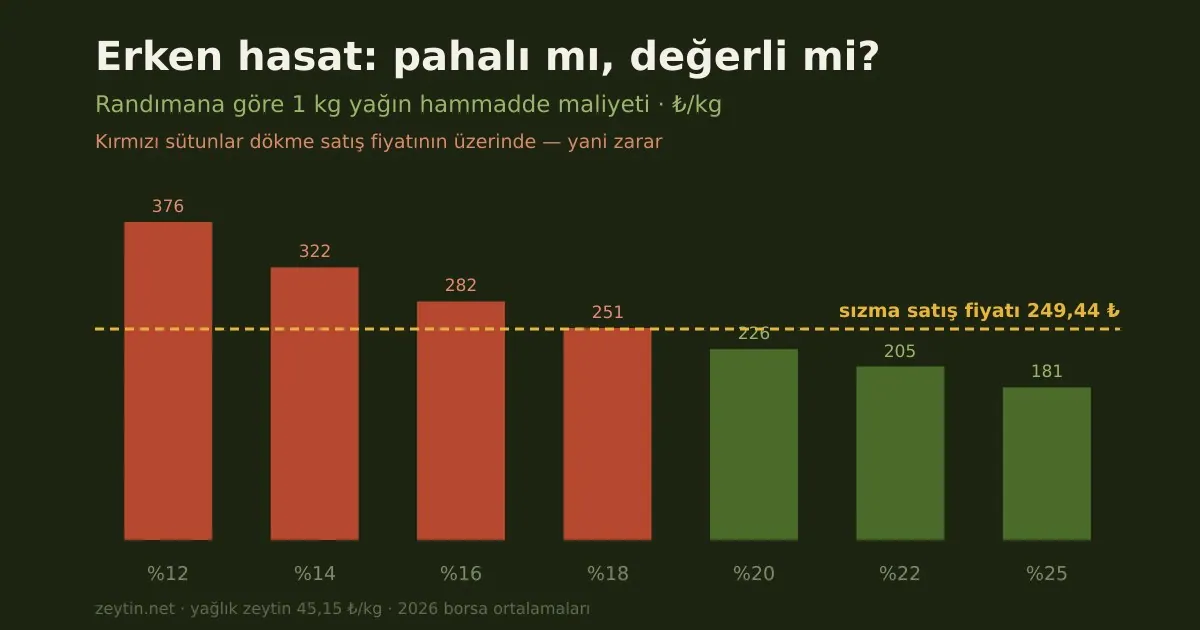
Below 18% yield the raw material costs more than the bulk price. Early-harvest oil needs a 43% premium to break even.
Article
Early harvest: expensive or valuable? The arithmetic of yield
Below 18% yield the raw material costs more than the bulk price. Early-harvest oil needs a 43% premium to break even.
 Article
Did olive oil go up 13.5 times, or 1.6 times?
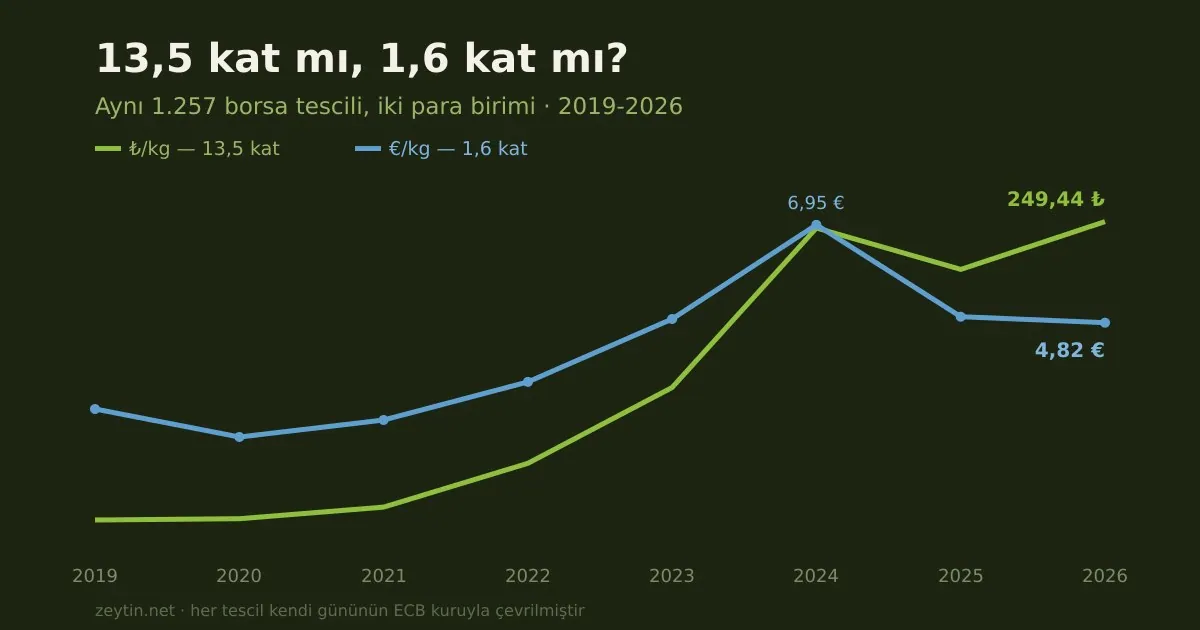
Up 13.5 times in lira, 1.6 times in euros. The same 1,257 registrations, each converted at its own day's ECB rate.
Article
Did olive oil go up 13.5 times, or 1.6 times?
Up 13.5 times in lira, 1.6 times in euros. The same 1,257 registrations, each converted at its own day's ECB rate.
 Article
Fourth in the world with 25 registrations — but what are they doing?
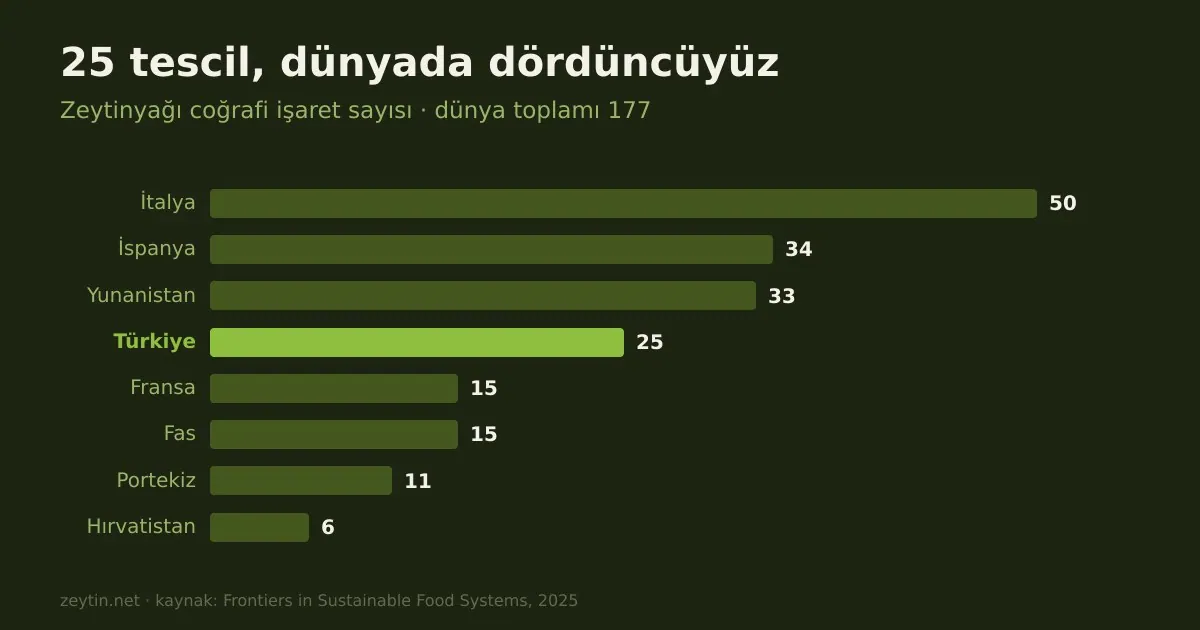
Türkiye is fourth in the world with 25 olive oil GIs. Yet exports fetch $3.17/kg — the product is still priced as a commodity.
Article
Fourth in the world with 25 registrations — but what are they doing?
Türkiye is fourth in the world with 25 olive oil GIs. Yet exports fetch $3.17/kg — the product is still priced as a commodity.
 Article
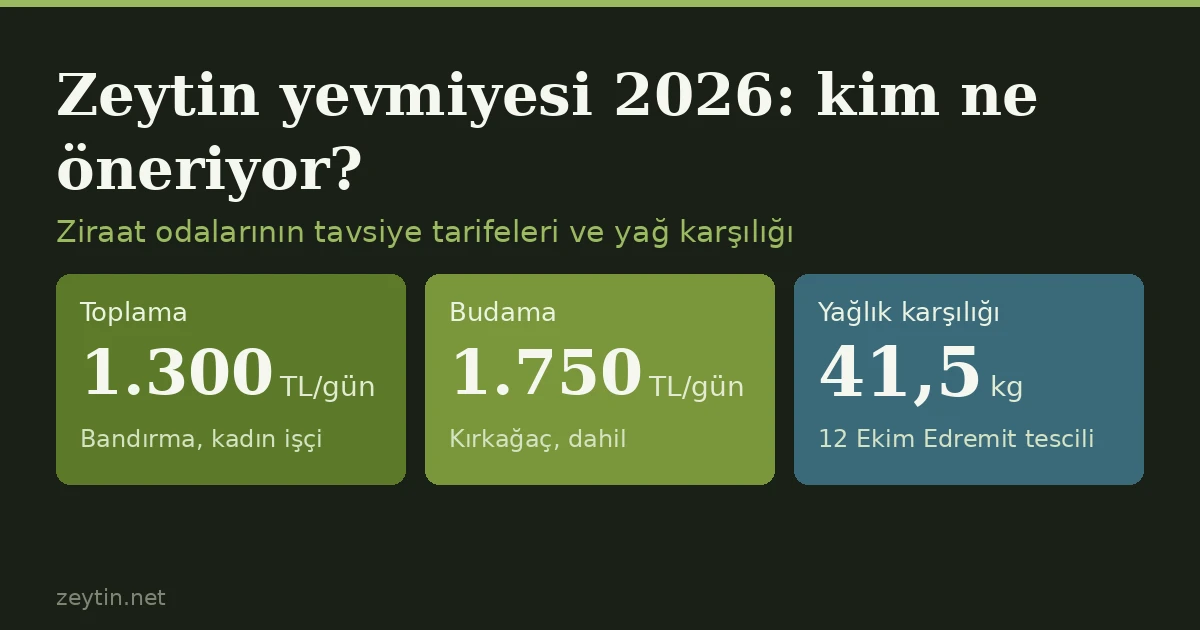
How much is the olive picking and pruning daily wage in 2026?
Turkish chambers recommend 1,200-1,500 lira a day for olive picking in 2026/27, up to 1,900 for shaking and 1,750 for pruning; none is binding.
Article
How much is the olive picking and pruning daily wage in 2026?
Turkish chambers recommend 1,200-1,500 lira a day for olive picking in 2026/27, up to 1,900 for shaking and 1,750 for pruning; none is binding.