Is a bigger pack of table olives and olive paste cheaper? Same brand, same market in 13 November 2026 shelf prices
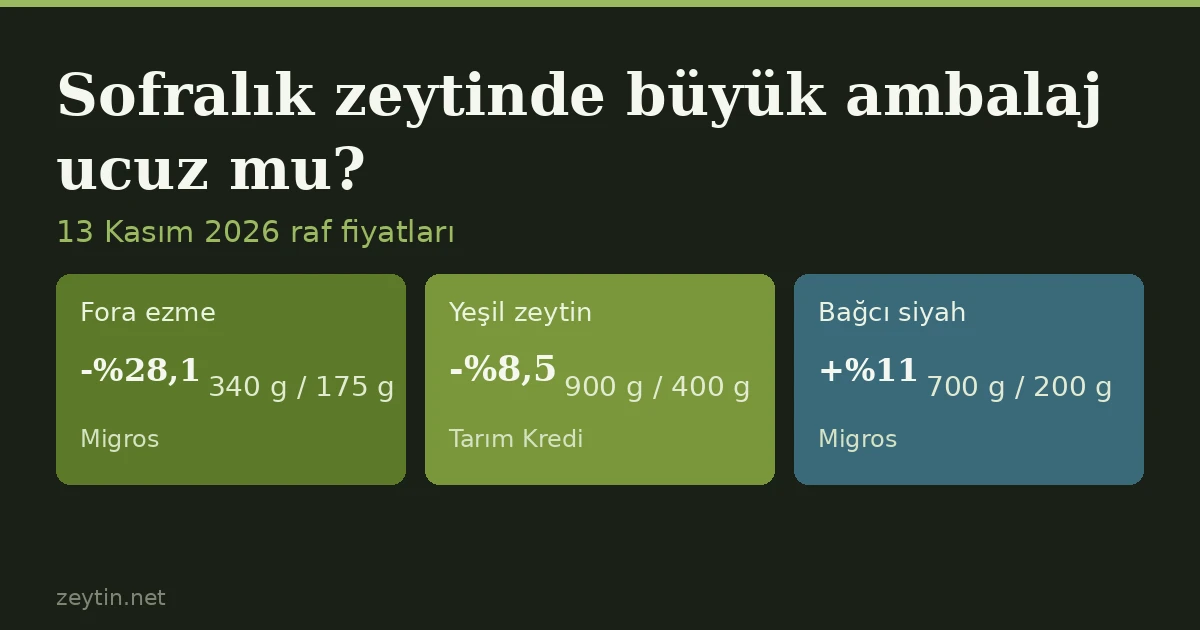
In 13 November 2026 shelf prices, in matches with the same brand, market and product name, the larger pack is 8.5% cheaper per kilogram for green olives and 28.1% for olive paste; where size or processing differs, the larger pack is about 11% dearer. Single-day data, small sample.
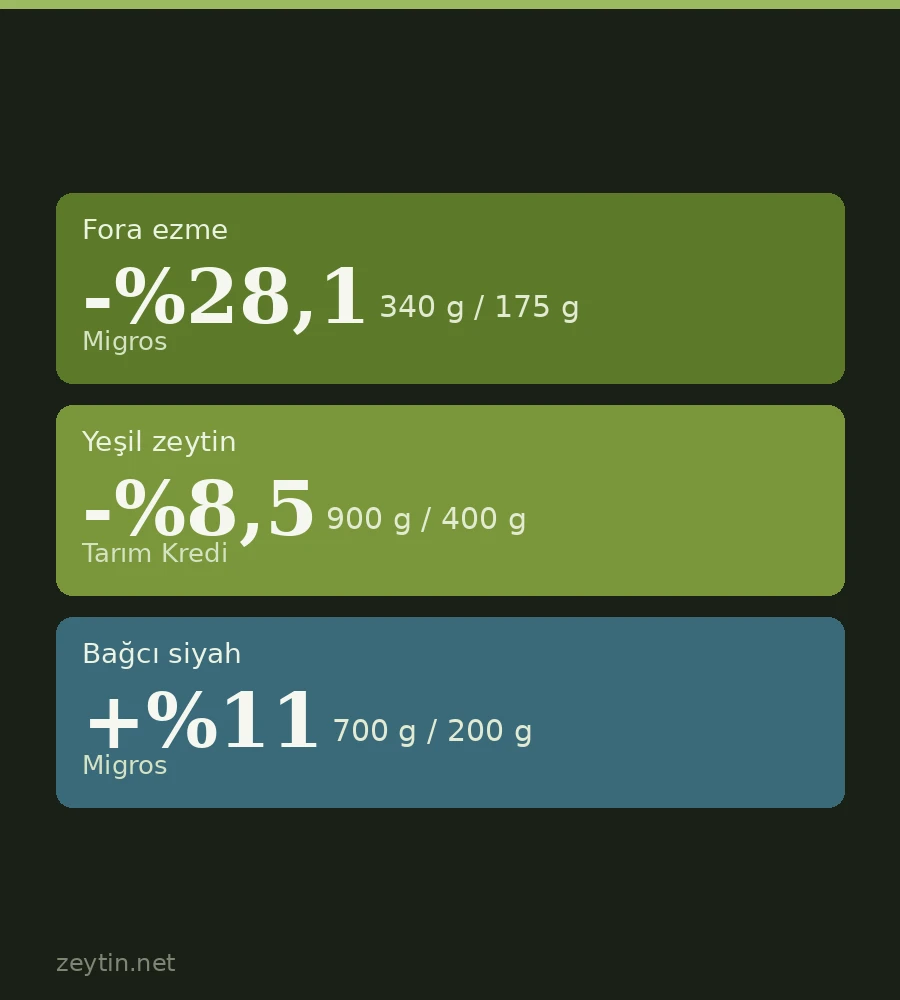
Is a bigger pack cheaper per kilogram for table olives and olive paste? Looking at the prices our site collected from supermarket shelves on the morning of 13 November 2026, the answer is mostly yes, but not in every pair: in clean matches, where the same brand sold in the same market under the same product name comes in two pack sizes, the larger pack is 8.5% (green olives) to 28% (paste) cheaper per kilogram; in two pairs where fruit size or processing differs, the larger pack costs more per kilogram. So pack size alone is not a sufficient clue.
This is an analysis: all figures come from our retail series, which is a single-day snapshot and does not show change over time. Prices are taken from the marketfiyati.org.tr record. We looked at the same question for oil in Is a bigger pack of olive oil cheaper?.
How much data is there?
The retail series holds 102 product records dated 13 November 2026; 24 are black table olives, 24 green table olives and 10 olive paste. The records come from seven chains (A101, BİM, Carrefour, Hakmar, Migros, Şok, Tarım Kredi). Here we looked only at matches with the same brand and the same market and a similar product type; the kilogram price is the label price divided by the pack weight.
Smaller pack, dearer kilo: three matches
| Product | Market | Smaller pack | Larger pack | Difference |
|---|---|---|---|---|
| Tarım Kredi Brined Green Olives XL-L | Tarım Kredi | 400 g: 212.50 TL/kg | 900 g: 194.44 TL/kg | -8.5% |
| Fora Plain Black Olive Paste | Migros | 175 g: 568.57 TL/kg | 340 g: 408.82 TL/kg | -28.1% |
| Fora green olives (cracked, grilled, sliced; product type differs) | Migros | 160 g: 781.25 TL/kg | 400 g: 512.50 TL/kg | -34.4% |
The first two rows are the cleanest matches: same brand, same market, same product name; only the pack differs. For Tarım Kredi's green olives, the 900-gram jar costs 8.5% less per kilogram than the 400-gram jar. For Fora's plain black paste, the 340-gram tub is 28% cheaper than the 175-gram one.
The third row is less clean: at Migros, Fora's three green olives are listed as 160 gram sliced (781.25 TL/kg), 230 gram grilled (647.83 TL/kg) and 400 gram cracked (512.50 TL/kg). The kilo price falls as the pack grows, but the products are cut differently, so we cannot say how much of the price gap comes from the pack and how much from the processing.
Two matches where the bigger pack costs more
| Product | Market | Smaller pack | Larger pack | Difference |
|---|---|---|---|---|
| Bağcı black olives (200 g: size 351-410; 700 g: natural brined) | Migros | 200 g: 307.50 TL/kg | 700 g: 341.43 TL/kg | +11.0% |
| Marmarabirlik black olives (500 g "Hiper"; 1 kg) | Carrefour | 500 g: 539.90 TL/kg | 1 kg: 599.95 TL/kg | +11.1% |
The explanation for both most likely lies in the product itself: the shelf names carry different size, processing or range labels ("Hiper", "natural brined", size 351-410). Since olive size, meaning the number of fruit per kilogram, is one of the factors that set the price, a larger pack may cost more per kilogram if it holds bigger fruit. The shelf data does not confirm this; we give it only as a possible reason.
When size is mixed in: 2 kilograms at Şok
At Şok, Lio brined black olives cost 310.00 TL/kg in the 500-gram pack (size 201-260) and 149.50 TL/kg in the 2-kilogram pack (size 381-460): a 51.8% drop. But the olives in the 2-kilogram pack are much smaller (381-460 fruit per kilogram). So in this match most of the price gap may come from size, not pack; we do not count this row as a pack effect.
Brand and market difference can be bigger than pack
Even for the same brand, the same product does not sell at the same price everywhere. Marmarabirlik's 1-kilogram black olives cost 449.00 TL/kg at Migros (size 231-260) and 599.95 TL/kg at Carrefour: a 33.6% difference. Because the size information in the shelf names does not fully match, we do not read this as a clean market difference either. Marmarabirlik's plain olive paste is 388.00 TL/kg at 175 grams at Tarım Kredi and 441.03 TL/kg at 340 grams at Carrefour (+13.7%); here the bigger pack is dearer, but the market also differs. We cannot separate the pack effect from the market effect.
What can we say, and what not?
- We can say: when the same brand, in the same market, under the same product name offers two pack sizes (two clean matches), the larger pack was cheaper per kilogram: 8.5% for green olives, 28% for paste.
- We cannot say: "a bigger pack is always cheaper" or "dearer". Our number of matches is small, from a single day, and we cannot separate the effect of size from that of processing.
- Comparing kilo prices without comparing the size range on the label (for example 201-260) can mislead. For size, see The economics of caliber: how fruit size triples the price; for the gap between the grower's price and the shelf, see The same olive, six times the price.
Summary
In the 13 November 2026 shelf data, in matches with the same brand, same market and same product name, the larger pack was 8.5% cheaper for green olives and 28.1% cheaper for olive paste. In pairs where size or processing differs this did not hold (+11.0%, +11.1%); in one pair the gap is nearly half (-51.8%), but that may come from fruit size. A single day of data supports nothing further.
One rating per visitor; you can change yours at any time. Ratings are real reader votes — no seeded or default scores.
Related
 Article
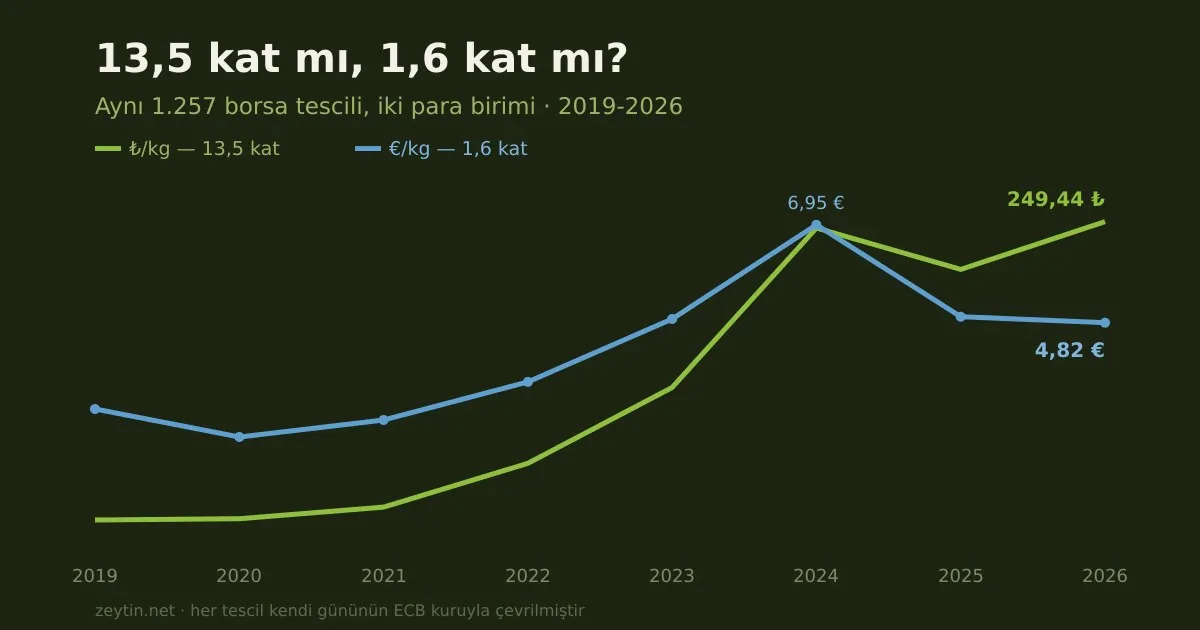
Did olive oil go up 13.5 times, or 1.6 times?
Up 13.5 times in lira, 1.6 times in euros. The same 1,257 registrations, each converted at its own day's ECB rate.
 Article
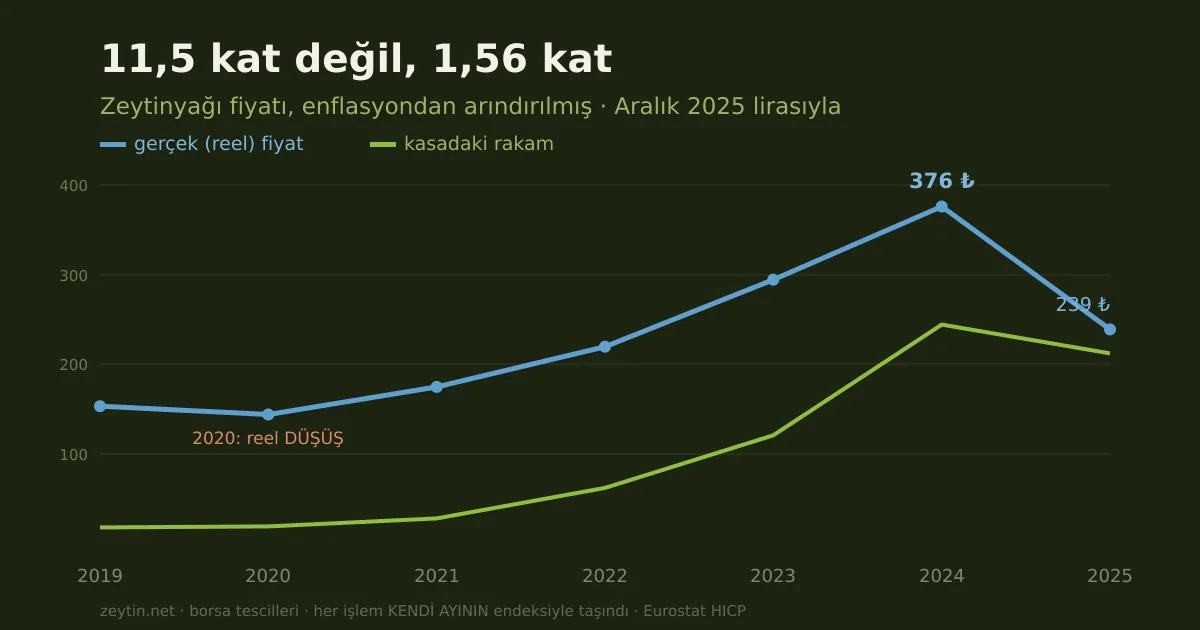
The real price of olive oil: the inflation-adjusted calculation
The lira price rose 11.5-fold, inflation 7.6-fold. The real increase is 1.56-fold — and it matches the euro-based calculation.
 Article
Vegetation water and pomace: olive oil's waste problem
Processing 1.5–2 million tonnes of olives yields 1 million tonnes of vegetation water and 1 million tonnes of pomace. Waste, or resource?
 Article
What share of extra virgin does crude olive oil fetch on the exchange? The crude/extra virgin ratio at Edremit and Aydın, 2019-2026
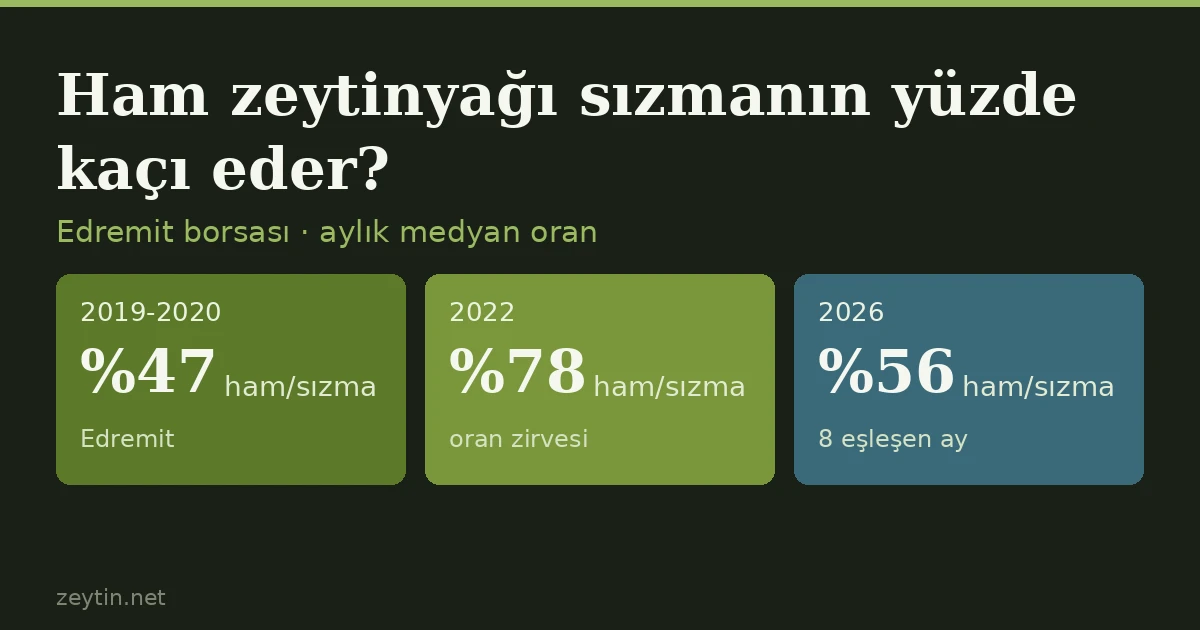
At the Edremit exchange, crude olive oil traded at 47% of extra virgin (monthly median) in 2019-2020, rose to 78% in 2022 and fell to 56% in 2026; at Aydın the ratio sits between 75% and 89%. The direction is the same at both, the level differs; the data cannot say why.