Şahinbey Municipality sells olive oil bought from growers at 4,250 lira a tin; buyers say they paid about 6,000 last year
In Gaziantep, Şahinbey Municipality sells olive oil it buys from growers in cash at its Meat Sales Point for 4,250 lira per tin. Buyers say they paid about 6,000 lira last year. Mayor Mehmet Tahmazoğlu says growers could not sell and were offered low prices on credit of several months. The tin's volume, the price paid to growers and any analysis result are not in the report.
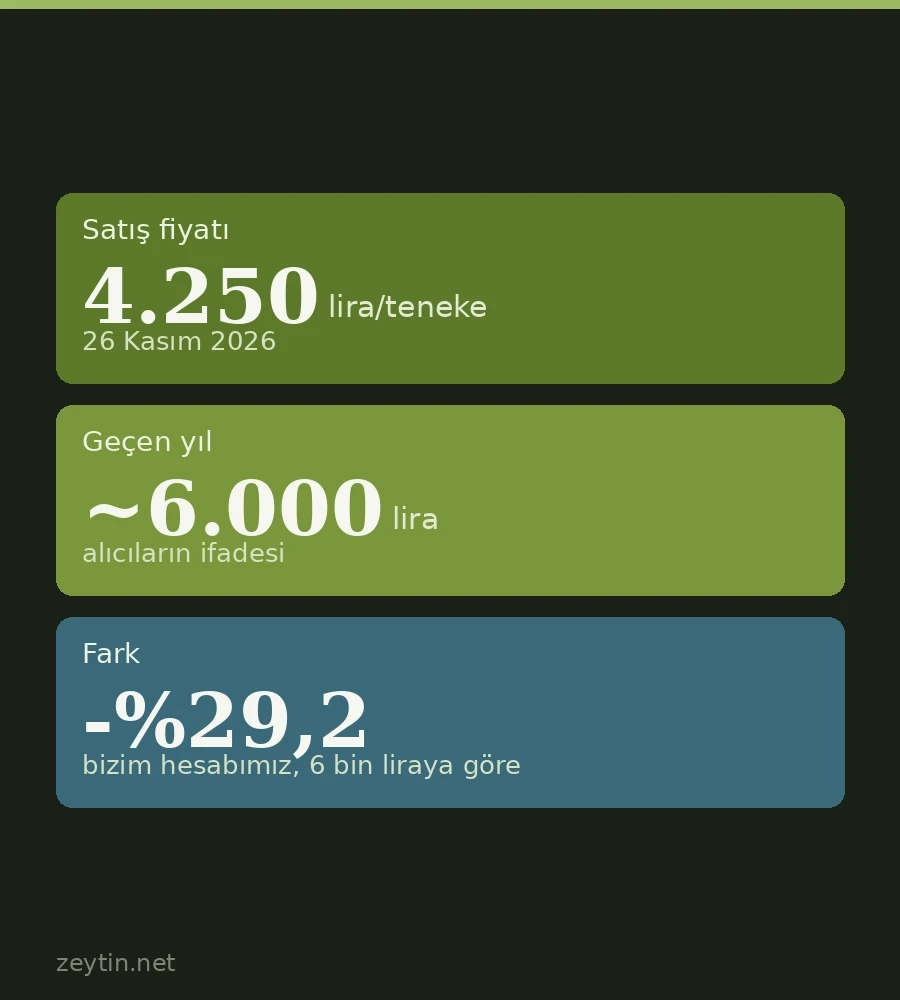
In Gaziantep, Şahinbey Municipality is selling olive oil that it buys directly from growers at 4,250 lira per tin. According to a report dated 26 November 2026, the sales take place at the municipality's Meat Sales Point; Mayor Mehmet Tahmazoğlu visited the sales point and said the scheme was drawing strong interest from residents. Buyers say they paid about 6,000 lira for the same oil last year.
What the report says
| Item | What the report says |
|---|---|
| Place of sale | Şahinbey Municipality Meat Sales Point |
| Sale price | 4,250 lira per tin |
| Last year's price as recalled by buyers | about 6,000 lira (6,000-7,000 in another remark) |
| How the oil is sourced | directly from growers, paid in cash up front |
| Oversight (the mayor's words) | pressed under municipal enforcement officers and food engineers, nothing added |
| Purpose (the mayor's words) | not profit, but a bridge between grower and consumer |
The report has three voices: the mayor, the farmer request the mayor relays, and buyers at the sales point. There is no statement in the growers' own words; what farmers said is the mayor's account. Also, 4,250 lira is the price at one municipal sales point in Gaziantep, not a national retail price.
How low is the price?
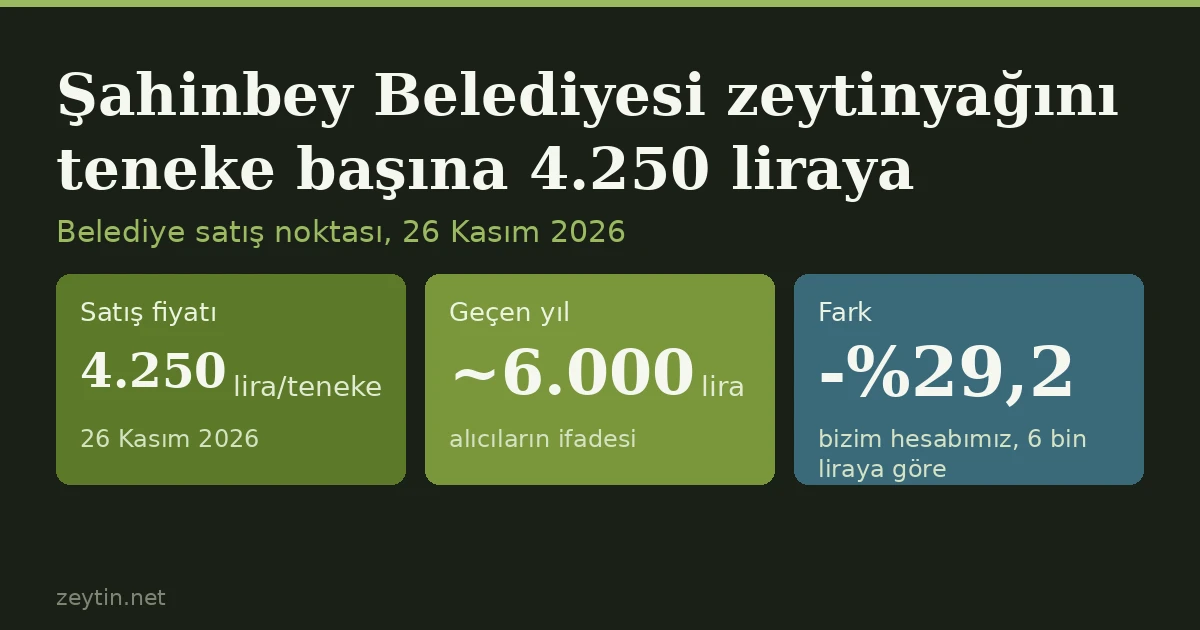
Comparing the buyers' "6,000 lira last year" with this year's 4,250 lira gives a difference of 29.2 per cent; taking the 7,000 lira remark it is 39.3 per cent (our calculation). These percentages should be read with two caveats: last year's price comes from what buyers remember, not from a price series, and the report does not say how many litres or kilograms a tin holds. Because the size of the tin is unknown, we do not convert 4,250 lira into lira per kilogram or per litre and set it beside the retail and exchange figures in our weekly price bulletin.
Why did growers come to the municipality?
According to Tahmazoğlu, growers asked for the sales themselves: they told him, "Mayor, we cannot sell our olive oil. They buy from us on credit of a few months and at very low prices." The municipality pays growers in cash up front. The price paid to growers is not in the report, but payment terms are one of the main themes of this season. Marmarabirlik has also announced that it will pay half of the price of oil olives up front: see Marmarabirlik purchase prices. In the same week a grower in Soma, in Manisa, described oil falling from 240-250 lira to 190-200 lira: Soma report. So the grower complaint of "we cannot sell, prices have fallen" is not unique to Gaziantep.
Within this season's price picture
The fall described by buyers moves in the same direction as the olive side of the market. In Gemlik, council president Sedat Akkuş had said oil olives were being discussed at 50 lira last year and at 25-30 lira this year: see the Gemlik statement. In Marmarabirlik's list, oil olives fell from last season's 53 lira to 40 lira. The per-kilogram price of olives cannot be compared directly with the price of a tin of oil, but a decline in the raw material is expected to feed through to the price of oil on shelves and at sales points; how far it has done so cannot be said without knowing the volume of the tin.
The municipality's role
In the arrangement described in the report, the municipality is both buyer and seller: it buys from growers in cash and sells to consumers at its own sales point. The mayor says the aim is not profit; the report does not say whether pressing, packaging, staff and sales point costs are reflected in the price. So we do not know whether 4,250 lira is a cost price or a price that includes a small margin.
From saplings to pressing
Tahmazoğlu said that about six years ago the municipality brought 750,000 olive saplings from Gemlik and handed all of them to farmers with a 50 per cent grant, that these saplings have grown into trees and are yielding "very good crops", and that this year's olive crop is also quite abundant. The report does not say how many decares or trees these saplings now cover, or how many tonnes of olives were bought this year.
The oversight and no-additives claim
The mayor says the oil is pressed under the supervision of municipal enforcement teams and food engineers and that nothing is allowed to be added. This is a statement: the report contains no laboratory analysis or acidity result. For official inspection of olive oil mills, see the Hatay mill inspection report. Another example of a municipality stepping into the sector is Menemen, where the municipal mill said it had not raised its pressing fee; details are in the Menemen report.
What are residents saying?
Buyers speaking at the sales point said the price helped their budgets. Buyers said "This cheapness has angered some people" and asked why it should bother anyone that oil sold for 6,000-7,000 lira last year is being sold at a more affordable price this year. The report does not say who was angered.
What the report does not say
- The volume or weight of the tin; the acidity level and grade of the oil.
- The price the municipality pays growers.
- The total amount sold, the stock, and whether there is a per-person limit.
- Any independent analysis result.
- The reaction of private sellers in the market; there is only the buyers' indirect remark.
What to watch
If the municipality discloses the volume of the tin, the price paid to growers and the quantity sold, a real comparison of 4,250 lira with the market becomes possible. Until then the conclusion from the report is this: a local government is buying oil in cash from growers who say they cannot sell, and selling it directly to consumers at 4,250 lira a tin.
One rating per visitor; you can change yours at any time. Ratings are real reader votes — no seeded or default scores.
Related
 Article
Opening prices in Akhisar: 60 lira for double Domat, 10 lira for milling olives
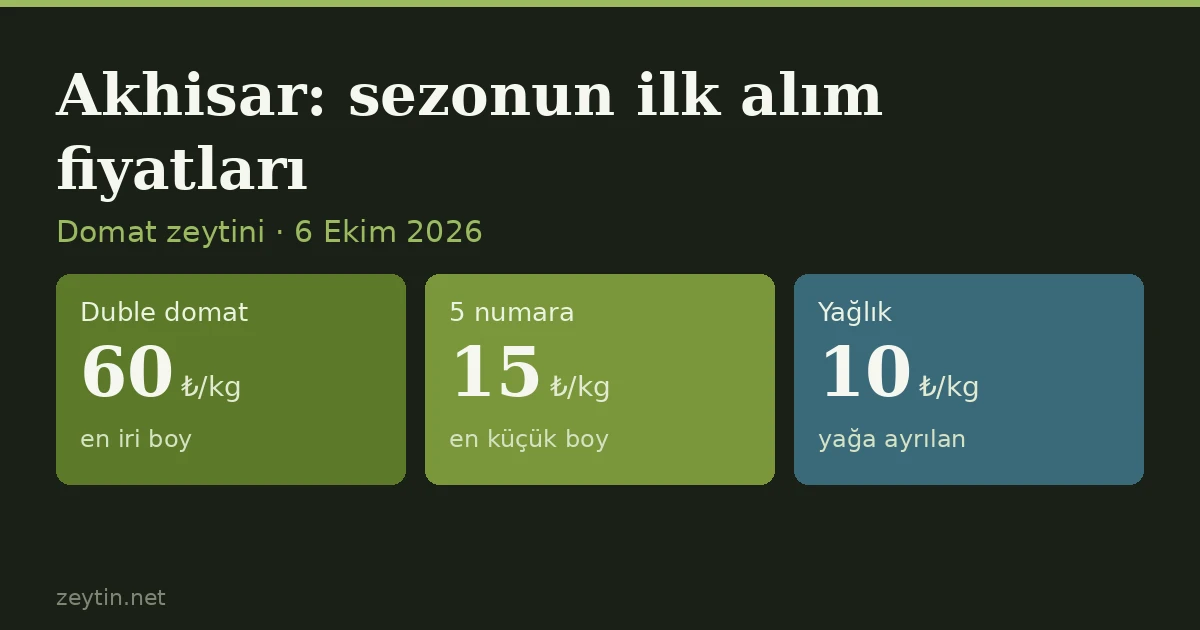
The season's first purchase prices for Domat olives have formed in Akhisar: 15 to 60 lira a kilo by size, and 10 lira for fruit sold for milling. The local chamber of agriculture says prices are below last year's and has called for a joint table. Farm input costs rose 27.6% over the same period.
 Article
Italian extra virgin has halved in a year: growers in Puglia set a Monday noon deadline
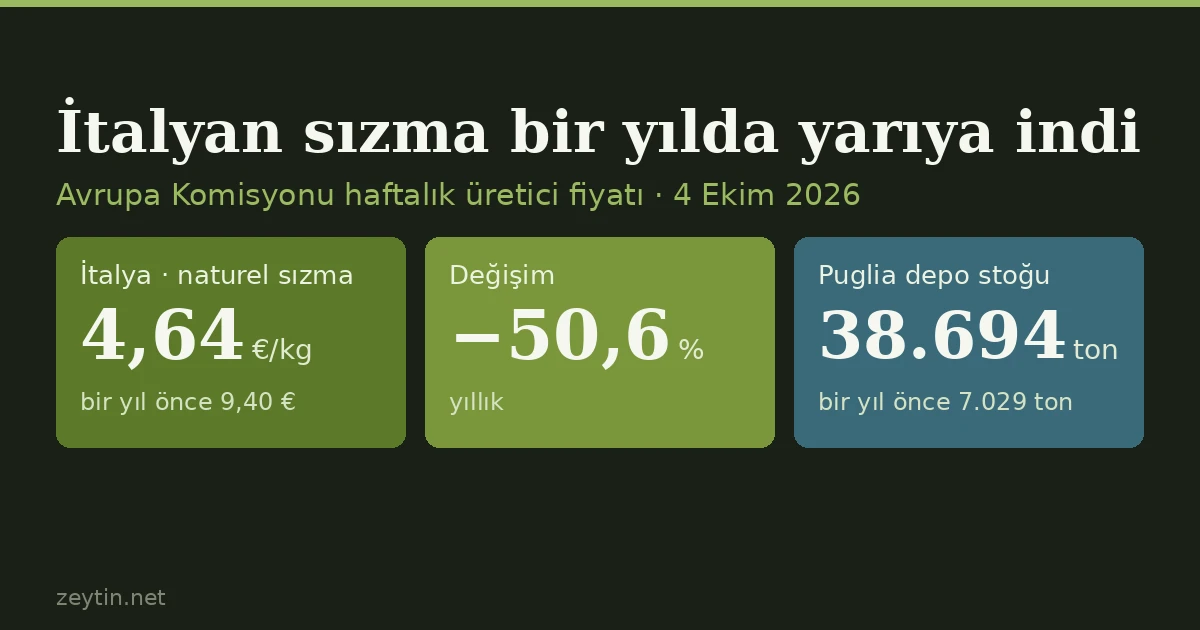
According to the European Commission's weekly producer prices, Italian extra virgin olive oil fell to €4.64 a kilo in the week of 4 October; a year earlier, in the same week, it was €9.40. Growers in Puglia have taken to the streets in the opening days of the harvest, holding sit-ins in Corato and Bitonto and giving the government until noon on 12 October to respond. Italian extra virgin stored in the region's warehouses has risen fivefold in a year.
 Article
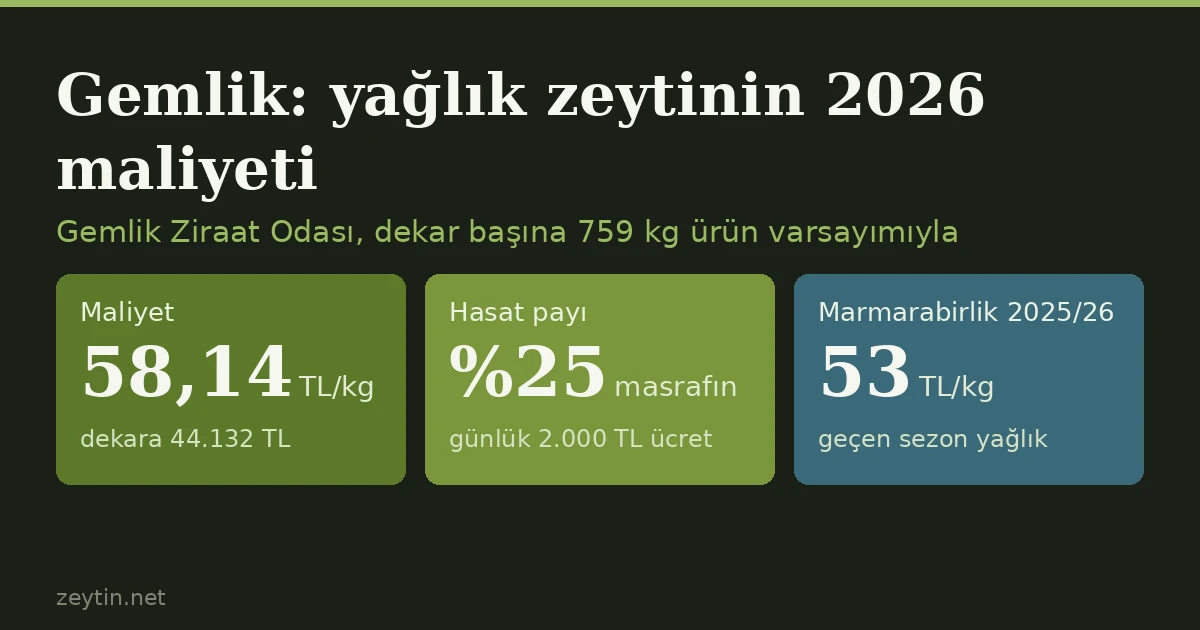
Gemlik puts the cost of oil olives at 58.14 lira a kilo: harvest is the biggest item
The Gemlik Chamber of Agriculture puts the 2026 cost of a kilo of oil olives at 58.14 lira: 44,132 lira per decare for 759 kg of fruit. The sheet assumes a 2,000-lira daily picking wage, and the 12,532-lira overhead line matches 24% interest, 3% overhead and 4,000 lira depreciation exactly. The widely reported 23-lira gap with Orhangazi rests on a wrong figure.
 Article
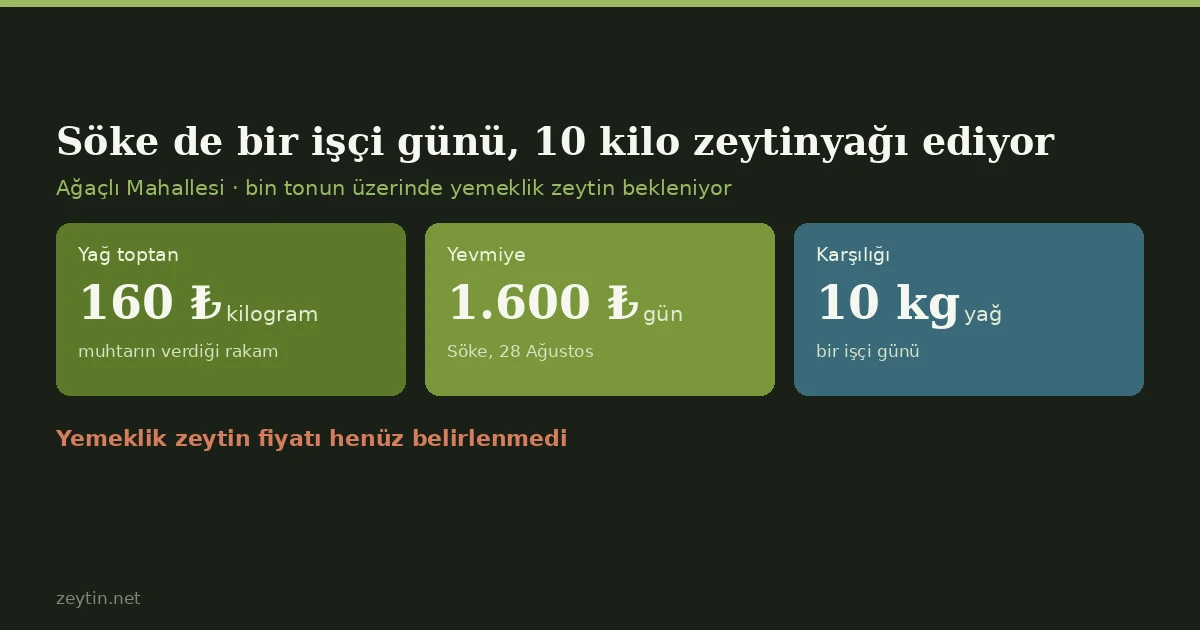
In Söke, one day's wage costs ten kilos of olive oil
Over 1,000 tonnes of table olives are expected in Söke's Ağaçlı. Two figures given by the headman sum up the season: oil at 160 lira wholesale, a day's wage at 1,600.