Soma olive oil producer: oil that opened the season at 240-250 lira is now 190-200, with day wages at 1,500-3,000 lira
Olive oil producer Şerif Ali Uysal in Soma, Manisa, says the per-litre price has fallen from 240-250 lira at the start of the season to 190-200 lira, and that oil which was 300 lira last year is now around 200. A woman's daily wage is 1,500 lira and a male machine-harvest worker costs 2,000-3,000 lira. The report does not give the oil grade or say whether 190 lira is a sale or an offer.
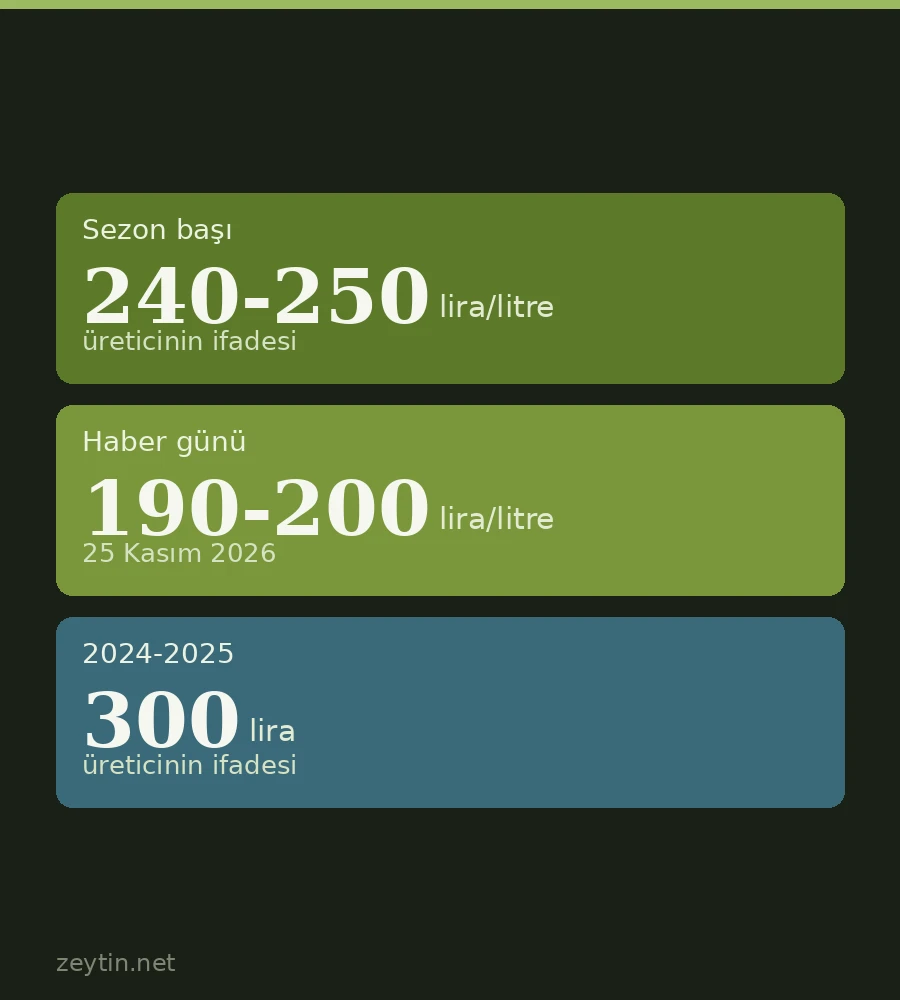
In the Avdan neighbourhood of Soma, in Turkey's Manisa province, olive grower and mill operator Şerif Ali Uysal says the price of olive oil has fallen from 240-250 lira at the start of the season to 190-200 lira. According to a report dated 25 November 2026, Uysal described a season that is very productive in volume but in which growers cannot turn that productivity into income, and said producers are "in a complete deadlock" because of diesel, fertiliser and labour costs.
What the report says
| Item | What the report says |
|---|---|
| Location | Avdan neighbourhood, Soma (Manisa) |
| Oil price at the start of the season (per litre) | 240-250 lira |
| Oil price on the day of the report (per litre) | 190-200 lira |
| Price in 2024 and 2025 | 300 lira |
| Daily wage, woman worker | 1,500 lira |
| Male worker harvesting with machinery | about 2,000-3,000 lira |
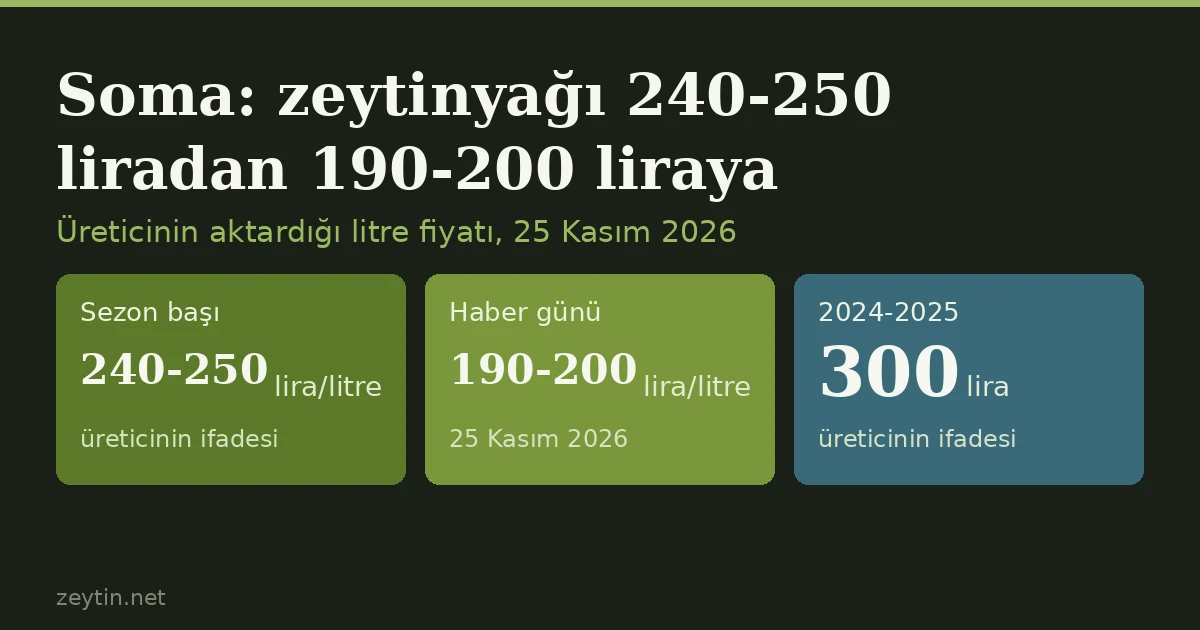
In Uysal's own words: "Oil prices started the season at 240-250 lira, came to 200 lira, and dropped as far as 190 lira." He describes last season like this: "The oil that was 300 lira last year is 200 lira today; it is even being offered at 190 lira."
How big is the drop?
With the figures Uysal gives, the arithmetic works out as follows (our calculation): going from 250 lira to 190 lira is a fall of 24 per cent, and from 240 lira to 190 lira a fall of 20.8 per cent. Measured against last year's 300 lira, 200 lira is a fall of 33.3 per cent and 190 lira a fall of 36.7 per cent. The report uses the phrase "it is even being offered at 190 lira", so it is not clear whether 190 lira is a completed sale or a buyer's offer.
The cost side
According to Uysal, the trouble comes as much from costs staying high as from the price falling. He says diesel and fertiliser have risen a great deal but gives no percentage. For labour there are numbers: a woman's daily wage is 1,500 lira, and a male worker harvesting with machinery costs roughly 2,000-3,000 lira. As someone who also runs a pressing facility, he complains about electricity and labour costs too. The "scissors moving in opposite directions", meaning prices falling while inputs rise, leave the grower in a tight spot; Uysal says he does not know what kind of measure could be taken. The report also gives no per-litre cost figure for his own production.
For scale only: at 190 lira per litre, a 1,500 lira daily wage equals about 7.9 litres of oil, and a wage of 2,000-3,000 lira equals 10.5-15.8 litres (our calculation). This is an indicator of scale, not a cost calculation: the report does not say how many kilograms of olives a worker picks in a day or how many kilograms of olives it takes to make a litre of oil, so a labour share per litre cannot be derived.
Reading the harvest and the price together
Uysal calls the season "very good in terms of quantity"; the report does not explain why. In Akhisar, in the same province, growers had said the crop had tripled compared with last year and that a kilogram of Domat olives had fallen from 100 lira to 40-45 lira: see the Akhisar report. Nationally, UZZK expects 4.03 million tonnes of olives for 2026/27. It is a reasonable reading that a large crop has pulled prices down, but that is our interpretation; Uysal does not explain the reason for the fall. The emphasis of the report is not the crop but the widening gap between cost and price.
Side by side with other regions
Dr Mustafa Tan, president of the National Olive and Olive Oil Council (UZZK), has put the average production cost of a kilogram of oil at 240-280 lira and the market purchase price at 170-200 lira; the details are in our piece on the UZZK 2026/27 statement. The 190-200 lira in Soma sits inside that purchase-price range. On the olive side, Marmarabirlik announced 40 lira for oil olives: see the Marmarabirlik purchase prices. In Manavgat, in Antalya, growers said oil had fallen from 250-300 lira to 200 lira: see the Manavgat report. The figure given by the Söke Commodity Exchange was 120 lira for 5-acidity oil and 170 lira for 0.5-acidity oil: see the Söke exchange statement. Because Uysal speaks of litres while the council speaks of kilograms, and because oil grades and sales channels differ, these figures cannot be compared one to one; we place them side by side only to show the general level.
Soma's olives
Uysal said that in the district Edremit-Ayvalık type, Akhisar Domat and Gemlik type olives are used both for the table and for oil, that early harvest and cold pressing matter for preserving oleuropein, the compound that gives bitterness, and that natural extra virgin oil obtained this way is valuable. For the district's cool climate and its protected oil, see our piece on Soma olive oil.
What the report does not say
- Which oil grade (acidity level) the 190 and 200 lira figures refer to.
- The volume processed at Uysal's facility and its pressing fee.
- The size of the rise in diesel and fertiliser costs.
- A separate crop forecast for Soma.
- The report's only voice is Uysal; there is no buyer, exchange or chamber of agriculture view.
- The concrete support or measure the grower wants; Uysal says only that "a solution must be found".
What to watch
The price is drawing a picture that differs from region to region this week; the figure from Soma can be compared with exchange and buying-centre prices in the coming weeks of the season. Which way the price will move, the price Uysal says "needs to rise", is something today's report does not tell us. For the weekly course of exchange, retail and export prices, see our latest price bulletin.
One rating per visitor; you can change yours at any time. Ratings are real reader votes — no seeded or default scores.
Related
 Article
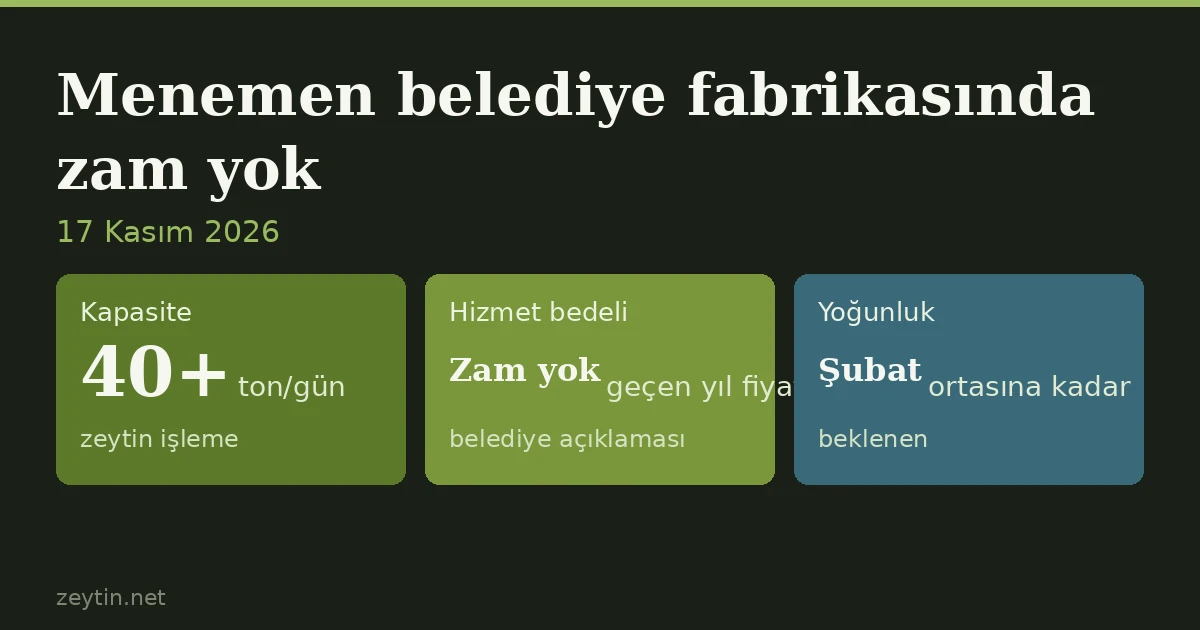
Menemen Municipality's olive oil mill leaves service fees unchanged: capacity above 40 tonnes a day, busy season expected to run to mid-February
In Menemen, İzmir, the municipality's olive oil mill in Emiralem is serving growers from Menemen, other İzmir districts and Manisa. According to Mayor Aydın Pehlivan, service fees were not raised and last year's prices were kept. The report does not give the fee in lira; daily capacity is above 40 tonnes.
 Article
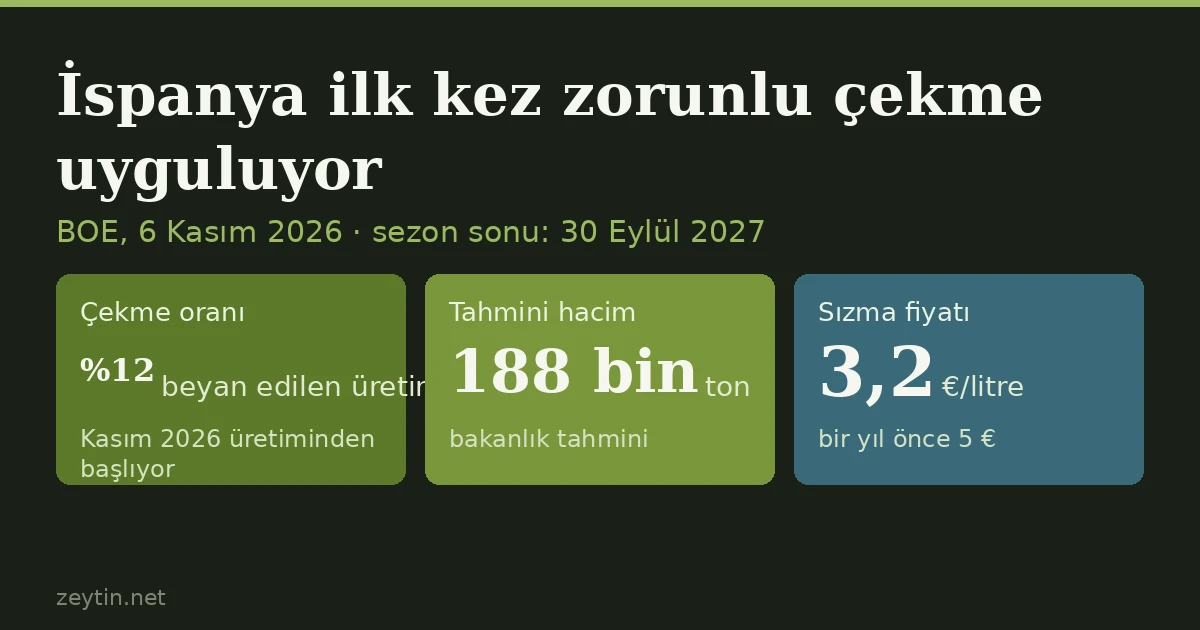
Spain activates mandatory olive oil withdrawal for the first time: 12% of output, about 188,000 tonnes held until September 2027
Spain's agriculture ministry published its decision in the BOE on 6 November: from November, mills must keep 12% of declared output in storage until 30 September 2027. The ministry estimates about 188,000 tonnes will be withdrawn; October early-harvest oils are exempt and mills receive no compensation.
 Article
Spain's olive oil producer price falls to €3.06 while shelf prices drop at half the pace
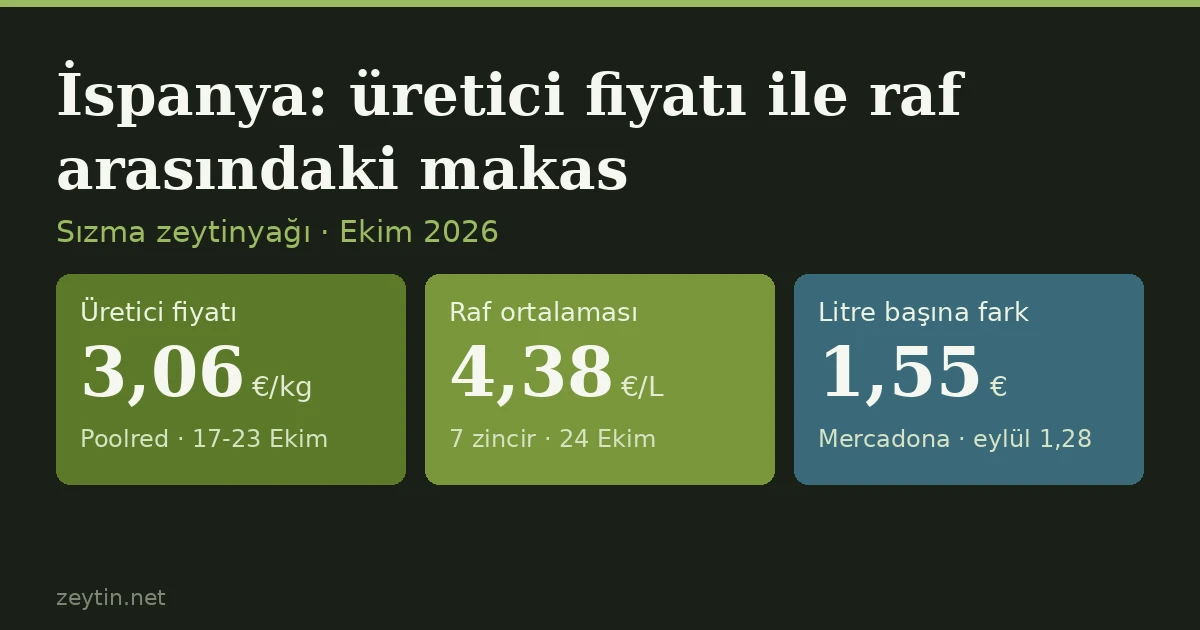
Poolred data show the Spanish producer price of extra virgin olive oil at €3.06/kg in 17-23 October, about 12% below early September. Seven chains' own-label bottles fell 6.7% on average to €4.38 per litre. At Mercadona the per-litre gap widened from €1.28 to €1.55.
 Article
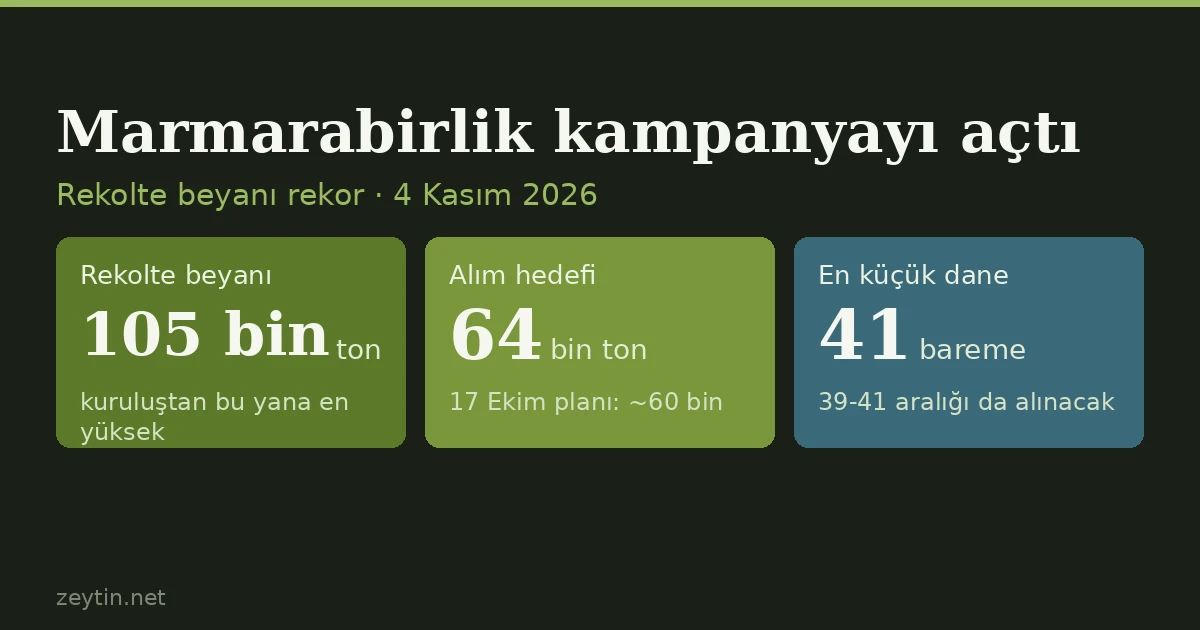
Marmarabirlik opens its purchase campaign: record 105,000-tonne declaration, 64,000-tonne target, olives bought down to size 41
Marmarabirlik opened its purchase campaign on 4 November 2026: members declared a record 105,000 tonnes and the buying target is 64,000 tonnes. Small olives will be bought down to size 41, and Erdek members hit by hail get a loan deferral and a price-difference payment.