İzmir Commodity Exchange proposes 6 urgent measures for olives and olive oil: per-kilogram premium, storage tanks, stock financing and olive oil in public canteens
İzmir Commodity Exchange chairman Ömer Gökhan Tuncer proposed 6 urgent measures against the surplus on 24 November 2026: a per-kilogram premium, storage tank support, stock financing, a graduated incentive and exchange-rate support for exporters, and olive oil in public canteens. The news item gives no amount for any of them.
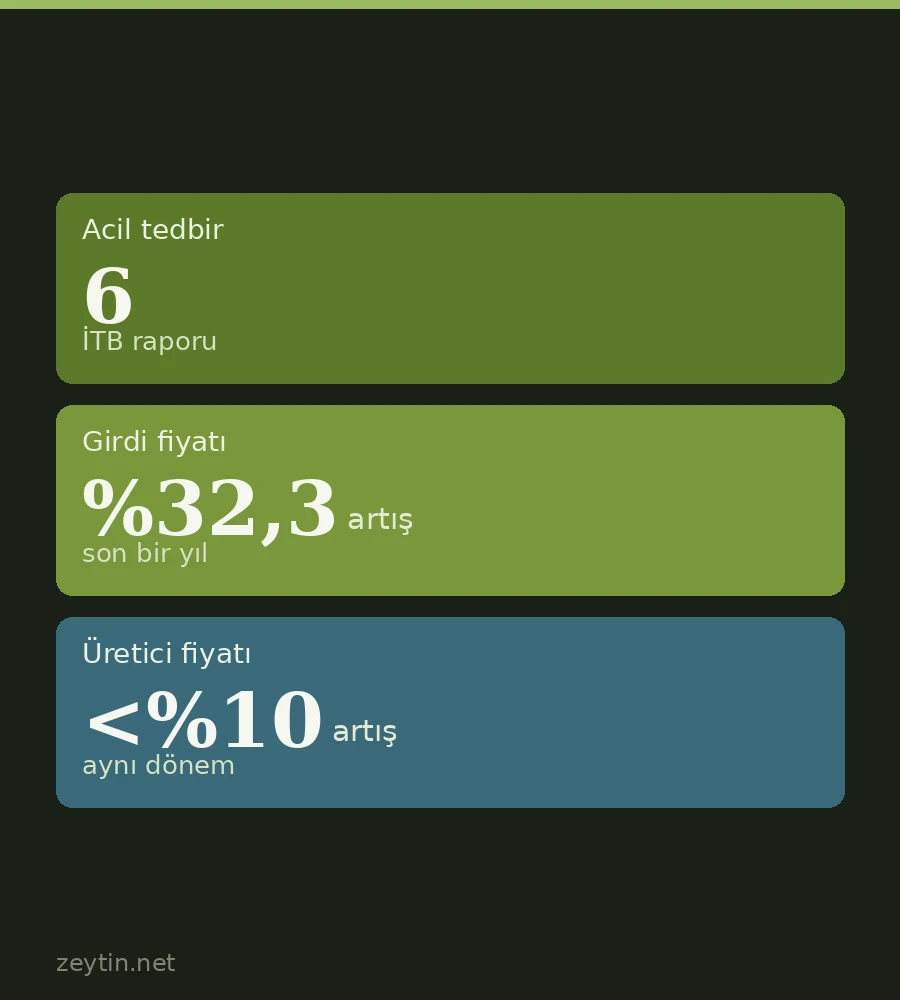
Ömer Gökhan Tuncer, chairman of the İzmir Commodity Exchange (İTB), said on 24 November 2026 that he is proposing 6 urgent measures against the surplus in olives and olive oil. The measures are set out in a report prepared by the exchange and sent to three general directorates. Among them are a per-kilogram premium for producers, storage tank support, low-interest stock financing, a graduated incentive and exchange-rate support for exporters, and giving olive oil priority in public-sector canteens in 2027.
What the report says
| Item | What the report says |
|---|---|
| Announced by | Ömer Gökhan Tuncer, İTB chairman of the board |
| Sent to | Ministry of Agriculture and Forestry, General Directorate of Plant Production; Ministry of Trade, General Directorates of Exports and of Domestic Trade |
| Number of urgent measures | 6 |
| Proposals on structural problems | 10 (no detail given in the news item) |
| Agricultural input prices, last 12 months | up 32.3 per cent |
| Producer prices, same period | up by less than 10 per cent |
The six measures
The news item lists the six urgent measures as follows:
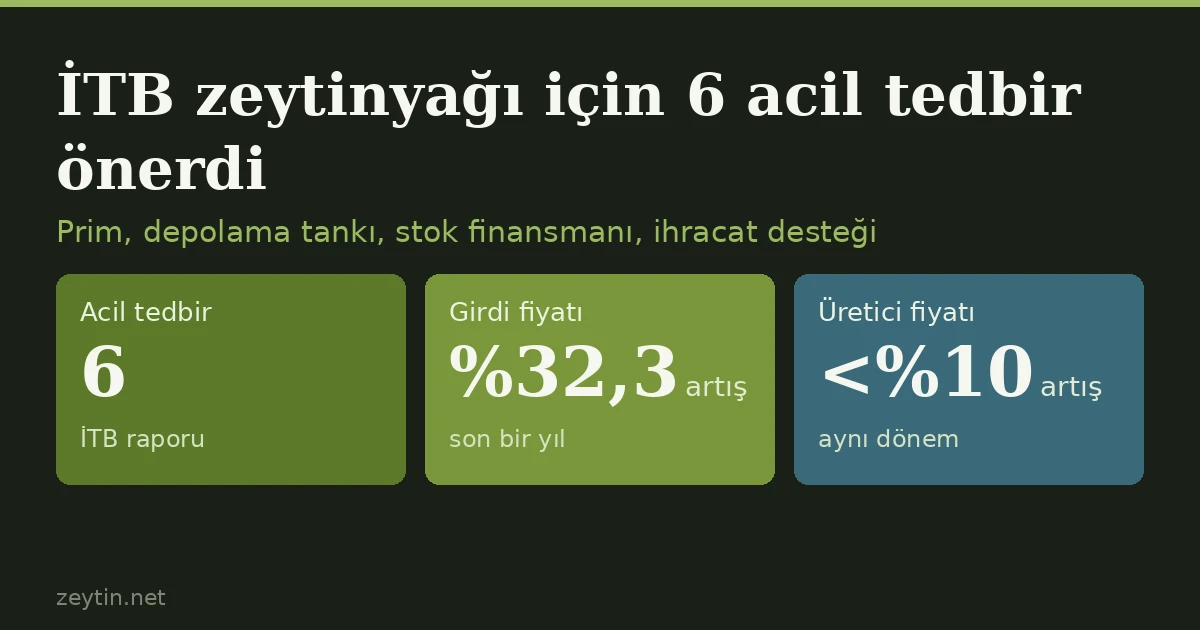
1. A per-kilogram premium for olive and olive oil producers.
2. Storage tank support for the sector, to prevent quality losses in surplus product.
3. High-value, low-interest, long-maturity stock financing for stocks that exceed the last three years' transaction volume.
4. A graduated incentive for firms exporting in bulk, under private label and under their own brand.
5. Exchange-rate support for exporters, limited to this season, so they can stay competitive in foreign markets.
6. Making olive oil a priority in the canteens of public institutions in 2027.
None of the reports gives an amount, a premium rate, an interest rate or a maturity for any of the items, so the size of the proposed support is not known. This is our own observation.
The gap between input costs and producer prices
Two figures that Tuncer cited explain the reasoning: agricultural input prices rose 32.3 per cent over the last year, while producer prices rose by less than 10 per cent. A simple way to read this: while the cost of inputs went from 100 lira to 132.3 lira, the price producers got for their crop did not even reach 110. The report does not say which product basket or index was used, so the figure should be read only as the exchange chairman's account.
The season's price picture shows the same tension from the field. Marmarabirlik cut its 2026/27 purchase price for oil olives from 53 to 40 lira; the details are in our article on Marmarabirlik's purchase prices. For the producers' side of the cost calculation, see our article on olive production cost in Gemlik in 2026.
How the proposals relate to earlier steps
One of the six measures, support for exporters, was already on the agenda: we described the package approved at 50 cents for branded packs and 15 cents for bulk and toll processing in our article on the export support package. Do the fourth and fifth items in İTB's list ask for something on top of that package, or do they aim to widen its scope? The news item does not say, so the two proposals cannot be compared with the package.
The supply side is the background to the proposals as well: according to Tan, the head of UZZK, the Turkish olive council, 4 million 30 thousand tonnes of olives are expected this season (see our UZZK crop article). The requests for storage tanks and stock financing suggest that the possibility of pressed oil not selling at once and having to be held is being taken seriously this season; this is our interpretation, as the news item does not draw that link explicitly.
In Spain, by contrast, the response to a surplus was for the state to take stock off the market directly: a rate of 12 per cent, about 188 thousand tonnes (Spain's mandatory withdrawal). İTB's proposals contain no mandatory withdrawal; they are premium-, finance- and demand-side.
How the measures group together
The six items can be sorted by target (our own grouping): the first two address producers and storage, the third finance, the fourth and fifth exports, and the last domestic demand. The package therefore aims both to make it easier to hold pressed product back and to speed up sales. The İTB Assembly also discussed the sector's problems the same day and a request to pause the harvest was voiced; we cover it in our news item on the calls for a harvest pause.
What the news item does not say
- The amount of the per-kilogram premium and which group of producers it would cover.
- The type of the storage tank support (grant or loan) and its ceiling.
- How "stock exceeding the last three years' transaction volume" would be measured.
- The exchange-rate level against which the exchange-rate support would be calculated.
- The content of the 10 structural proposals.
- The response the ministries have given or will give to the report.
What to watch
Which of the proposals enter the ministries' agenda, and in particular how the request for a per-kilogram premium and the requests on top of the export support are answered, are points to watch in the coming weeks of the season. If the report is published in full, the detail of the 10 structural proposals will also become visible.
One rating per visitor; you can change yours at any time. Ratings are real reader votes — no seeded or default scores.
Related
 Article
Olive oil falls to 200 lira a litre in Mersin: the report cites high yields and old stock
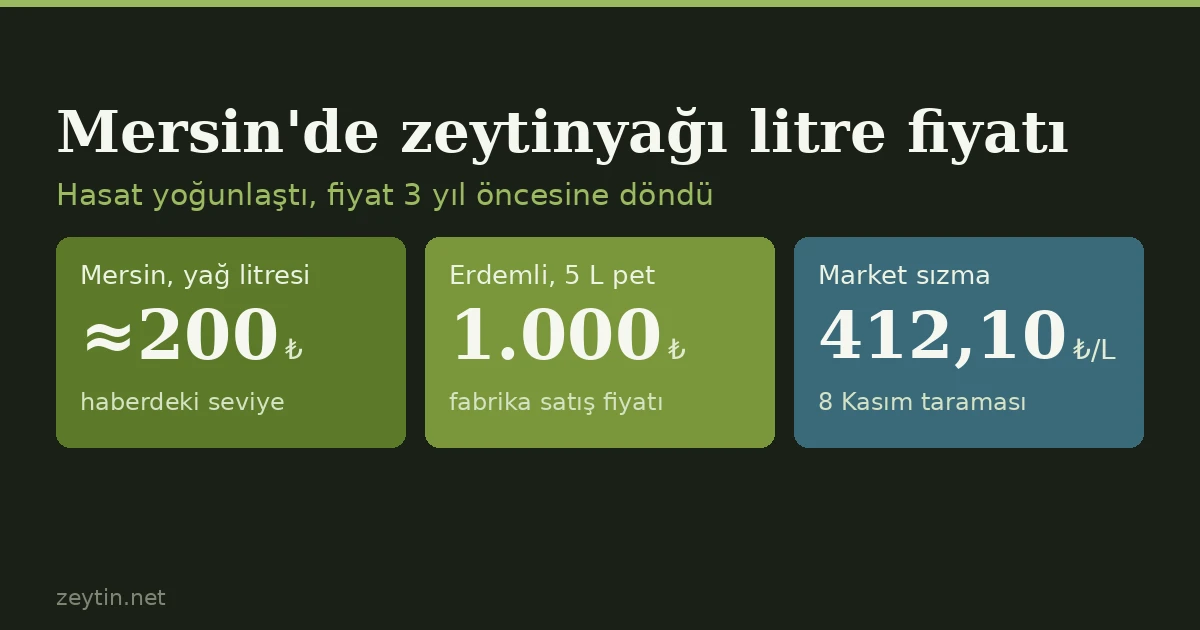
As the harvest picks up in Mersin, a litre of olive oil has fallen to about 200 lira, the level of three years ago; in Erdemli a 5-litre container sells for 1,000 lira. The report cites high yields and stock left from last year. The figure is set beside the site's exchange and supermarket measurements.
 Article
A 282-member doctors' cooperative puts sensors in the olive grove
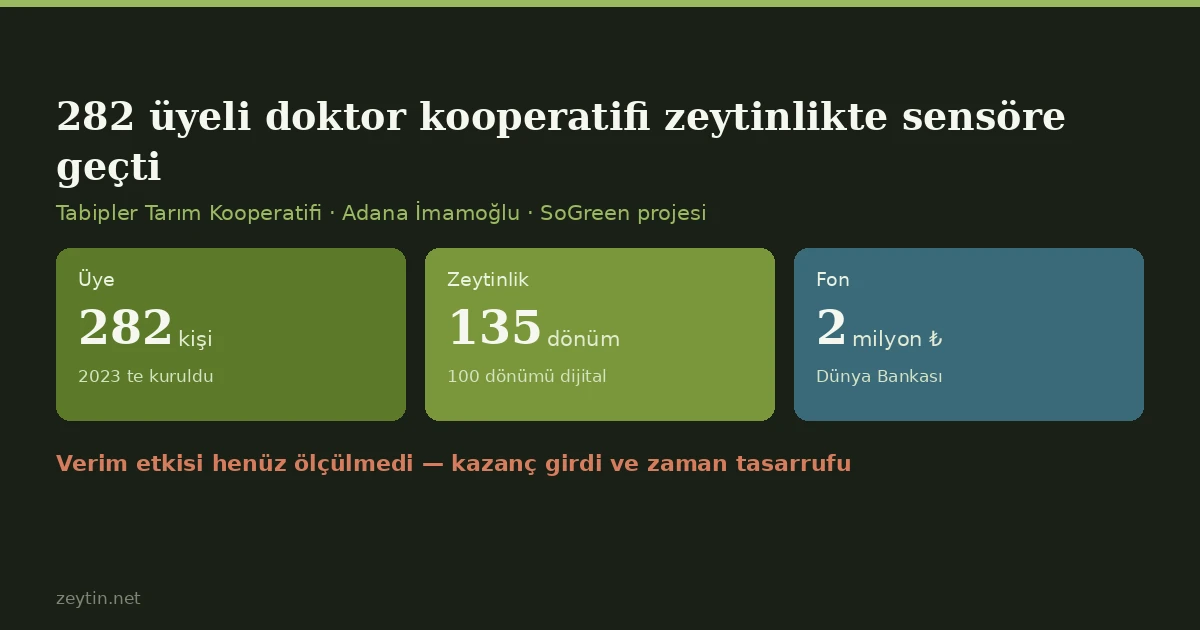
A cooperative founded by doctors in Adana is monitoring water and fertiliser with buried sensors across 100 of its 135 dönüm of bearing olive grove, funded with 2 million lira.
 Article
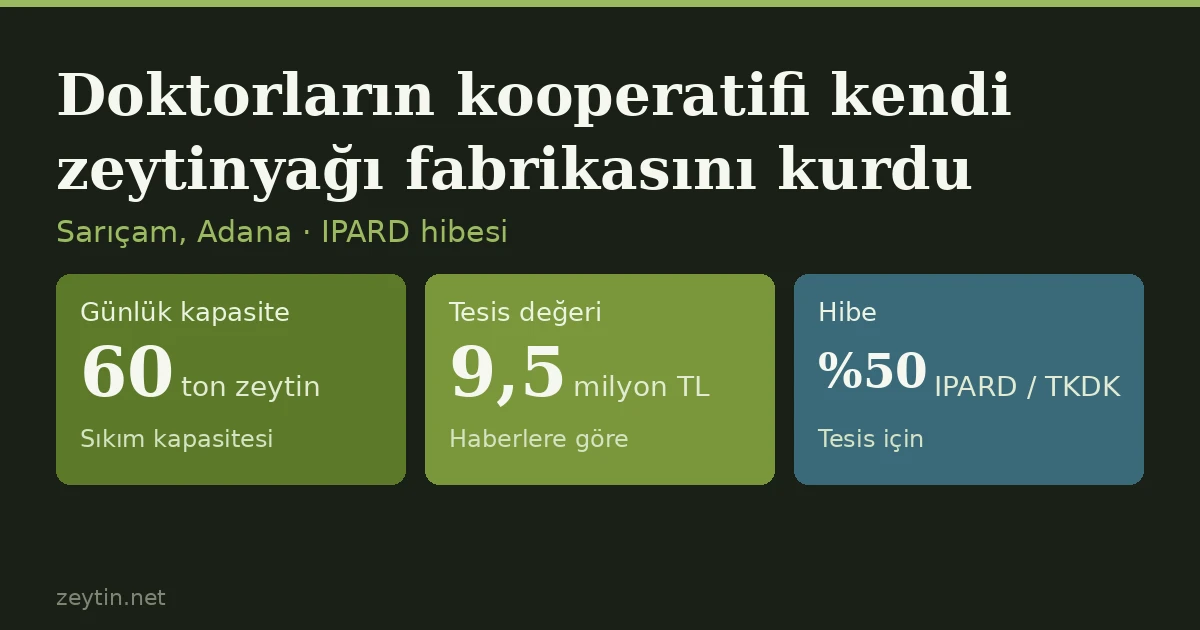
Adana's 282-doctor cooperative opens its own olive oil mill: 60 tonnes a day, 9.5 million lira, 50 per cent grant
Adana's Tabipler Tarım Kooperatifi, a cooperative of 282 doctors, has built an olive oil mill in Sarıçam with a 50 per cent grant from the IPARD programme run by TKDK. The plant is worth 9.5 million lira and can press 60 tonnes a day. Its chair says the mill will also take other farmers' olives.
 Article
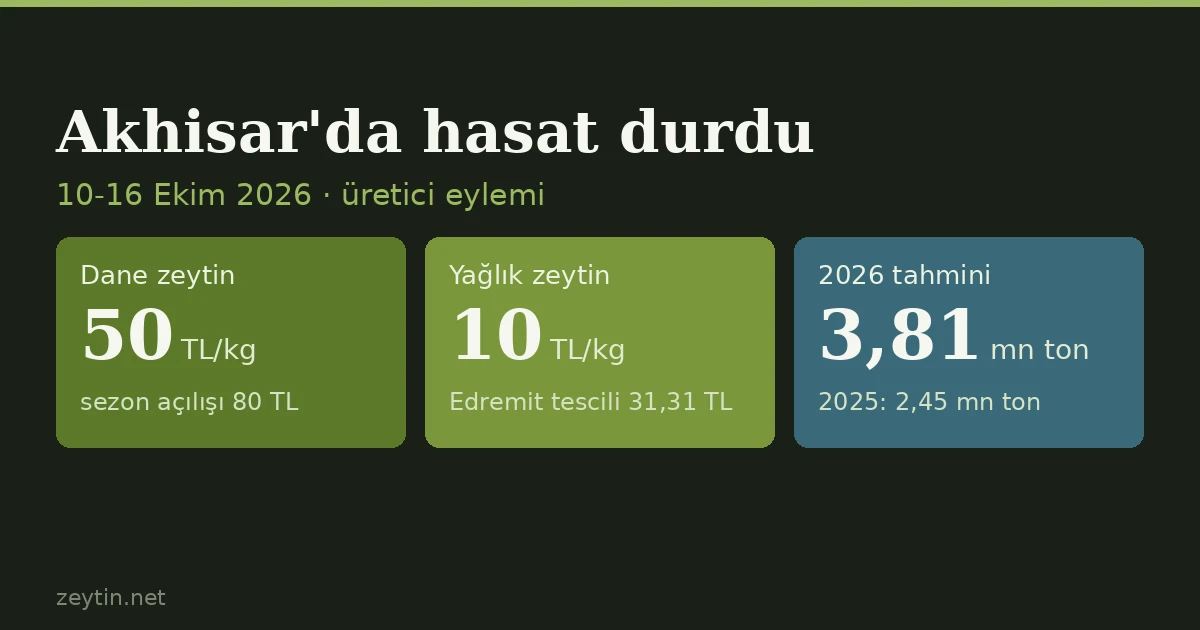
Harvest halted amid a record forecast: 50 lira for table olives in Akhisar, 10 for oil
Growers in Akhisar halted the harvest for a week on 10 October. Table olive prices that opened the season at 80 lira fell to 50, and oil olives to 10 — below last season's table olive floor. In the same days the official first estimate puts production at 3.8 million tonnes.