Gemlik puts the cost of oil olives at 58.14 lira a kilo: harvest is the biggest item
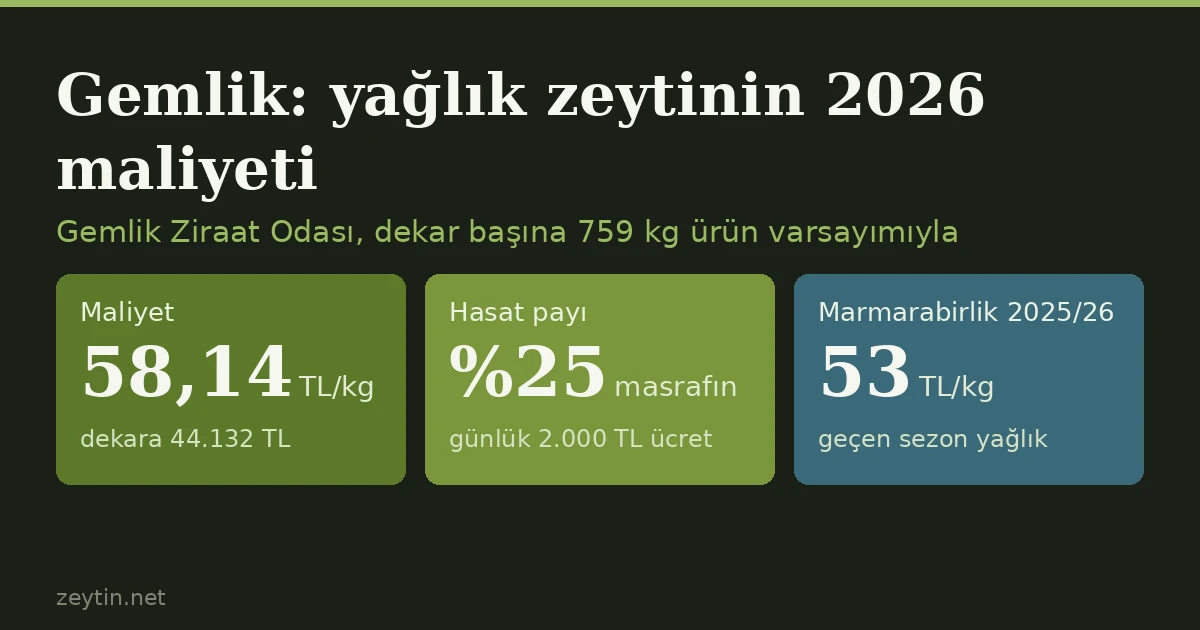
The Gemlik Chamber of Agriculture puts the 2026 cost of a kilo of oil olives at 58.14 lira: 44,132 lira per decare for 759 kg of fruit. The sheet assumes a 2,000-lira daily picking wage, and the 12,532-lira overhead line matches 24% interest, 3% overhead and 4,000 lira depreciation exactly. The widely reported 23-lira gap with Orhangazi rests on a wrong figure.
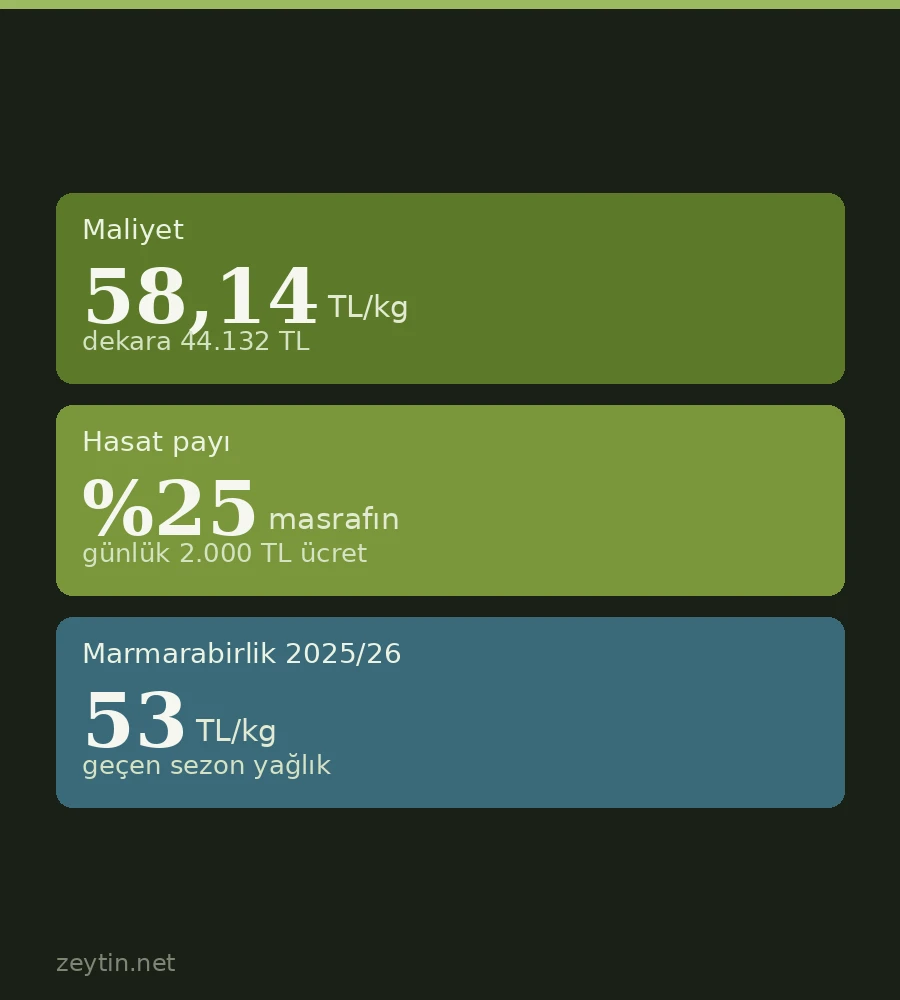
The chamber of agriculture in Gemlik, the olive district on the southern shore of the Sea of Marmara in Bursa province, has published its production cost sheet for the 2026 harvest. According to the figures shared by the chamber's president, agricultural engineer Ercan Barutçuoğlu, it costs 58.14 Turkish lira to produce one kilogram of oil olives this season. The number arrived in a week when Marmarabirlik, the region's olive cooperative union, had still not announced its purchase prices for the new season, and local growers immediately began quoting it as the floor for price talks.
The chamber built its calculation on one decare (a tenth of a hectare, the standard Turkish land unit). It assumes an average of 33 trees per decare and 23 kilograms of fruit per tree, for a total of 759 kilograms of olives. The full production cost per decare comes to 44,132 lira; divided by 759 kilograms, that gives 58.14 lira per kilogram.
The cost items
| Item | TRY/decare | Share | TRY/kg |
|---|---|---|---|
| Harvest (4 workers × 2,000 TRY) | 8,000 | 25.3% | 10.54 |
| Pruning | 6,750 | 21.4% | 8.89 |
| Tillage | 5,500 | 17.4% | 7.25 |
| Pesticides and spraying labour | 4,400 | 13.9% | 5.80 |
| Other (sorting, salting, gathering branches, hauling) | 2,900 | 9.2% | 3.82 |
| Fertiliser | 2,350 | 7.4% | 3.10 |
| Transport | 1,700 | 5.4% | 2.24 |
| Direct costs | 31,600 | 100% | 41.63 |
| Financing, depreciation, overhead | 12,532 | — | 16.51 |
| Total production cost | 44,132 | — | 58.14 |
Items and totals as announced by the chamber; the share and per-kilogram columns are zeytin.net calculations based on 759 kg per decare.
Harvesting is the largest single item. The chamber's sheet assumes four worker-days per decare at a daily wage of 2,000 lira, which works out to 10.54 lira for every kilogram picked. When we compiled the 2026 picking and pruning wage table in mid-October, the picking wages announced by chambers of agriculture ranged from 1,200 to 1,500 lira a day, and no chamber in Bursa had published a figure. The 2,000 lira that Gemlik has now written into its cost sheet sits above that range.
Pruning is the second-largest item at 6,750 lira per decare, more than a fifth of direct costs. Tillage follows at 5,500 lira. Fertiliser, at 2,350 lira, is a comparatively small line, smaller than pest control. In other words, the cost of an oil olive in Gemlik is driven mainly by labour: picking, pruning, spraying and the "other" line of sorting and hauling together account for more than half of the direct costs.
Where does the extra 12,532 lira come from?
The chamber gave the gap between direct costs and the total as a single line, "financing, depreciation and general administrative shares", without breaking it down. But the number fits a formula used in the region exactly: 24 percent of 31,600 lira as interest (7,584 lira), 3 percent as general overhead (948 lira), plus 4,000 lira of depreciation. The sum is precisely 12,532 lira.
The neighbouring Orhangazi Chamber of Agriculture spelled out the same method in its 2024 calculation: it added 24 percent interest, 3 percent overhead and 3,600 lira of depreciation to 26,900 lira of direct costs, arriving at 37,763 lira per decare and 53.41 lira per kilogram. So about 16.5 lira of Gemlik's 58.14 is not money spent in the grove but the cost of capital and equipment. Growers doing their own sums should keep that share separate: for a grower working without debt, the cash cost falls to 41.63 lira per kilogram.
Is the "23,000-lira gap" right?
During the week, several local outlets reported a cost gap of 23.24 lira per kilogram between Gemlik and Orhangazi, two neighbouring districts. That calculation uses 53.14 lira as Gemlik's figure. The chamber's published figure is 58.14 lira. Against the 76.38 lira that the Orhangazi Chamber of Agriculture is reported to have announced for this season, the real gap is 18.24 lira per kilogram, or 18,240 lira per tonne.
That is still a large difference. The two districts sit side by side and grow the same variety; the gap most likely comes from the yield assumption, the wage rate and which items each chamber chose to include. We were unable to obtain Orhangazi's 2026 item-by-item breakdown, so we do not compare the two sheets line by line.
One more note: the heading of the Gemlik sheet refers to "table olives", while the closing sentence gives the result for "oil olives", and the "other" line includes salting. In the region the Gemlik variety goes both to the table and to the mill. The chamber did not say separately which product the figure applies to.
Where are prices?
| Price | TRY/kg | Note |
|---|---|---|
| Marmarabirlik oil olives, 2025/26 | 53.00 | Last season's final price |
| Edremit exchange oil olives, 27 Oct 2026 | 21.12 | Average; low 20.40, high 26.53 |
| Marmarabirlik 2026/27 | — | Not announced as of 30 October |
The 53 lira that Marmarabirlik paid last season for oil olives is 9.7 percent below Gemlik's cost this year. The union plans to buy around 60,000 tonnes this season, but has not yet put a price on it.
Among the commodity exchanges this site tracks, Edremit is the only one where oil olives are registered. There the average price on 27 October was 21.12 lira (Edremit exchange). The dominant variety around the Gulf of Edremit is Ayvalık, and the region is different, so this figure cannot be compared directly with the Gemlik cost. It does show the range in which oil olives are actually changing hands today. In Akhisar, in Manisa province, growers had reported offers of 10 lira for oil olives.
The gap between the two numbers is wide: at the Edremit average, a kilogram of oil olives fetches a little over a third of what Gemlik's chamber says it costs to grow one. Even if the regions are not identical, that order of magnitude explains why growers in several provinces have been talking about leaving fruit on the trees this autumn.
Cost calculations by chambers of agriculture are not binding and do not impose a price on anyone. But since there is no state floor price for table olives, the distance between the price Marmarabirlik eventually announces and this cost will set the frame for bargaining across the region. For an older calculation based on the cost records of 152 farms in the Aegean, see what does a kilo of olives cost to produce.
One rating per visitor; you can change yours at any time. Ratings are real reader votes — no seeded or default scores.
Related
 Article
Olive oil exports down 62% by value as a record harvest is expected
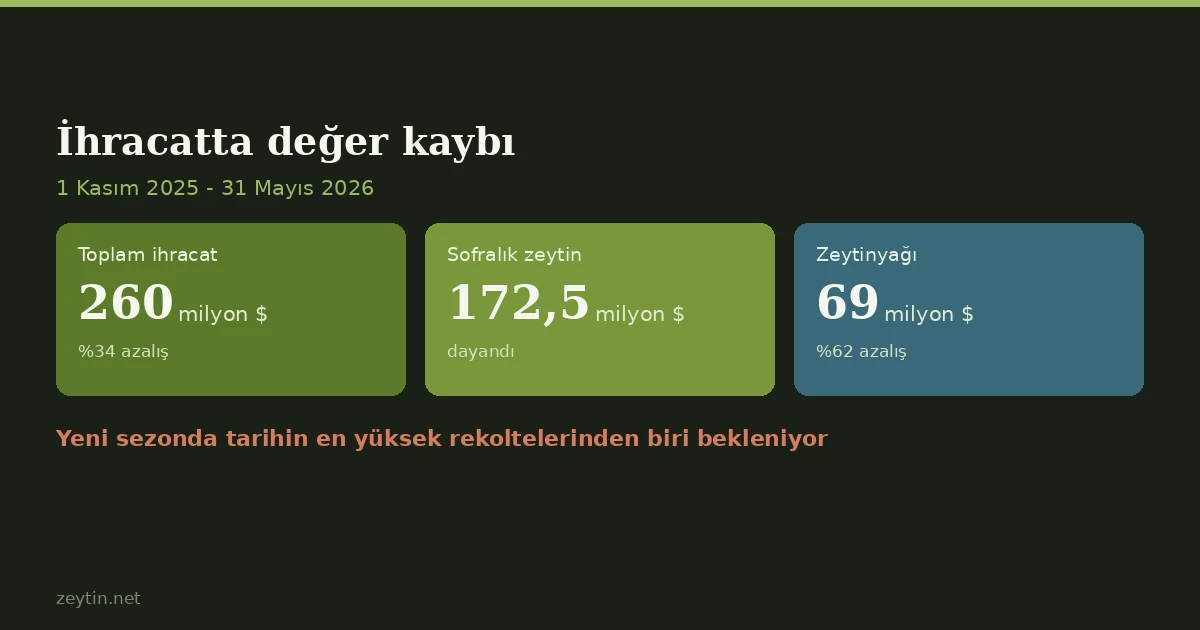
Olive and olive oil exports fell 34% to $260 million between 1 November 2025 and 31 May 2026. Table olives held at $172.5 million while olive oil dropped to $69 million. The target is a return to $1 billion.
 Article
Six jailed for taking produce without paying: the grower's most fragile moment is the start of harvest
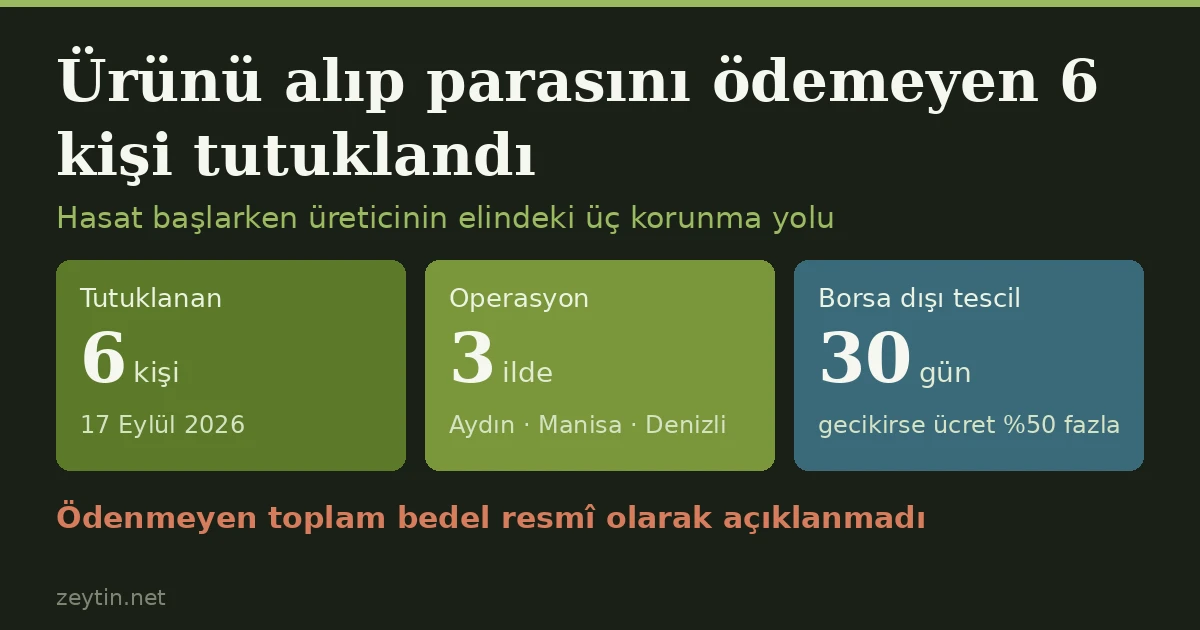
In Bozdoğan, Aydın, six people who bought olive oil, nuts and livestock from growers and failed to pay were caught in a simultaneous operation across three provinces on 15 September and jailed on 17 September. The method is a familiar one: the first purchase is paid in full, and once trust is established the large purchase is not. In the week harvest begins, growers have three concrete protections.
 Article
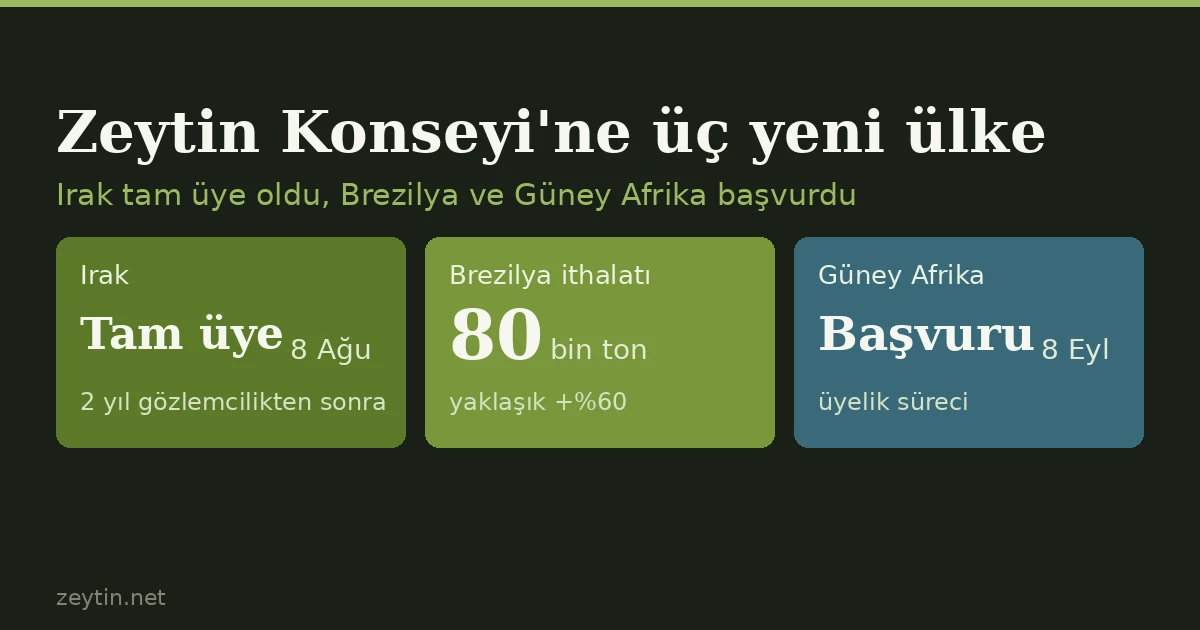
The International Olive Council grows: Iraq joins, Brazil and South Africa apply
The International Olive Council (IOC) saw three developments in a month: Iraq became a full member on 8 August, South Africa submitted its membership request on 8 September and Brazil on 9 September. The expansion reflects olive oil's shift towards production and consumption areas beyond the Mediterranean.
 Article
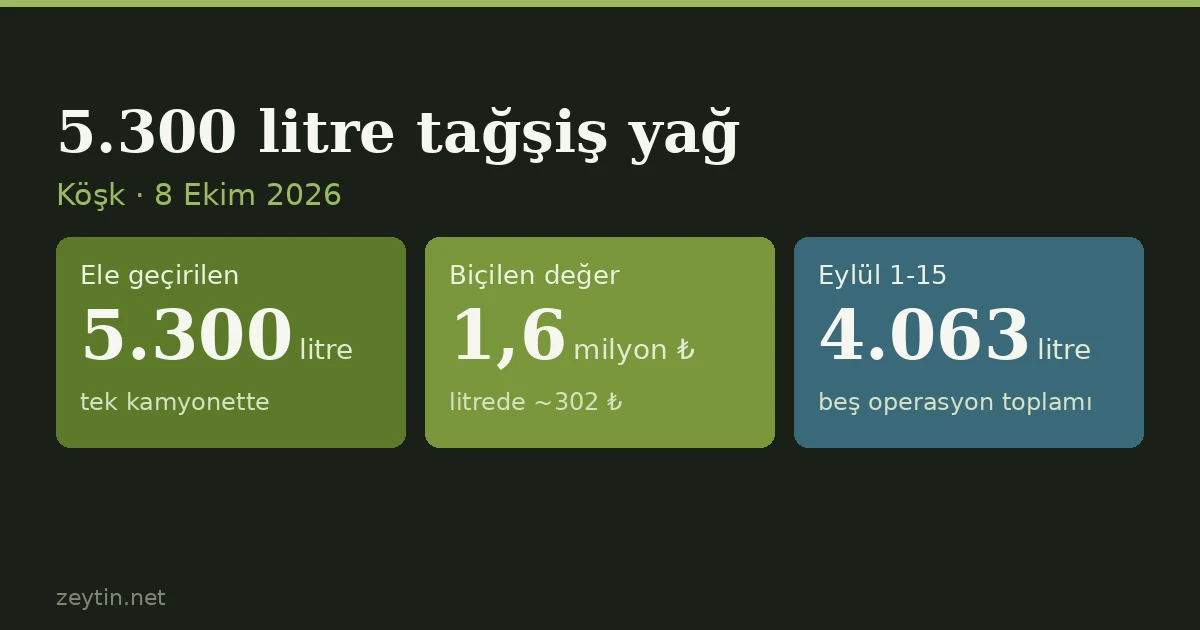
5,300 litres of adulterated oil in one van at Köşk — more than all of September
A van stopped on the Aydın-Denizli highway was found to be carrying 5,300 litres of counterfeit and adulterated olive oil, valued at 1.6 million lira; two people face proceedings. The single shipment exceeds the 4,063 litres seized across five operations in the province in the first half of September.