FDA refuses 6.8 kg of Marmarabirlik-branded olive oil without analysis: the union says "we did not make the shipment"
The FDA's 9 October 2026 refusal record lists Marmarabirlik as producer; the stated reason is pesticides, but no analysis result was shared. The union says a third party sent the 20-package (6.8 kg) shipment from İzmir; the oil was returned.
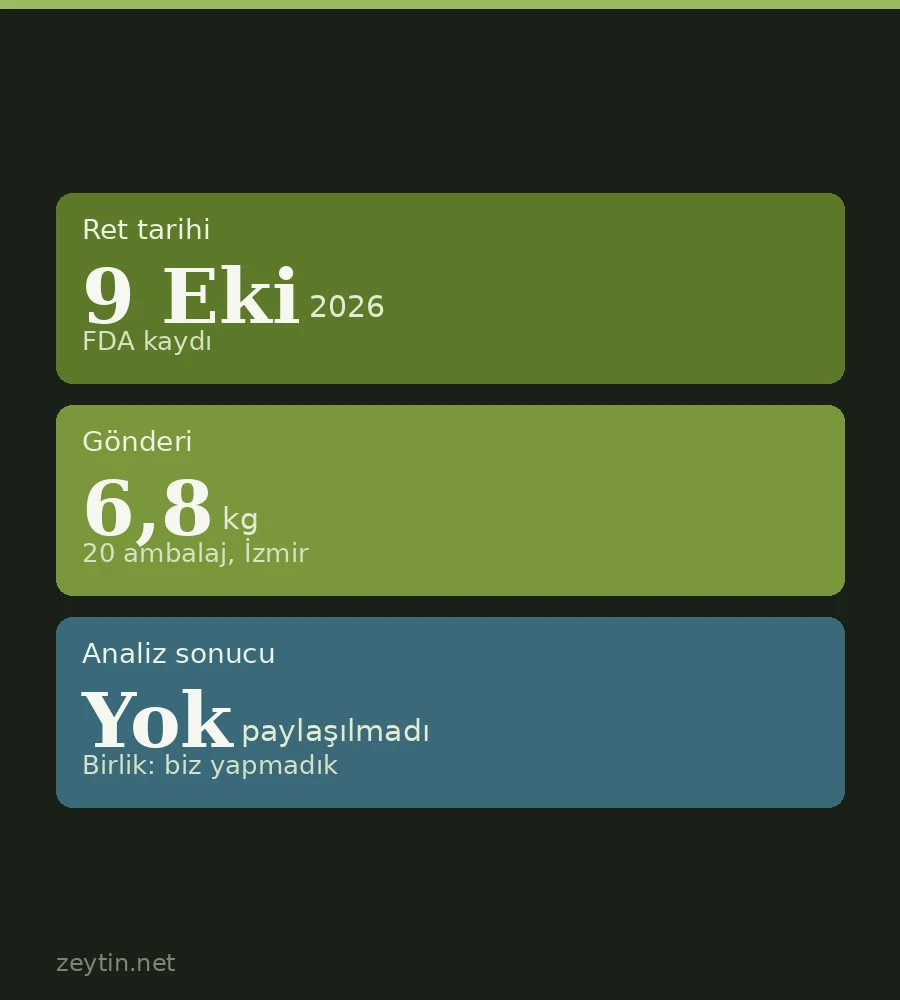
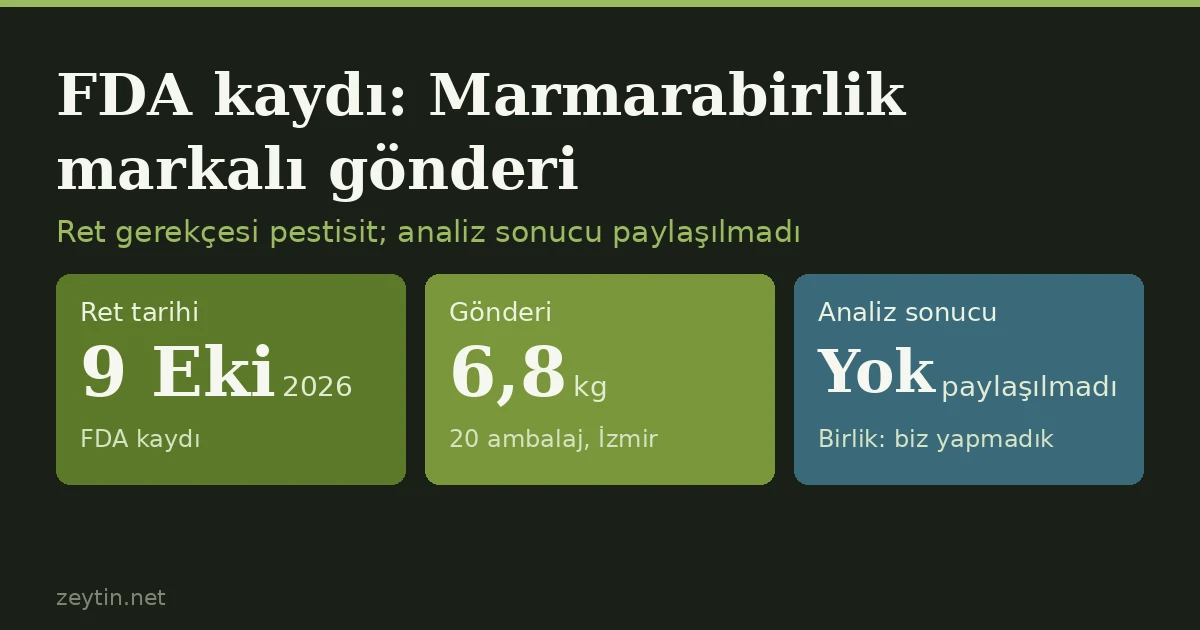
The US Food and Drug Administration (FDA) refused entry to an olive oil consignment that its import refusal records list as made by Marmarabirlik, in a decision dated 9 October 2026, citing pesticides. The record does not share any analysis result for the products. Marmarabirlik says it did not make the shipment: a third party with no connection to the cooperative union sent 20 packages weighing 6.8 kilograms in total, carrying the Marmarabirlik brand, from İzmir to the United States. The news surfaced in the last week of November.
What the record says, and what the union says
| Item | Stated |
|---|---|
| FDA record date | 9 October 2026 |
| Reason for refusal | pesticides |
| Number of packages | 20 |
| Total weight | 6.8 kg |
| Point of origin | İzmir |
| Analysis result shared | none |
In a reply based on its own review of the FDA document, Marmarabirlik said the agency could not reach the sender to request the products' analysis documents, so the oils were refused "without analysis, on suspicion of pesticide presence". In the union's words: "In other words, there is no finding of pesticides in the product either." The refusal, then, rests on missing paperwork rather than on a laboratory finding. The 20 products were returned to the sender in İzmir. The union added that, because it did not make the shipment, it does not even know whether the products are genuine, and that for its own exports pesticide, quality and purity analyses are carried out at accredited laboratories, with exports going ahead only if the results meet FDA rules. No statement from the FDA on the matter could be obtained.
A small consignment
The figures show how small the shipment was. Dividing 6.8 kilograms by 20 packages gives an average of 340 grams per package, which looks more like an individual parcel than a commercial shipment. It was not stated whether the total weight includes packaging, so we do not calculate the amount of oil inside. The fact that the record names the brand as the producer can give the impression that the union itself was exporting, and that is exactly what the union objects to.
Three records from 2022
The FDA's past records also hold three pesticide-based refusal decisions in Marmarabirlik's name, dated 23 November, 6 December and 29 December 2022. Of these three, only the 23 November record is said to show that the FDA sampled and analysed the product and found 2 active pesticide substances. The other two decisions, and the 9 October 2026 decision, carry no analysis result. Only one of the four records contains a measurement. That does not mean the pesticide claim in the other three has been verified, but it does not mean it has been disproved either. That is as far as the available information goes.
Why the FDA can refuse without analysis
In FDA import controls, products can be held without a physical examination. For producers placed on an import alert list because of past violations, the importer can be asked for analysis documents showing compliance with food rules; if compliance cannot be demonstrated, the shipment can be refused without a fresh analysis. Being on such a list is not an absolute export ban. The statements do not say whether Marmarabirlik is on such an alert list; this mechanism describes only the general procedure. In the 9 October record, the failure to reach the sender appears to have meant that no documents could be produced at all.
Is this Turkish olive oil's problem in the United States
Not directly, but the context matters. According to figures from the Turkish Exporters Assembly (TİM), exports of olives and olive oil fell 28.2 per cent to 273.7 million dollars in January-September 2026; sales to the US dropped 45 per cent, which left Germany as the largest market with a 16.5 per cent share. The sector is also dealing with the 12.5 per cent additional tariff that the US applies to Turkish olive products. Against that background, a brand appearing in an FDA record can turn into a reputational debate in the market even when the consignment is tiny and belongs to someone else. For the wider picture on this subject, see pesticide residues in olive oil.
How to read a record like this
An import refusal record can blur three separate things: whether the product really contains pesticides, whether the paperwork is missing, and whose brand it is. In this case the information released shows only the second: the sender could not be reached, documents could not be requested, and the goods were returned. For the first there is no measurement; for the third there is no evidence beyond the union's own statement, because nobody has confirmed whether the products are genuine. So the sentence "pesticides were found in Marmarabirlik oil" is not supported by the record, while "a parcel sent under the Marmarabirlik name was turned back for lack of documents" is. The goods were not destroyed; they were handed back to the sender.
What remains open
Who made the shipment and why, whether the product was really made by Marmarabirlik, and whether the FDA will correct or amend the record are all unclear. If the FDA responds, this report will be updated with that information.
One rating per visitor; you can change yours at any time. Ratings are real reader votes — no seeded or default scores.
Related
 Article
The crop is heading for 500,000 tonnes, exports fell to 17,000: the sector wants a premium and an exchange-rate mechanism
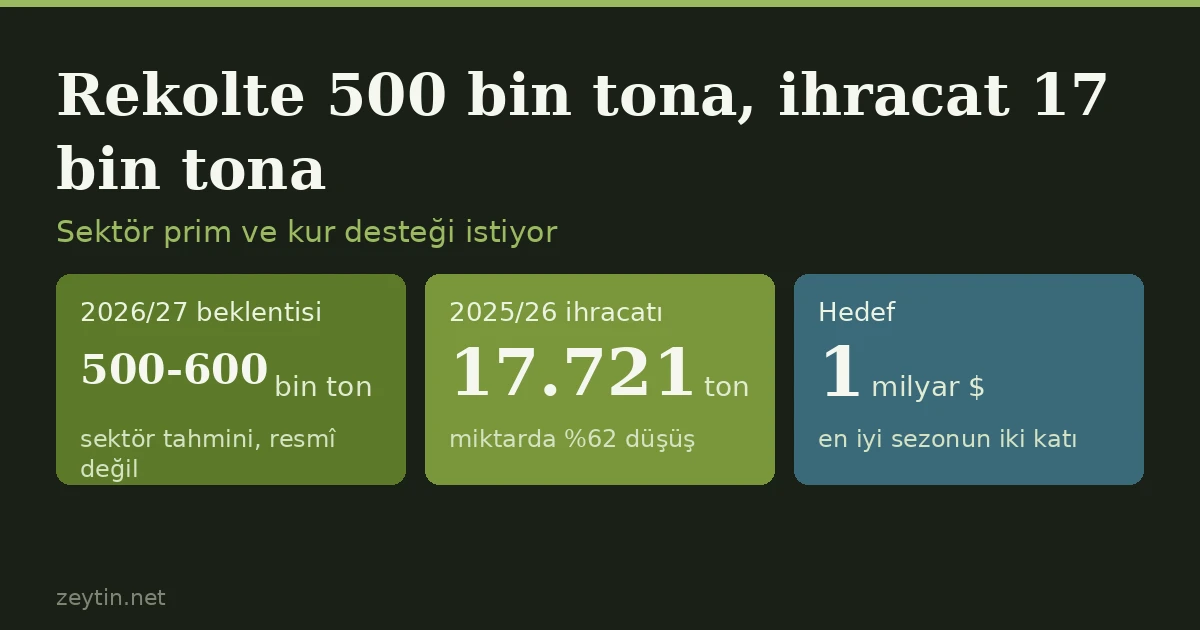
Industrialists and exporters meeting in Izmir put this season's olive oil crop at 500,000-600,000 tonnes. Last season Türkiye shipped 17,721 tonnes of olive oil: down 62% in volume and 59% in value. The crop is not the problem; selling the crop is.
 Article
Table olive tasting panel training in Aydın
Aydın Commodity Exchange is extending its sensory analysis experience from olive oil to table olives, with 20 panellists trained over three days.
 Article
Kahramanmaraş opens Doğukent olive oil plant with 90-tonne daily capacity, half of it grant-funded
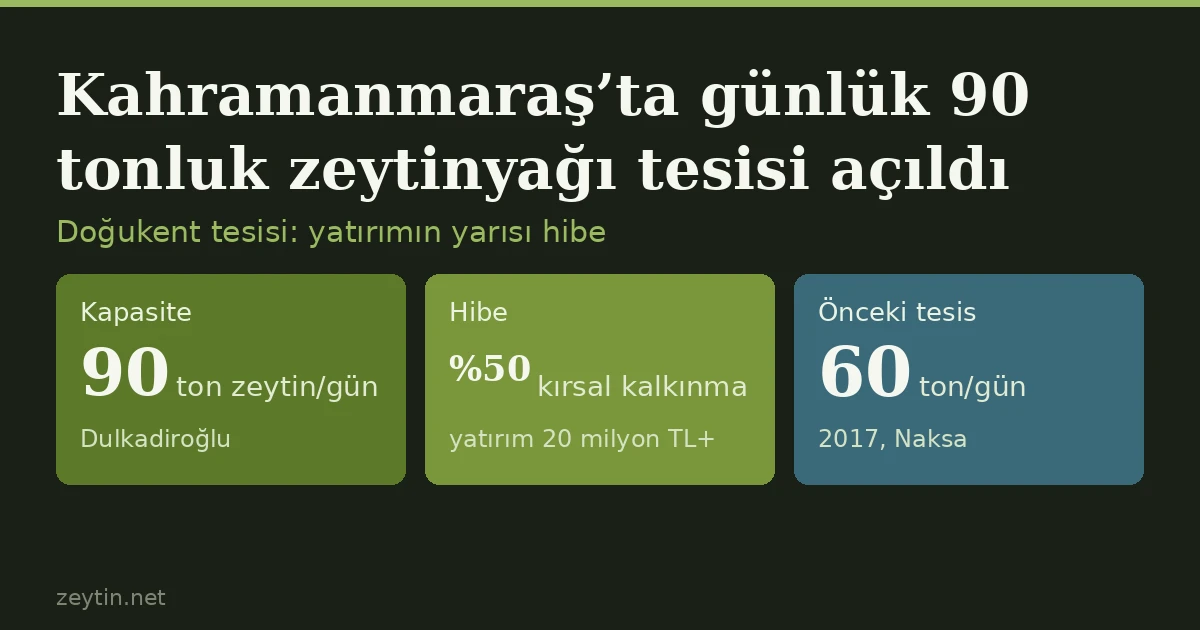
The Doğukent Olive Oil Production Facility, able to process 90 tonnes of olives a day, has opened in Dulkadiroğlu, Kahramanmaraş. The investment exceeds 20 million TL, about half covered by a rural development grant. Set against the province's recorded 2025-2026 output, the capacity shows its scale; the tree count given in the speech does not match the recorded series.
 Article
Table olives with half the salt: potassium, calcium and magnesium instead of sodium
Researchers at Spain's Instituto de la Grasa (CSIC) cut sodium in pimento-stuffed green Manzanilla olives from 14,216 mg to about 7,100 mg per kilogram. Potassium, calcium and magnesium salts added to the packing brine made the olives a source of these minerals.