Concordat in Akhisar: a one-year moratorium for Baktat Zeytin
A Turkish commercial court has granted a one-year definitive moratorium to Baktat Zeytin, a table-olive processor in Akhisar. We set out what the ruling means and why it matters for the sector.
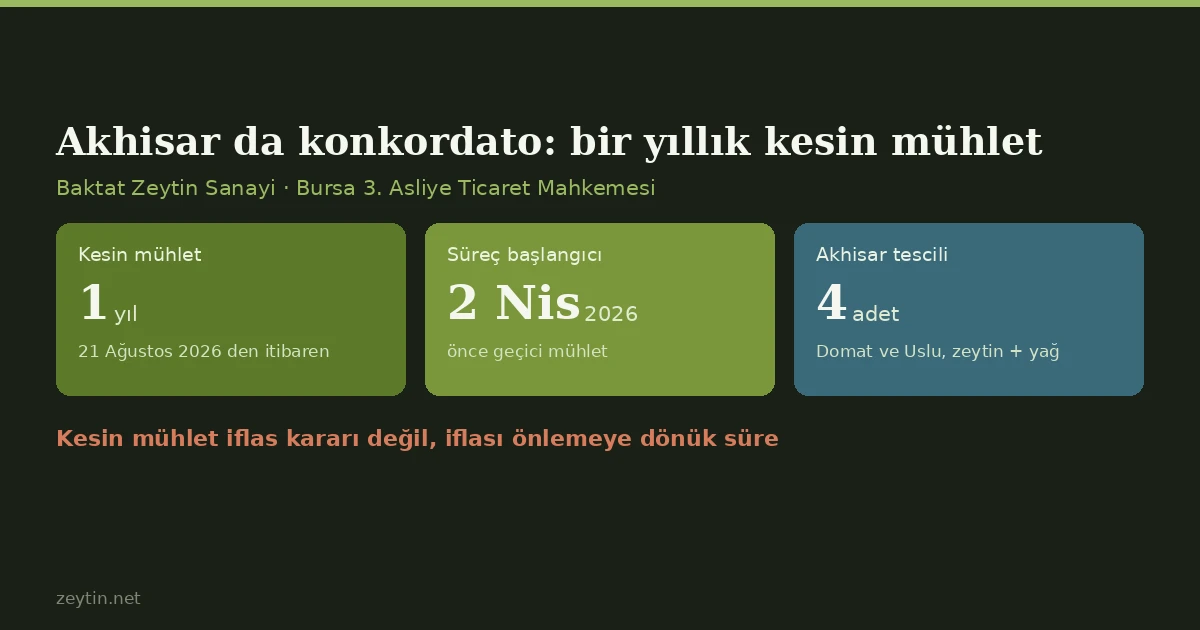
Bursa's 3rd Commercial Court of First Instance has granted a one-year definitive moratorium (kesin mühlet) to Baktat Zeytin Sanayi Ticaret A.Ş., a table-olive processor in Akhisar, Manisa. The ruling was announced on 25 August 2026 and takes effect from 21 August 2026.
This does not mean the company has closed. Below is what it does mean, and why it is worth following for the olive sector.
The timeline
| Date | Stage |
|---|---|
| 2 April 2026 | Concordat proceedings opened; the court granted a three-month provisional moratorium |
| 1 July 2026 | Provisional moratorium extended by two months; review set for 21 August |
| 21 August 2026 | Definitive moratorium takes effect (one year) |
| 25 August 2026 | Ruling announced |
The court ended the appointments of the provisional commissioners and named three people to oversee the process: the lawyer Hakan Yıldız and the certified accountants Engin Dinçeli and Birol Aslan. Their monthly fees are to be met from the company's assets. Measures imposed during the provisional period continue to apply.
What a definitive moratorium means
Concordat is a legal route allowing a company that cannot meet its debts to restructure them without going bankrupt. It has two stages:
- Provisional moratorium: short-term protection while the court examines the situation.
- Definitive moratorium: longer protection granted if the court decides the process should continue. Enforcement proceedings against the company are suspended while it keeps trading and works on restructuring.
A definitive moratorium is therefore not a bankruptcy ruling but time granted in order to avoid one. If creditors accept the concordat plan and the court ratifies it, the company continues; if not, bankruptcy may follow.
Why Akhisar
Akhisar is one of the centres of Turkey's table-olive industry. The district holds four separate geographical indication registrations: Akhisar Domat table olive, Akhisar Domat olive oil, Akhisar Uslu table olive and Akhisar Uslu olive oil.
That concentration also means the processing capacity in the district is where growers sell. In table olives the link between grower and consumer is usually a processing and packing plant of exactly this kind; we examined those links one by one in from tree to shelf.
Why it matters for the sector
Table olives are more labour-intensive than oil and involve more processing stages: brining, sizing, sorting, packing. Those stages require capital and stock-holding — the harvest happens in one season while sales are spread across the year.
That structure squeezes processors from both sides: raw material to be paid for at harvest, receivables collected over the following months. We looked at this cost structure in informality in the table olive sector and what does a kilo of olives cost to produce.
For that reason one company's concordat is not only that company's affair: who growers in the district can sell to, when they are paid, and how competition is shaped all follow from it.
What comes next
The definitive moratorium runs for a year. During it the commissioners monitor the company's finances, a concordat plan is drawn up and put to creditors. The process may be extended or end early.
Concordat rulings are published in the Turkish Trade Registry Gazette, where anyone following the case can verify them.
One rating per visitor; you can change yours at any time. Ratings are real reader votes — no seeded or default scores.
Related
 Article
Table olive tasting panel training in Aydın
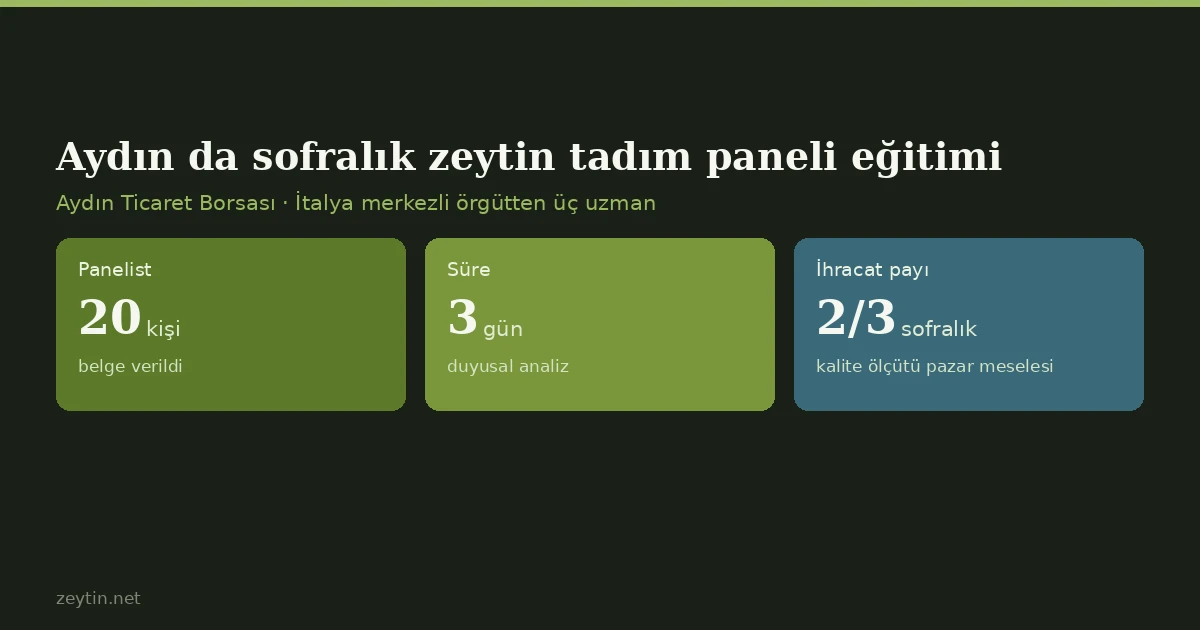
Aydın Commodity Exchange is extending its sensory analysis experience from olive oil to table olives, with 20 panellists trained over three days.
Article
Table olive tasting panel training in Aydın
Aydın Commodity Exchange is extending its sensory analysis experience from olive oil to table olives, with 20 panellists trained over three days.
 Article
Tunisia sold 381,000 tonnes of olive oil in ten months: 85.5% in bulk, half of it to Spain and Italy
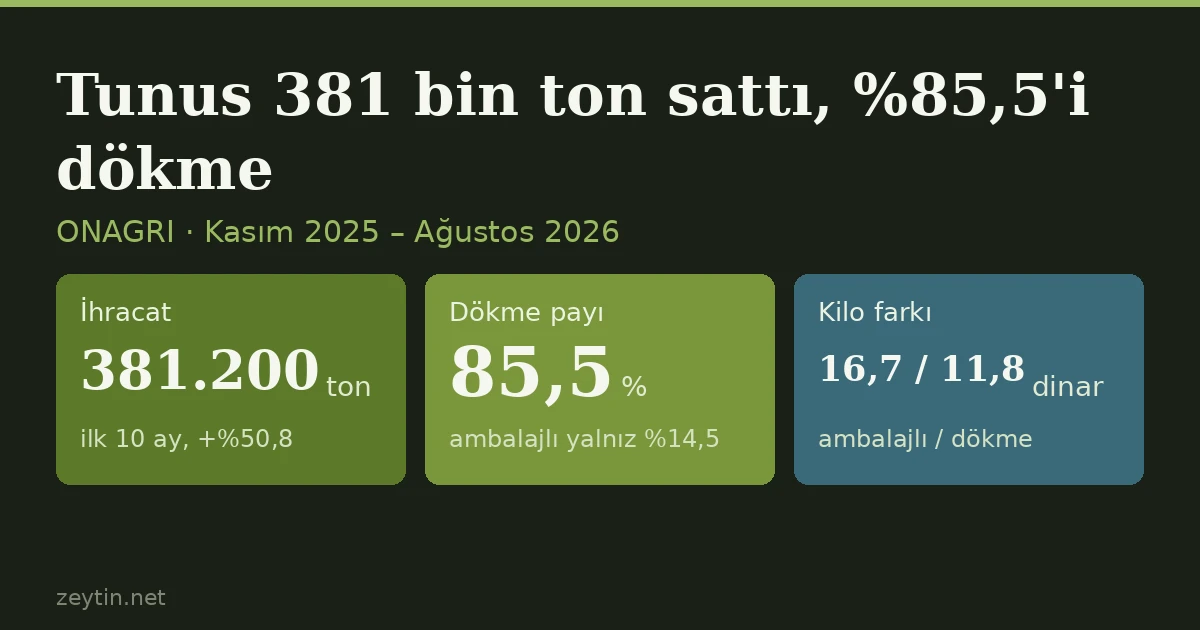
According to the National Observatory of Agriculture (ONAGRI), Tunisia exported 381,200 tonnes of olive oil in the first ten months of the 2025/26 season — volumes up 50.8% and receipts up 41.2% year on year. But 85.5% of it left the country in bulk, and more than half went to Spain and Italy. Packaged oil averaged 16.7 dinars per kilo against 11.8 for bulk. Production is set to fall 40% next season, which changes the bulk market Turkish exporters face.
Article
Tunisia sold 381,000 tonnes of olive oil in ten months: 85.5% in bulk, half of it to Spain and Italy
According to the National Observatory of Agriculture (ONAGRI), Tunisia exported 381,200 tonnes of olive oil in the first ten months of the 2025/26 season — volumes up 50.8% and receipts up 41.2% year on year. But 85.5% of it left the country in bulk, and more than half went to Spain and Italy. Packaged oil averaged 16.7 dinars per kilo against 11.8 for bulk. Production is set to fall 40% next season, which changes the bulk market Turkish exporters face.
 Article
Greece opens the season at €4: no scarcity in the Mediterranean, but pressure on price
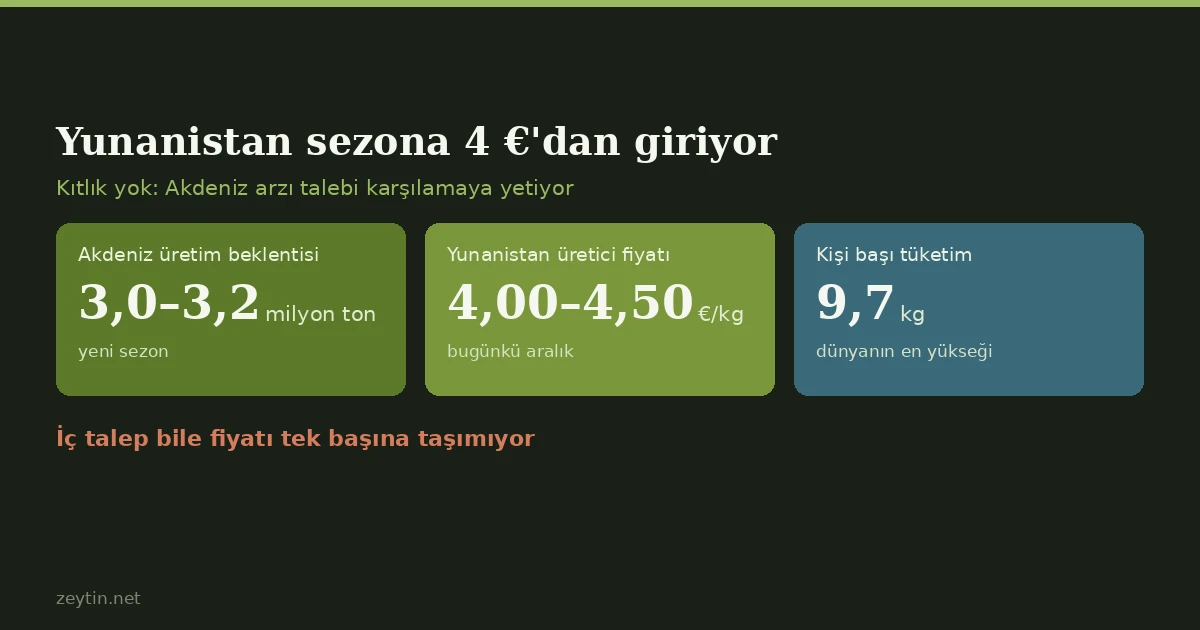
Manolis Giannoulis, president of the National Interprofessional Olive Oil Organization, expects the season to open at around €4 per kilogram. Mediterranean output is forecast at 3–3.2 million tonnes: no record, but enough to meet demand. The market is quiet, buyers are few, and costs plus North African imports keep the pressure on.
Article
Greece opens the season at €4: no scarcity in the Mediterranean, but pressure on price
Manolis Giannoulis, president of the National Interprofessional Olive Oil Organization, expects the season to open at around €4 per kilogram. Mediterranean output is forecast at 3–3.2 million tonnes: no record, but enough to meet demand. The market is quiet, buyers are few, and costs plus North African imports keep the pressure on.
 Article
Italy is back at 325,000 tonnes yet is handing cash to its mills: a 40-million-euro zero-interest loan
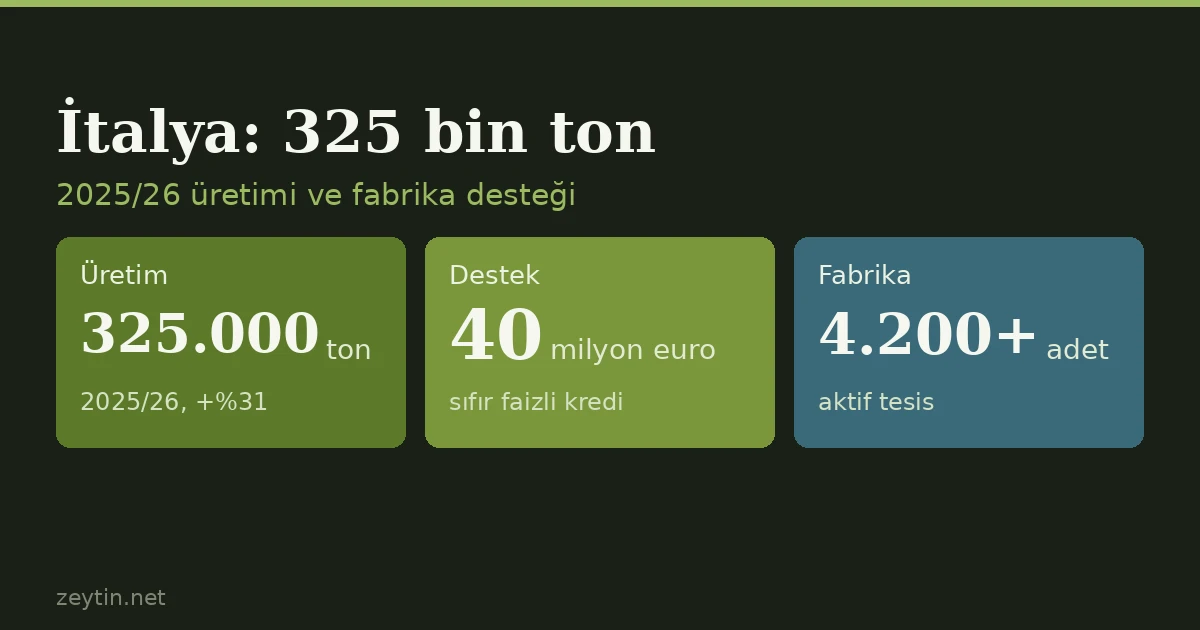
Italy produced 325,000 tonnes of olive oil in the 2025/26 campaign, up 31%, according to Ismea's sector report. Yet even as output recovers, the state is pumping liquidity into mills: the 40-million-euro "Cambiale Frantoi Oleari" offers zero-interest loans of 3,500 to 50,000 euros. The five-year national olive plan aims to lift production by 25%.
Article
Italy is back at 325,000 tonnes yet is handing cash to its mills: a 40-million-euro zero-interest loan
Italy produced 325,000 tonnes of olive oil in the 2025/26 campaign, up 31%, according to Ismea's sector report. Yet even as output recovers, the state is pumping liquidity into mills: the 40-million-euro "Cambiale Frantoi Oleari" offers zero-interest loans of 3,500 to 50,000 euros. The five-year national olive plan aims to lift production by 25%.