What happens when snow falls on an olive tree? Broken branches, frost and what to do
Snow is usually less dangerous to olives than cold itself; the damage comes from wet snow breaking branches and the frost that follows. Wet snow weighs 7.5 times as much as dry snow, and unpruned trees break more. Shaking, pruning time, copper and insurance.
Short answer: for an olive tree, snow is usually less dangerous than the cold itself. The real damage comes in two ways: heavy snow breaking branches, and the hard frost that follows a snowfall and freezes the snow sitting on the tree. A blanket of snow on the ground, by contrast, protects the soil and the lower part of the tree from cold to some extent. What you should do depends on the type of snow, the temperature and how well the tree has been pruned.
Why does an olive tree hold so much snow?
The olive is an evergreen; it keeps its leaves through winter. On a bare deciduous fruit tree, snow falls through the branches. On an olive it settles on the foliage and builds up. During Storm Filomena in Spain in January 2021, David Marcos of a Spanish olive nursery summed this up: the olive's broad leaves cannot shed snow, and although the tree is relatively flexible, heavy snow can break its branches.
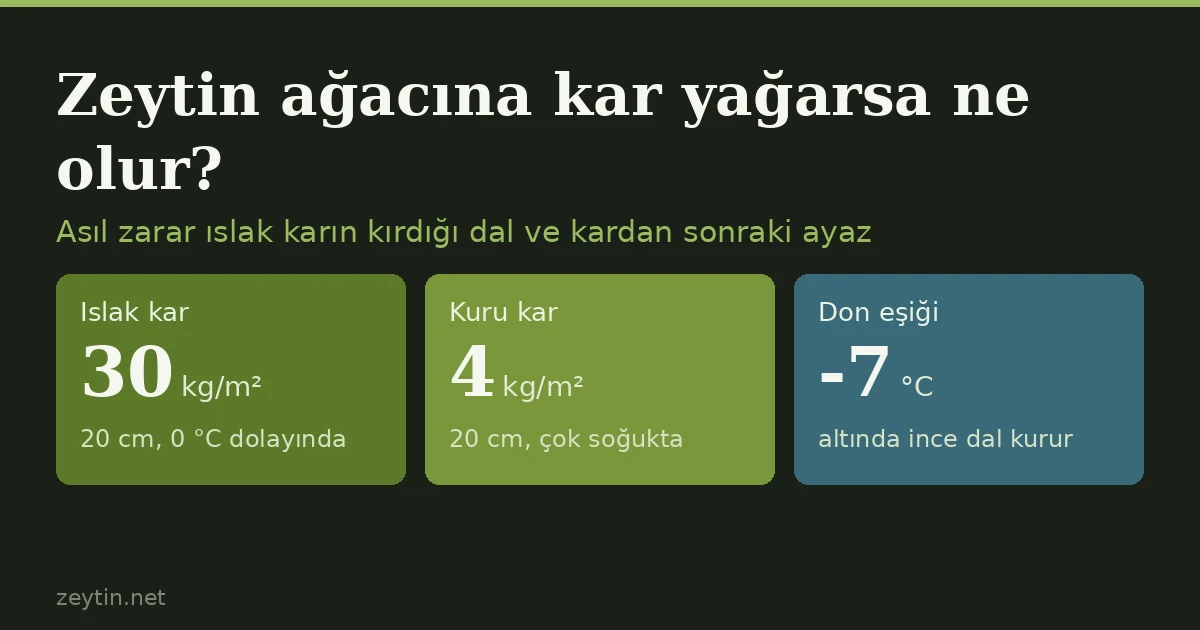
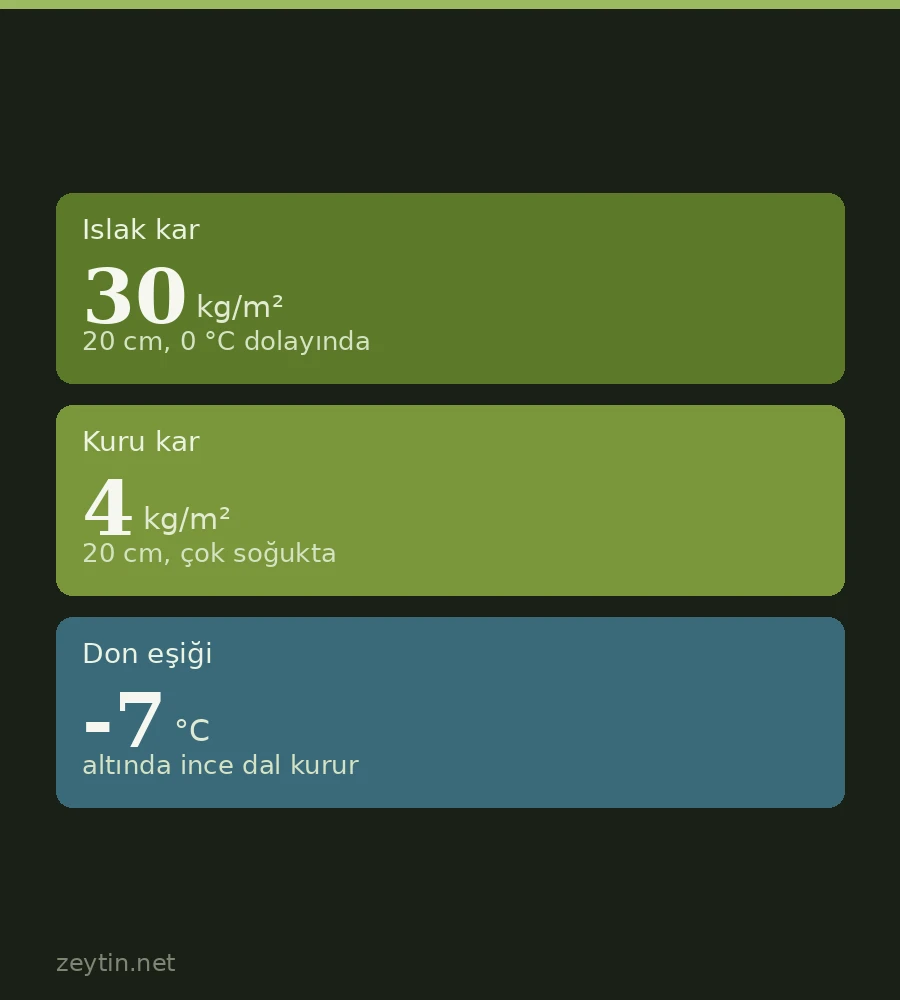
How heavy snow is depends very much on its type. The meteorological service of the National Observatory of Athens gives the following loads for a 20-centimetre layer of snow:
| Type of snow | Load |
|---|---|
| Dry snow falling in very cold weather | 4 kg/m² |
| Snow falling just below freezing | 12 kg/m² |
| Wet snow falling at around 0 °C | 30 kg/m² |
In other words, wet snow of the same depth weighs about seven and a half times as much as dry snow. The observatory attributed the large number of trees that fell in Athens during Storm Medea in February 2021 to snow that fell in relatively mild weather and carried a lot of water. The lesson for olive growers is clear: sticky snow falling at around zero degrees is the kind that breaks branches.
Which branches break?
According to a 2015 study by Meltem Ayaz and Nurhan Varol of the Olive Research Station in Bornova, İzmir, heavy snow most often breaks:
- branches joined to the trunk at a narrow angle,
- rotten or previously damaged branches,
- branches overloaded with fruit.
The same study notes that damage is greater on poorly pruned trees. A January 2015 warning by the Manisa Provincial Directorate of Agriculture confirms this from the field: after heavy snow at the end of December 2014, broken branches were seen mostly in groves that had not been pruned properly, while correctly pruned groves suffered far less breakage. Pruning that balances light and air in the canopy and leaves branches at wide angles is also the best preparation for snow.
The condition of the tree matters as well. According to the same study, a tree without fruit suffers less than one carrying a crop, a tree with thick, mature bark less than one with thin bark, and a lightly pruned tree less than a heavily pruned one. In a grove where harvest is not finished, snow loads the branch with both the weight of the fruit and its own.
Does snow protect the tree?
Under certain conditions, yes. Paul Vossen, olive advisor with the University of California Cooperative Extension, writes that snow cover can protect trees. Ayaz and Varol also note that cold has less effect where the ground is covered with snow. Fresh, uncompacted snow traps a great deal of air, which makes it a good insulator and limits how deep the soil freezes.
The Manisa directorate's warning also marks the limit of that protection. As long as day and night temperatures stay below zero, snow on the tree can create a protective environment around leaves, buds and shoots. There are two exceptions. The first is snow heavy enough to break branches. The second is south-facing slopes, where snow melts in the daytime and refreezes at night, causing frost damage. Marcos made the same observation during Filomena: snow on its own softens the cold; the problem begins when temperatures fall after the snowfall and the snow freezes on the tree.
This is why the temperature on the nights after a snowfall matters more than the snow itself. According to a 2016 review by Nurengin Mete and colleagues at the Olive Research Institute, leaf loss and dieback of thin twigs appear below -7 °C, and the whole plant can die at -12 °C. The thresholds are explained in detail in our article on olive temperature thresholds.
What should you do during and right after a snowfall?
1. Shake off heavy snow. Both the Manisa directorate and Ayaz and Varol recommend shaking snow off the branches as an important cultural measure where snowfall is heavy; the same advice applies on south-facing slopes to prevent thawing and refreezing. Do not push branches downwards while doing so. Iowa State University Extension's advice for evergreens is to push snow off with a soft broom from below, sweeping upwards, or to shake the branch gently; pressing down on an already bent branch can snap it.
2. If there is ice, leave it alone. According to the same source, hitting an ice-covered branch with a stick makes the damage worse; the ice should be left to melt on its own.
3. Record broken branches, but do not rush to prune. A broken branch should be removed with a clean cut, but timing matters. The Manisa directorate advises leaving pruning until the risk of frost has passed, and at the earliest until sap is flowing again. After Filomena, IMIDRA, the agricultural research institute of the Madrid region, likewise advised waiting until the tree sprouts to see the extent of the damage, and pruning late. Removing hanging, split or dangerous branches early is a separate matter.
4. Seal the wounds and protect them with copper. A snow break is an open wound. Turkey's Ministry of Agriculture and Forestry, in its Integrated Pest Management Technical Instructions for olives, states that the olive knot bacterium enters through wounds and that the size of the galls is related to the size of the wound. One of the sprays it recommends in groves where the disease is present is a copper spray applied "immediately after frost and hail damage". In Spain, the plant health service of the Government of Aragón advised after Filomena that broken branches be removed with clean cuts, that large cuts be sealed with pruning paste, and that groves be sprayed with an authorised copper product once the clean-up was done.
5. Leave the soil alone. The Manisa directorate recommends avoiding tillage through the winter, or keeping it very shallow. Trees should be checked for bark cracks and the first signs of olive knot.
If there is frost damage as well, the order of work is set out step by step in our article on frost damage in olive trees.
What has happened in Turkey and around the Mediterranean?
Snow damage is not a remote risk for Turkey's olive regions. According to a 2004 study by Nusret Koca, heavy snow in Çanakkale in January of that year broke olive branches, and production fell in the following years. In Manisa, more snow than average fell in the winter of 2014-2015 and branches broke in unpruned groves. In January 2022, teams from the Mudanya District Directorate of Agriculture and Forestry in Bursa carried out field inspections in five neighbourhoods for broken branches and frost damage after days of snow.
In Spain, Storm Filomena on 8-9 January 2021 was the biggest snowstorm the country had seen since 1971. According to IMIDRA, snow reached 60 centimetres in Madrid, and in the cold wave that followed the temperature fell to -21 °C. Branches broke and the unharvested crop was damaged. In Catalonia, the young farmers' union JARC said that around 46,000 hectares of olive groves had been affected and that recovery would take two to three years.
Young trees and saplings
Young trees and newly planted saplings are more vulnerable: thin bark and a weak framework cope poorly with both snow load and hard frost. Iowa State University Extension's advice for evergreens is to tie the branches together loosely with a soft strip of fabric or flexible cord before snow and to untie them in spring. Although this advice was not written specifically for olives, it can be applied to a small sapling. Details on planting are in our article on how to plant an olive sapling.
Does insurance cover snow damage?
TARSİM, Turkey's state-supported agricultural insurance pool, defines "snow weight" in its 2026 General Conditions for crop insurance as damage caused by the weight of snow accumulating on trees, or by snow sliding or falling off them. This cover applies to the tree itself and only for total loss, meaning the complete loss of three years of the tree's yield; where the timing allows, the crop must be insured before the tree. The basic package for the crop covers risks such as hail, storm, fire and flood; snow weight is not part of crop cover. Separate additional cover can be bought for frost damage to the crop. More details are in our article on crop insurance for olives.
Related reading: Cold-hardy olive varieties · Olive knot disease
One rating per visitor; you can change yours at any time. Ratings are real reader votes — no seeded or default scores.
Related
 Article
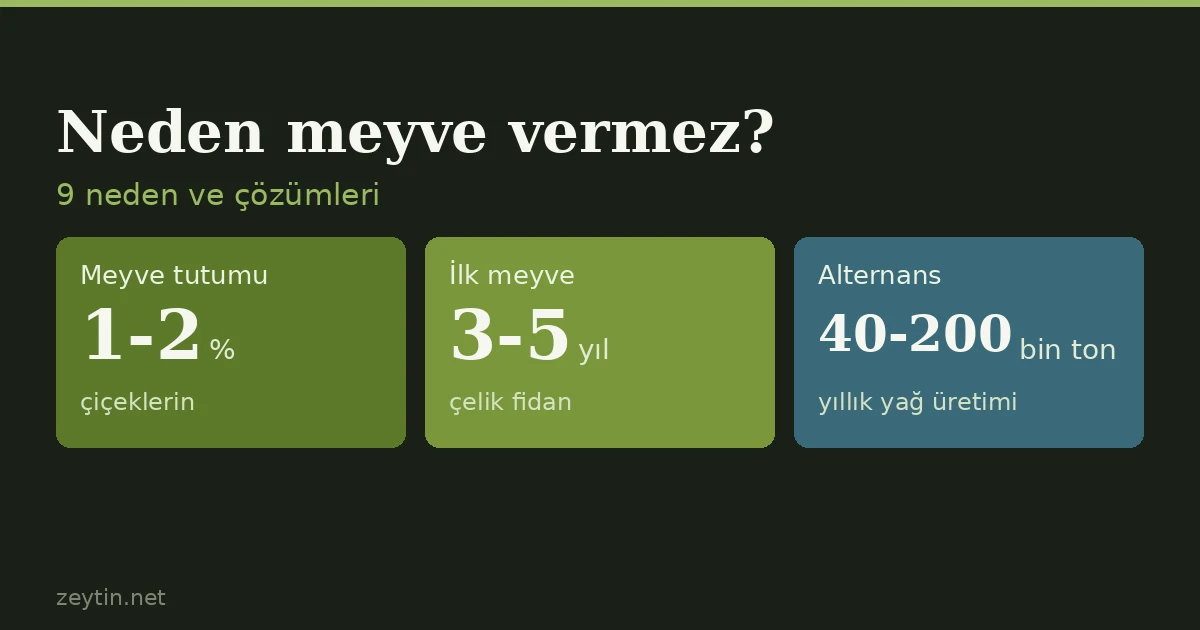
Why is my olive tree not bearing fruit? 9 causes and what to do
Behind an olive tree that flowers but sets no fruit, fills one year and stays empty the next, or has never cropped at all, there is usually more than one cause. From the tree's age and lack of grafting to missing pollinators, insufficient chilling, drought and the wrong fertiliser or pruning, here is how to diagnose by symptom and what to do.
 Article
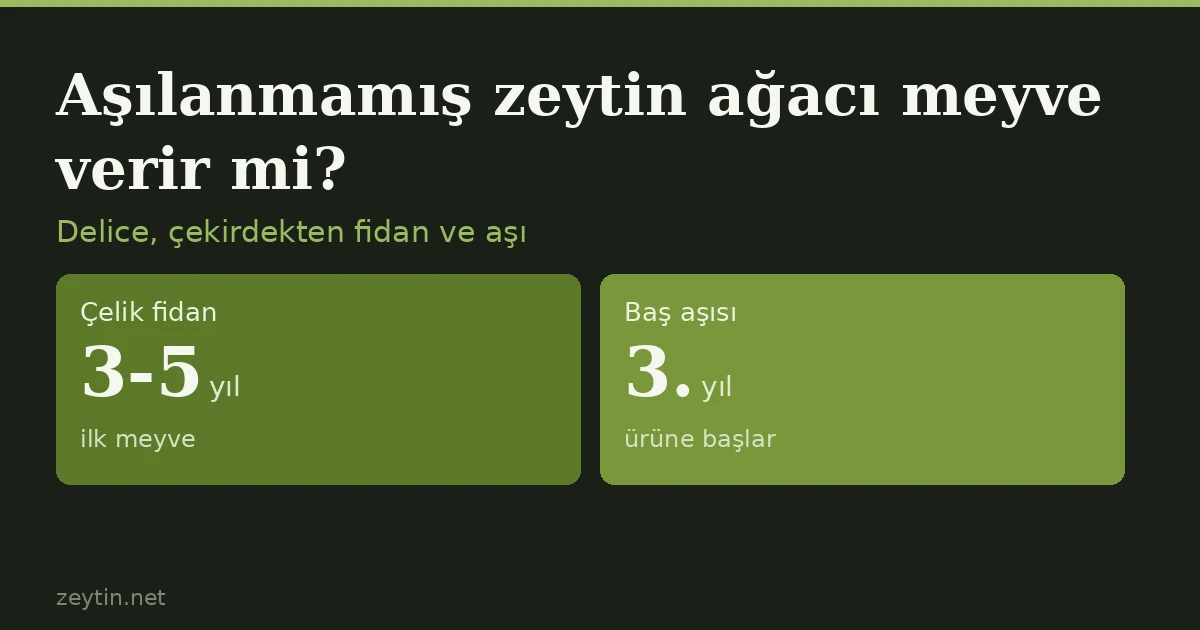
Does an ungrafted olive tree bear fruit? Wild olives, seedlings and grafting
An ungrafted olive tree does bear fruit, but usually small, thin-fleshed and low in oil. Neither the wild trees known in Turkey as delice nor seedlings grown from a stone carry the variety of the parent tree. How to tell, what grafting gains, and why wild olives are still valuable.
 Article
Where does an olive sapling come from? From cutting to laboratory
Most table olive varieties will not root, and those that do are clones of one another — defenceless against disease. Tissue culture reports up to 85% success in vitro, but zeatin is expensive.
 Article
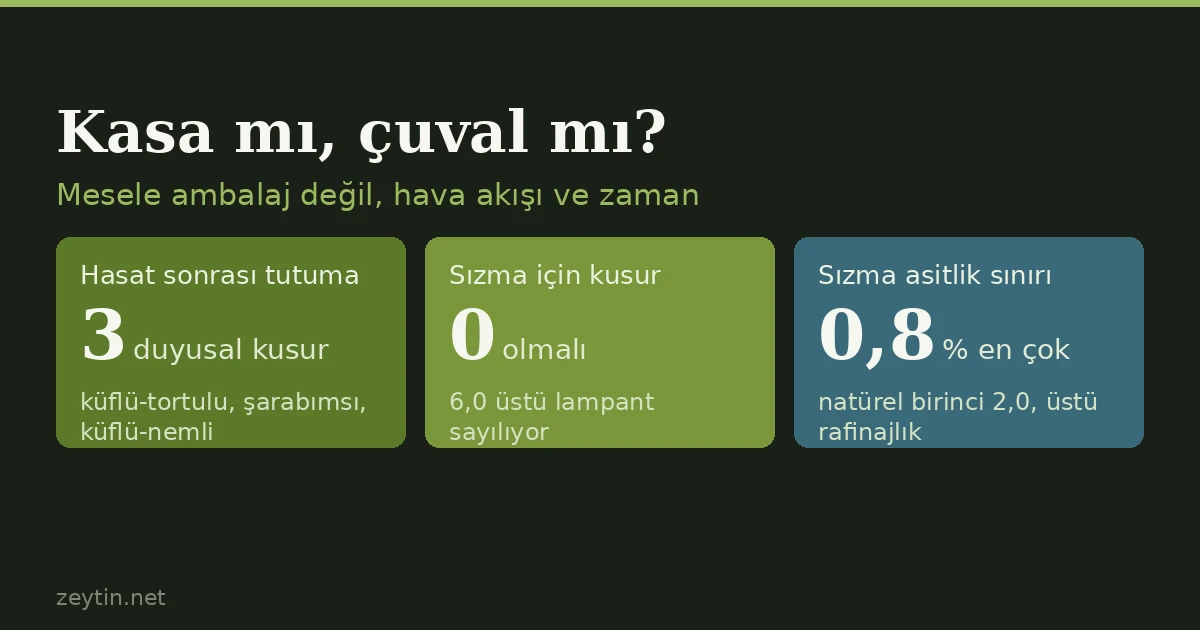
Should harvested olives be carried in crates or in sacks?
The cheapest decision of the harvest season is also one of the decisions that sets the grade of the oil. Three separate defects in the International Olive Council's vocabulary are defined directly by how the fruit was held after picking — and all three describe what a sack does.