What happens if an olive tree is flooded? Root asphyxiation, root rot and what to do after the water recedes
In a flood the olive suffers mainly at the roots: roots starved of oxygen stop working and root rot fungi follow. Symptoms appear weeks later. The article draws on ministry research-institute leaflets and a peer-reviewed study and sets out sensible steps after a flood and drainage criteria for planting.

The olive is known for its drought tolerance, but flooding and soil that stays waterlogged are among the conditions it likes least. After a flood or a burst of heavy rain, the grower usually asks the same questions: will the tree survive, when will I know, and what should I do now? This article draws on publications from research institutes of Turkey's Ministry of Agriculture and Forestry and on one peer-reviewed study. One point up front: we could not find a reliable figure for how many days an olive tree can survive under water, so we do not give one.
What happens to the roots in a flood
Roots breathe too, and they need oxygen. When the soil fills with water, the pores lose their air, oxygen runs out quickly and the root cannot do its job. This is general plant physiology rather than something specific to the olive, but the consequences for olives are well known. The farmer leaflet of the Atatürk Horticultural Central Research Institute in Yalova says that very heavy soils prevent the formation of fine roots and block aeration. In other words, the problem is not only the excess of water but the fact that the water drives out the air.

The result comes in two stages. First the root can no longer take up water and nutrients, and the leaves show it in a way that looks like drought: the tree can look tired even though the soil is wet. Then the weakened roots become exposed to fungi that thrive in wet soil.
What kills the tree is often a fungus
A study of the "drying syndrome" in young olive plantings in southern Spain is one of the clearest sources on this. Sánchez Hernández and colleagues, in the European Journal of Plant Pathology in 1998, reported that root rot fungi were very common in samples from diseased trees and were the main cause of the drying syndrome in the second field survey, which took place after heavy winter rainfall. The ability of several species, among them Phytophthora megasperma, P. palmivora and Pythium irregulare, to cause disease depended on the water content of the soil: extensive root rot and sudden death of the plant occurred only when the soil was continuously waterlogged.
The authors conclude that the frequent presence of P. megasperma in waterlogged field soils suggests the pathogen may play an important role in the well-known sensitivity of young olive trees to "root asphyxiation". The experiments used rooted cuttings of the Picual cultivar, and the study focuses on young plants; we cannot say directly that the same result holds for mature trees.
Other root diseases that are often discussed in Turkey sit in the same territory, and we cover them in our article on root rots. For Verticillium wilt, too, the leaflet from the Alata research institute of the Ministry asks growers to avoid excessive irrigation and flood irrigation.
Rain is one thing, standing water another
A misunderstanding needs correcting here: the olive is not harmed by rain. According to the Yalova leaflet the olive grows naturally in places with 400 to 600 mm of rain and can also grow where rainfall exceeds 600 mm. Spring and winter rain stored in the soil has a positive effect on flowering, improves fruit set and reduces fruit drop. The problem is less the amount of rain than water that stays in the soil. In a well-drained soil, extra rain simply drains away; in a heavy, low-lying soil the same rain can leave the roots in water for days.
When do symptoms appear?
On the day the water recedes, nothing may show on the tree. Damage becomes visible weeks later. In general, expect the following:
- Yellowing, wilting and dropping of leaves. The tree looks thirsty even though the soil is wet. Leaf drop has other causes too; our article on leaf drop helps to tell them apart.
- Growth stops. Spring shoots stay weak or do not appear at all.
- Dieback. First a few branches, then larger parts of the tree dry out.
- Sudden death. In a young tree, especially if the soil stayed under water for a long time, the tree can dry out abruptly.
The extent of the damage does not depend on a single factor. How long the water stayed, the temperature, how heavy the soil is, whether the tree was young and which cultivar it is all change the outcome. In the sources young trees appear to be more sensitive; beyond that, we found no statement that gives a firm threshold.
What to do after a flood
The following is an order of priorities based on the drainage and disease advice in the official leaflets and on general plant physiology. No olive-specific "post-flood protocol" has been published, so read these as reasonable steps rather than fixed rules.
1. Get the water out. Channelling water that has collected in hollows is the most urgent job. The Yalova leaflet says that where the water table is closer than 1 metre and roots stay under water for 3 to 4 weeks in winter, an orchard should be planted only after drainage has been done. This is a criterion for establishing an orchard; it does not mean that a tree can survive that long.
2. Stay off wet soil. Driving heavy machinery or cultivating heavily on wet soil increases compaction and makes aeration even worse. Do not work the soil until it crumbles in the hand.
3. Do not prune or fertilise in a hurry. Cutting the tree or giving a lot of nitrogen before you know the condition of the roots puts strain on weak roots. Seeing what the tree does in spring leads to a better decision. If pruning is needed, avoid damp and rainy days: the official leaflet says this for olive knot and recommends disinfecting tools with 10 per cent bleach.
4. Clear the base of the trunk. If mud and silt have piled up around the trunk, keeping the root collar open reduces the risk of wounds and rot.
5. Cut back on irrigation. There is no point in irrigating saturated soil; return to irrigation once the soil has dried and the tree starts to recover.
6. Wait for spring. Shoot growth usually decides whether the tree is alive. In young trees losses can come earlier.
Does insurance cover it?
In the tree and sapling insurance that TARSİM offers for olives, "flood and inundation" is among the listed perils. For fruit insurance the standard cover is the hail package, with frost added as an option. You will find what each cover includes and how the loss is calculated in our article on olive crop insurance; the details of a claim after damage depend on the policy and the insurer.
For the future: when planting an orchard
The best protection against flooding comes from choices made when the orchard is planted. The olive knot recommendations in the Alata leaflet say to avoid soils that hold a lot of water and have a clay base, and to open drainage channels if the trees are already planted. The Yalova leaflet repeats the same advice for peacock spot: do not establish an orchard on valley-floor land or on heavy, water-retaining soils, and open drainage channels if you do. Looking at the water situation of a site before planting saplings is cheaper than any intervention afterwards.
Summary
Flooding harms the olive mainly by suffocating the roots and by opening the way to root rot fungi, and young trees are the most at risk. Symptoms appear weeks later, so the first decision after a flood is not hasty pruning or fertiliser but getting the water away and waiting. The sources we have do not give a number for how many days an olive tree can stand in water; it is safest to solve the problem with drainage when the orchard is planted, rather than testing it on a tree.
One rating per visitor; you can change yours at any time. Ratings are real reader votes — no seeded or default scores.
Related
 Article
When does the olive harvest begin?
The harvest starts in late September and runs into February. Erkence is earliest, Memecik hangs into mid-December, and Mission's table and oil harvests are two months apart.
 Article
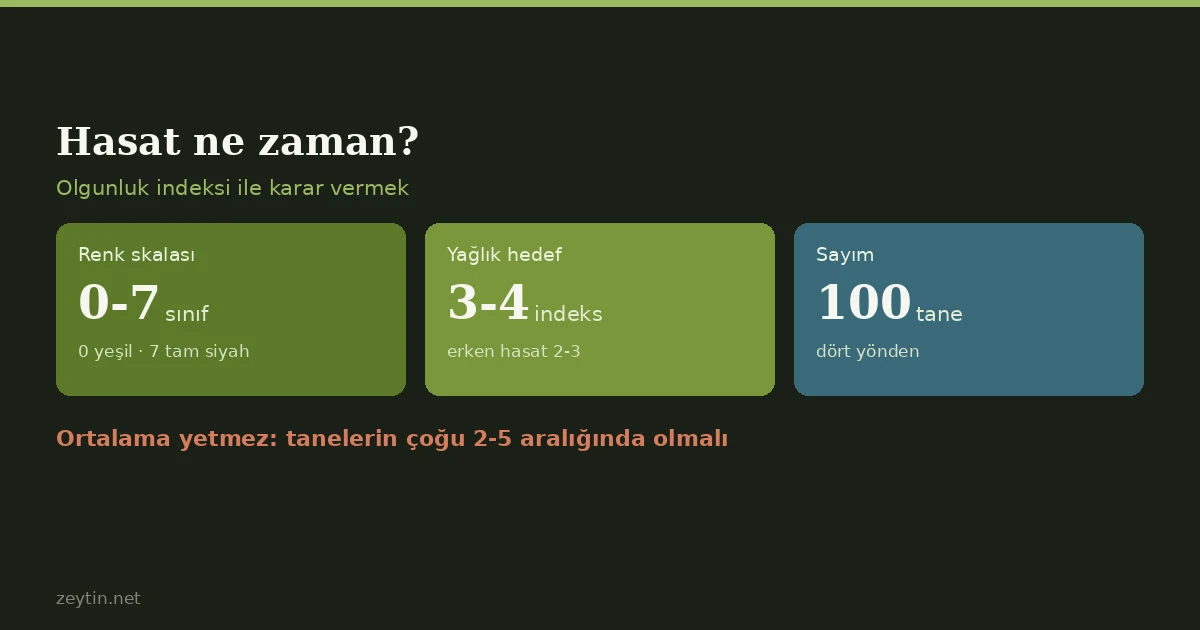
When to harvest olives: deciding with the maturity index
Harvest timing is set by the maturity index, not the calendar. The 0-7 colour scale, how to calculate it from 100 fruits, early versus late harvest compared, and ripening times by variety.
 Article
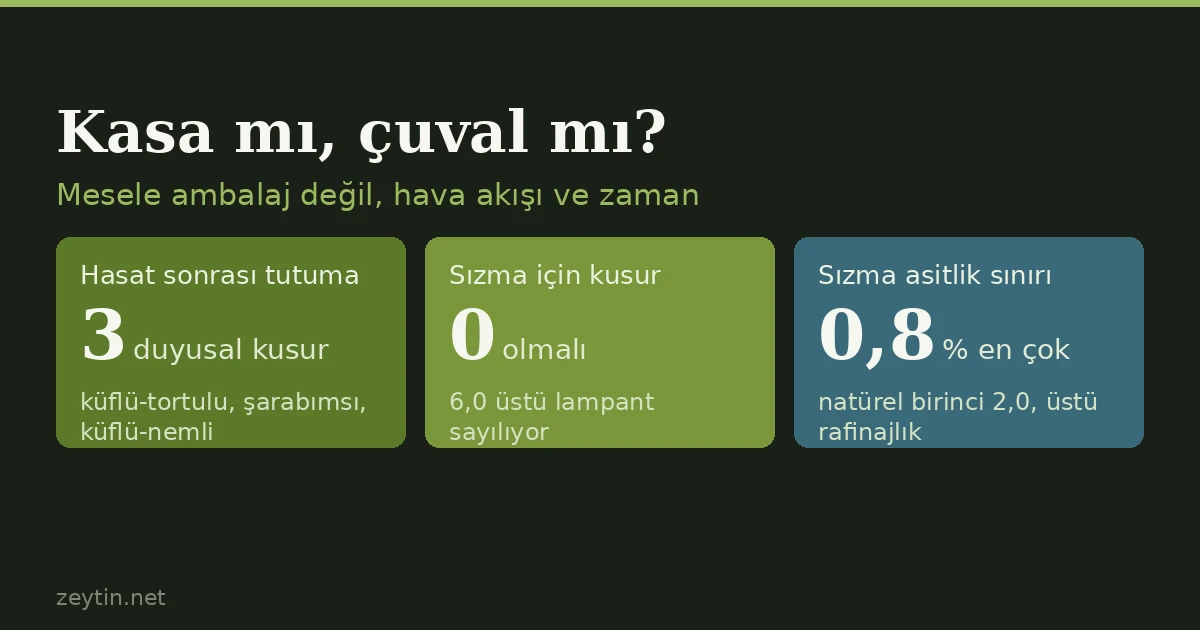
Should harvested olives be carried in crates or in sacks?
The cheapest decision of the harvest season is also one of the decisions that sets the grade of the oil. Three separate defects in the International Olive Council's vocabulary are defined directly by how the fruit was held after picking — and all three describe what a sack does.
 Article
Can olive leaves be used as animal feed? Do sheep and goats eat them, and are they harmful?
Olive leaves are a fibrous roughage eaten by sheep, goats and cattle: crude protein 8-12% of dry matter, NDF 46-53%. In sheep, fresh leaves are 55-60% digestible, leaves from chopped branches only 15-40%. Leaves sprayed with copper fungicides pose a poisoning risk to sheep.