Nematodes in olives: what root-knot nematode is and what swollen or dirty-looking roots mean
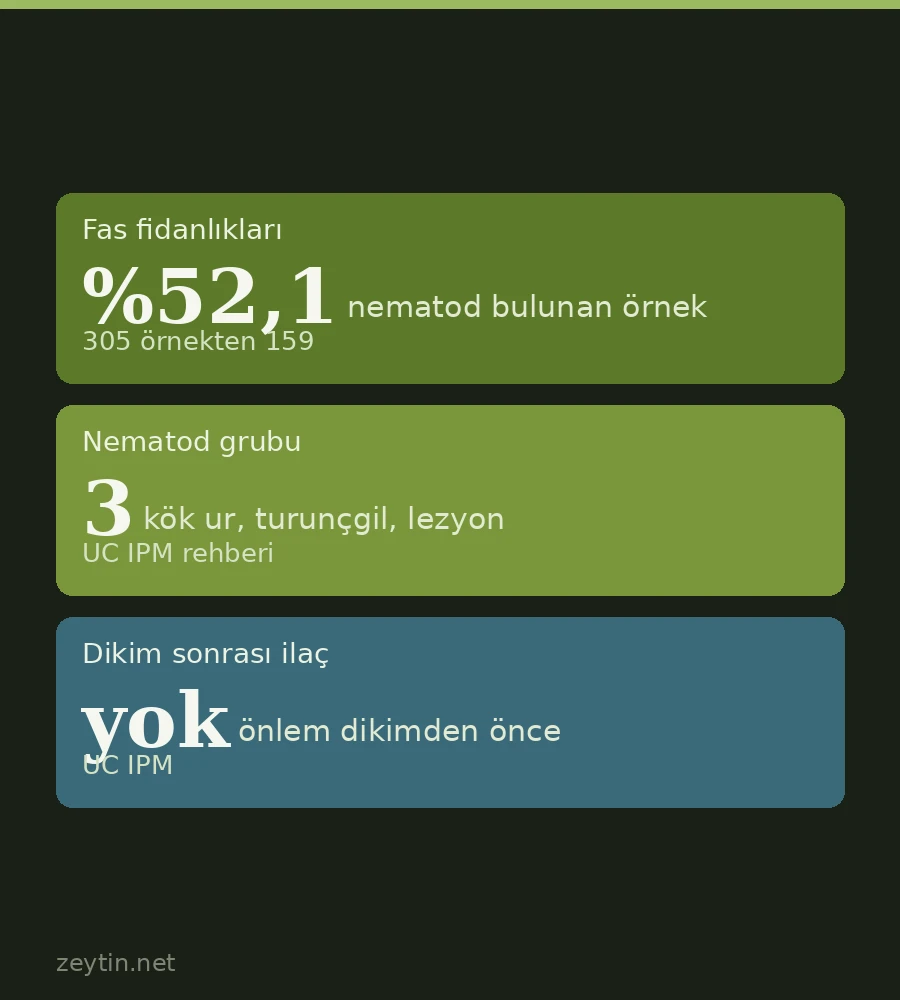
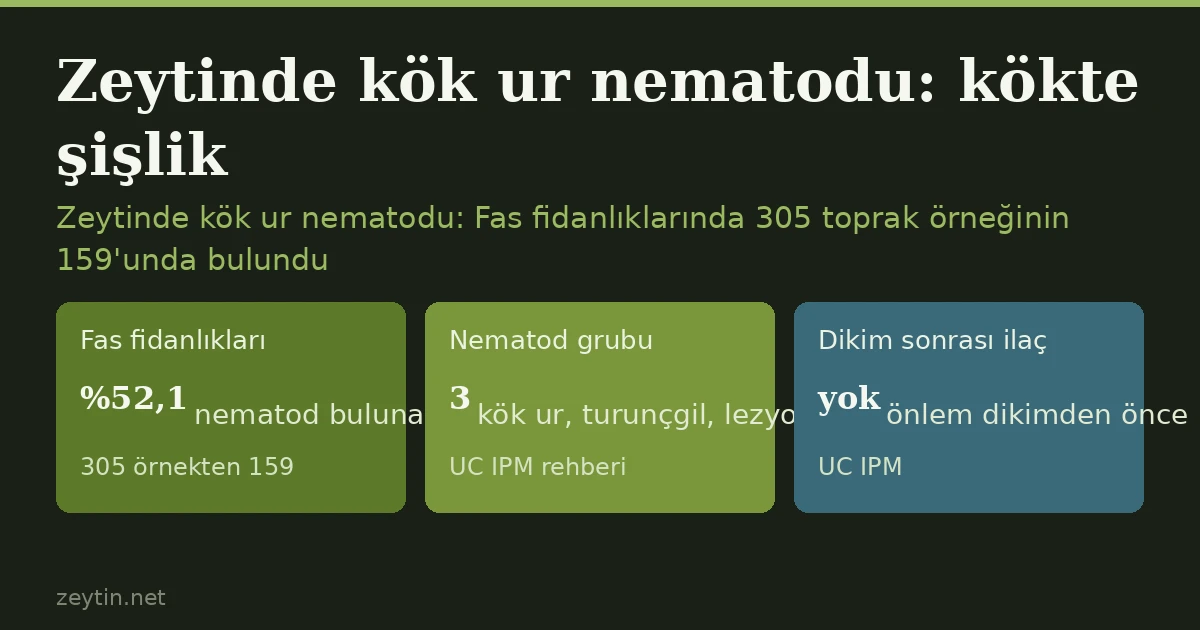
The three nematode groups that invade olive roots (root-knot, citrus, root lesion) leave different marks; galls are specific to root-knot nematodes and cannot be rubbed off. There is no post-planting treatment, and nurseries are the gateway: in Morocco root-knot nematodes were found in 52.1 percent of nursery samples.
If you have noticed swelling, a rough surface or a "dirty"-looking coating on the roots of an olive tree, you are most likely looking at nematodes. Nematodes are microscopic true roundworms that live in the soil, and in olives they damage the root system so that the tree carries water and nutrients less efficiently. From above the result looks like drought or a nutrition problem; the cause is underground.
The University of California's olive pest management guidelines (UC IPM) are explicit on two points. First, all root-invading nematodes push in the same direction: roots transport water and nutrients less efficiently, which leads to reduced growth, reduced fruit production and decline of the tree. Second, there is no treatment that can be applied after planting; the real precaution has to be taken before planting.
Three nematode groups stand out in olives
The guidelines name three groups: the citrus nematode (Tylenchulus semipenetrans), the root lesion nematode (Pratylenchus vulnus and other Pratylenchus species) and root-knot nematodes (Meloidogyne species). They leave different marks on the root, so opening up the root gives the first clue.
| Group | How it feeds | What shows on the roots |
|---|---|---|
| Root-knot (Meloidogyne) | Invades the root tip and sets up a permanent feeding site inside the root | Root tissue swells into galls; roots look bumpy and swollen and no fine feeder roots remain |
| Citrus nematode (Tylenchulus) | Buries its front end in the root cortex while the rear end stays outside | Soil sticks to the gelatinous layer protecting the eggs, so the root looks dirty and thickened, the surface is rough, and feeder roots shorten and slowly disappear |
| Root lesion (Pratylenchus) | Moves through the root while feeding, and moves on to other roots when damage is heavy | Narrow, dark lesions along the root; rot-causing pathogens often enter through these wounds |
Galling is specific to root-knot nematodes. According to the guidelines a gall is the root tissue itself grown larger, so it cannot be rubbed or washed off; that gives a simple test for telling a gall from a clump of soil stuck to the root. Over time individual galls merge and give the root a bumpy, swollen look.
What the tree shows
The guidelines describe the damage root-knot nematodes do to olives in measured terms: trees become slightly weaker, especially in sandy soils, and fruit size on infected trees is reduced. They also add, as a piece of good fortune, that olive trees have hardy root systems. In other words this is not a disease like root rot that takes a tree quickly; it is more a stress that pulls down yield and growth.
Pot experiments show a picture consistent with that. In a study published in the Journal of Nematology in 2003 by Nico, Jiménez-Díaz and Castillo, Picual plants that met root-knot nematodes showed yellowing of the uppermost leaves followed by partial leaf drop. In the same study M. arenaria and M. javanica caused more severe symptoms than M. incognita, and Meloidogyne species clearly shortened the height of Arbequina.
These symptoms are not specific. Leaf yellowing, fewer shoots and dieback also appear with root rots, with nutrient deficiencies and with irrigation mistakes. So nematodes cannot be diagnosed by looking only upwards; you need to look at the roots themselves and, if doubt remains, send a root and soil sample to a laboratory that works on nematodes.
Not every species multiplies on every cultivar
In the same study Arbequina and Picual turned out not to be suitable hosts for the root lesion nematodes Pratylenchus fallax and P. thornei or for Zygotylenchus guevarai, whereas ring and spiral nematodes multiplied on both cultivars. So the word "nematode" does not mean a single kind of damage: which species dominates, on which cultivar and under which conditions changes the outcome. Picual and Arbequina are cultivars that were tested in this respect, but no cultivar-level resistance claim should be drawn from a single pot trial.
The nursery is the gateway
In a survey of olive nurseries and orchards in Morocco (Ait Hamza and colleagues, 2017), root-knot nematodes were found in 159 of the 305 soil samples taken from nurseries, about 52.1 percent. The dominant species in both nurseries and orchards was M. javanica; M. incognita was found only in nurseries. The authors regard nurseries as a likely source of contamination for orchards and stress that using clean substrate in the nursery is a preventive measure.
There is a similar warning from Turkey. In Ödemiş, İzmir, 368 soil samples were taken between 2008 and 2011 from areas where saplings of 16 fruit species, olive among them, were being grown. The study detected eight plant-parasitic nematode species, including Meloidogyne incognita, M. javanica, Tylenchulus semipenetrans, Pratylenchus thornei and P. penetrans. The most widespread groups were, in order, Helicotylenchus, Pratylenchus and Meloidogyne. The summary gives no olive-specific rate, so we do not quote an olive percentage here.
The practical conclusion: an infested sapling carries the problem into the orchard itself. That is why choosing certified saplings and checking the roots by eye before planting are also an insurance against nematodes; if you see galls, a dirty coating or a rough patch on the roots when you plant the sapling, not planting that sapling is the cheapest precaution.
How to check the roots
It is enough to open the soil at one small spot at the edge of the canopy shade of the suspect tree and expose the fine roots; there is no need to dig a large pit, which would only harm the tree. If you see galls or roughness on the root, check whether it comes off when you wash or rub the soil: if it does not, a gall is likely. You can make the same check on a sapling's root ball before planting.
What can be done before and after planting
The UC IPM guidelines say that new orchard sites can be fumigated before planting to reduce nematode numbers, but that there is no treatment after planting. The details in the guidelines are written for Californian conditions (drying the soil beforehand, applying before mid-November, injecting 18 to 30 inches deep, roughly 45 to 75 centimetres); we do not carry them over to Turkey as they are, and we name no product. Which product is registered in Turkey and how it may be used is a question for the provincial or district agriculture directorate.
In an established orchard the guidelines suggest two cultural measures. The first is to irrigate infested, weakened trees more often to protect them from water stress; see our article on drip irrigation for the irrigation routine. The second is to be careful about cover crops: according to the guidelines most cover crops host root-knot nematode, whereas few host root lesion and citrus nematodes. If you suspect root-knot nematode in your orchard and use a cover crop, that crop may itself be a host that feeds the nematode, so it is worth rethinking the choices in our article on weed management.
In short
If you see galls, a dirty surface or narrow dark lesions on the roots, nematodes are a likely cause. The damage root-knot nematode does in olives is generally a slow weakening of the tree and smaller fruit, but because infestation is common in nurseries, choosing clean saplings matters. Because there is no treatment after planting, the main protection is clean planting material and the measures taken before planting. Nematodes are only one possible cause at the root: first rule out root rot and nutrient deficiency.
One rating per visitor; you can change yours at any time. Ratings are real reader votes — no seeded or default scores.
Related
 Article
Olive anthracnose: the disease of the mummified fruit left on the branch
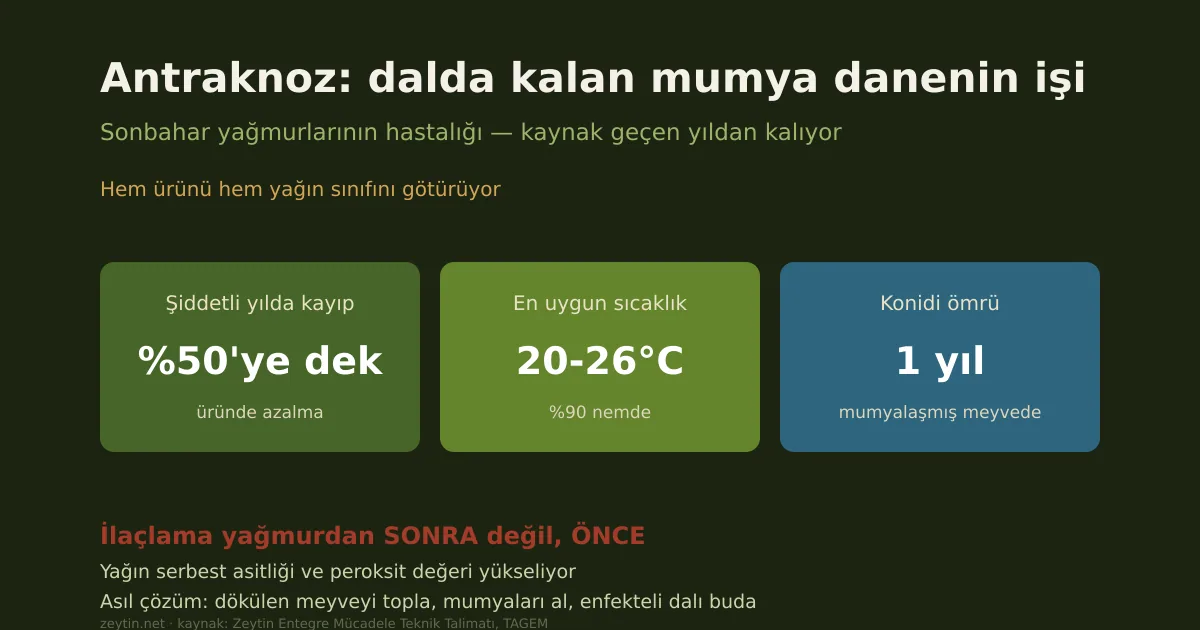
Up to 50% crop loss in bad years. The source is last year's mummified fruit still on the branch, and the spray goes on before the autumn rains, not after.
 Article
Do starlings damage olive crops? Winter flocks and what growers can do
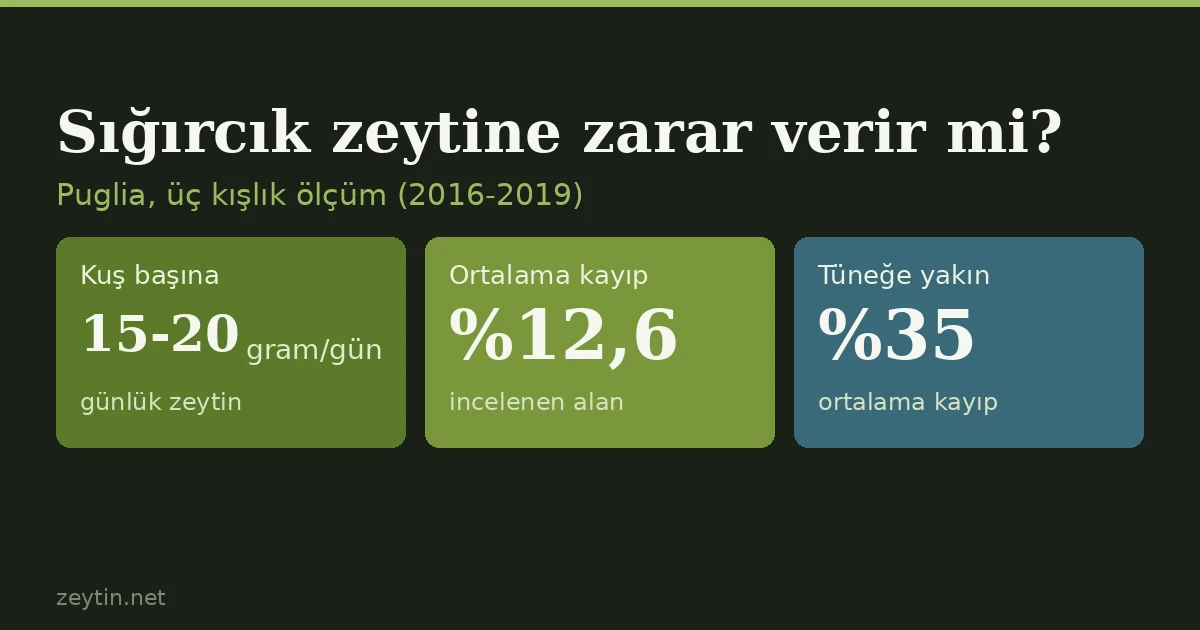
Starlings eat ripe olives from the tree and the ground, 15-20 grams per bird a day. In Apulia 12.6% of the expected crop was lost over three winters, 35% near roosts. Why scaring devices wear off and why harvest timing matters.
 Article
Weeds in the olive grove: bare soil is not the goal
Johnson grass, Bermuda grass and fat hen. With perennials, ill-timed tillage spreads them while mowing stops the seed. Clean under the canopy, covered between rows.
 Article
What is the olive bark beetle? Symptoms, and why pruning waste is the key to control
The olive bark beetle (Phloeotribus scarabaeoides) bores into branch forks and dries out shoots. It breeds in pruning waste and favours weak trees. A guide to recognising and controlling it, based on field studies from Mut and Mardin, the Dalmatian calendar and the IOC's trap-branch method.