What is the olive bark beetle? Symptoms, and why pruning waste is the key to control
The olive bark beetle (Phloeotribus scarabaeoides) bores into branch forks and dries out shoots. It breeds in pruning waste and favours weak trees. A guide to recognising and controlling it, based on field studies from Mut and Mardin, the Dalmatian calendar and the IOC's trap-branch method.
In spring, a grower looking closely at olive branches will sometimes find the same thing: pinhead-sized holes in the forks where two branches meet, and thin shoots that have started to dry from the tip and snap easily when bent. There is no obvious disease spot. One of the common causes is a small insect that lives under the bark: the olive bark beetle, Phloeotribus scarabaeoides. In Turkish it is known as filizkıran — literally "shoot breaker" — and sometimes as the "olive bark beetle" (zeytin kabuk böceği).
This article explains how to recognise the beetle, when and where it breeds, what field studies in Türkiye have found, and why pruning waste, rather than spraying, is the deciding factor in controlling it.
Three "bark" pests that get mixed up
Three different olive pests carry "bark" or "scale" in their common names, and they are often confused:
| Common name | Species | What it does |
|---|---|---|
| Olive bark beetle (filizkıran) | Phloeotribus scarabaeoides | Small beetle that tunnels under the bark; dries out shoots and thin branches |
| Olive branch borer (dal kurutan) | Hylesinus oleiperda | A larger bark beetle; its larvae tunnel under the bark of branches and trunks |
| Olive scale | Parlatoria oleae | Not a beetle but a scale insect; sucks sap on leaves, twigs and fruit |
The olive scale belongs to a different group of pests and is covered in our article on other olive pests. This article is about the first two, mainly the olive bark beetle.
What the olive bark beetle is
The olive bark beetle is a bark beetle (subfamily Scolytinae) a few millimetres long, dark-coloured and cylindrical. According to the description in the International Olive Council's (IOC) Production Techniques in Olive Growing, it resembles the olive branch borer but is smaller; branch borer females measure 3.5-3.7 mm.
The IOC classes it as a secondary pest: rather than healthy, vigorous trees, it attacks weakened, woody branches and pieces of dead wood. The same source notes, however, that it can cause serious damage on weak trees and lead to yield losses of up to 10 kilograms per tree.
Life cycle: it breeds in pruning waste and feeds on the tree
The beetle's life is split between two places:
- Breeding in cut wood. The female bores through the bark of pruning offcuts, stacked firewood and dying branches and lays her eggs underneath; the larvae develop in galleries under the bark.
- Feeding and overwintering on the living tree. Newly emerged adults fly to the trees and dig feeding and overwintering galleries in the forks of young branches. These galleries are what dry out and break the shoots.
Findings from an older Turkish study (Çakıcı, 1982), as cited in later work, report that the olive bark beetle occurs wherever olives are grown in Türkiye and that it spends the winter as an adult in galleries in branch forks. In İzmir, adults leaving their winter galleries were first caught on trap branches on 21 March 1974 and 18 March 1975; first-generation adults were seen between 16 May and 22 July, and second-generation adults between 7 October and 25 November.
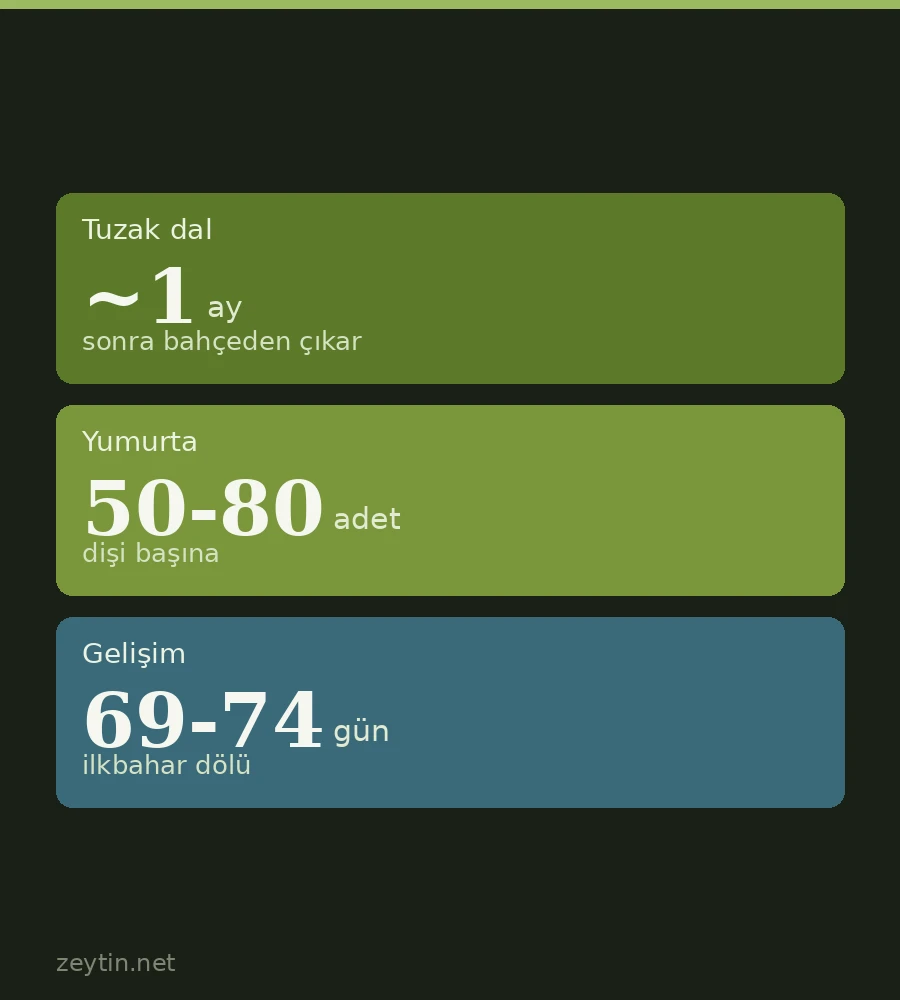
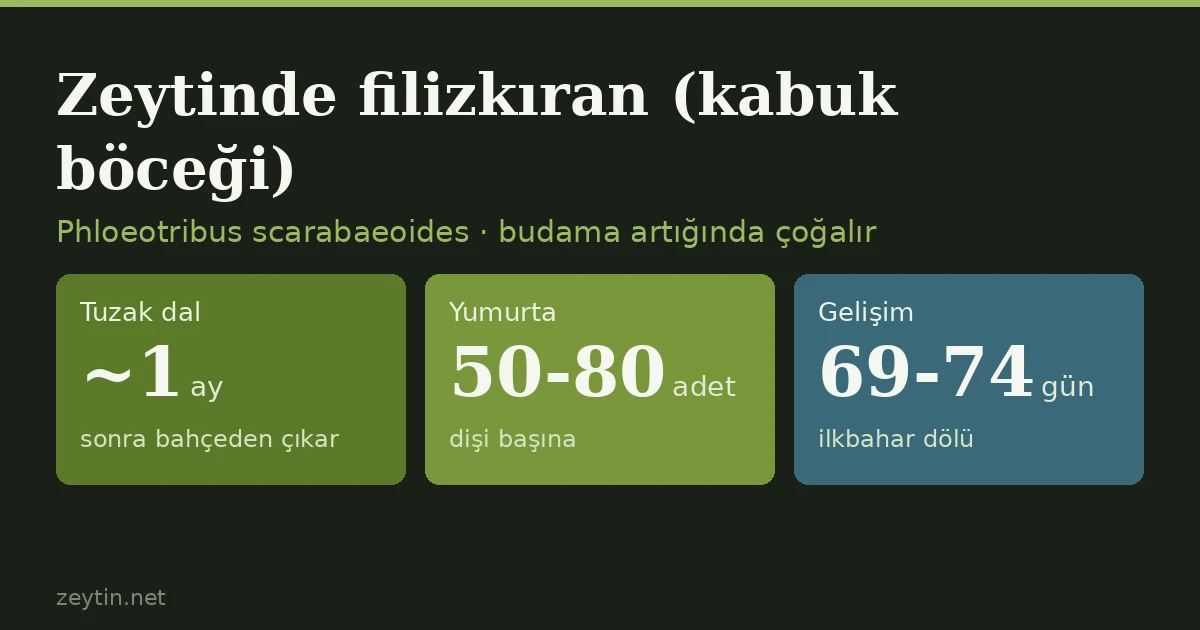
A study on the Dalmatian coast of Croatia (Katalinić et al., 2012) gives a slightly earlier calendar: the reproductive flight starts at the end of February and lasts until the end of May, each female lays 50-80 eggs, and the spring generation takes 69-74 days to develop from egg to adult. The number of generations varies with climate: 2.5-3 have been reported for Italy, 5 for France and Algeria, and 4 in a more recent study from Algeria, which also found the beetle favouring neglected trees and thin branches of 2-4 mm diameter.
What field studies in Türkiye show
Mut (Mersin), 2001-2002. In a study by Çetin and Alaoğlu of Selçuk University, shoot infestation ranged from 0 to 26 percent depending on the village in 2001 and from 0 to 7 percent in 2002. The most striking observation concerned orchard conditions: trees in poorly drained hollows, whose roots stayed under water for long periods and which had become weak, carried large numbers of entry holes, and in the problem orchards 3-5 trees died as a result. The main damage in the district was seen in March and April. Shoots with a single entry hole, by contrast, showed no breakage or drying.
Mardin, 2014-2015. In Kaplan's study of olive orchards in Mardin, the olive bark beetle accounted for 7 percent of the individuals of the pest species identified and was ranked among the primary pests. Damage appeared on shoots in April-May and again in September-October; the beetle was especially dense in places surrounded by pruning waste and preferred neglected, stressed trees.
The same papers cite figures from elsewhere: crop losses of up to 73 percent under heavy attack in Spain, and bark beetle densities of 0-6 percent in the olive groves of central Antalya. In the Dalmatian study the maximum yield loss was about 9 percent.
Symptoms: what to look for
- Small round entry holes in branch forks, at the point where two branches divide.
- Shoot tips that dry from the hole outwards and break easily in the wind or by hand — the origin of the Turkish name "shoot breaker".
- Transverse galleries under the bark when it is peeled back.
- Pruned branches and woodpiles left inside or at the edge of the orchard.
Branches also dry out for other reasons. If there are no holes in the bark and the drying starts on one limb and spreads, think of verticillium wilt; if there are galls on the branch, olive knot; if the whole tree is declining, root rots; if young shoots were scorched across the tree after winter, frost damage. The bark beetle's entry holes are the distinguishing sign.
Control: pruning waste first
1. Do not leave pruning waste in the orchard. The IOC describes pruned branches as an "ideal habitat" for the beetle and says they should not be left in the field. The concentration seen in the Mardin study around pruning waste points the same way. Keeping firewood stacks out of the orchard and away from its edge follows the same principle.
2. Trap branches. The most important measure recommended in the same source turns the beetle's habit against it: branches cut at pruning are left under the trees for about a month, the beetles lay their eggs in them, and the branches are then removed from the orchard. The Mut trial shows how quickly this works: of the trap branches hung on 17 March 2002, every one was infested by 7 April, and no new entry holes appeared after 22 April. Timing is critical: if the branches are not taken out before the new generation inside them becomes adult and emerges, the trap turns into a breeding site. Chipping the branches and removing them is an alternative to burning, which in many places is banned or requires a permit.
3. Keep the trees vigorous. The common thread in the field studies is that the beetle chooses weak trees. Drainage in waterlogged hollows, water in drought, balanced nutrition and good pruning are the most lasting protection.
4. Natural enemies. The Dalmatian study found that parasitoid wasps — Cheiropachus quadrum, Raphitelus maculatus and Dendrosoter protuberans — reduced bark beetle populations by about 23 percent. Broad-spectrum spraying kills these wasps too.
5. Insecticides as a last resort. The Turkish Ministry of Agriculture and Forestry's 2022 Integrated Pest Management Technical Instruction for Olives has no separate section on the olive bark beetle, and the IOC source recommends chemical treatment only when unavoidable. If spraying is needed, ask your provincial or district agriculture directorate about products and doses; for the calendar of other pests see our article on olive pest calendar and intervention thresholds.
The olive branch borer: larger and less common
Hylesinus oleiperda has one or two generations a year; males measure 2.5-3 mm and females 3.5-3.7 mm. Its larvae tunnel under the bark of branches and trunks, and a branch can be hollowed out to the point of breaking. According to the IOC it settles in the trunk on trees younger than six years and in the branches on older ones, and the critical threshold is passed when more than five infested spots are found on a tree. Older studies from the Aegean region report that it is less widespread than the olive bark beetle and prefers mild places with high rainfall.
Reading notes
⚠ The calendars come from İzmir (1970s), Dalmatia and Mut; they can shift by a few weeks with region and the year's weather. Time your trap branches by watching for the first holes in your own orchard.
⚠ The yield-loss figures (9 percent, 73 percent, 10 kg per tree) come from different countries and infestation levels; they are not one average.
⚠ This article does not name products or doses; registrations change.
One rating per visitor; you can change yours at any time. Ratings are real reader votes — no seeded or default scores.
Related
 Article
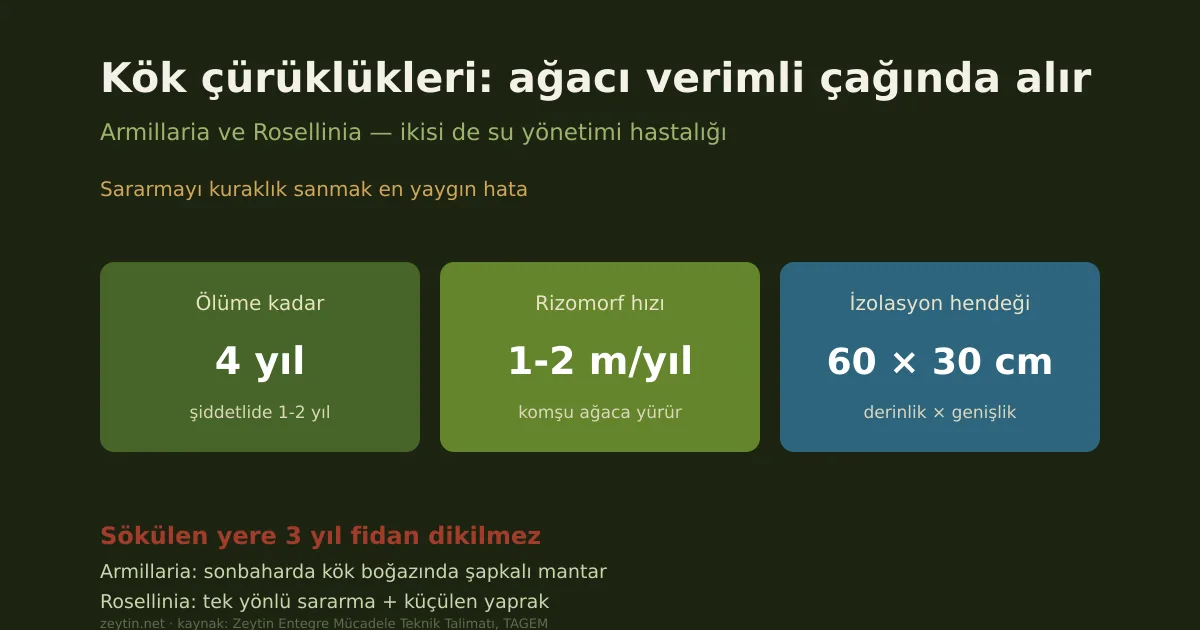
Olive root rots: Armillaria and Rosellinia
Mistaking the yellowing for drought is the common error. Two soil-borne fungi kill the tree in its prime; there is no chemical cure — the work is water management and isolation.
 Article
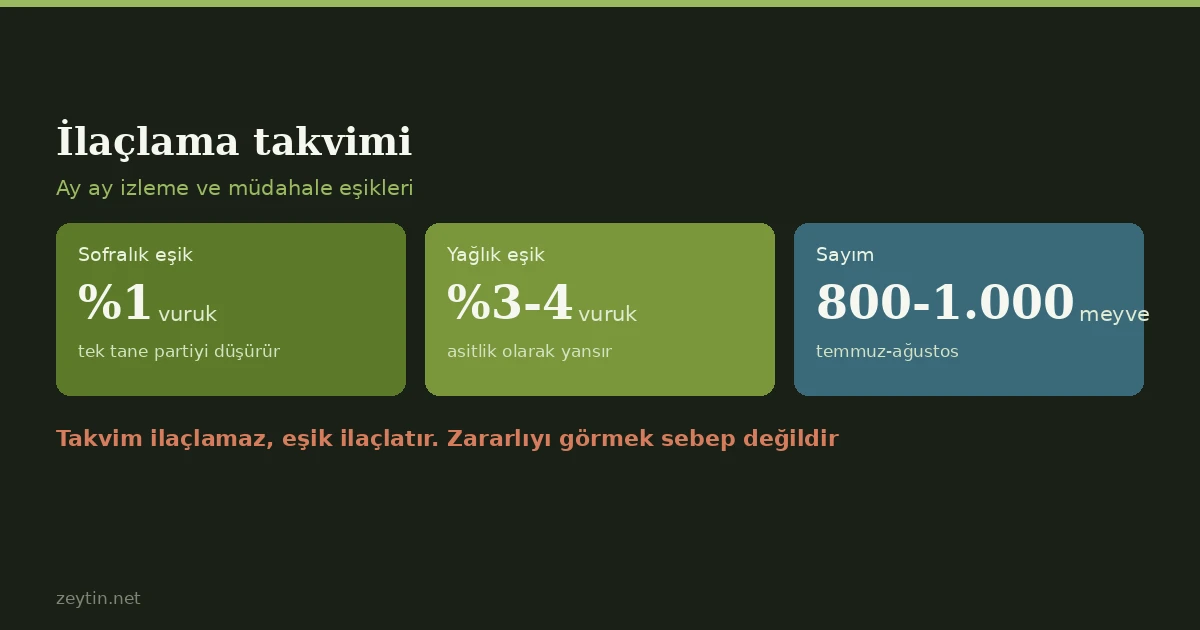
The olive pest calendar and intervention thresholds
Month by month: which pest is at which stage, and when to count. Fly infestation thresholds, black scale shoot counts, and the three regional programmes for peacock spot.
 Article
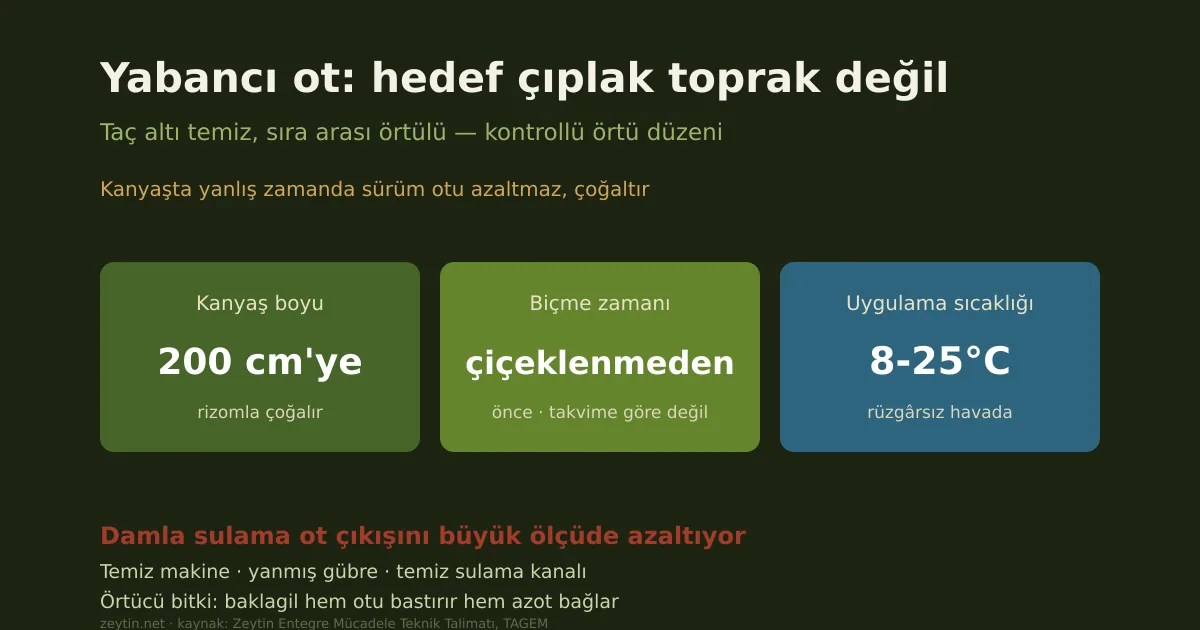
Weeds in the olive grove: bare soil is not the goal
Johnson grass, Bermuda grass and fat hen. With perennials, ill-timed tillage spreads them while mowing stops the seed. Clean under the canopy, covered between rows.
 Article
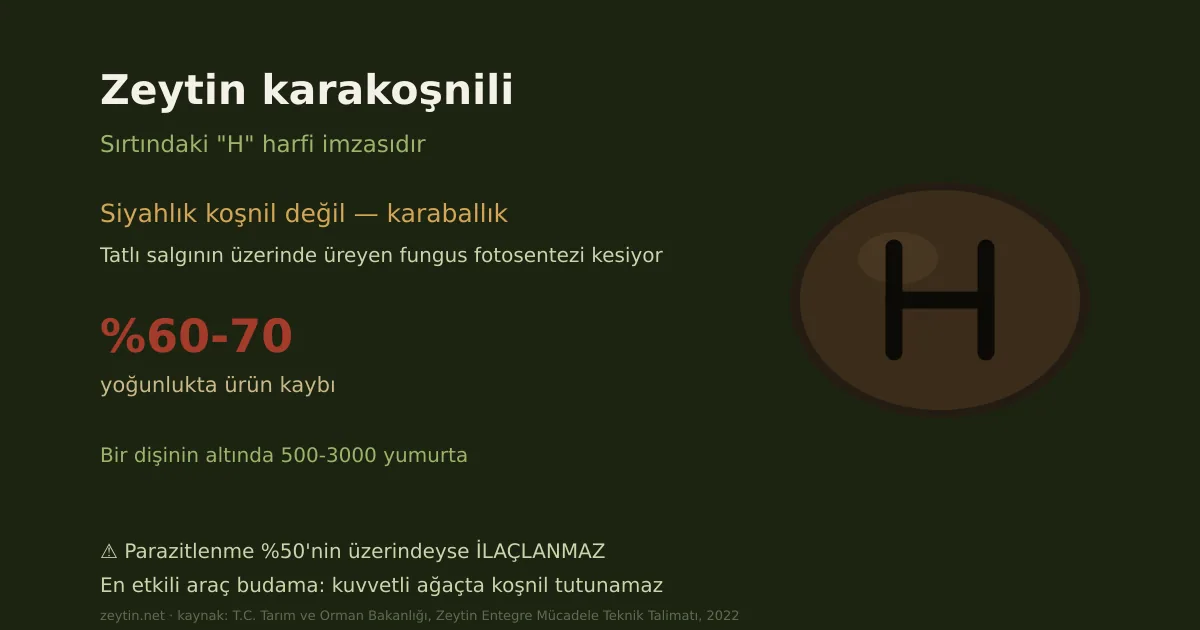
Olive black scale and sooty mould: the H on its back
The olive pest behind sooty mould: a scale with an H on its back. Losses of 60-70%; if parasitism tops 50%, do not spray.