Orhangazi olive oil starts on the road to geographical indication, with samples to be tested for acidity and polyphenols
The Orhangazi Chamber of Commerce and Industry has begun preparing a geographical indication application for "Orhangazi Olive Oil". More than 20 producers will be consulted, samples tested in Bursa and the influence of the Lake İznik basin studied. The area's Gemlik Olive registration covers only table olives.
Orhangazi, one of the olive-growing districts of Bursa in north-west Turkey, is preparing to protect its olive oil under a name of its own, stepping out of the shadow of the table olives the area is famous for. The Orhangazi Chamber of Commerce and Industry (OTSO) has started preparatory work on a geographical indication (GI) application for "Orhangazi Olive Oil". According to announcements the chamber made on 15 and 16 September, the dossier will be prepared together with the district's institutions and producers and then submitted to the Turkish Patent and Trademark Office.
Two meetings and a roadmap
The first step was a Geographical Indication Evaluation and Coordination Meeting organised by the chamber. Alongside OTSO board chairman Erol Hatırlı, it brought together:
- Erkan İnce — Deputy Mayor of Orhangazi
- Mehmet Çınar — Orhangazi District Director of Agriculture and Forestry
- Turgay Durmuş — President of the Orhangazi Chamber of Tradesmen and Craftsmen
- Dinçer Dimrit — President of the Orhangazi Chamber of Agriculture
- Ahmet Özkul — Second Vice-Chairman of the Chamber of Agriculture board
- Fahrettin Uludağ — Chairman of Orhangazi Bahçe Kültürleri ve Tarım A.Ş., the municipal horticulture and agriculture company
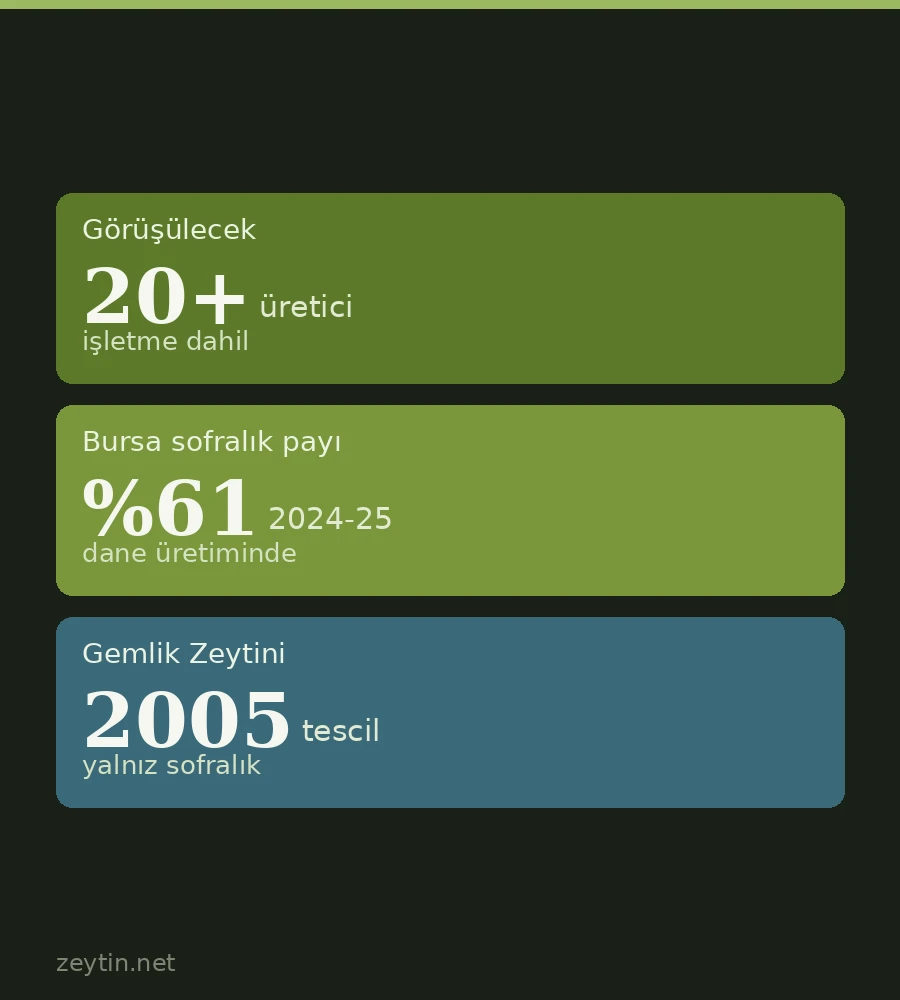
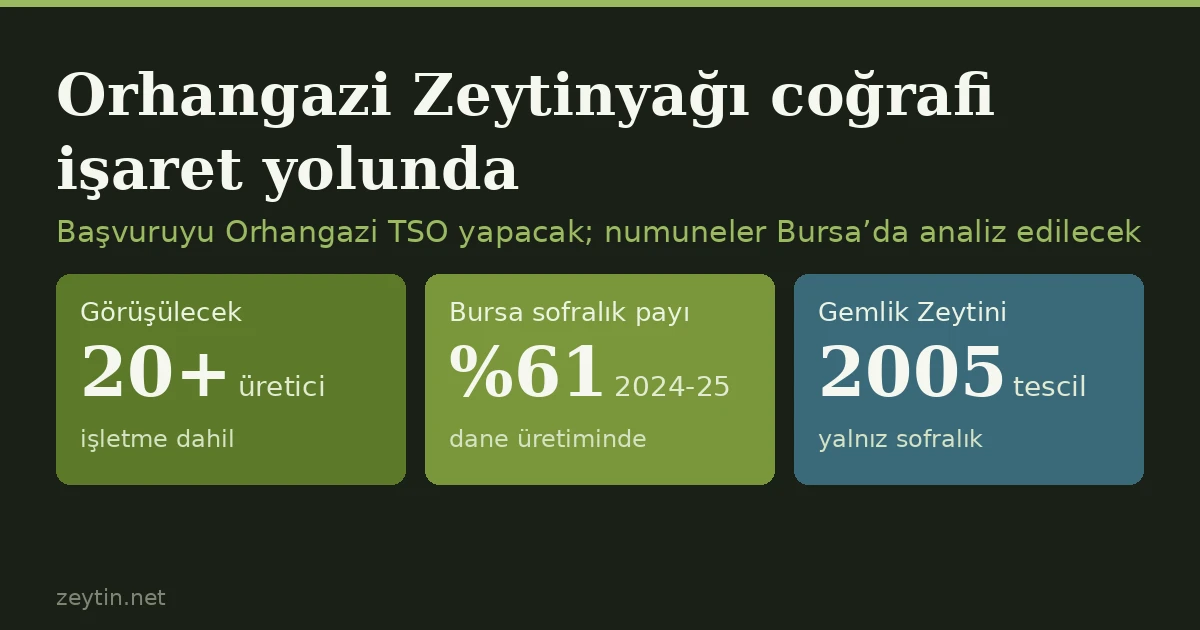
The first meeting set out the roadmap and working method for the process. At a second meeting the chamber sat down with olive oil producers operating in the district to discuss current production practices, harvesting and milling, and the characteristics specific to the area. Hatırlı said the chamber would hold talks with more than 20 olive oil producers and businesses in the district, and that their views would be included in the application file.
What will go into the dossier?
A geographical indication ties a product's name to the place it comes from. Claiming that link is not enough; it has to be demonstrated. According to the chamber's announcement, the Orhangazi dossier will be built around the following areas:
- Production conditions and methods: documenting how olives are harvested, how they are milled and what practices are in use across the district.
- Geographical factors: the area's microclimate and soil structure, and the influence of the Lake İznik basin on the olives and the oil.
- Harvesting in the cold: the effect on oil quality of the fact that olives in Orhangazi are typically picked in cold weather.
- Laboratory analysis: samples collected from producers will be tested at Bursa Food Laboratory to establish quality characteristics, starting with acidity and polyphenol levels.
- Academic support: work with universities documenting the properties of both the Orhangazi olive and the oil made from it.
Hatırlı said the chamber wants the dossier to "reflect real production conditions in the field". The aim, he stressed, is not simply to file an application but to carry through a registration process that protects producers and helps build a brand. He added that the process is not the chamber's alone, and that it can only succeed if the district's institutions and producers act together, from the orchard through harvest to the mill.
The Gemlik Olive registration already covers Orhangazi
The obvious question is whether Orhangazi is not already inside a registered name. It is, but for a different product.
Gemlik Olive was registered as a designation of origin on 3 October 2005 under registration number 76, and its geographical boundary covers the districts of Gemlik, İznik, Orhangazi and Mudanya. It received EU protection in 2023. That registration, however, applies to table olives. Olive oil needs its own product definition, its own criteria and its own dossier. This is the gap Orhangazi's initiative is aiming at.
The reason for the gap shows up in the numbers. According to 2024-25 figures in the zeytin.net database, Bursa produced 280,720 tonnes of olives, of which 61% went to table use; olive oil output was 25,127 tonnes. The province ranks sixth in Turkey for olive production but only ninth for olive oil. Olive growing in Bursa is built around table olives, and its oil has so far not been marketed under a name of its own.
Olive oil GIs are new in the Marmara region
In the registration list tracked by this site, olive oil GIs along the Marmara coast are strikingly recent. In neighbouring Balıkesir province, Edincik Su Olive Oil was registered as a designation of origin in 2024, and Erdek Kapıdağ Olive Oil as a geographical indication (the looser "mahreç" category) in 2025. No olive oil GI registered for Bursa appears in that list.
The chamber has not yet said which type of protection it will apply for, and the difference matters. Under a designation of origin, every stage of production must take place within the defined area. Under a geographical indication in the narrower Turkish sense, it is enough for at least one stage to take place there. The first is a stricter commitment and is usually harder to document; the second is easier to obtain but says less about where the olives themselves came from.
Registration alone is not enough
Turkey ranks fourth in the world for olive oil geographical indications, behind Italy, Spain and Greece. Yet the question of what its 25 registrations actually achieve remains open. Whether a GI translates into a price premium depends on what happens after registration: inspection of the production rules, recognition among buyers, and whether producers actually put the name on their bottles. A name that stays on a certificate does little for the grower.
Seen from that angle, Orhangazi's decision to put laboratory data and producer involvement at the centre from the start is a sound beginning. A dossier built on measured acidity and polyphenol values, and on the practices of the twenty-plus mills and producers in the district, is more likely to produce a specification that can be inspected, and a name that buyers can trust.
The chamber expects the formal application to be filed once the work is complete. No date has been given for submission. With the new season's harvest now getting under way across Turkey's olive regions, the samples taken in the coming weeks will provide the first data for the analytical part of the file.
Sources
- Meetings, participants and scope of the dossier: announcements by the Orhangazi Chamber of Commerce and Industry, 15 and 16 September 2026
- Gemlik Olive registration details: Turkish Patent and Trademark Office GI record, registration no. 76
- Bursa production figures and registration list: zeytin.net database
One rating per visitor; you can change yours at any time. Ratings are real reader votes — no seeded or default scores.
Related
 Article
Olive oil got cheaper in the UK and Filippo Berio lifted its share to 15%
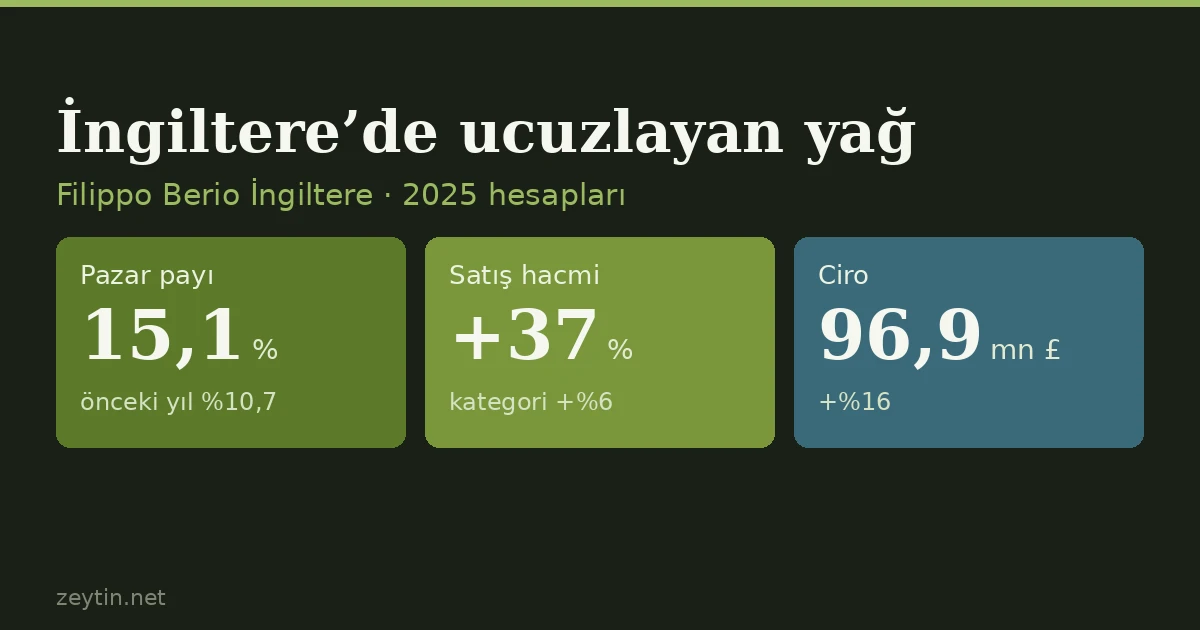
The 2025 accounts of Filippo Berio's UK company show how falling prices reached the shelf: volumes up 37%, revenue up 16%, market share from 10.7% to 15.1%. The category grew 6% and lower wholesale costs were passed on to shoppers.
Article
Olive oil got cheaper in the UK and Filippo Berio lifted its share to 15%
The 2025 accounts of Filippo Berio's UK company show how falling prices reached the shelf: volumes up 37%, revenue up 16%, market share from 10.7% to 15.1%. The category grew 6% and lower wholesale costs were passed on to shoppers.
 Article
Crop forecast climbs as the minimum-price debate returns: what the exchange numbers say
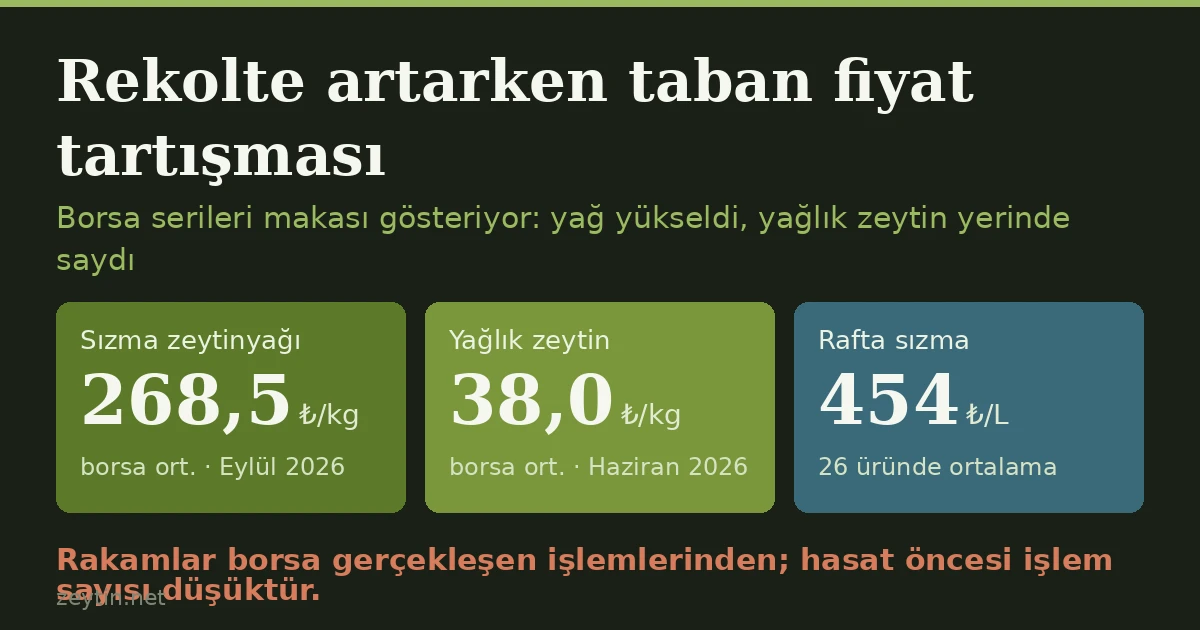
With the 2026 harvest approaching, crop forecasts are up 40 percent in some provinces and growers want a floor price. Our exchange series shows why the dispute is really about olives, not oil.
Article
Crop forecast climbs as the minimum-price debate returns: what the exchange numbers say
With the 2026 harvest approaching, crop forecasts are up 40 percent in some provinces and growers want a floor price. Our exchange series shows why the dispute is really about olives, not oil.
 Article
The 2026/27 season opens: first harvests in Ayvalık, Gemlik and Bozcaada
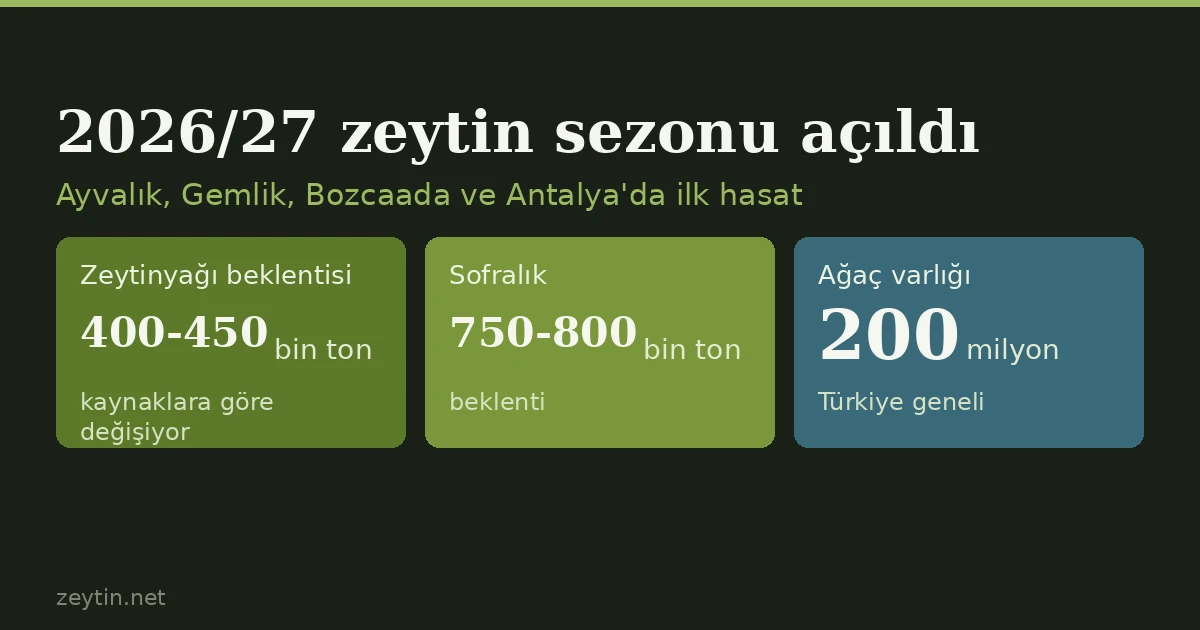
The new olive season opened with three events on 11-13 September. In Ayvalık, an on-year forecast of 400,000-450,000 tonnes of olive oil was voiced; in Gemlik the first olives were picked during the festival; and on Bozcaada the island's first olive oil was pressed with a portable system.
Article
The 2026/27 season opens: first harvests in Ayvalık, Gemlik and Bozcaada
The new olive season opened with three events on 11-13 September. In Ayvalık, an on-year forecast of 400,000-450,000 tonnes of olive oil was voiced; in Gemlik the first olives were picked during the festival; and on Bozcaada the island's first olive oil was pressed with a portable system.
 Article
Tunisia's output falls from 500,000 to 300,000 tonnes — revenue may hold
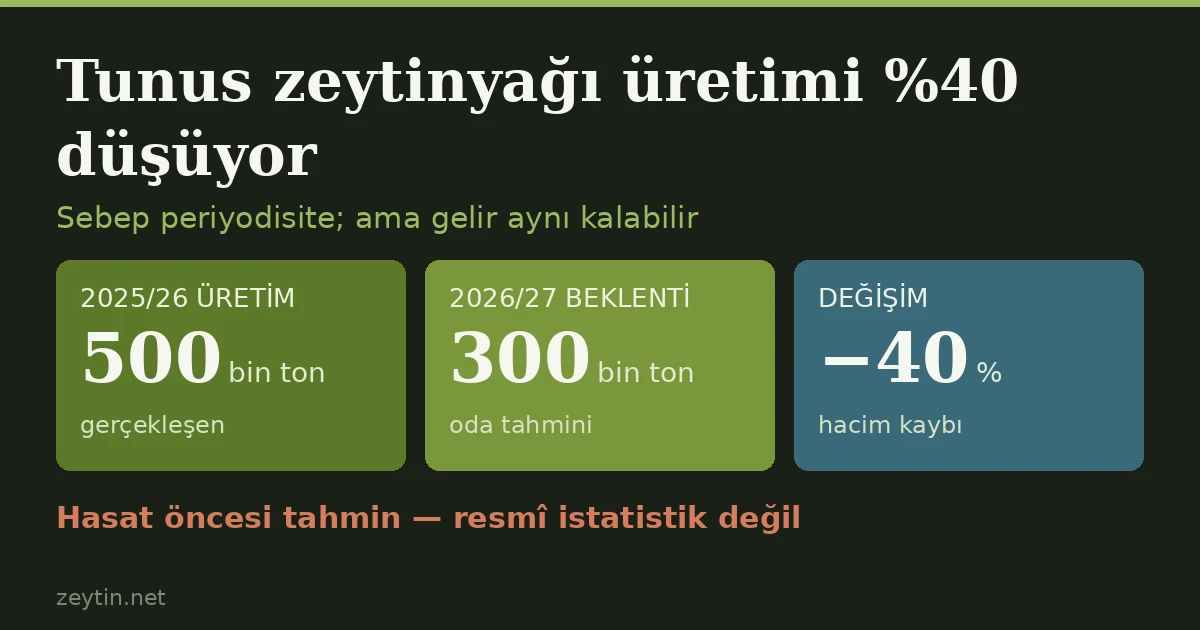
Tunisia's National Chamber of Olive Producers expects olive oil output to fall from 500,000 to 300,000 tonnes in 2026/27, citing alternate bearing. Revenue is still expected to match last season because prices are higher. Türkiye's most direct bulk competitor is shrinking.
Article
Tunisia's output falls from 500,000 to 300,000 tonnes — revenue may hold
Tunisia's National Chamber of Olive Producers expects olive oil output to fall from 500,000 to 300,000 tonnes in 2026/27, citing alternate bearing. Revenue is still expected to match last season because prices are higher. Türkiye's most direct bulk competitor is shrinking.