Olive oil or butter? What a 221,000-person study actually found
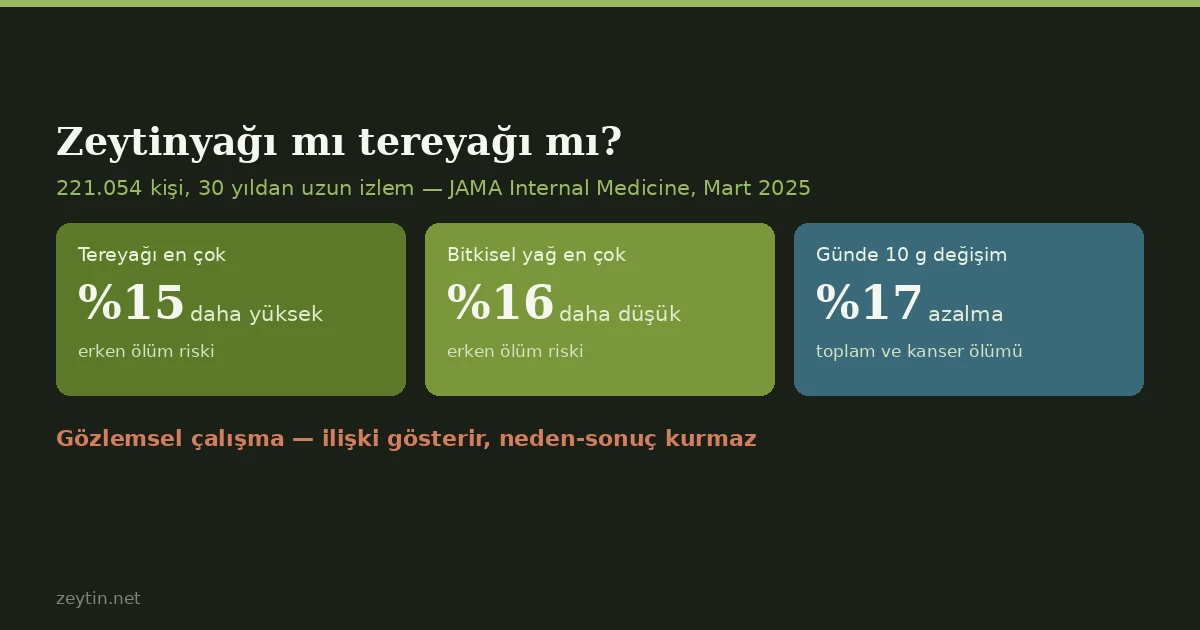
A Harvard-led study followed 221,054 people for over 30 years. Highest butter intake carried 15% higher mortality; highest plant-oil intake 16% lower. We look at what the numbers say — and what they do not.
"Olive oil or butter?" is a standing kitchen argument. A large study published in March 2025 did not settle it as a taste question — but it did measure how the two fats relate to mortality within the same dataset. Most of the figures circulating in the press come from this study, and some of them are being reported wrongly.
Below we separate what the study says, what it cannot say, and what it means at the stove.
The study
| Title | Butter and plant-based oils intake and mortality in US women and men |
|---|---|
| Authors | Yu Zhang (first author), Daniel Wang (corresponding author) — Channing Division of Network Medicine, Brigham and Women's Hospital · Harvard T.H. Chan School of Public Health |
| Journal | JAMA Internal Medicine, 6 March 2025 · doi:10.1001/jamainternmed.2025.0205 |
| Participants | 221,054 — Nurses' Health Study, NHS II and the Health Professionals Follow-up Study |
| Follow-up | More than 30 years |
Findings
- Those with the highest butter intake had a 15% higher risk of premature death than those with the lowest.
- Those with the highest plant-oil intake had a 16% lower risk.
- Replacing 10 grams a day of butter with plant-based oils was calculated to correspond to a 17% reduction in total and cancer mortality.
- The oils examined were soybean, canola and olive oil; all three were associated with lower total, cancer and cardiovascular mortality.
The mistake the press keeps making
In Turkish coverage the 15% from this study is often rendered as "people who use olive oil have a 15% lower risk of cardiovascular disease." That is wrong.
The 15% in the study is the higher mortality risk among those eating the most butter. The olive-oil-side figure is the 16% reduction, and the substitution calculation is 17%. Three separate numbers with three separate meanings; none is interchangeable with another.
What the study cannot say
This is an observational study. What people ate is self-reported, and nobody was instructed to eat anything. A causal sentence such as "butter shortens life" cannot be built from it. The sentence it supports is "higher butter consumption was associated with higher mortality."
The researchers state their own limitation clearly: participants were largely health professionals, which makes it harder to generalise to the wider population.
One further detail: the study treated olive oil in the same group as soybean and canola. So the finding is not "olive oil beats other plant oils"; it is "the picture improves when plant oils take butter's place."
The claim that olive oil is unaffected by heat
Another sentence recurs in the same coverage: that extra virgin olive oil produces no toxic compounds even at high temperatures. That is overstated.
Extra virgin olive oil is a stable fat thanks to its high oleic acid content and antioxidants — that much is true. But stable is not immune. In is olive oil suitable for frying we set out why smoke point is not the only criterion, and why how often the oil is reused and how long the heat is held matter as well.
The difference on the butter side is structural: butter is not pure fat but contains milk solids and water, and those solids brown at a relatively low temperature. In clarified butter, with the milk solids removed, that problem largely disappears — so which butter is meant also matters.
What it means in the kitchen
The study's most usable result is not a ban list but the substitution calculation: replacing 10 grams of butter a day with plant oil. Ten grams is roughly a teaspoon.
That does not mean removing butter from your life. It means making olive oil the main cooking fat and keeping butter for flavour — the same frame we set out in how much olive oil a day and olive oil and heart health.
A final reminder: studies of this kind measure dietary patterns, not single spoonfuls. Olive oil's effect is better read within the whole of the Mediterranean diet than on its own.
One rating per visitor; you can change yours at any time. Ratings are real reader votes — no seeded or default scores.
Related
 Article
Olive oil and brain health: what a 92,000-person study and the randomised evidence say
The headlines about olive oil and the brain are bold; the evidence is more measured. In a 92,383-person cohort followed for 28 years, more than 7 g a day was associated with a 28% lower risk of dementia-related death. The randomised PREDIMED trial points the same way.
Article
Olive oil and brain health: what a 92,000-person study and the randomised evidence say
The headlines about olive oil and the brain are bold; the evidence is more measured. In a 92,383-person cohort followed for 28 years, more than 7 g a day was associated with a 28% lower risk of dementia-related death. The randomised PREDIMED trial points the same way.
 Article
How many calories are in an olive? By piece, portion and variety
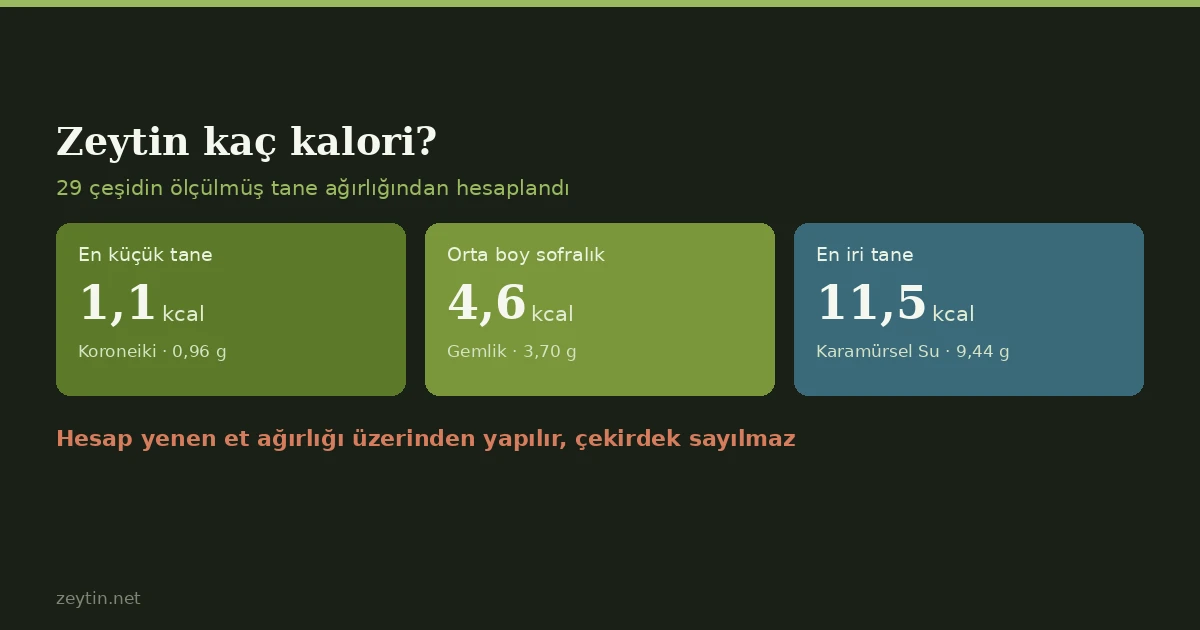
A single olive contains between 1 and 12 calories depending on variety. A table calculated from the measured fruit weight and flesh ratio of 29 varieties, portion equivalents and the calories in olive oil.
Article
How many calories are in an olive? By piece, portion and variety
A single olive contains between 1 and 12 calories depending on variety. A table calculated from the measured fruit weight and flesh ratio of 29 varieties, portion equivalents and the calories in olive oil.
 Article
How many olives should you eat a day? Portions, salt and common questions
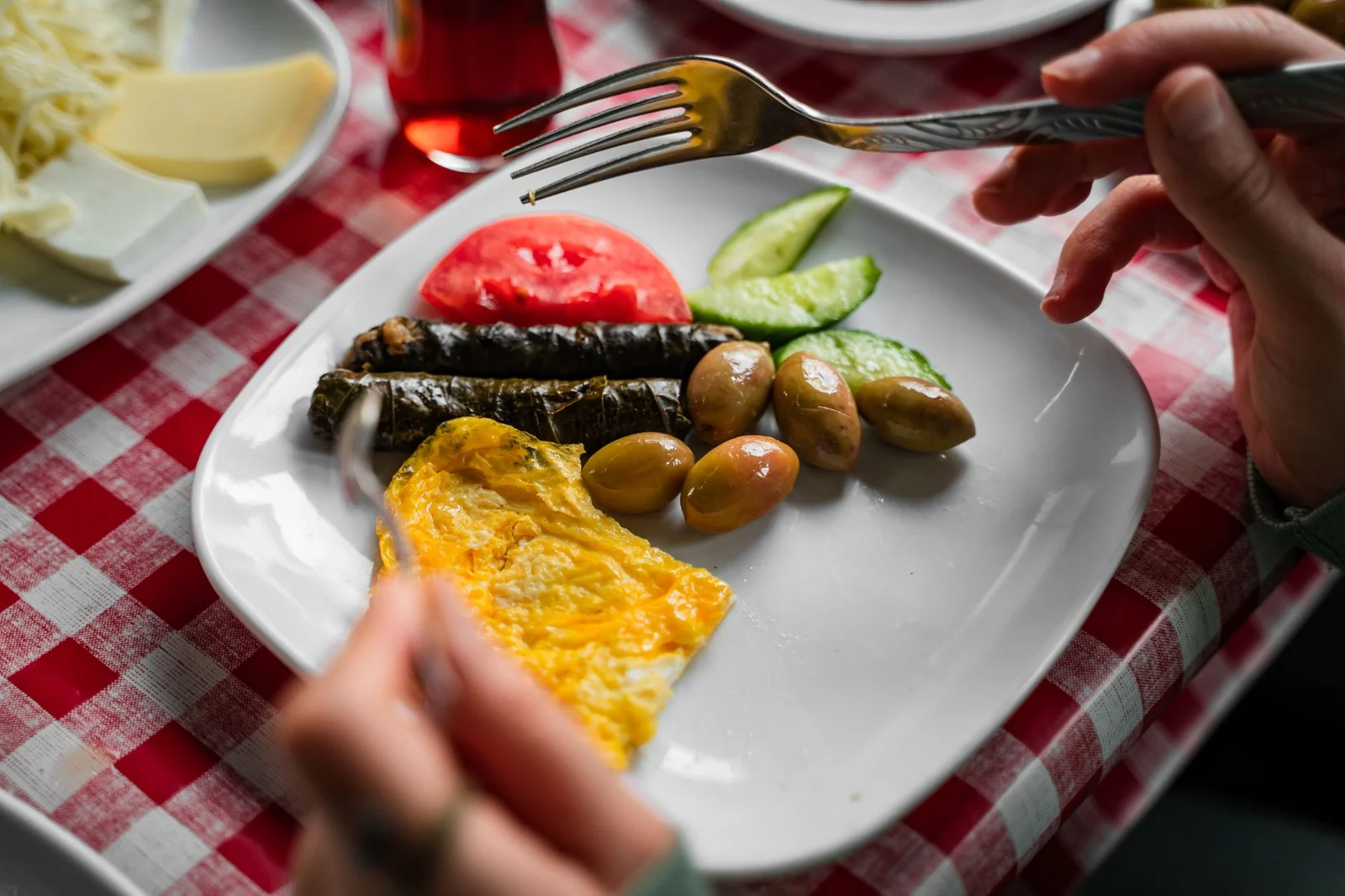
Calories, fat and salt in olives: what is a sensible daily amount? Based on nutrition data, without unauthorised health claims.
Article
How many olives should you eat a day? Portions, salt and common questions
Calories, fat and salt in olives: what is a sensible daily amount? Based on nutrition data, without unauthorised health claims.
 Article
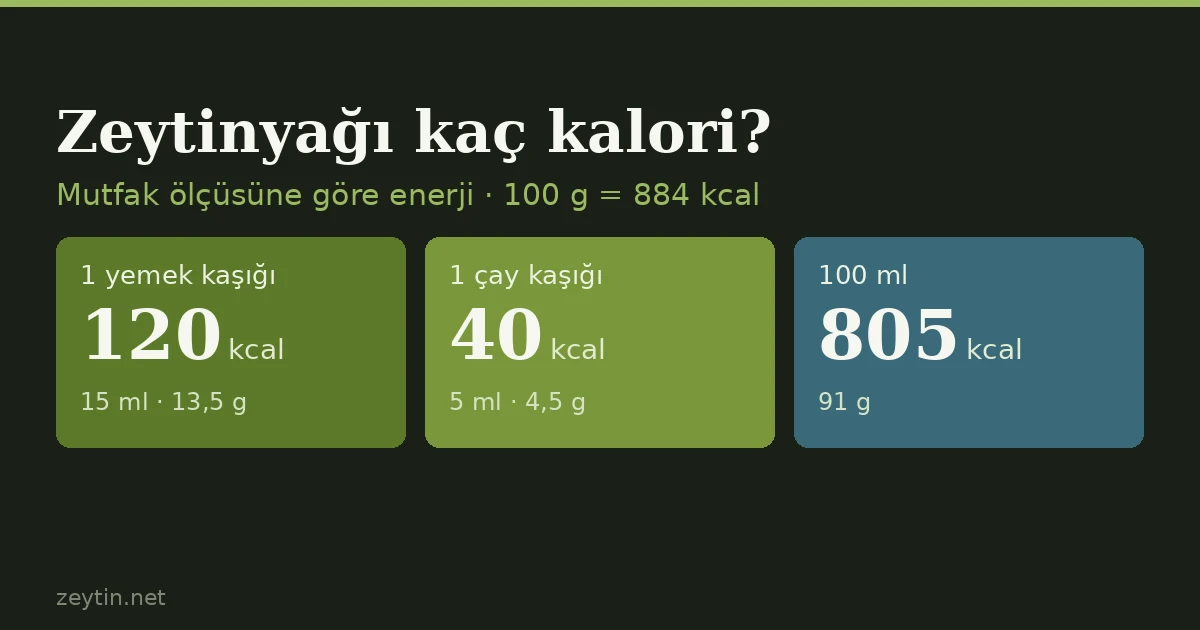
How many calories are in olive oil? Tablespoon, teaspoon and 100 ml
One tablespoon of olive oil has about 120 calories and one teaspoon about 40. Extra virgin, refined blends and sunflower oil carry almost the same energy. A measure table, plus how to count it in salads and cooked dishes.
Article
How many calories are in olive oil? Tablespoon, teaspoon and 100 ml
One tablespoon of olive oil has about 120 calories and one teaspoon about 40. Extra virgin, refined blends and sunflower oil carry almost the same energy. A measure table, plus how to count it in salads and cooked dishes.