Are olive trees irrigated in winter? In the November-March rest the tree uses little water; the real cost of a dry winter is paid in spring
An olive tree uses very little water during its winter rest, so a wet winter needs no irrigation. The problem comes when the winter is dry and the soil enters spring short of water: shoots and flower clusters form then. The article reads a Turkish irrigation guide by Ertek together with California experiments published in 1953.
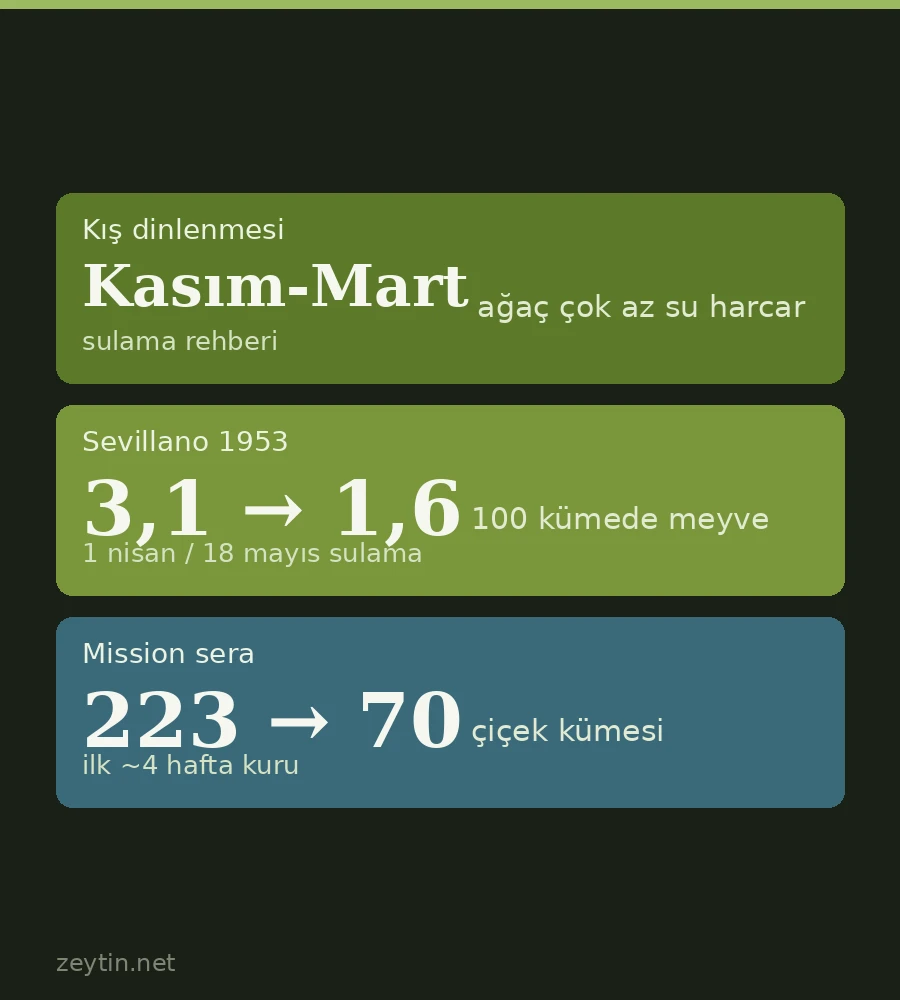
Short answer: in a wet winter an olive tree is not irrigated; in a dry winter irrigation can be "beneficial", and what really matters is that the soil does not enter spring short of water. The tree uses very little water during its winter rest, which runs from November to February-March; but if it goes short of water in early spring, when flower clusters and new shoots are forming, it pays for it with that year's crop. In this article we read two sources side by side: the irrigation guide "Zeytin Bahçelerinde Sulama" (Irrigation in Olive Groves), prepared under the supervision of Prof. Dr. Ahmet Ertek, and the experiments Hartmann and Hoffman published in California Agriculture in 1953 on soil moisture during flower development in olives.
Why does the tree use so little water in winter?
According to the guide, in a Mediterranean climate summers are hot and dry and winters mild and rainy; rainfall is concentrated in winter. The same guide says that in this period water loss from the soil by evaporation and the tree's own water use are very low, so a large part of the rain goes unused. In spring and summer, when the tree actually needs water, the soil usually does not hold enough.
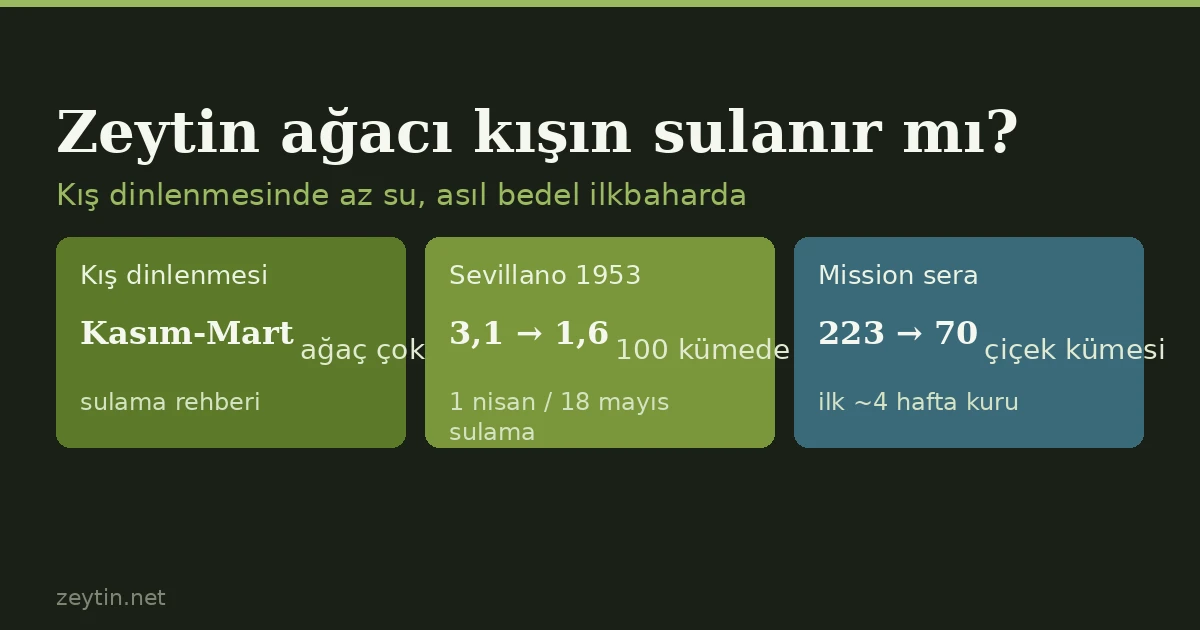
The guide also gives the calendar of the winter rest: it begins in November and lasts until February-March, during which the tree's vegetative activity is at its lowest, as are losses through transpiration and evaporation. Between November and February, then, the olive's water "demand" is close to nothing, which is why no separate irrigation is considered in an ordinary wet winter.
Where does a dry winter cause trouble?
The trouble begins when a dry winter leaves the soil unable to fill this water store. The guide states that rain falling in winter and spring is stored in the soil and meets the tree's water needs, improving flowering and fruit set and reducing the June drop. The same source says that as the weather warms, root activity increases and shoots and new growth form; if the tree cannot take enough water from the soil in this period, shoot growth slows or does not happen at all. Because flowers form on one-year-old shoots, this can carry over into the following year's crop.
This is where the "winter irrigation" debate really sits. The guide assesses winter irrigation in two separate sentences: in areas where rainfall is insufficient, for cultivation aimed at olive oil production, winter irrigation is "very important" or "largely beneficial". So it is not a requirement; it is a support for places where the rain falls short.
What was measured in California in 1953?
There is an old but clear experiment that shows this effect. According to Hartmann and Hoffman, the floral parts of the olive develop quickly: only about eight weeks, from mid-March to mid-May, separate the first microscopic sign from full bloom. The authors suspected that a lack of soil moisture during this time could harm fruit set and set up two experiments.
The first was in a Sevillano orchard in the Corning district. That year only 0.31 inches (about 8 mm) of rain fell between 21 February and 26 April; the usual spring rainfall in the district is given as about 5.7 inches. Three plots were separated by the timing of the first irrigation:
| Plot | First irrigation | Fruit per 100 flower clusters | Yield per tree |
|---|---|---|---|
| 1 | 1 April | 3.1 | 101 lb (about 46 kg) |
| 2 | 14 April | 2.3 | 113 lb (about 51 kg) |
| 3 | 18 May (after bloom) | 1.6 | 65 lb (about 29 kg) |
In Plot 3, irrigated after flowering, fruit set was about half (52 per cent) that of Plot 1, and yield per tree stayed at 64 per cent of Plot 1 and 58 per cent of Plot 2 (our calculation). Note that the yield ranking did not exactly follow the fruit-set ranking: Plot 2 yielded slightly more than Plot 1, and the article does not explain this in the table. The authors report that the trees irrigated in early April set fruit markedly better and that early irrigation raised yield markedly. Light, intermittent rain totalling 1.9 inches between 28 April and 7 May did not penetrate deep into the soil and had no effect because the flower buds were already almost ready to open.
The second was with potted Mission olives in a greenhouse. Three-year-old trees were split into three groups: Group 1 had ample water throughout flower development; Group 2 was held near wilting moisture for about four weeks and Group 3 until fruit set was finished.
| Measure | Group 1: ample water | Group 2: dry first ~4 weeks | Group 3: dry throughout |
|---|---|---|---|
| Flower clusters per tree at full bloom | 223 | 70 | 94 |
| Clusters dropped before bloom (%) | 3 | 38 | 28 |
| Average flowers per cluster | 12.3 | 7.6 | 8.1 |
| Perfect (pistillate) flowers (%) | 54.7 | 8.5 | 12.0 |
| Fruit per 100 clusters | 7.2 | 0.0 | 0.0 |
Group 2, dry for the first four weeks, could not catch up with the well-watered group even when the soil was wetted afterwards: its cluster count fell from 223 to 70 (31 per cent) and it set no fruit at all. The authors summarise the result this way: trees short of water during the early period when the floral parts are forming become less fruitful, and when trees dry out in this critical early period it makes little difference to fruitfulness whether water is supplied later. The greatest effect was seen between the moment the flower clusters first became visible and the point at which they reached about an inch in length.
What irrigation plan does the guide suggest, by winter rainfall?
Ertek's guide ties irrigation to the amount of winter rain. It says the 400-600 mm of water requirement for oil olives applies only to mature groves that have received at least 500 mm of winter rain up to the start of spring, and it advises avoiding water shortage during flowering. The plan is:
- In districts with about 500 mm of winter rain, irrigation is applied twice: at pit hardening and after it.
- If winter rainfall is insufficient, three times: in early spring during flower-bud differentiation, in early summer at the start of flowering, and in the fruit-formation stage when pit hardening begins. As another option the guide lists irrigating 2-3 weeks before flowering, when the fruit reaches one third of normal size and when it reaches full size.
What stands out here is that the first irrigation proposed for a dry winter is asked for not in January but in early spring. In other words, according to the guide, if the winter is dry the job is not to leave the tree short of water at the start of spring.
What to watch if you do irrigate
The guide says irrigation should begin three weeks after the last effective rain. It adds that in cold-winter districts giving the tree too much water at the end of summer or in autumn should be avoided, because shoots that have not fully matured can be damaged by cold. Excess water is a separate risk too; we explained in detail how roots can suffer in poorly drained soil in our article on flooded olive trees. The signs of water shortage and what can be done in a dry year are in an olive tree without water, and the details of drip irrigation and the water plan by stage are in the olive irrigation guide. The effect of winter cold on the tree is a separate subject: frost damage.
Limits of this reading
- The publication date of the Ertek guide is not given in the document; the newest source in its bibliography dates from 2019. Its recommendations are general and make no distinction by region or variety.
- The California experiments date from 1953 and used a single variety (Sevillano) in the field and three-year-old potted Mission trees; they cannot be applied directly to a grove in Turkey. What they show is a tendency: a water shortage in early spring disturbs flowering.
- No source gives a winter irrigation dose of the "give this many litres in January" kind; so we do not give such a figure either.
- The irrigation decision depends on soil, slope and water source; the advice of the local chamber of agriculture or provincial directorate takes precedence over this general reading.
Summary
In a wet winter an olive tree is not irrigated; from November to February-March the tree uses almost no water. If the winter is dry, the damage shows not in winter but in early spring, when flower clusters and shoots are forming; for that reason guides recommend the first irrigation in places short of rain in early spring, before flowering. The 1953 experiments also show that irrigation after flowering does not bring back what was lost in this early period.
One rating per visitor; you can change yours at any time. Ratings are real reader votes — no seeded or default scores.
Related
 Article
Building a high-density olive grove: five requirements
High-density planting is not a choice of variety but a five-component system — miss one and it performs worse than a traditional grove. Spacing, yields, the overlooked oil-content trade-off, and who it does not suit.
 Article
Cold-hardy olive varieties: Gemlik, Ayvalık and the other candidates in the data
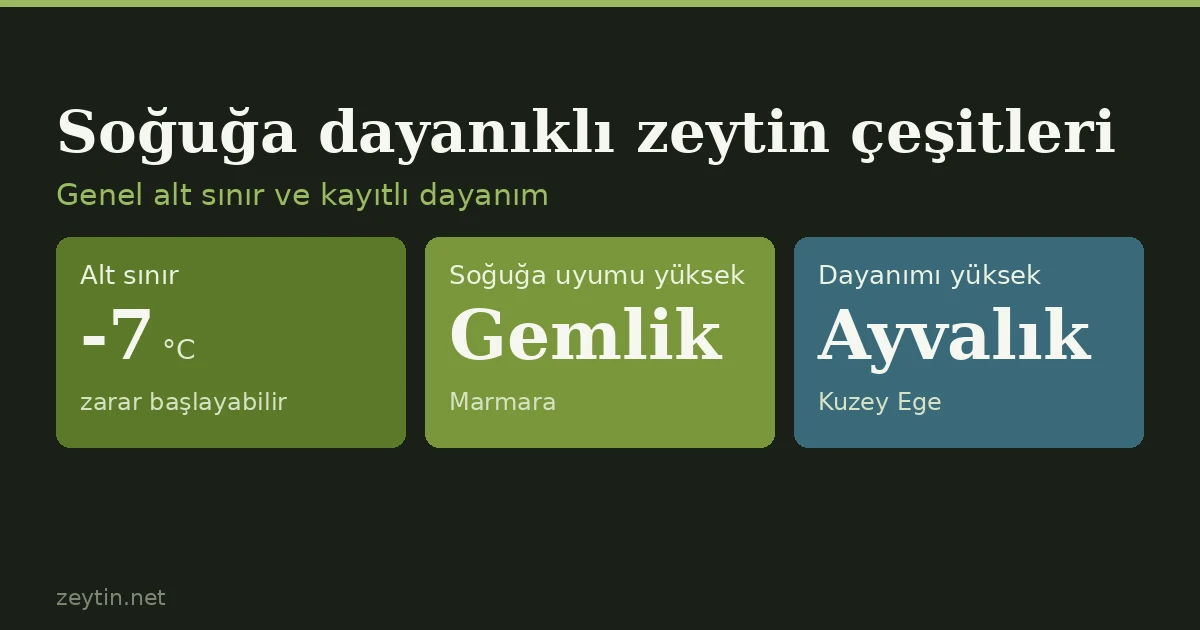
In our variety data, Gemlik, Ayvalık, Coratina, Picual and Hojiblanca are recorded with high cold adaptation or hardiness; Kalamata, Leccino, Memecik and Domat are medium, Frantoio moderately sensitive and Saurani low. But variety alone is not enough: tree age, the duration of the cold and the site of the grove also decide.
 Article
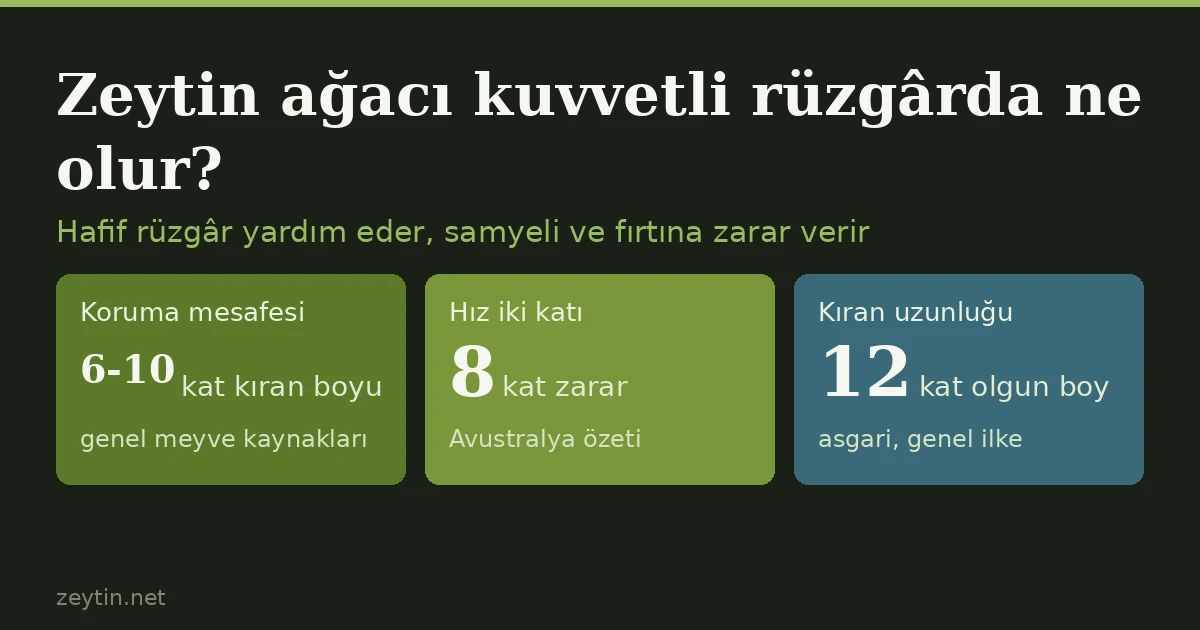
What does strong wind do to an olive tree? Broken branches, drying wind, salinisation and protection
Wind both helps and harms olives depending on the season: a light breeze in April and early May aids fertilisation, the drying samyeli of late May spoils it, storms break branches and topple trees, and sea wind salinates the soil. The article rests on a review from the Olive Research Institute and states plainly that no olive-specific windbreak dimensions were found.
 Article
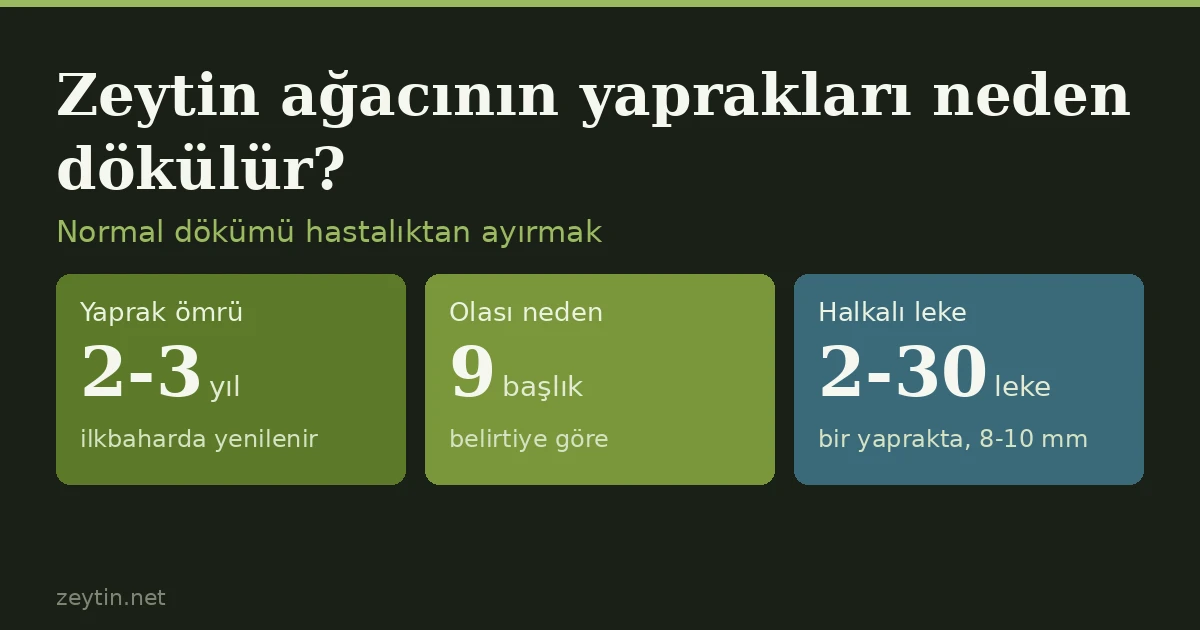
Why is my olive tree dropping its leaves?
An olive leaf lives two to three years and falls in spring along with the new growth; that is normal. The worrying drop is the one whose season, location or amount does not fit. Rings on the upper surface point to peacock spot, grey patches underneath to Cercospora leaf spot, dieback on one branch to Verticillium, one-sided yellowing to root rot. Water, nutrient deficiencies, scale insects, frost and lack of light also make olives shed leaves. How to tell them apart, and what to do.