Adulterated olive oil costs more than the real thing: price is no longer a sign of authenticity
Diker, president of the Edremit Chamber of Agriculture, says adulterated oils sold online now exceed the wholesale price of genuine oil: wholesale starts at 240 lira, the fake sells above 300. Our exchange data complicates the picture — genuine extra virgin in Aydın is already 307.60 lira.
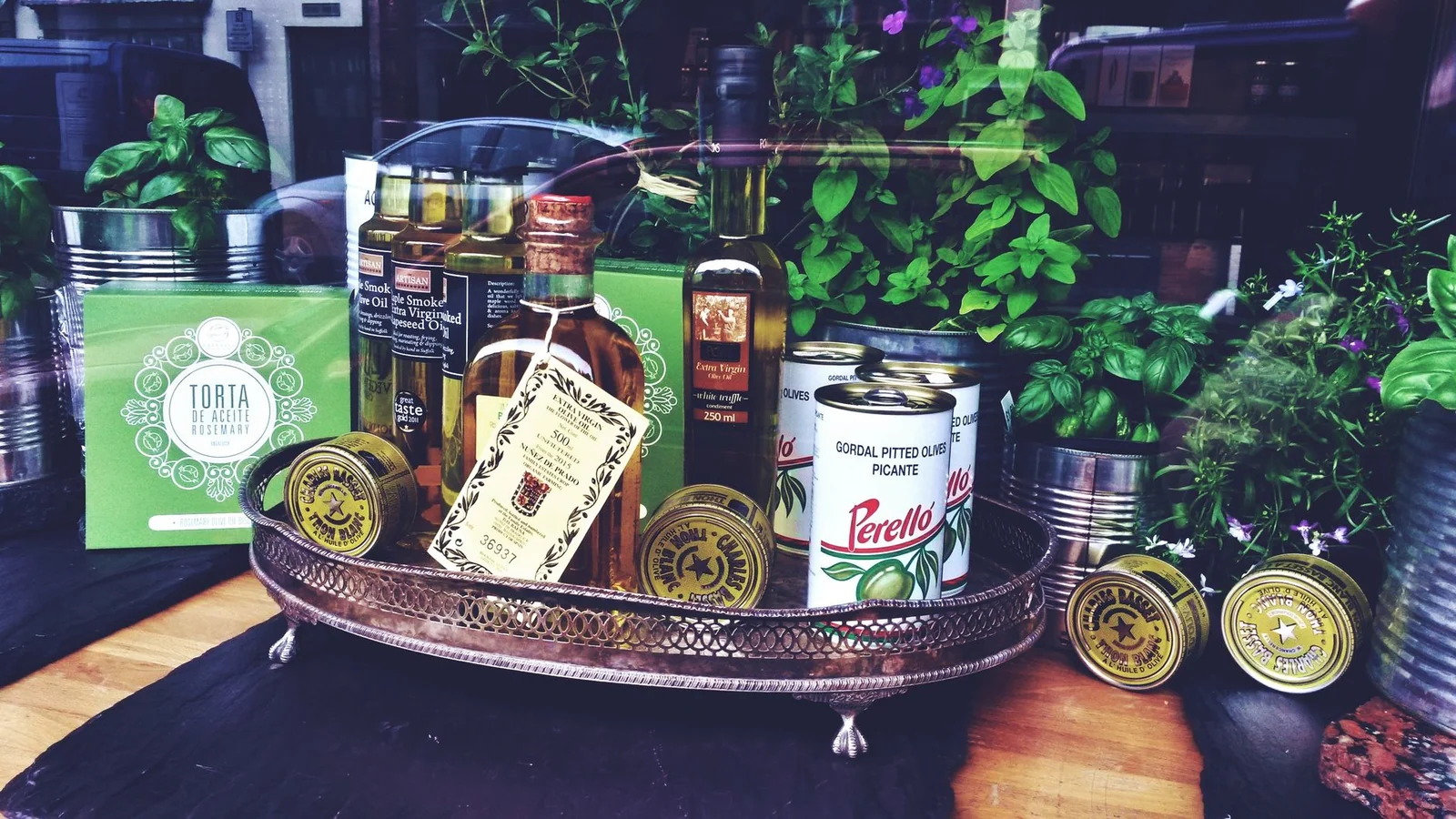
The measure consumers trust most in olive oil is price: if it costs more, it must be real. A market survey before the new season turns that assumption around.
Diker, president of the Edremit Chamber of Agriculture, announced that adulterated olive oils sold online are priced above the wholesale price of genuine oil bought from producers. The two figures given: wholesale olive oil starts at 240 lira, while fake and adulterated oils sell online above 300 lira.
What does exchange data say?
Set the claim against our own price records. Registered averages for extra virgin olive oil on the commodity exchanges:
| Exchange | Extra virgin | Date |
|---|---|---|
| Aydın | TRY 307.60 | 18.08.2026 |
| Edremit | TRY 254.33 | 25.08.2026 |
| Nazilli | TRY 201.09 | 19.08.2026 |
"Wholesale starts at 240 lira" fits that table: Nazilli at 201, Edremit at 254 — the lower band sits about there.
But the top row shows the matter is more complicated. Genuine extra virgin on the Aydın exchange is already TRY 307.60 — above the level at which the "fake" is said to sit. On the same day, in the same country, the exchange price of the real product ranges between 201 and 308.
The real problem: the price signal has broken
The conclusion is not "fake is expensive". It is something more troubling: the price you see on a shelf or online no longer bears a relation to whether the product is genuine.
It fails in both directions:
- What is cheap may be fake — the classic risk, familiar to everyone.
- What is expensive may also be fake — because the seller sets the price not from cost but from the buyer's reflex that "expensive means good". In adulteration the cost is low and the margin high; pushing the price above 300 is a positioning decision, not a cost one.
With exchange prices swinging between 201 and 308, the consumer has no reference point either. Is a bottle at 280 lira expensive or cheap — measured against which exchange?
What to look at instead of price
Diker's warning is sound: do not go by price alone, but attend to the product's source, its producer and its reliability. In practice that means:
- Is the harvest date on the label? In extra virgin oil this is the single most informative piece of data. If it is missing, ask why.
- Are the producer and the business registered? Online, the seller's name and the producer's name are often different.
- Does it carry a geographical indication? A registered name means an inspection body and reporting at least once a year — we set out that system in detail in the Edremit Zeytinyağı registration.
- Is an analysis certificate available? Free acidity and peroxide values are the basic measures of whether the oil is genuinely extra virgin.
We explained how adulteration is done and which oils are blended in a separate article. Reading exchange prices is another matter; we covered why confusing volume with the crop misleads in trading volume is not the harvest.
The timing is not accidental
That the statement comes before the new season matters. Stocks run down before the harvest starts and the new crop is not yet on the market. This narrow window of tight supply is the most favourable period for adulteration: demand continues, genuine product grows scarce, prices rise — and a high price is itself read as a sign of trust.
That gap closes when the new harvest arrives. Until then the consumer's only real protection is not price but documentation and traceability.
How is adulteration caught? The sterol fingerprint
If price does not work, what does the laboratory do? The measure that carries olive oil's identity is the sterol profile — the ratio of sterol compounds in the oil. That ratio differs from plant to plant and is disturbed by blending.
Geographical indication registrations write this profile into the definition. The Akhisar Domat Zeytinyağı document, for instance, sets these limits:
| Criterion | Value | What it catches |
|---|---|---|
| β-sitosterol | 86.20 – 87.64% | olive oil's principal sterol |
| Total sterols | ≥ 1000 mg/kg | dilution |
| Erythrodiol + uvaol | ≤ 3.0 | pomace oil blending |
| Brassicasterol | ≤ 0.1 | rapeseed/canola blending |
The last two rows exist specifically to detect adulteration.
Erythrodiol and uvaol come from the stone and skin of the olive; they are low in extra virgin oil and high in pomace oil. A rise in the ratio signals that pomace oil has been blended into something sold as extra virgin. Where the codex allows 4.5, the registration holds it at 3.0 — a narrower gate for the registered product than the codex requires.
Brassicasterol is effectively absent from olives; it is the characteristic sterol of rapeseed oil. Above 0.1% indicates cheap seed oil in the blend.
Adulteration is therefore not opaque: which oil was blended can be read from the sterol table. The laboratory does what a consumer cannot do by looking at a bottle — but that requires the product to have an analysis certificate.
Why online in particular?
The emphasis on "sold online" in Diker's statement is not incidental. Three protections weaken at once in digital sales:
- No physical inspection. Colour, clarity and the bottle's light transmission cannot be seen.
- Seller and producer separate. On a shelf there is a brand; online there is often an intermediary seller account, with no producer name visible.
- The inspection surface scatters. A product checked at a single point in a supermarket is spread across hundreds of seller accounts online.
With those three together, using price as a "quality signal" becomes a low-risk strategy for the seller.
One rating per visitor; you can change yours at any time. Ratings are real reader votes — no seeded or default scores.
Related
 Article
Palestinian olive oil: output down from 33,000 to 7,000 tonnes — the cause is access, not the crop
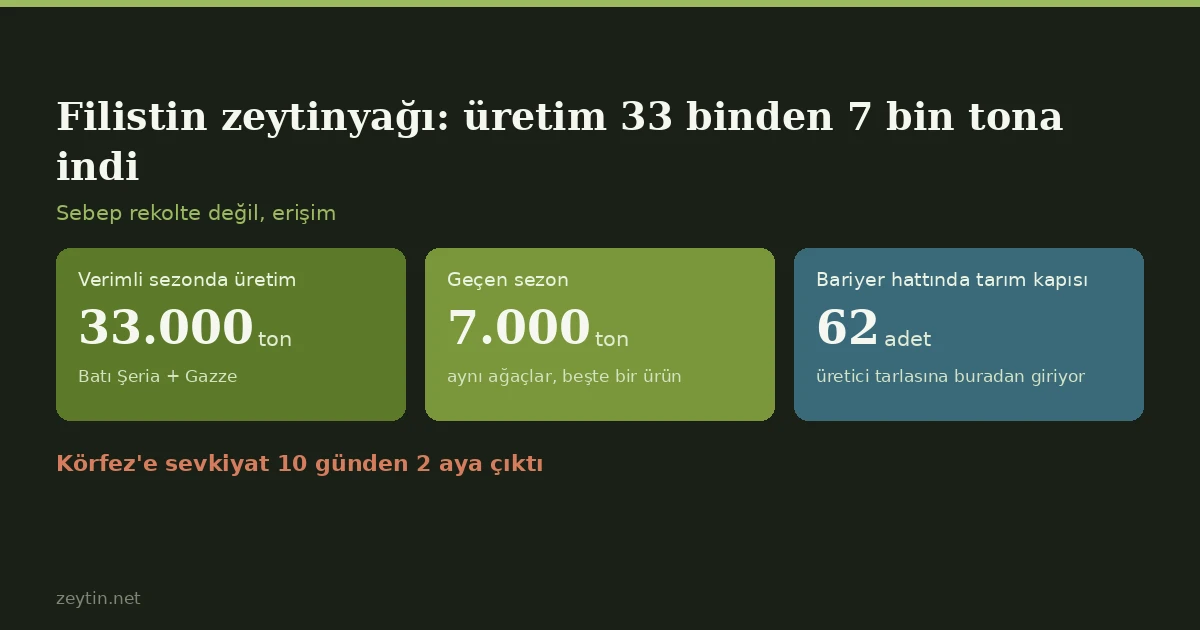
In a productive season Palestine yields 33,000 tonnes of olive oil; last season it produced 7,000. Seventy per cent of the groves sit in the northern West Bank, reached through 62 agricultural gates, and shipping times have gone from ten days to two months.
Article
Palestinian olive oil: output down from 33,000 to 7,000 tonnes — the cause is access, not the crop
In a productive season Palestine yields 33,000 tonnes of olive oil; last season it produced 7,000. Seventy per cent of the groves sit in the northern West Bank, reached through 62 agricultural gates, and shipping times have gone from ten days to two months.
 Article
Gaza's olive report: 150,000 trees left of two million, production down 87.5%
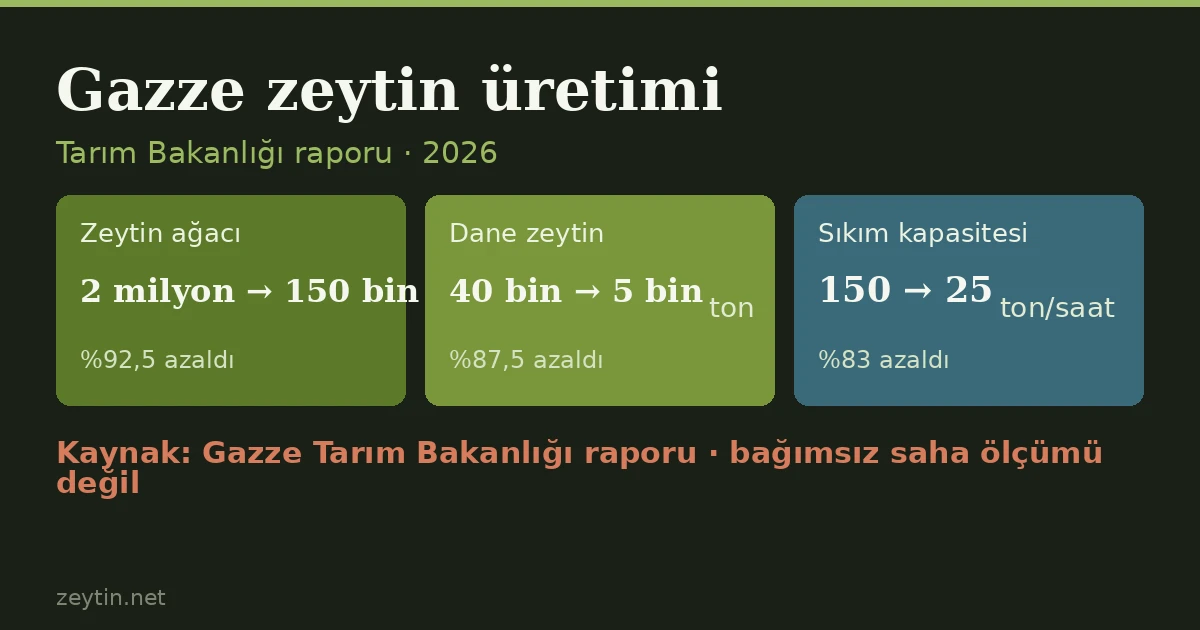
According to a report from Gaza's Ministry of Agriculture, olive groves have shrunk from 50,000 dunums to 5,000 and the olive crop from 40,000 tonnes to 5,000. The loss is not confined to the grove: milling capacity has fallen from 150 tonnes an hour to 25, and the number of growers from 20,000 to 1,000.
Article
Gaza's olive report: 150,000 trees left of two million, production down 87.5%
According to a report from Gaza's Ministry of Agriculture, olive groves have shrunk from 50,000 dunums to 5,000 and the olive crop from 40,000 tonnes to 5,000. The loss is not confined to the grove: milling capacity has fallen from 150 tonnes an hour to 25, and the number of growers from 20,000 to 1,000.
 Article
Italy's protest widens: thousands of growers in Bari, mills idle in Sicily, still no crisis status
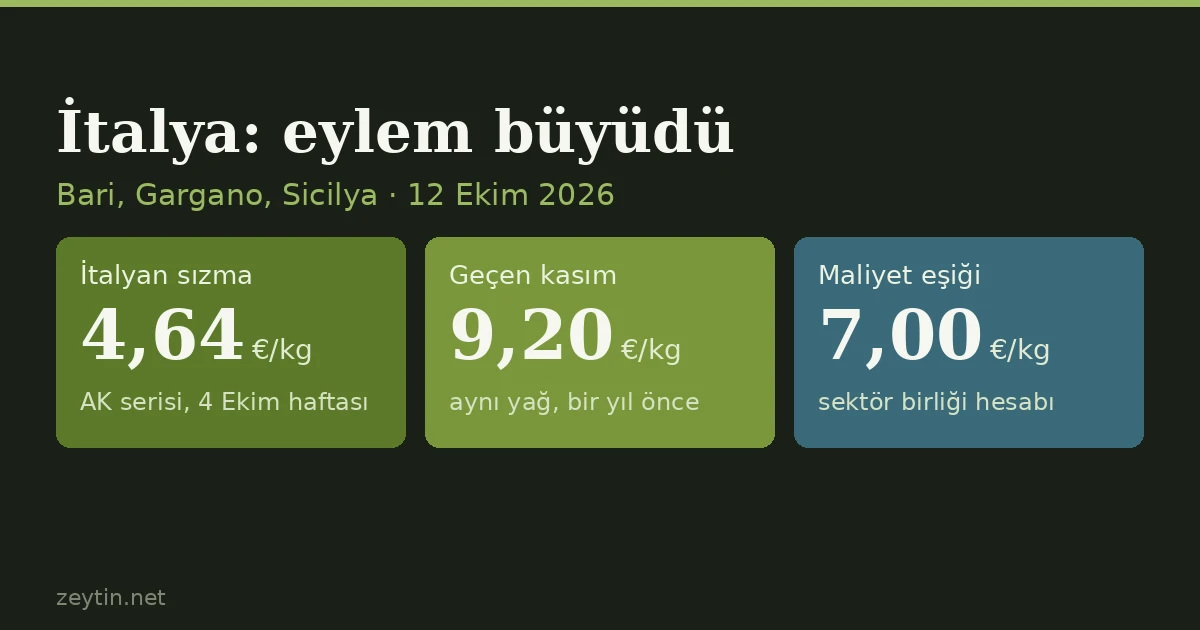
The deadline given in Puglia expired without crisis status being granted: on 12 October thousands of growers gathered in front of the Bari prefecture, hundreds of tractors blocked roads on the Gargano, and harvesting and milling have been suspended since 5 October across nine municipalities in Sicily. Two of the four demands concern anti-fraud controls and an electronic transport document for olives. In the European Commission series, Italian extra virgin stood at 4.64 €/kg in the week of 4 October; the figure quoted in the field is 4 euros, against 9.20 € last November. The next threshold is 15 October.
Article
Italy's protest widens: thousands of growers in Bari, mills idle in Sicily, still no crisis status
The deadline given in Puglia expired without crisis status being granted: on 12 October thousands of growers gathered in front of the Bari prefecture, hundreds of tractors blocked roads on the Gargano, and harvesting and milling have been suspended since 5 October across nine municipalities in Sicily. Two of the four demands concern anti-fraud controls and an electronic transport document for olives. In the European Commission series, Italian extra virgin stood at 4.64 €/kg in the week of 4 October; the figure quoted in the field is 4 euros, against 9.20 € last November. The next threshold is 15 October.
 Article
Orhangazi olive oil starts on the road to geographical indication, with samples to be tested for acidity and polyphenols
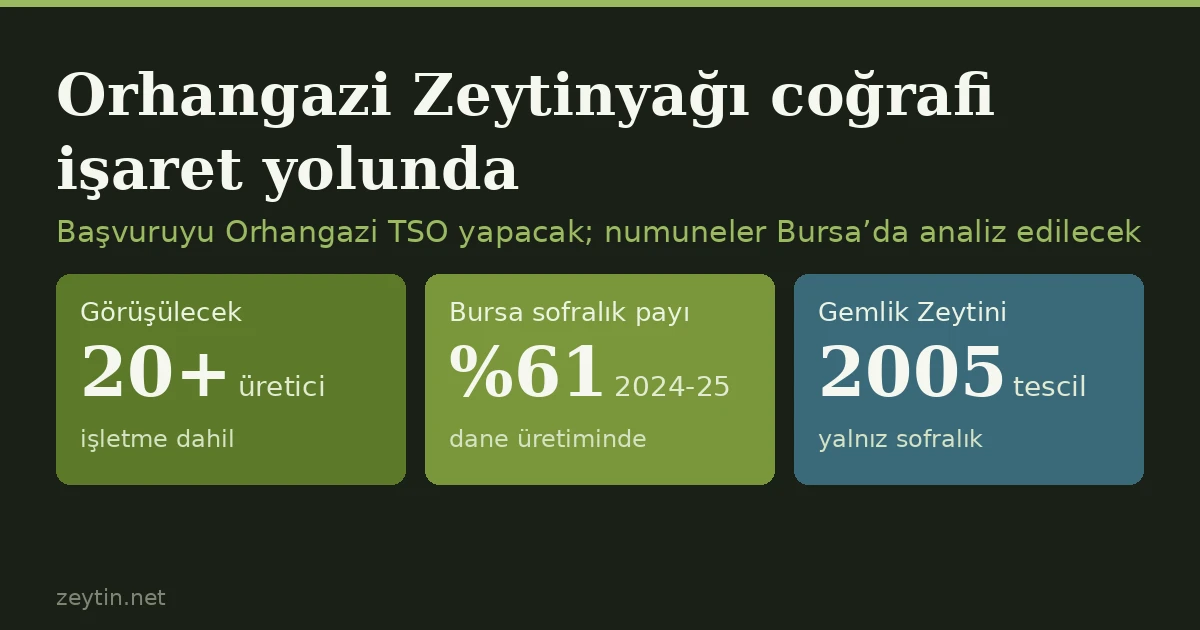
The Orhangazi Chamber of Commerce and Industry has begun preparing a geographical indication application for "Orhangazi Olive Oil". More than 20 producers will be consulted, samples tested in Bursa and the influence of the Lake İznik basin studied. The area's Gemlik Olive registration covers only table olives.
Article
Orhangazi olive oil starts on the road to geographical indication, with samples to be tested for acidity and polyphenols
The Orhangazi Chamber of Commerce and Industry has begun preparing a geographical indication application for "Orhangazi Olive Oil". More than 20 producers will be consulted, samples tested in Bursa and the influence of the Lake İznik basin studied. The area's Gemlik Olive registration covers only table olives.