Tunisia exported 368,000 tonnes of olive oil — but earned less per tonne
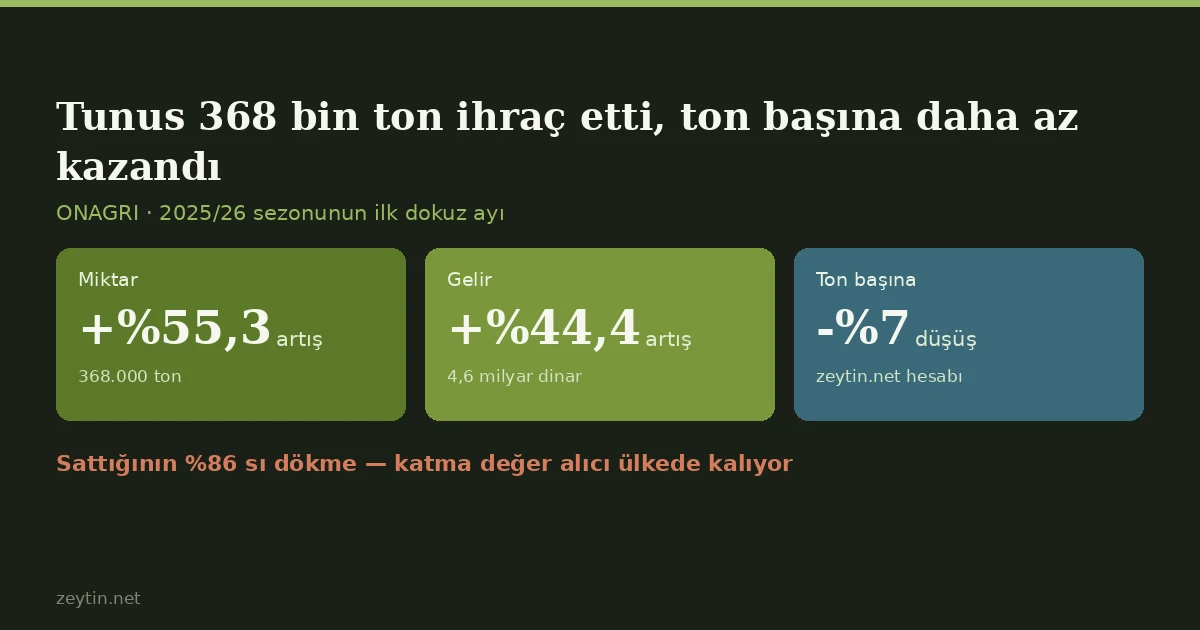
Tunisia's agriculture observatory ONAGRI reports olive oil exports up 55.3% by volume and 44.4% by value in the first nine months of 2025/26. The gap between the two means about 7% less earned per tonne.
Tunisia's National Observatory of Agriculture, ONAGRI, has published olive oil export figures for the first nine months of the 2025/26 season. They matter here because Tunisia is one of Turkey's most direct competitors in bulk olive oil.
The figures
| Indicator | 2025/26, first 9 months | Change |
|---|---|---|
| Volume exported | 368,000 t | +55.3% |
| Export revenue | TND 4.6053 bn | +44.4% |
| Bulk share (volume) | 86% | — |
| Bulk share (revenue) | 81.4% | — |
| Packaged share (volume) | 14% | — |
| Packaged share (revenue) | 18.6% | — |
| Organic olive oil | 51,200 t | ~TND 673.4 m |
ONAGRI also reports that the average export price rose 1.4% in July 2026 against the same month a year earlier.
What the coverage missed: revenue per tonne fell
Read one at a time, the figures look good: both volume and revenue are up. But they are not up at the same rate.
If volume rose 55.3% and revenue 44.4%, then revenue per tonne moved as follows:
t; 1.444 ÷ 1.553 = 0.930 → a fall of about 7%
Tunisia sold far more oil than last year and earned less on each tonne of it. This is the familiar effect of a bumper crop on price: as supply rises, unit value falls. It is the mirror image of the mechanism we described in how Spain's drought set the price in Türkiye.
The real story: bulk versus packaged
The most instructive pair of rows in the table:
- Bulk: 86% of volume, 81.4% of revenue
- Packaged: 14% of volume, 18.6% of revenue
Packaged product earns roughly 1.3 times its share of volume. The gap shows where the added value ends up: oil sold in bulk is bottled in the buying country and often re-exported under that country's brand.
This is precisely Turkey's problem too. We examined the same structure in profitability in olive oil exports: selling a lot and earning little is a question of the marketing chain, not production capacity. In from tree to shelf we traced step by step where the value is created.
Tunisia proves it with numbers: the country is having the largest harvest in its history, exports are up by more than half, and yet revenue does not rise in step — because 86% of what it sells goes out in bulk.
What it means for Turkey
Three distinct effects:
1. Price pressure. More supply in the Mediterranean pulls the world price down. Tunisia's 368,000 tonnes is large enough to affect the price Turkish exporters can get.
2. Competition. In the bulk market the rival is selling to the same buyers — bottlers in Spain and Italy, for whom the country of origin is secondary and price is primary.
3. A lesson. If even Tunisia's 14% packaged share produces 18.6% of revenue, the return on enlarging that share is a calculable thing. The same question follows from Turkey's own export mix, where two-thirds of exports are table olives.
One rating per visitor; you can change yours at any time. Ratings are real reader votes — no seeded or default scores.
Related
 Article
Co-op branding in the adulteration list: one name, four separate announcements
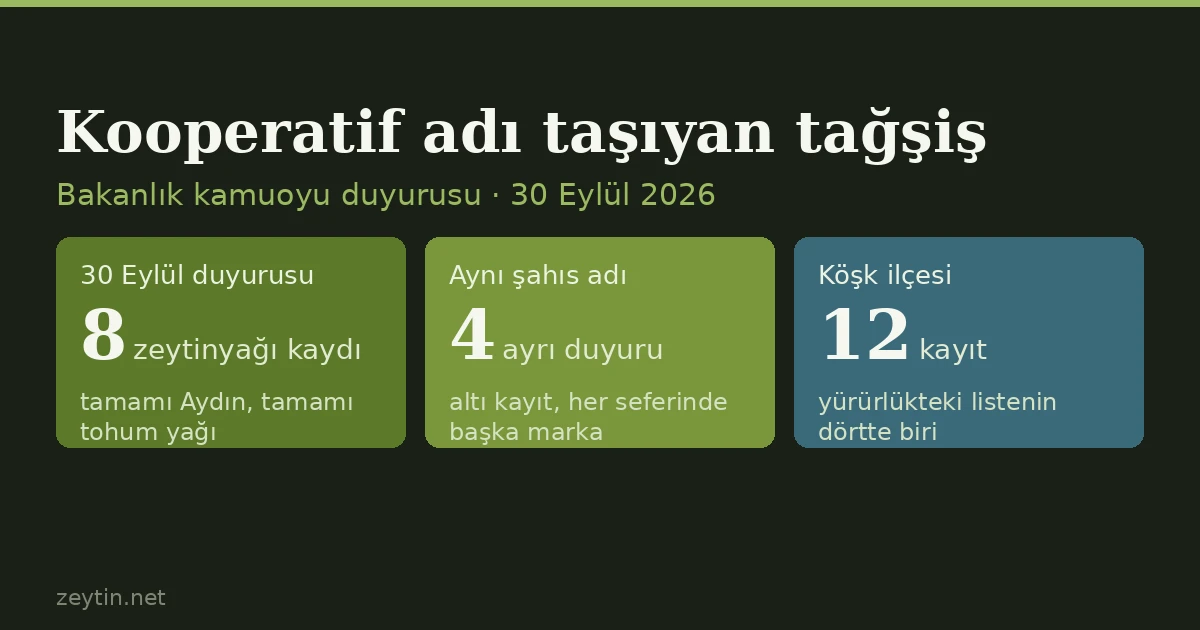
All eight olive oil entries in Turkey's 30 September 2026 food-fraud announcement come from a single province, Aydın, and all eight carry the same finding: seed oil blended into oil sold as extra virgin. The brand names tell a second story — three of them invoke a cooperative or a producers' union. Read as a time series, the live list shows one trader's name across four separate announcements, under a new brand each time.
Article
Co-op branding in the adulteration list: one name, four separate announcements
All eight olive oil entries in Turkey's 30 September 2026 food-fraud announcement come from a single province, Aydın, and all eight carry the same finding: seed oil blended into oil sold as extra virgin. The brand names tell a second story — three of them invoke a cooperative or a producers' union. Read as a time series, the live list shows one trader's name across four separate announcements, under a new brand each time.
 Article
Olive oil got cheaper in the UK and Filippo Berio lifted its share to 15%
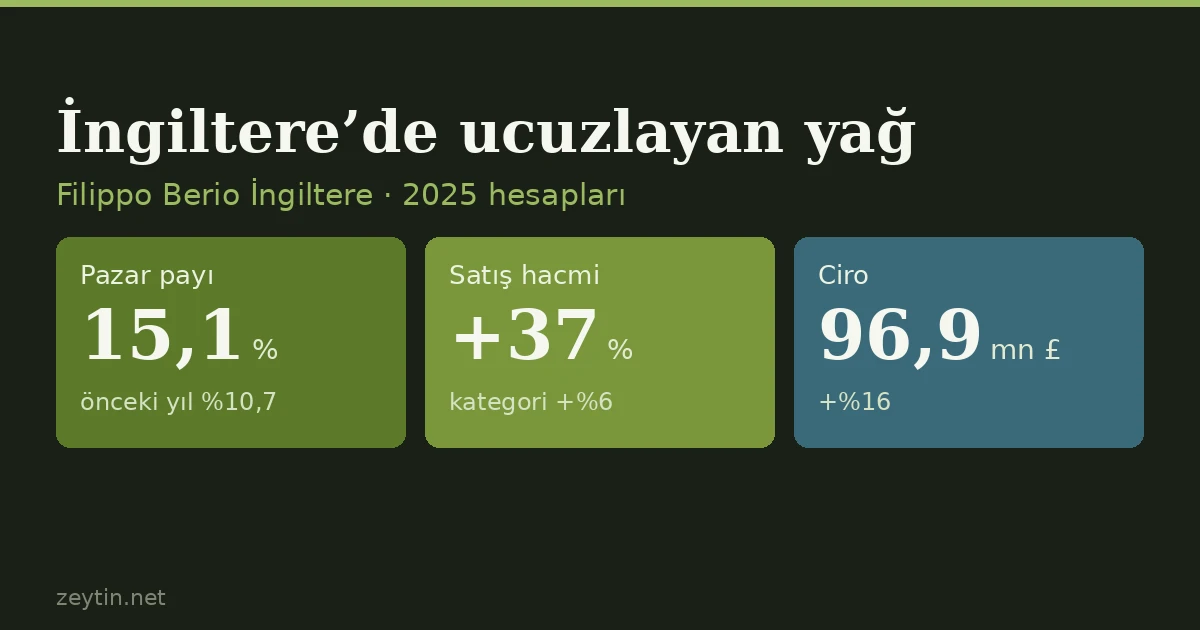
The 2025 accounts of Filippo Berio's UK company show how falling prices reached the shelf: volumes up 37%, revenue up 16%, market share from 10.7% to 15.1%. The category grew 6% and lower wholesale costs were passed on to shoppers.
Article
Olive oil got cheaper in the UK and Filippo Berio lifted its share to 15%
The 2025 accounts of Filippo Berio's UK company show how falling prices reached the shelf: volumes up 37%, revenue up 16%, market share from 10.7% to 15.1%. The category grew 6% and lower wholesale costs were passed on to shoppers.
 Article
Greece heads for 300,000 tons: first lot sold at €5.95 after last year's €7.85
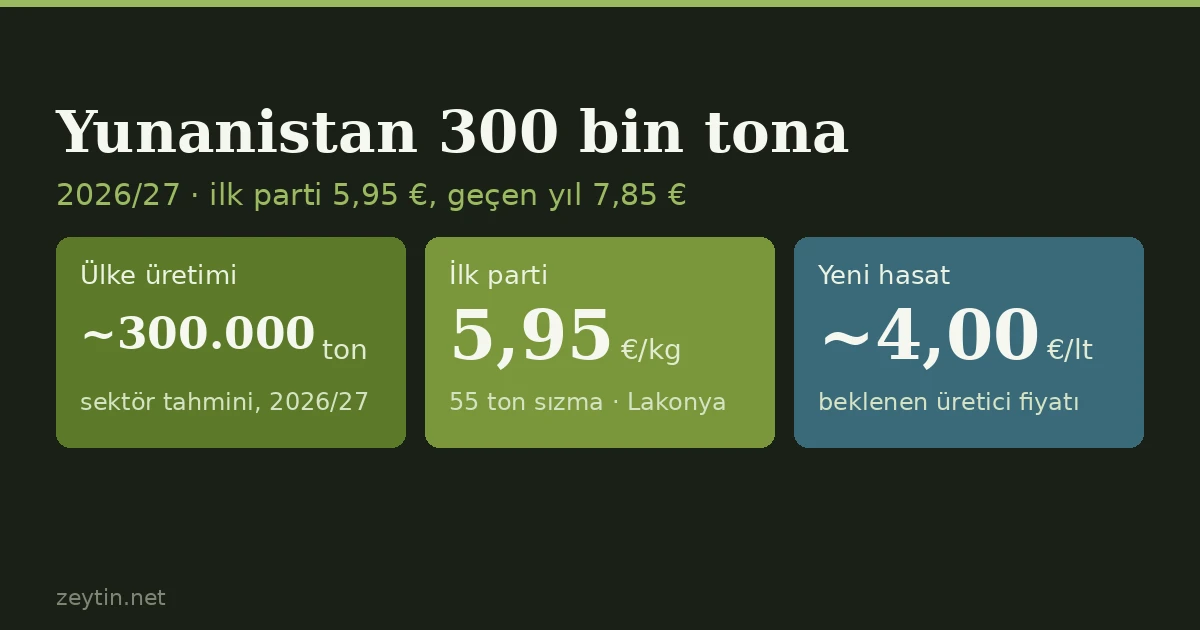
Greece expects its largest olive oil harvest since 2022/23 in 2026/27, with industry estimates near 300,000 tons. The season's first lot — 55 tons of extra virgin in Laconia — changed hands at €5.95 per kilo, down from €7.85 a year earlier. Carryover oil sells near €3.40 and new-crop producer prices are expected around €4. A simultaneous rebound across the three largest producers pushes down the world price Turkish exporters will meet.
Article
Greece heads for 300,000 tons: first lot sold at €5.95 after last year's €7.85
Greece expects its largest olive oil harvest since 2022/23 in 2026/27, with industry estimates near 300,000 tons. The season's first lot — 55 tons of extra virgin in Laconia — changed hands at €5.95 per kilo, down from €7.85 a year earlier. Carryover oil sells near €3.40 and new-crop producer prices are expected around €4. A simultaneous rebound across the three largest producers pushes down the world price Turkish exporters will meet.
 Article
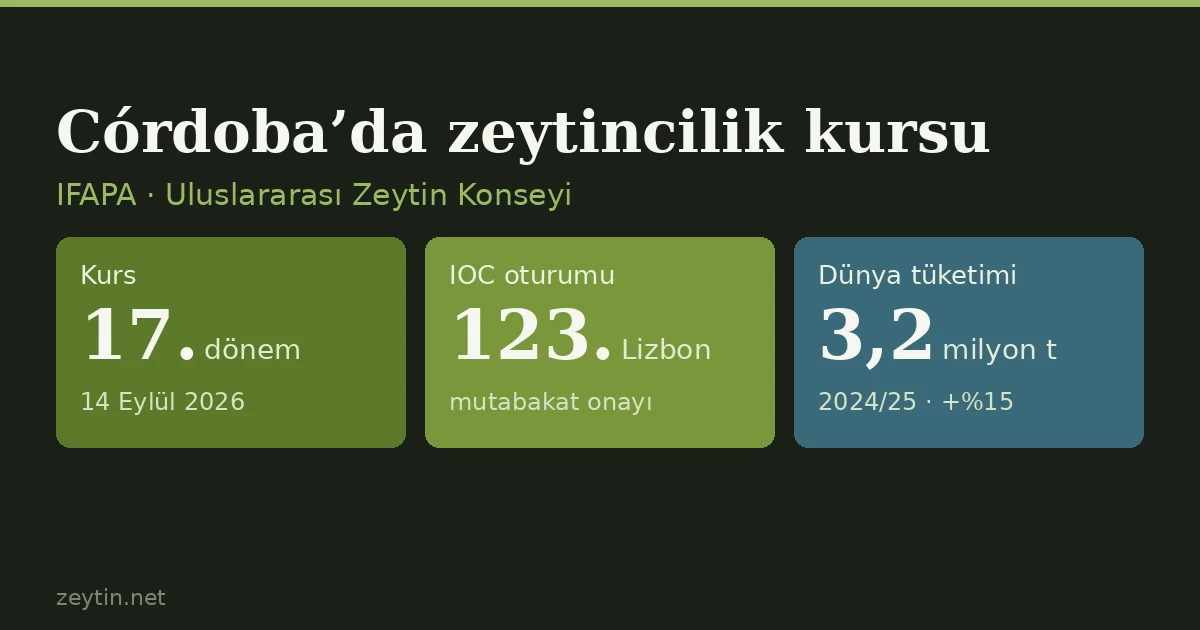
17th Advanced Course in Olive Growing opens in Córdoba as the IOC and IFAPA move towards genetic resources cooperation
Andalusia's Institute of Agricultural and Fisheries Research and Training (IFAPA) opened its 17th Advanced Specialisation Course in Olive Growing in Córdoba on 14 September, with the International Olive Council giving the opening lecture. The Council has approved signing a memorandum of understanding with IFAPA, which hosts one of the world's key olive germplasm collections.
Article
17th Advanced Course in Olive Growing opens in Córdoba as the IOC and IFAPA move towards genetic resources cooperation
Andalusia's Institute of Agricultural and Fisheries Research and Training (IFAPA) opened its 17th Advanced Specialisation Course in Olive Growing in Córdoba on 14 September, with the International Olive Council giving the opening lecture. The Council has approved signing a memorandum of understanding with IFAPA, which hosts one of the world's key olive germplasm collections.