Olive Oil Prices: Week 48 of 2026
Week 48 of 2026: Turkish exchange prices, European producer prices and exchange rates side by side.
This bulletin brings together current prices from four open sources: trades registered at Turkish commodity exchanges (TOBB), retail prices on Turkish supermarket shelves, weekly producer prices in Europe (European Commission) and exchange rates (European Central Bank). The figures below are those available when the bulletin was prepared.
Turkey: registered exchange prices
| Product | Exchange | Average TL/kg | Trade date |
|---|---|---|---|
| Extra virgin olive oil | Aydın | 220,00 | 22.09.2026 |
| Extra virgin olive oil | Edremit | 260,00 | 17.11.2026 |
| Extra virgin olive oil | Nazilli | 165,70 | 19.11.2026 |
| Crude olive oil | Aydın | 178,00 | 12.11.2026 |
| Crude olive oil | Edremit | 150,00 | 03.11.2026 |
| Crude olive oil | Gaziantep | 189,75 | 20.10.2026 |
| Crude olive oil | Nazilli | 232,88 | 27.10.2026 |
| Olive oil (cooking) | Edremit | 225,00 | 22.10.2026 |
| Black olives, extra-extra | Edremit | 270,00 | 19.06.2026 |
| Green olives, special | Aydın | 70,00 | 14.05.2026 |
| Green olives, special | Edremit | 60,00 | 11.11.2026 |
| Olives for oil | Edremit | 20,41 | 04.11.2026 |
| Black olives, brined | Aydın | 97,84 | 06.04.2026 |
| Black olives, brined | Edremit | 213,33 | 20.10.2026 |
⚠ These are not daily quotations but prices registered on the day that product actually traded; dates differ because the olive is seasonal.
Turkey: supermarket shelf
| Product | Unit | Lowest | Average | Highest | Chains |
|---|---|---|---|---|---|
| Black table olives | ₺/kg | 124,50 | 344,82 | 912,74 | 6 |
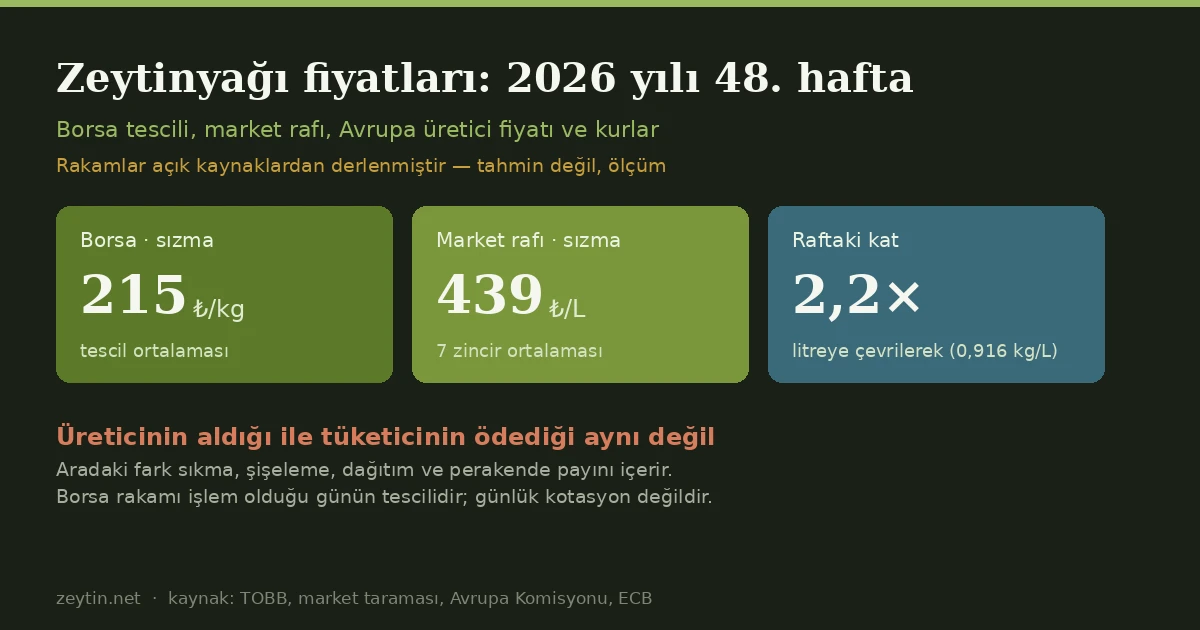
| Extra virgin olive oil | ₺/L | 249,00 | 438,84 | 1239,90 | 6 |
| Green table olives | ₺/kg | 125,56 | 418,19 | 1499,71 | 6 |
| Riviera olive oil (refined blend) | ₺/L | 199,00 | 351,75 | 879,80 | 5 |
| Olive paste | ₺/kg | 323,24 | 517,79 | 1078,68 | 3 |
Prices are stripped of package size and shown per unit: oils by the litre, table olives and paste by the kilogram. Surveyed on 22.11.2026. The exchange price is what the producer receives; this is what the shopper pays, and the gap covers milling, bottling, distribution and retail margin.
Europe: weekly producer prices (extra virgin)
| Country | €/kg | Weekly change | Week ending |
|---|---|---|---|
| Spain | 3,17 | ▼ %2,3 | 01.11.2026 |
| Italy | 5,18 | ▲ %8,4 | 01.11.2026 |
| Portugal | 3,47 | ▼ %2,2 | 01.11.2026 |
| Croatia | 9,02 | ▼ %25,0 | 01.11.2026 |
Exchange rates (20.11.2026)
- 1 EUR = 55,5788 TRY
- 1 EUR = 1,0990 USD
- 1 USD = 50,5722 TRY (cross rate)
What stands out this week
Extra virgin registrations rose in Edremit and Nazilli compared with the previous bulletin, but remain below the levels of two to three weeks ago. In Edremit the latest registration for extra virgin olive oil went from 245.30 TRY/kg on 13 November to 260.00 TRY/kg on 17 November (+6.0%); against 273.92 TRY/kg on 6 November, described in the previous bulletin, the price is still 5.1% lower, and against 304.73 TRY/kg on 26 October it is 14.7% lower. In Nazilli it went from 163.13 TRY/kg on 11 November to 165.70 TRY/kg on 19 November (+1.6%); that is 15.1% below the 195.07 TRY/kg of 2 November. The bulletin shows only the latest registration; there may have been other trades on days in between, and each line is the price of a single registration, not an average. Aydın's extra virgin line is still at 220.00 TRY/kg from 22 September; we see no new extra virgin registration from Aydın.
The rest of the exchange table is the same as in the previous bulletin. The crude olive oil lines in Aydın, Edremit, Gaziantep and Nazilli, the "yemeklik" (cooking-grade) line in Edremit and all the olive lines (oil olives, "yeşil hususi" green, black, brine-cured) show the same registrations as last week; so there is no "this week" move in these lines, only no new trade.
On the supermarket shelf the averages moved in both directions; because the number of supermarkets did not change, this may be a real price move this time, but we do not state it as certain. In all five items the number of supermarkets is the same as in the previous bulletin (olive paste 3, Riviera olive oil 5, the rest 6). The average for extra virgin olive oil fell from 467.48 to 438.84 TRY/L (−6.1%); the cheapest (249.00) and the most expensive (1,239.90) prices stayed the same, so the fall comes from the products in between. For Riviera olive oil the average fell from 360.98 to 351.75 TRY/L (−2.6%) with the ends unchanged (199.00 and 879.80). For black table olives the average slipped from 347.85 to 344.82 TRY/kg (−0.9%), ends unchanged. For green table olives the average rose from 393.33 to 418.19 TRY/kg (+6.3%); the cheapest price fell from 140.00 to 125.56 (−10.3%) and the most expensive rose from 943.17 to 1,499.71 (+59.0%). Ends moving this much suggests the products in the scan may have changed. For olive paste the average rose from 488.50 to 517.79 TRY/kg (+6.0%); the cheapest price went from 224.95 to 323.24 (+43.7%) while the most expensive is unchanged (1,078.68). With only three supermarkets in the paste scan, a change in a single product moves the average noticeably.
The European table was again not refreshed this week; exchange rates moved slightly. The rows for the four European countries are the same as in the previous bulletin and all belong to the week of 1 November, so we offer no comment on Europe. The euro went from 55.6667 TRY on 13 November to 55.5788 TRY on 20 November (−0.2%); euro/dollar went from 1.1052 to 1.0990 (−0.6%) and the dollar from 50.3680 to 50.5722 TRY (+0.4%). Any link between the exchange-rate move and the lira prices above cannot be drawn from this data.
A note on comparison
The Turkish and European figures are not directly comparable: the European data is a weekly average producer price, the Turkish data the price of individual registered trades. Anyone comparing them must also account for the exchange rate and the difference in dates.
For current tables see the market page.
One rating per visitor; you can change yours at any time. Ratings are real reader votes — no seeded or default scores.
Related
 Article
Why does olive oil foam? Is foaming oil spoiled?
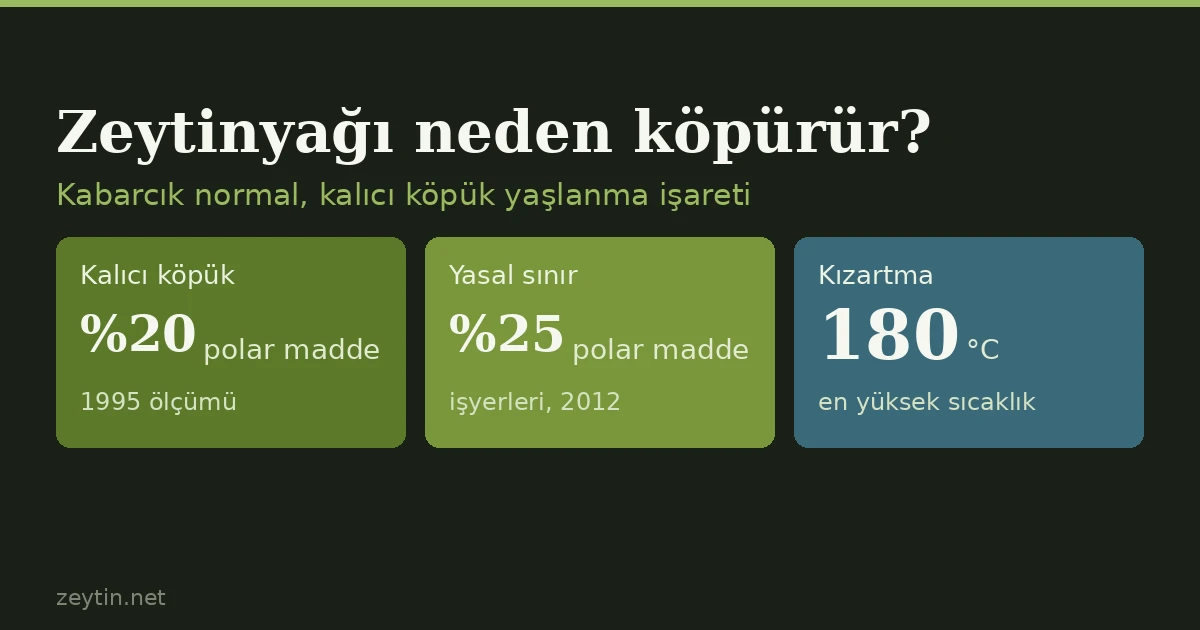
Bubbles when food goes in are steam and perfectly normal. Foam that stays after the food is out shows the oil is ageing: durable foaming starts once polar compounds pass 20%. In Turkey the limit for food businesses is 25% polar compounds and 180 °C.
 Article
When does new-harvest olive oil come out, and when should you buy it?
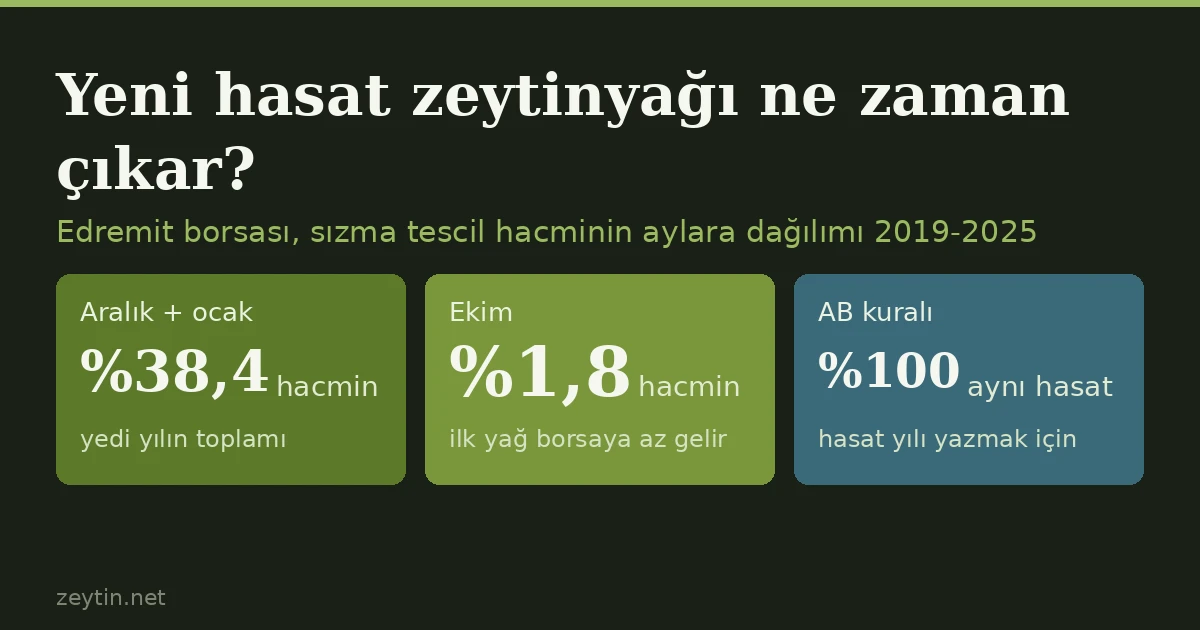
In Turkey the first new-season oil appears in October, mostly early harvest; the bulk arrives between November and January depending on region. At the Edremit exchange 38.4% of seven years' extra virgin volume was registered in December–January, only 1.8% in October. Turkish rules say nothing on harvest year; the EU allows it only if 100% comes from one harvest.
 Article
Olive Oil Prices: Week 37 of 2026
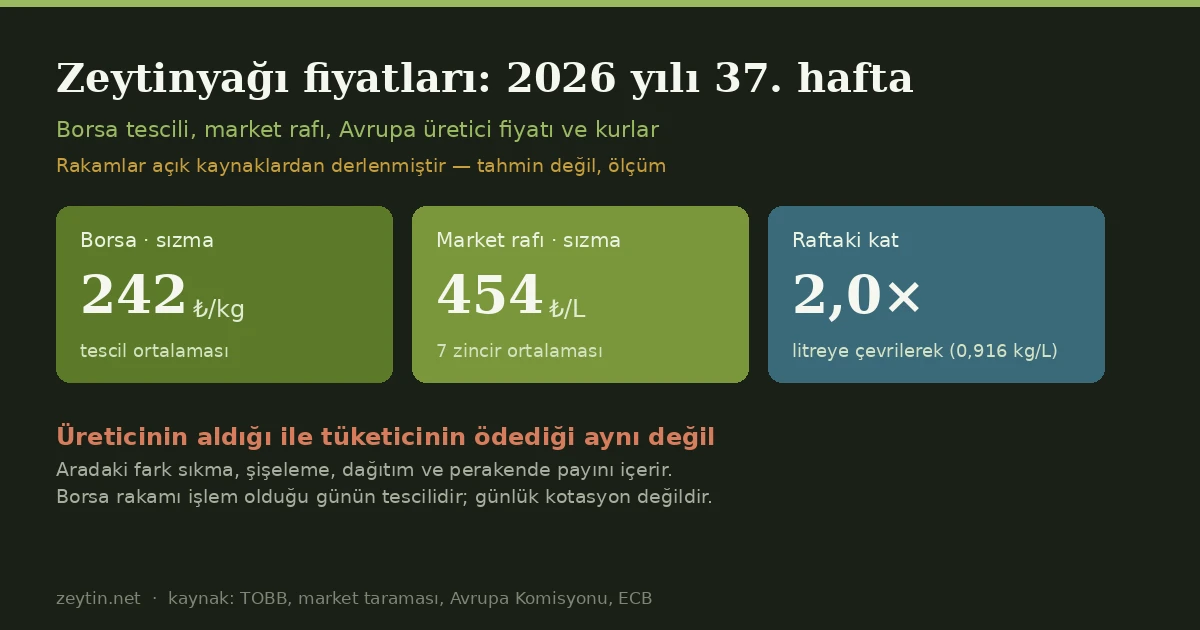
Week 37 of 2026: Turkish exchange prices, European producer prices and exchange rates side by side.
 Article
What is stone-pressed olive oil? Stone mills, presses and what the label means
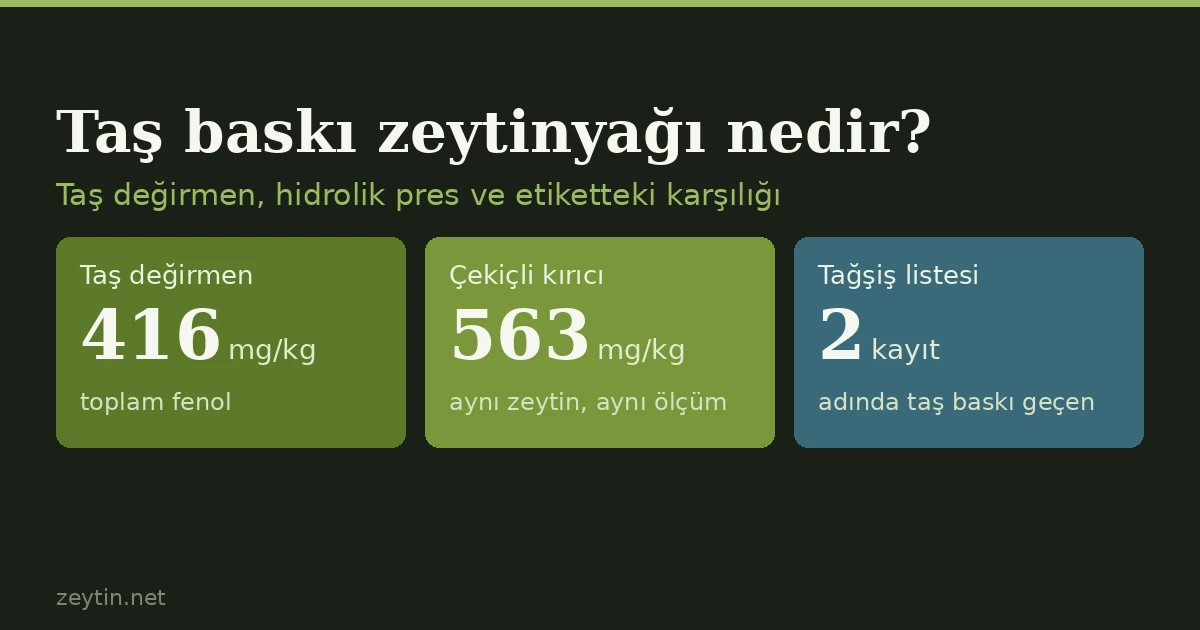
Stone-pressed is the everyday name for crushing olives in a granite stone mill and squeezing the paste in a hydraulic press. Measurements show stone-milled oil can be milder but lower in phenols (416 versus 563 mg/kg). The term is not defined in the regulations, and two products with stone-pressed in their name appear on Türkiye's adulteration list.