Osmaniye expects 107,000 tonnes: 3.5 times last season, in line with on-year averages
The governor's office in Osmaniye says the province's roughly 10 million olive trees are expected to yield more than 107,000 tonnes this year. That is 3.5 times last season — but 2025-2026 was an off year, and the forecast is consistent with on-year yields. Small discrepancies remain in tree counts and ranking.
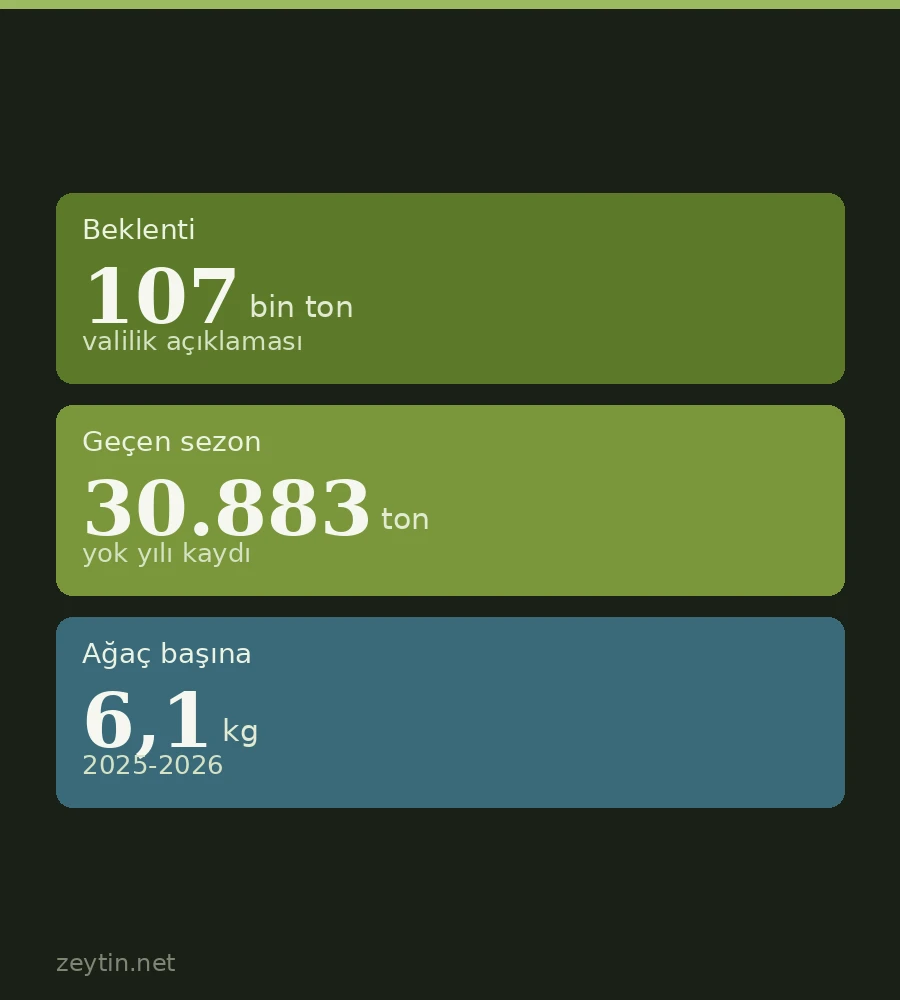
The olive harvest in Osmaniye opened on 9 October 2026 with a ceremony in the village of Kazmaca, in the central district. According to the provincial governor's office, Governor Mehmet Fatih Serdengeçti said the province has roughly 10 million olive trees and expects a crop of more than 107,000 tonnes this year. The same statement notes that Osmaniye ranks 12th in Turkish olive production and that Osmaniye olive oil holds a geographical indication registration.
How the forecast squares with the recorded series
The size of the figure is startling at first glance. Provincial data based on official statistics put Osmaniye's 2025-2026 season as follows:
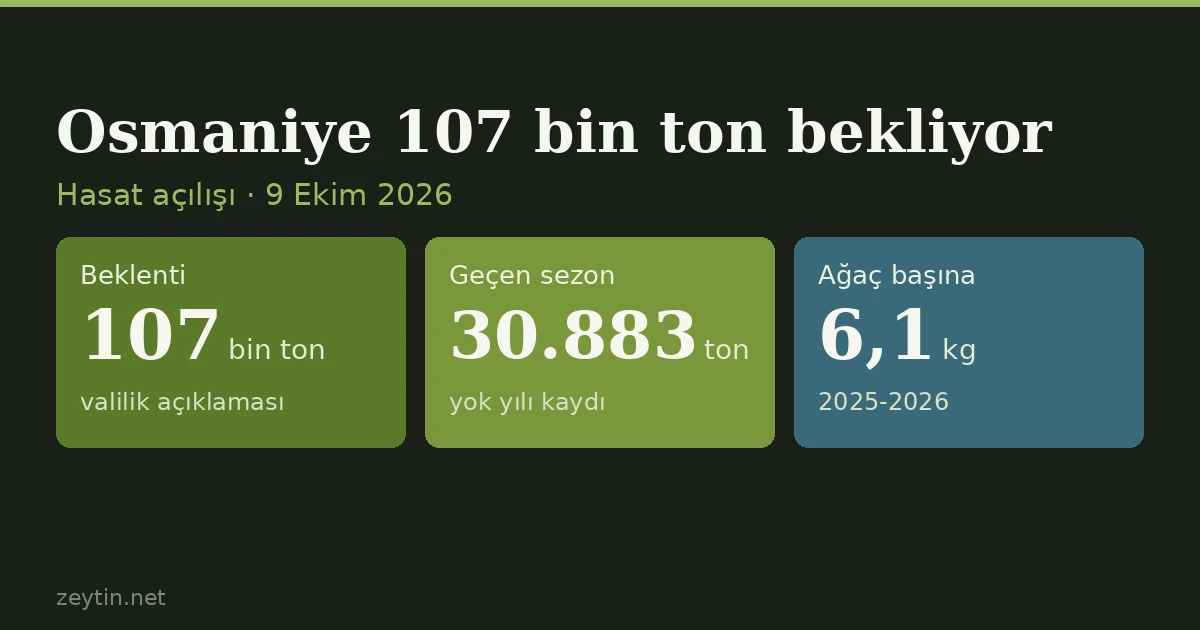
| Item | 2025-2026 |
|---|---|
| Olives (fruit) | 30,883 t |
| — sent to milling | 25,574 t |
| — sent to table use | 5,309 t |
| Olive oil | 6,394 t |
| Trees of bearing age | 5.10 million |
| Not yet bearing | 0.97 million |
| Yield per tree | 6.1 kg |
The expected 107,000 tonnes is therefore some 3.5 times last season's recorded output. A jump of that size can raise an eyebrow on its own — but it matters a great deal which year the comparison is being made against.
From an off year to an on year
The 2025-2026 season was an off year across Türkiye. According to the National Official Assessment Committee report, national output that season came to 2.45 million tonnes of fruit and 310,000 tonnes of oil, against 3.6 million tonnes of fruit and 475,000 tonnes of oil in the preceding 2024-2025 season. Yield per tree nationally fell from 21 kilograms to 13.9 kilograms.
In Osmaniye the drop was sharper still: 6.1 kilograms per tree, less than half the national average. The olive is a biennial-bearing tree, loading one year and resting the next. The year against which 107,000 tonnes should be compared is therefore not last season but the on year before it — and the provincial breakdown for that year is not in the data we hold.
Working the arithmetic backwards is more illuminating. Divided by the 10 million trees cited by the governor's office, 107,000 tonnes comes to roughly 10.7 kilograms per tree. Calculated instead on the recorded number of bearing trees (5.10 million), it rises to 21 kilograms — precisely the national average recorded in the 2024-2025 on year. Whichever tree count is used, the forecast sits in a plausible range for on-year yields.
The gap between two tree counts
The distance between the 10 million trees in the statement and the recorded series is still worth noting: official statistics put bearing and non-bearing trees together at 6.07 million. The difference can be explained by the two figures coming from different sources and resting on different definitions. Provincial agriculture directorate records may count every tree entered in the farmer registration system, whereas production statistics work from the trees that enter the yield calculation.
That 970,000 trees in Osmaniye have yet to come into bearing suggests part of the gap will close over time. This fits a pattern seen across many Turkish basins in recent years: in Manisa the tree count rose by 8 million in three years, reaching 38 million.
On the question of ranking
The "12th place" in the statement is likewise an approximate ranking. On the 2025-2026 provincial data we hold, Osmaniye stands 13th in olive fruit production, behind Aydın, İzmir, Manisa, Mersin, Hatay, Muğla, Balıkesir, Bursa, Çanakkale, Antalya, Gaziantep and Adana. Because rankings shift as provinces fluctuate against one another in an off year, a difference of one place most likely reflects which season is being cited.
On the oil side Osmaniye sits higher. Last season's 6,394 tonnes of olive oil put it ahead of Adana and Denizli, both of which produce considerably more fruit. The reason is that 83 per cent of its fruit goes to milling: the province's production pattern is weighted towards oil rather than table olives.
What the registration covers
Osmaniye olive oil was registered with the Turkish Patent and Trademark Office on 11 January 2023 under number 1317, as an indication of source; the registration was obtained by the Osmaniye Chamber of Commerce and Industry, and the geographical boundary was set as the province as a whole. An indication of source means the product's link to a particular place rests on at least one stage of its production — unlike an appellation of origin, it does not require all the raw material to come from within that boundary. The registration is set out in detail on Osmaniye olive oil's own page.
The practical value of a registration only emerges when the registered product is priced separately in the market. Abundant years are both an opportunity and a risk in this respect: there is plenty of product, but product that does not differentiate itself is surrendered to the bulk price.
Where it sits in the region
Osmaniye lies at the eastern end of the Mediterranean basin, on the olive-growing belt that runs from Hatay to Gaziantep. On the same season's data, its neighbours look like this: Hatay 182,319 tonnes, Mersin 224,537 tonnes, Adana 36,821 tonnes, Gaziantep 42,339 tonnes, Kilis 25,768 tonnes. At 30,883 tonnes, Osmaniye is the small but oil-weighted link in that chain.
Its position is equally clear in extraction terms: last season 25,574 tonnes of milling fruit produced 6,394 tonnes of oil, an oil yield of around 25 per cent. That points to a settled milling pattern, and it is why the province ranks higher in oil output than in fruit output.
What the price side says
An abundant crop is not automatically good news for the grower. Extra virgin olive oil was registered on the Nazilli commodity exchange at 200.46 lira a kilogram on 8 October. On the table-olive side, the season's opening purchase prices in Akhisar came in below last year's, with fruit diverted to milling fetching 10 lira a kilo.
World supply is abundant too: Spain expects 1.6 million tonnes of olive oil in 2026/27, and Spanish extra virgin had fallen to €3.43/kg in the week of 4 October. Osmaniye's 107,000 tonnes will enter a market in which every kilo produced this year has weak bargaining power. How much of the crop returns to the local economy will be settled by the purchase prices that form over the coming weeks of harvest.
One rating per visitor; you can change yours at any time. Ratings are real reader votes — no seeded or default scores.
Related
 Article
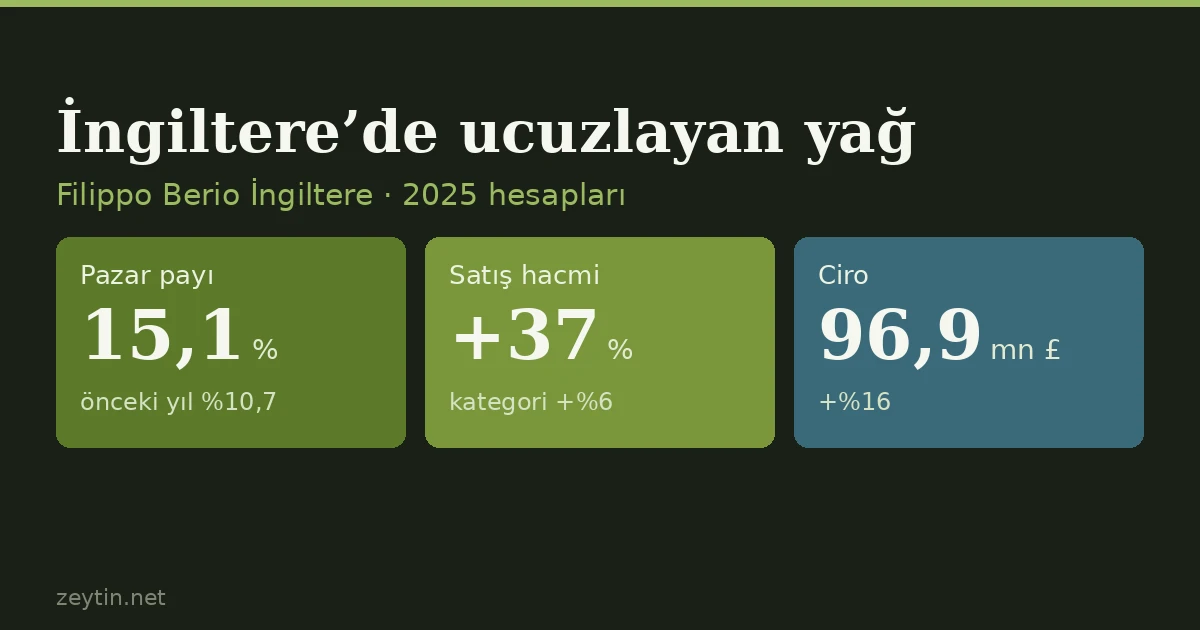
Olive oil got cheaper in the UK and Filippo Berio lifted its share to 15%
The 2025 accounts of Filippo Berio's UK company show how falling prices reached the shelf: volumes up 37%, revenue up 16%, market share from 10.7% to 15.1%. The category grew 6% and lower wholesale costs were passed on to shoppers.
Article
Olive oil got cheaper in the UK and Filippo Berio lifted its share to 15%
The 2025 accounts of Filippo Berio's UK company show how falling prices reached the shelf: volumes up 37%, revenue up 16%, market share from 10.7% to 15.1%. The category grew 6% and lower wholesale costs were passed on to shoppers.
 Article
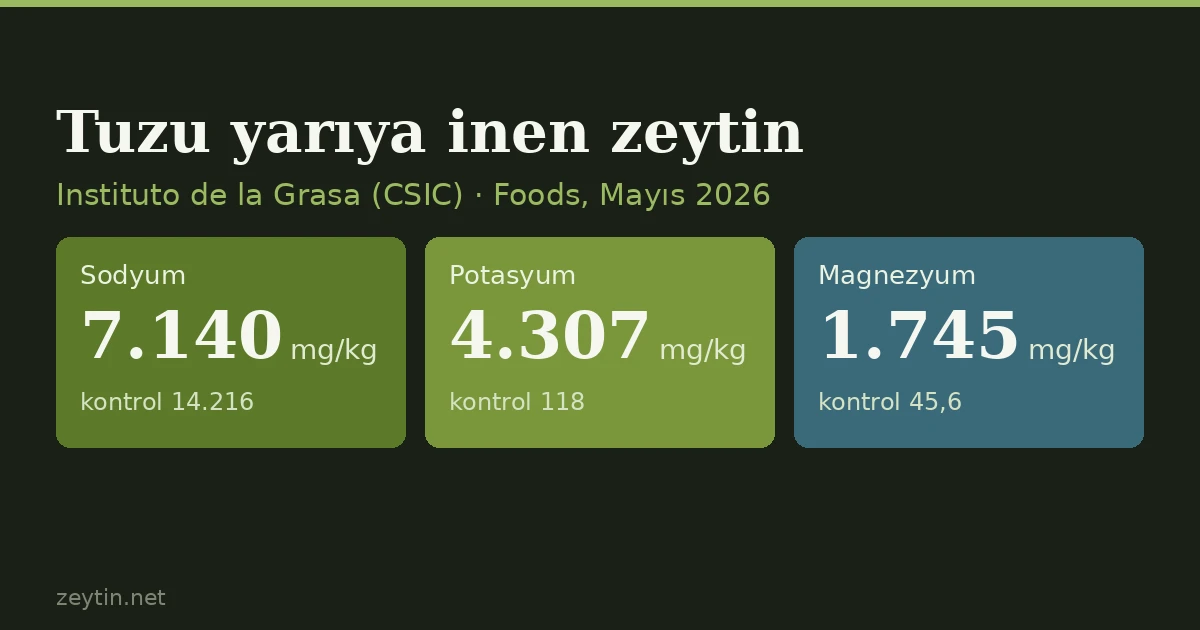
Table olives with half the salt: potassium, calcium and magnesium instead of sodium
Researchers at Spain's Instituto de la Grasa (CSIC) cut sodium in pimento-stuffed green Manzanilla olives from 14,216 mg to about 7,100 mg per kilogram. Potassium, calcium and magnesium salts added to the packing brine made the olives a source of these minerals.
Article
Table olives with half the salt: potassium, calcium and magnesium instead of sodium
Researchers at Spain's Instituto de la Grasa (CSIC) cut sodium in pimento-stuffed green Manzanilla olives from 14,216 mg to about 7,100 mg per kilogram. Potassium, calcium and magnesium salts added to the packing brine made the olives a source of these minerals.
 Article
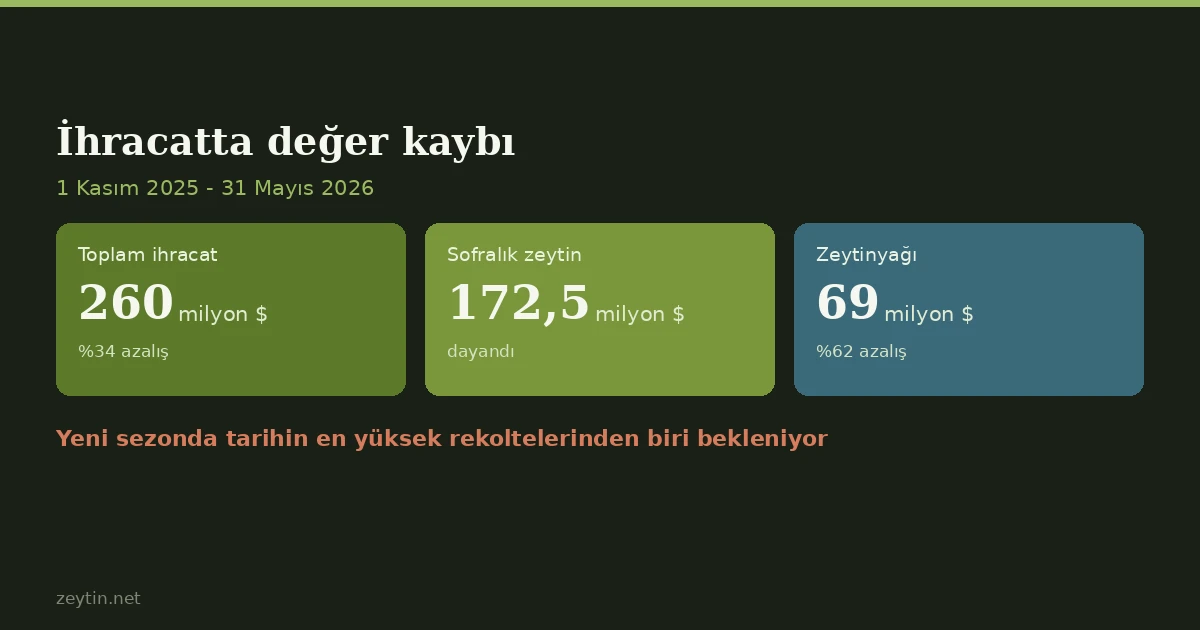
Olive oil exports down 62% by value as a record harvest is expected
Olive and olive oil exports fell 34% to $260 million between 1 November 2025 and 31 May 2026. Table olives held at $172.5 million while olive oil dropped to $69 million. The target is a return to $1 billion.
Article
Olive oil exports down 62% by value as a record harvest is expected
Olive and olive oil exports fell 34% to $260 million between 1 November 2025 and 31 May 2026. Table olives held at $172.5 million while olive oil dropped to $69 million. The target is a return to $1 billion.
 Article
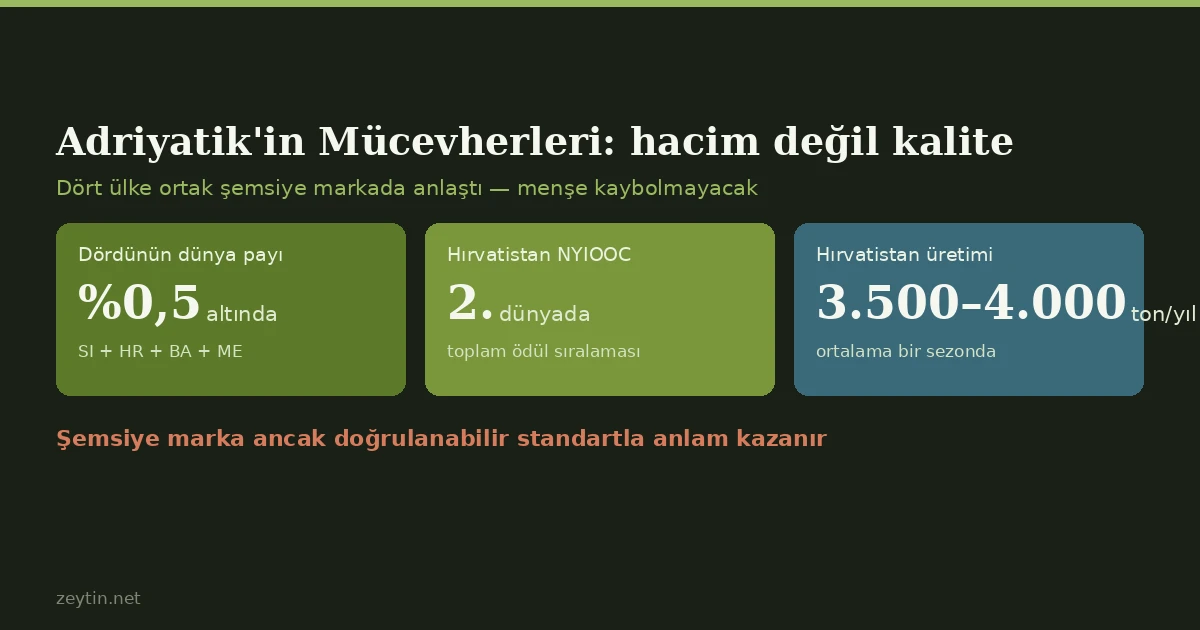
"Jewels of the Adriatic": four countries choose to compete on quality, not volume
Slovenia, Croatia, Bosnia and Herzegovina and Montenegro together produce under 0.5% of the world's olive oil — yet Croatia finished second worldwide at the NYIOOC. A panel in Mostar proposed a shared umbrella brand: origin stays, common rules are the condition.
Article
"Jewels of the Adriatic": four countries choose to compete on quality, not volume
Slovenia, Croatia, Bosnia and Herzegovina and Montenegro together produce under 0.5% of the world's olive oil — yet Croatia finished second worldwide at the NYIOOC. A panel in Mostar proposed a shared umbrella brand: origin stays, common rules are the condition.