Olive knot: galls, warts and a bacterium that enters through wounds
The bacterial canker among olive tree diseases that enters through wounds: galls and warts. Pole harvest and pruning errors spread it.
Olive knot is a bacterial disease (Pseudomonas savastanoi pv. savastanoi) that shows as galls and warts on the trunk, branches and shoots of the tree.
Its defining feature is this: the bacterium cannot enter the tree by itself — it enters through a wound. Which means most of this disease is decided by how you harvest and how you prune.
Where the bacterium lives, how it spreads
The bacterium lives in living, cream-green galls and warts. In humid, rainy weather it comes to the surface of fresh galls and spreads from there by:
- Rainwater
- Wind
- Insects
- ⚠ Pole harvesting
- ⚠ Contaminated grafting wood
One important detail: under strong light and heat the galls turn dark brown, cracked and sunken at the top. In galls in that state the bacterium has died and can no longer infect. So not every gall on the tree is an active danger — you have to look at the colour.
| Appearance | Meaning |
|---|---|
| Cream-green, living | Bacterium alive — infectious |
| Dark brown, cracked, sunken | Bacterium dead — cannot infect |
The bacterium's optimum temperature is 25-26°C, maximum 34-35°C, minimum 12°C.
The size of the gall is the size of the wound
The key sentence in the instruction: "The size of these galls is related to the size of the wounds through which the pathogen entered."
- Small, rounded warts form in the natural wounds left on annual shoots by leaf, flower and fruit fall.
- Large galls that wrap the branch along cracks come from pole strikes, hail wounds and pruning errors.
In other words, the big cankers on a tree are mostly ones we opened ourselves.
Where young shoots are heavily infected, leaves, flowers and fruit drop and the branch is left bare.
What to do
Cultural measures
- Establish new groves with certified nursery stock.
- Use clean grafting wood and buds.
- Do not grow olives on unsuitable sites, particularly where frost is frequent — frost wounds open the door to the bacterium.
- Avoid waterlogged, clay-bottomed soils; if already planted, provide drainage.
- ⚠ Do not prune infected trees on humid or rainy days; prune in summer, when the pathogen is dormant.
- Where harvesting is mechanised, leave the diseased trees until last.
- ⚠ Disinfect pruning tools frequently by dipping in 10% sodium hypochlorite (bleach).
- Do not apply more nitrogen than needed.
- Burn the pruning debris.
July-August: clearing the galls
In July and August, when the galls are clearly visible and the bacteria are inactive, inspect the grove:
- Clear out dead branches carrying many galls
- Paint the wound with 5% copper sulphate (bluestone) solution
The timing is not accidental: because the bacterium is dormant in those months, cutting does not create fresh infection.
Spray calendar
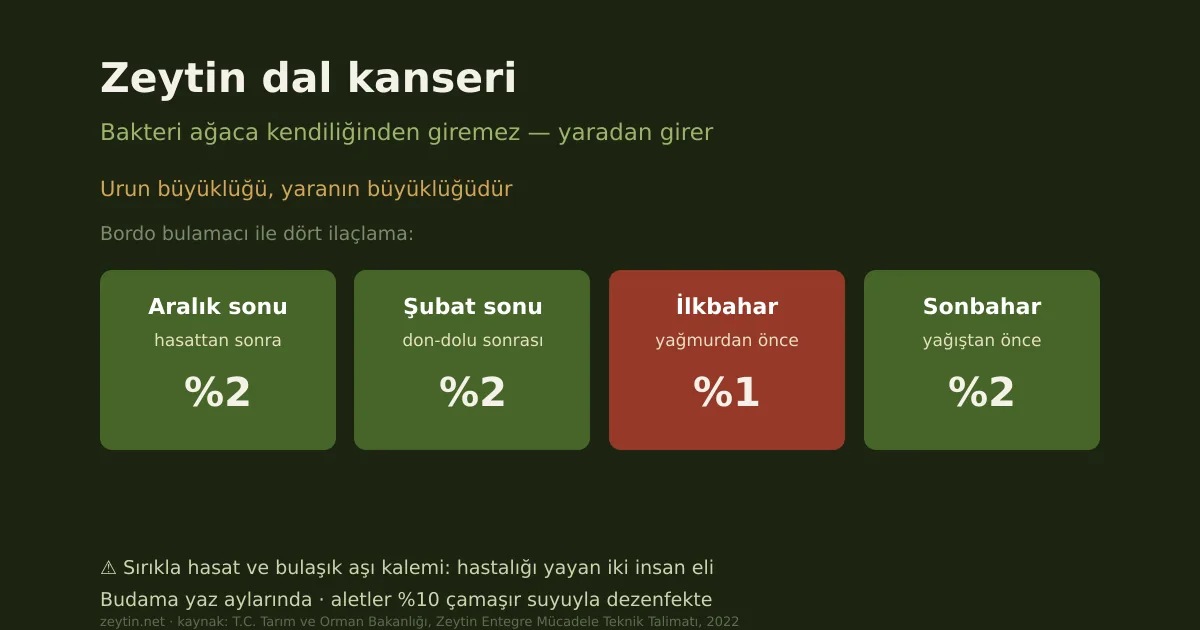
In groves where the disease occurs, four applications are made:
| # | Timing | Bordeaux mixture |
|---|---|---|
| 1 | End of December, immediately after harvest | 2% |
| 2 | End of February, immediately after frost and hail damage | 2% |
| 3 | Before the spring rains begin | 1% |
| 4 | Before the autumn rains | 2% |
⚠ Only the spring application uses 1%; the other three use 2% Bordeaux mixture. The rate is lowered in spring because of the tender shoots and flowers.
The logic of the calendar: two of the sprays follow the moments wounds are made — after harvest (pole and machine damage) and after frost or hail. The other two come before rain, against the moment the bacterium would spread.
Bordeaux mixture is a traditional copper preparation and the instruction gives its rate; even so, consult your Provincial or District Directorate of Agriculture and Forestry on preparation and application, and check the current licensed product list.
Summary
- The agent is a bacterium; it enters only through wounds.
- Cream-green gall = living bacterium; dark brown, sunken gall = dead, not infectious.
- The gall's size is the wound's size: pole strikes, hail and pruning errors make big cankers.
- ⚠ Pole harvesting and contaminated grafting wood are the two human routes of spread.
- Prune in summer, never on rainy days; disinfect tools with 10% bleach.
- In mechanised harvest, diseased trees last.
- In July-August clear galled branches and paint wounds with 5% copper sulphate.
- Four sprays: end of December, end of February, before spring rain (1%), before autumn rain.
Source
t; Republic of Türkiye, Ministry of Agriculture and Forestry, General Directorate of Agricultural Research and Policies, Department of Plant Health Research. Olive Integrated Pest Management Technical Instruction. Ankara, 2022.
Related reading: Verticillium wilt · Olive peacock spot · The olive harvest: when and how
One rating per visitor; you can change yours at any time. Ratings are real reader votes — no seeded or default scores.
Related
 Article
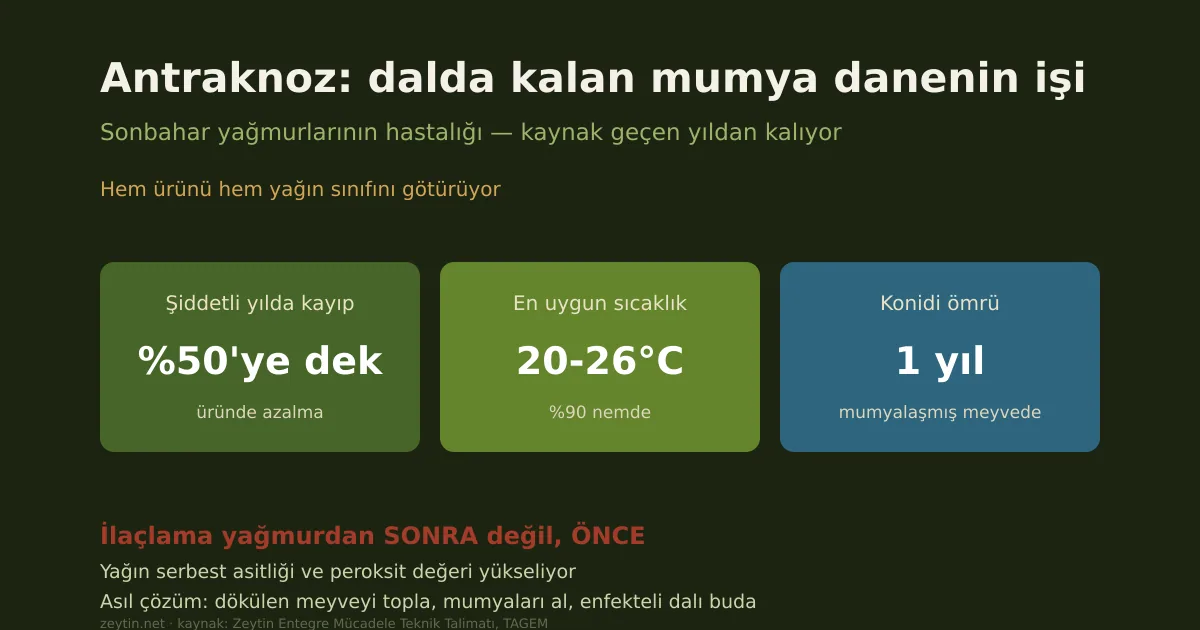
Olive anthracnose: the disease of the mummified fruit left on the branch
Up to 50% crop loss in bad years. The source is last year's mummified fruit still on the branch, and the spray goes on before the autumn rains, not after.
Article
Olive anthracnose: the disease of the mummified fruit left on the branch
Up to 50% crop loss in bad years. The source is last year's mummified fruit still on the branch, and the spray goes on before the autumn rains, not after.
 Article
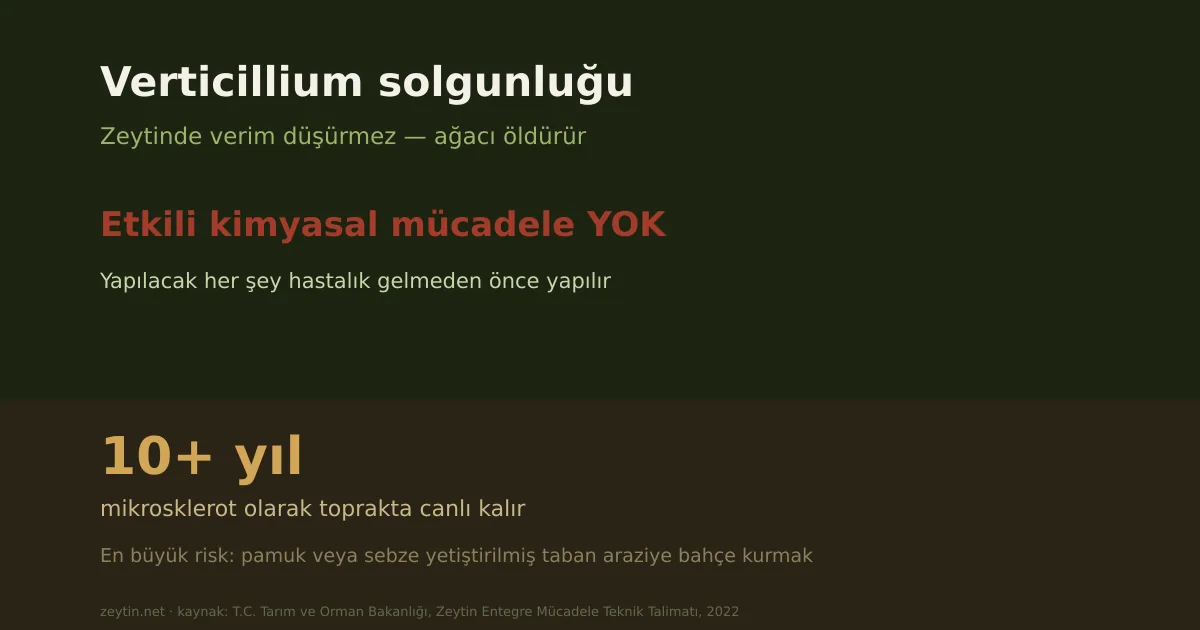
Verticillium wilt: the disease that kills the tree and has no cure
The olive tree disease that kills: it survives over 10 years in the soil, blocks the vessels, and has no effective chemical control.
Article
Verticillium wilt: the disease that kills the tree and has no cure
The olive tree disease that kills: it survives over 10 years in the soil, blocks the vessels, and has no effective chemical control.
 Article
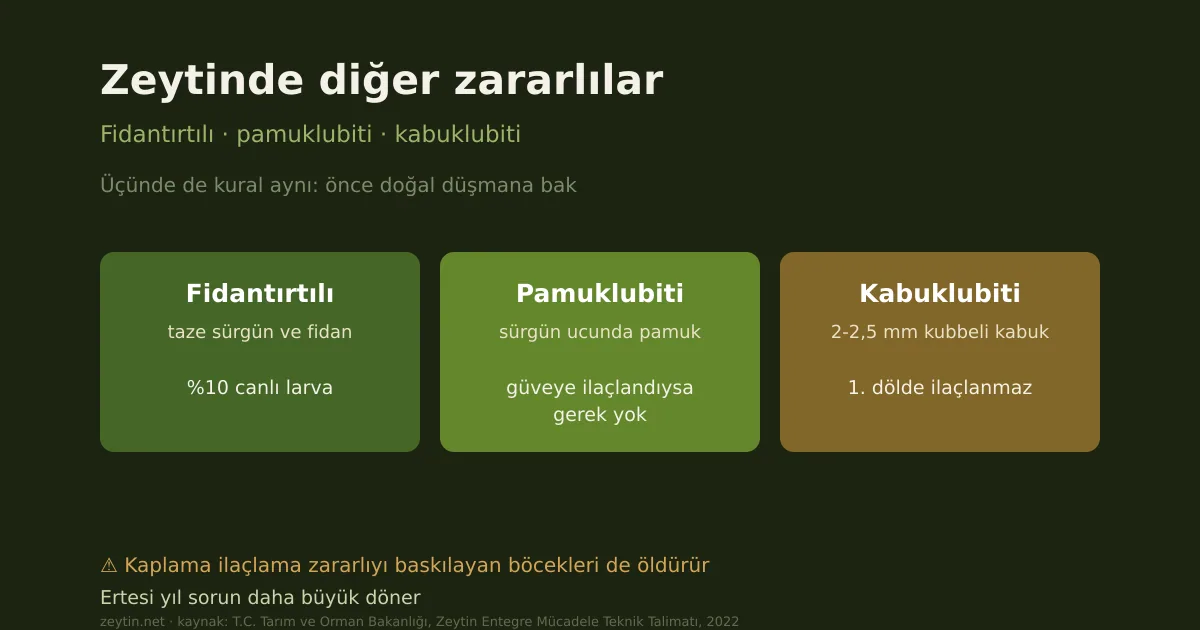
Other olive pests: jasmine moth, psyllid and olive scale
Three olive pests overshadowed by the fruit fly: the jasmine moth on tender shoots, the cottony psyllid, and olive scale.
Article
Other olive pests: jasmine moth, psyllid and olive scale
Three olive pests overshadowed by the fruit fly: the jasmine moth on tender shoots, the cottony psyllid, and olive scale.
 Article
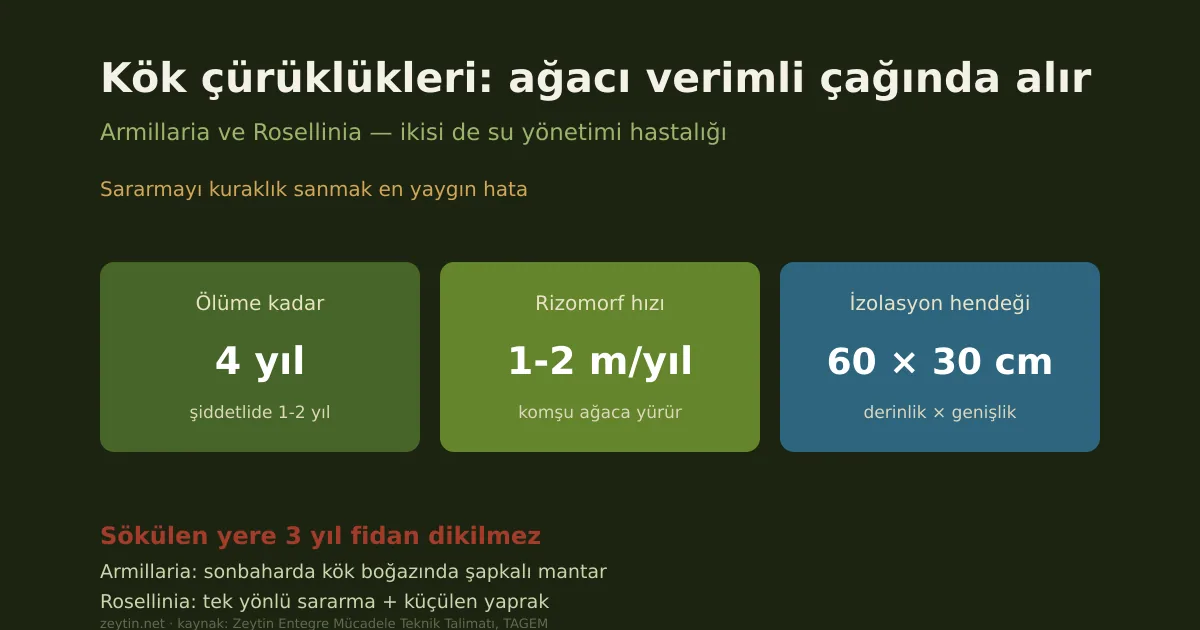
Olive root rots: Armillaria and Rosellinia
Mistaking the yellowing for drought is the common error. Two soil-borne fungi kill the tree in its prime; there is no chemical cure — the work is water management and isolation.
Article
Olive root rots: Armillaria and Rosellinia
Mistaking the yellowing for drought is the common error. Two soil-borne fungi kill the tree in its prime; there is no chemical cure — the work is water management and isolation.