The olive fruit fly: sting thresholds, traps and a control calendar
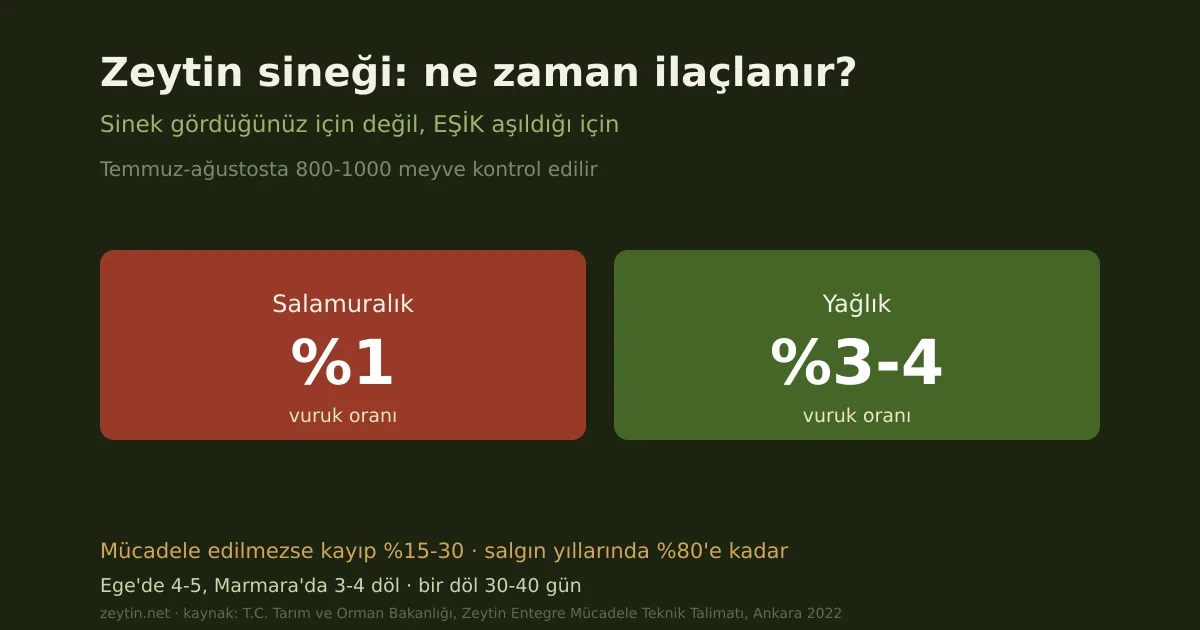
The olive pest that costs most: losses of 15-30% if left alone. Sting threshold 1% for table varieties, 3-4% for oil.
One pest costs the olive grower more than all the others combined: the olive fruit fly (Bactrocera oleae). Türkiye's Ministry of Agriculture and Forestry calls it plainly "the principal pest of the olive" and records it in virtually every olive-growing area of the country.
Left uncontrolled, losses run at 15-30%; in outbreak years they reach 80%.
Drawing on the official Olive Integrated Pest Management Technical Instruction, this article covers how to recognise the fly, when to intervene, and which method suits which grove.
How to recognise it
| Stage | Size | Appearance |
|---|---|---|
| Adult | 4-6 mm | Glossy brown and honey-coloured; head and antennae yellow, with three pale brown bands across the thorax |
| Egg | 0.7-0.9 mm | Matt white, spindle-shaped |
| Larva | 6.0-8.5 mm | Legless, white; narrow head, body thickening towards the rear |
| Pupa | 3.8-5.0 mm | Brown, barrel-shaped |
But what the grower actually watches is not the fly — it is the mark on the fruit.
The female lays her egg in a V-shaped slit 0.5-1 mm deep, cut with her ovipositor. A day later the spot turns dark brown. That mark is called a "sting", and the entire control programme runs on counting them.
What happens, and when
- Winter: overwinters as a pupa 2-5 cm deep in the soil, or as an adult in groves and scrub.
- Spring: adults begin to emerge once soil temperature reaches 10°C.
- June: numbers rise. Towards the end of the month, as fruit becomes suitable for egg-laying, the females mate.
- Summer: the female selects large, glossy fruit that has begun to accumulate oil. One female can lay 200-250 eggs, only one per fruit. In heavy years a single fruit may carry 7-9 eggs from different females.
- Development: eggs hatch in 2 days at 18°C in summer, 6-10 days in autumn. The larva develops in 15-16 days and pupates inside the fruit.
A generation takes 30-40 days. By region:
| Region | Generations |
|---|---|
| Aegean | 4-5 |
| Marmara | 3-4 |
In humid, temperate areas damage starts from late June or early July, hitting the brining varieties Gemlik and Manzanilla first, and Ladoelies among the oil varieties.
What the damage is
The larva feeds by tunnelling galleries around the stone. The results:
- Fruit rots and drops
- Oil yield falls
- Acidity rises, partly — meaning a risk of dropping out of the extra virgin grade
- Damage is worse in table olives, because a stung fruit cannot be sold
That last point matters. Tolerance in table olives is close to zero. Since size and blemish-free fruit translate straight into price, the same sting rate that is manageable in oil olives leaves a table crop unsellable.
⚠ The intervention threshold — the heart of the matter
This is the single most important figure in the technical instruction. You spray because a threshold was crossed, not because you saw a fly.
In July and August, once trap catches begin to rise, 800-1,000 fruits are inspected and the sting rate calculated:
| Variety type | Sting rate |
|---|---|
| Brining (table) | 1% |
| Oil | 3-4% |
In an "off" year of alternate bearing the threshold for oil varieties may be lowered — with less fruit on the tree, every one counts for more.
Spraying below the threshold wastes money and the natural balance alike: the fly's natural enemies — some ten parasitoids, chiefly Psyttalia concolor, plus one predator — die along with it.
Cultural measures — the part that costs nothing
These are the foundation of control and they are free:
Winter tillage. Kills the pupae overwintering in the soil. This is the job that comes before any spray.
Collecting infested fruit. Through the damage period, fallen and stung fruit should be gathered and removed from the grove every three or four days. The larva inside is still developing.
Early harvest. To avoid the autumn peak, varieties that have reached harvest maturity should be picked without delay. What early harvest does to oil quality is a separate question; here the point is to deny the fly its last generation.
Monitoring and traps
Monitoring traps tell you when to act:
- McPhail bait trap
- Pheromone yellow sticky trap
When catches start climbing and the fruit is nearing the susceptible stage, mass trapping begins.
Mass trapping brings the population down. It works over areas of at least 2-5 hectares and only if traps go up simultaneously across the district; one grove acting alone is swamped by immigration from its neighbours.
Bottle trap (DAP) — the method a grower can build. The instruction's recipe:
- 2-3% diammonium phosphate (DAP) solution
- A 2-litre plastic bottle with four 5 mm holes near the top
- One litre of solution per bottle
- One trap per tree, hung on the south-east side
- For groves of at least 0.5-1 hectare with low to moderate populations
- Top up the solution if it runs out during the season
Licensed ready-made traps are hung at the density the Ministry specifies.
Chemical control — the last resort
If the threshold is crossed, there are two methods.
Partial branch spraying (preferred). The aim is to draw adults to one point and kill them there; the whole tree is not sprayed, so natural enemies survive.
- An "insecticide + attractant" mixture is used
- Applied to a 1.5-2 m² patch on the south-east side of the tree, at 150-200 ml of mixture
- Every row is treated — none skipped
- Low-pressure knapsack sprayer with an agitator; nozzle size 2-3, coarse droplets
- Effective in isolated or semi-isolated groves of at least one hectare
- Repeated until 20 days before harvest
Full-cover spraying. Targets adults and larvae together; the tree is sprayed thoroughly from the inside out and the outside in, with particular care to wet the fruit. High-pressure motorised sprayer, nozzle size zero.
⚠ No product names or doses are given in this article. The plant protection products and their doses appear in Annex 4 of the Ministry's instruction, and registrations change over time. Before treating, consult the current list of licensed products and your Provincial or District Directorate of Agriculture and Forestry. Follow the label exactly; do not spray in very hot or windy weather; do not harvest before the pre-harvest interval has elapsed.
Summary
- The olive fruit fly is the olive's principal pest: 15-30% loss, up to 80% in outbreak years.
- The sign is the sting on the fruit: a V-shaped slit 0.5-1 mm deep, dark brown by the next day.
- 4-5 generations in the Aegean, 3-4 in Marmara; a generation takes 30-40 days.
- Threshold: 1% stings in table varieties, 3-4% in oil varieties, on 800-1,000 fruits. Below it, do not spray.
- Free and effective: winter tillage, collecting infested fruit every 3-4 days, early harvest.
- Monitor with McPhail and pheromone sticky traps; mass trapping is meaningful over 2-5 hectares or more.
- Bottle trap: 2-3% DAP, 2 L bottle, four holes, one litre, hung south-east.
- In chemical control, prefer partial branch spraying — it spares the natural enemies.
Source
t; Republic of Türkiye, Ministry of Agriculture and Forestry, General Directorate of Agricultural Research and Policies, Department of Plant Health Research. Olive Integrated Pest Management Technical Instruction. Ankara, 2022. (Olive fruit fly section revised 05.05.2025)
Related reading: The olive harvest: when and how · Is early harvest expensive or valuable? · What does acidity in olive oil mean? · The economics of caliber
One rating per visitor; you can change yours at any time. Ratings are real reader votes — no seeded or default scores.
Related
 Article
Olive black scale and sooty mould: the H on its back
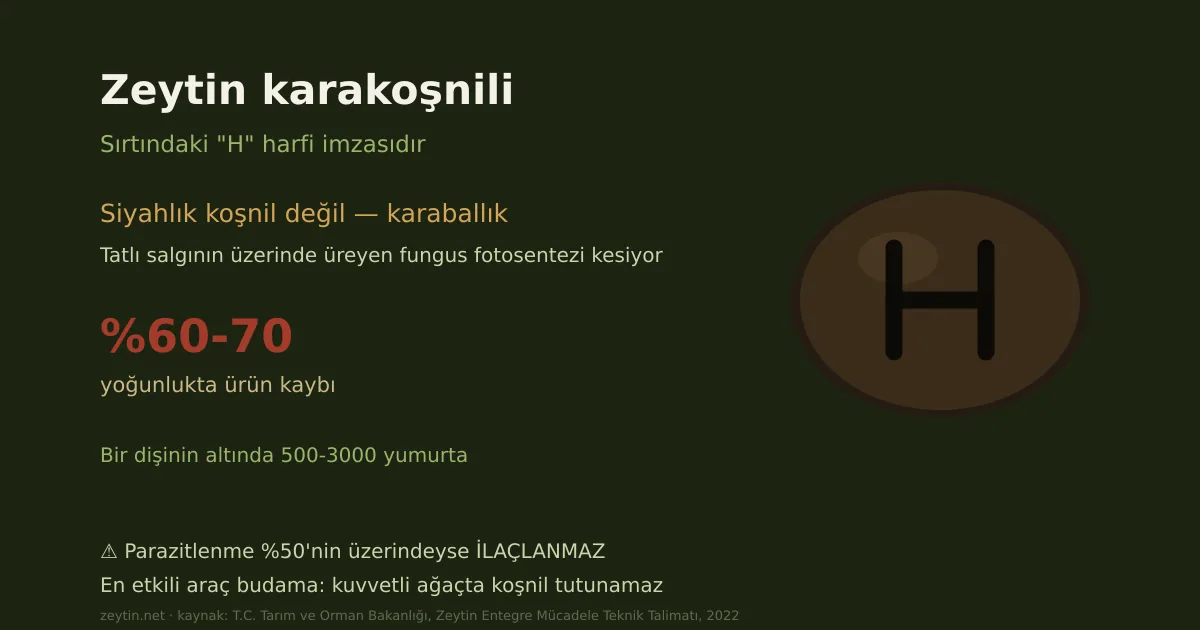
The olive pest behind sooty mould: a scale with an H on its back. Losses of 60-70%; if parasitism tops 50%, do not spray.
Article
Olive black scale and sooty mould: the H on its back
The olive pest behind sooty mould: a scale with an H on its back. Losses of 60-70%; if parasitism tops 50%, do not spray.
 Article
Olive peacock spot: symptoms and a region-by-region spray calendar
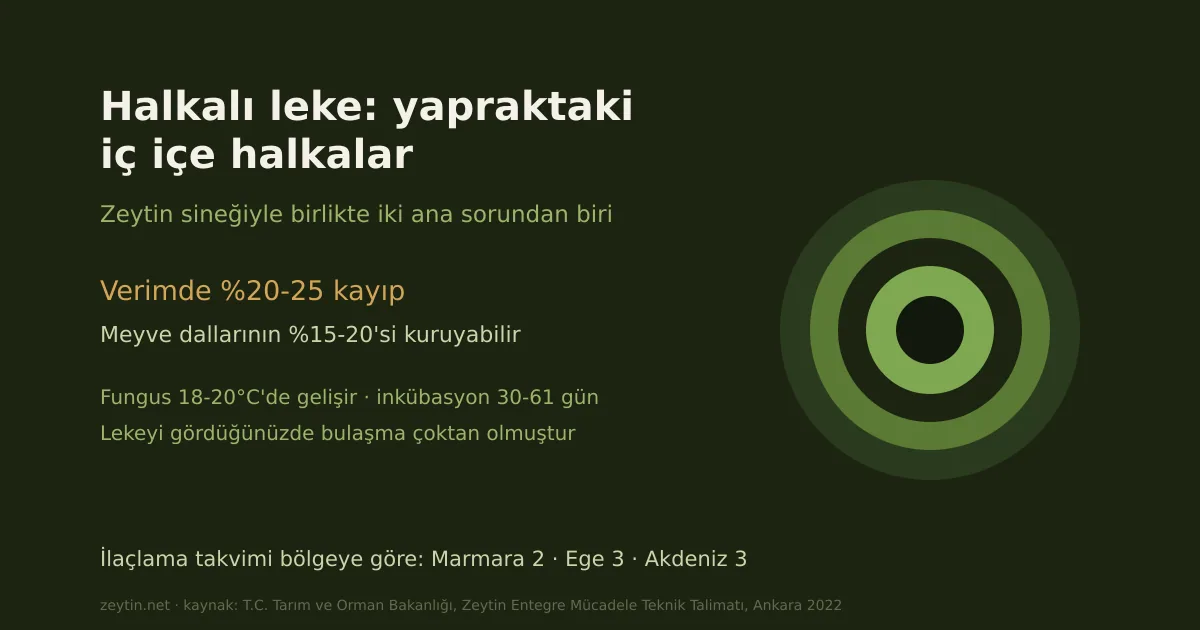
The commonest of olive tree diseases: concentric rings on the leaf, shedding, a shrubby tree. Yield falls 20-25%; spray timing varies by region.
Article
Olive peacock spot: symptoms and a region-by-region spray calendar
The commonest of olive tree diseases: concentric rings on the leaf, shedding, a shrubby tree. Yield falls 20-25%; spray timing varies by region.
 Article
The olive moth: three generations, three kinds of damage
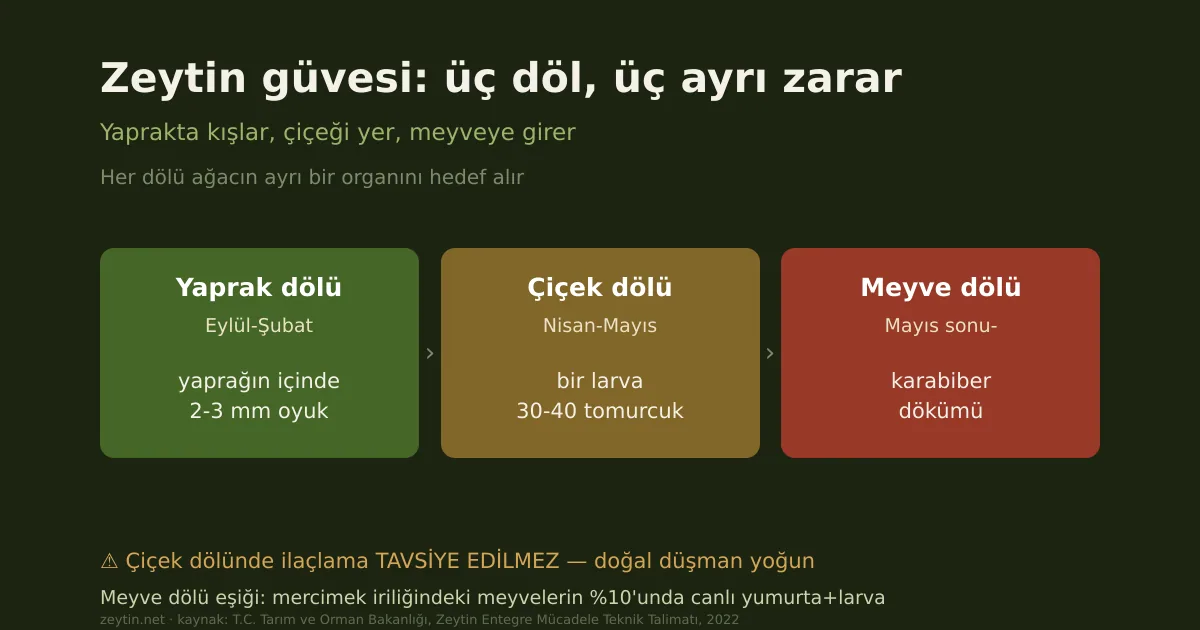
The olive pest with three generations: it winters in the leaf, eats the flowers, enters the fruit. One larva can take 30-40 buds.
Article
The olive moth: three generations, three kinds of damage
The olive pest with three generations: it winters in the leaf, eats the flowers, enters the fruit. One larva can take 30-40 buds.
 Article
Olive anthracnose: the disease of the mummified fruit left on the branch
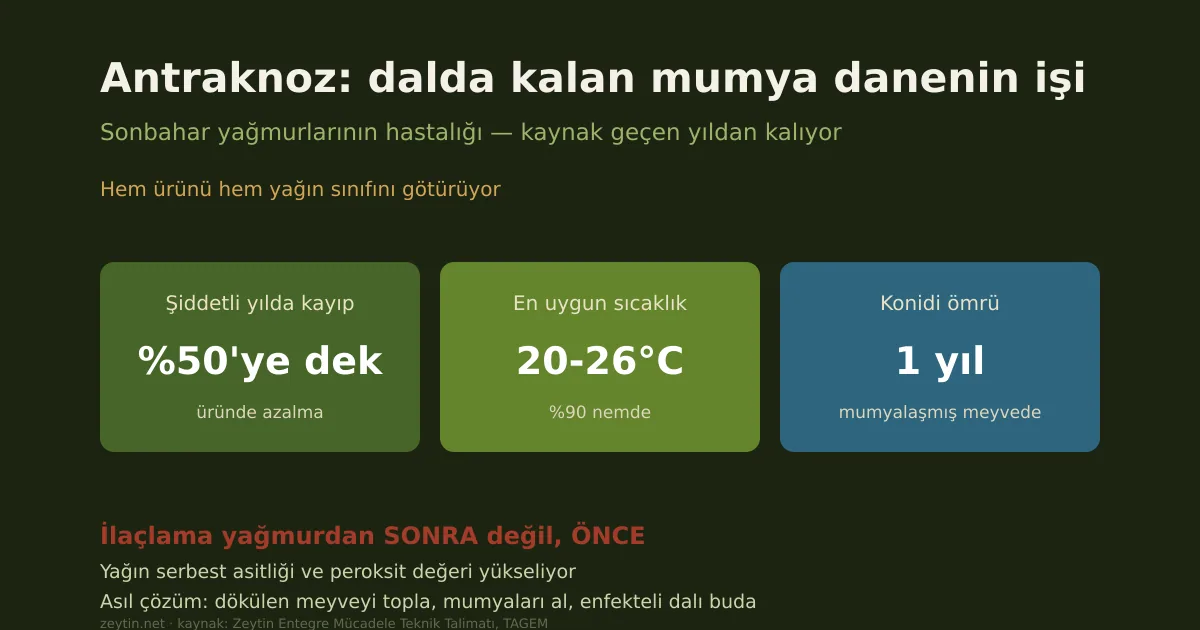
Up to 50% crop loss in bad years. The source is last year's mummified fruit still on the branch, and the spray goes on before the autumn rains, not after.
Article
Olive anthracnose: the disease of the mummified fruit left on the branch
Up to 50% crop loss in bad years. The source is last year's mummified fruit still on the branch, and the spray goes on before the autumn rains, not after.