Karamürsel Su olive: characteristics, oil content and growing areas
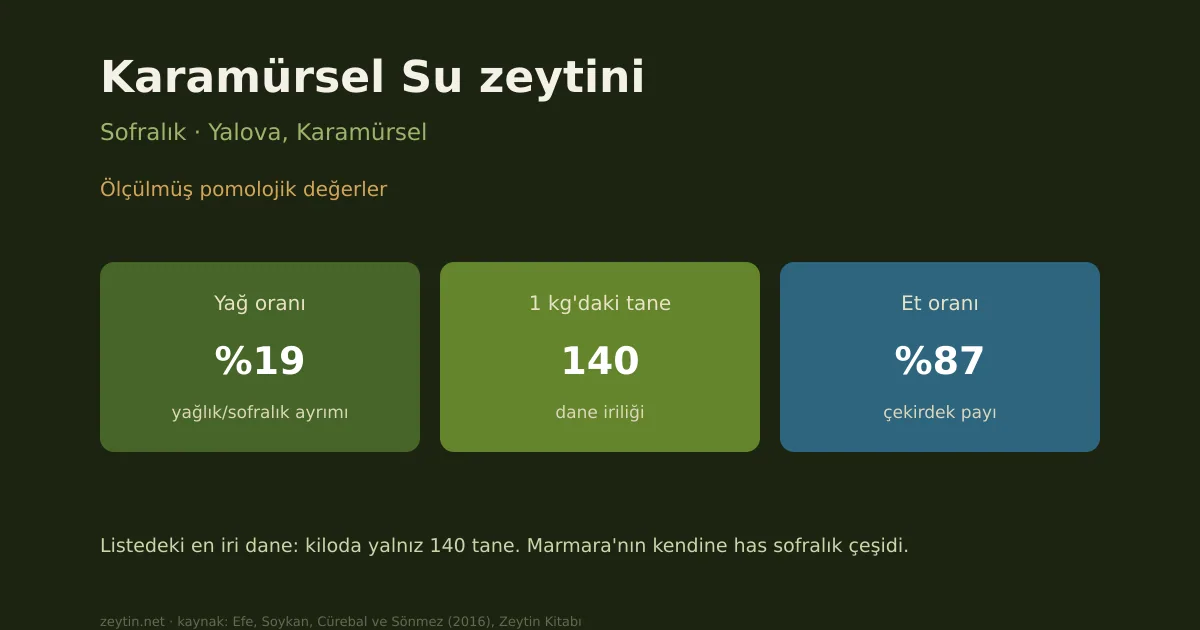
The largest fruit on the list: only 140 per kilo. Marmara's own distinctive table variety.
Karamürsel Su has the largest fruit on the list: only 140 per kilo. For comparison, Kilis Yağlık runs to 560 — one Karamürsel Su fruit equals four Kilis fruits.
Karamürsel Su in numbers
| Oil content | 19% |
| Fruits per kilo | 140 |
| Flesh ratio | 84% |
| Use | Table |
| Main areas | Yalova, Karamürsel |
Source: Efe, Soykan, Cürebal and Sönmez (2016), Zeytin Kitabı. Fields the source leaves blank are shown as "—"; nothing has been estimated.
What the largest fruit is good for
At a measured 9.44 g, Karamürsel Su sits above Domat — the second largest in the same trial at 7.96 g — and is nine times the 1.09 g of the Arbequina IRTA-18 clone.
In table olives, size is price directly: as the calibre falls, so does the price per kilo. In the buying prices published by Marmarabirlik the gap between 18 fruits and 41 fruits to the unit is more than threefold — see the economics of calibre.
But size alone is not enough. In table processing the flesh-to-stone ratio and how easily the stone leaves the flesh also decide the outcome, and here the table carries a warning: Karamürsel Su also produces the trial's heaviest stone (1.50 g). Its flesh-to-stone ratio of 5.29 is good, yet below Manzanilla at 5.50 and Çilli at 5.57.
One further distinguishing feature is shape: with a shape index of 1.60, Karamürsel Su is the only elongated cultivar in the trial. All the others were round or oval.
When flowering shifts into February
The measurement study recorded another finding: in mild winters, flowering in Karamürsel Su and Domat shifts into February.
This is a concrete example of how climate change shows up in olives. Early flowering carries two risks: a late frost can strike the blossom, and if flowering no longer overlaps with the pollinator cultivar, fertilisation fails.
A chilling requirement of 526 hours places the cultivar in the middle group — below Gemlik at 600 hours and far below the 1,000 hours reported for Ayvalık. More on this: chilling requirement in olives.
What being a Marmara cultivar means
Karamürsel Su is one of the local cultivars of the Marmara region. Because the region's olive growing stands in the shadow of Gemlik, these cultivars are little known — yet Marmara holds real variety beyond Gemlik: Karamürsel Su, Samanlı, Eğriburun and Edincik Su.
On the region's olive growing and its price data: olive growing in Marmara.
Where it stands among measured cultivars
Its position on each axis is shown live in the comparison strip on this page, against every cultivar with a published figure. For the full ranking — and how that ranking is built — see olive variety rankings.
In short
Karamürsel Su is among Türkiye's largest-fruited varieties (140 per kilo) and, at 87% flesh, a pure table olive. It is the local variety of the Yalova–Karamürsel belt and little planted elsewhere.
Despite rivalling Domat on size it never matched it in stuffed processing, owing to differences in skin and texture. For the regional picture, see olive growing in Marmara.
Where it stands among measured varieties
çeşit sayfası
Zeytin Kitabı — Efe, Soykan, Cürebal, Sönmez (2016) s.37-80
çeşit sayfası
çeşit sayfası
çeşit sayfası
Values are those published on each variety's own page; the comparison covers only varieties with a measured figure, so it is a comparison of what is known — not of every Turkish variety. See the full ranking and how it is built →
One rating per visitor; you can change yours at any time. Ratings are real reader votes — no seeded or default scores.
Related
 Article
Mavi olive
Mavi is a recorded variety of south-eastern Anatolia. No measured pomological data published.
Article
Mavi olive
Mavi is a recorded variety of south-eastern Anatolia. No measured pomological data published.
 Article
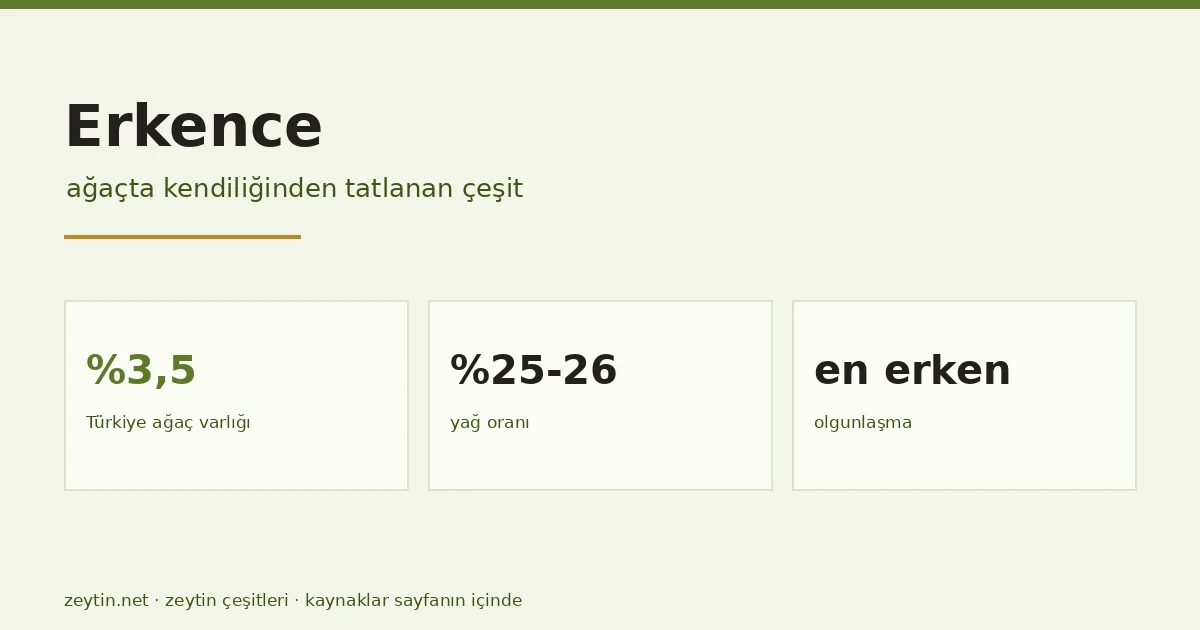
The Erkence olive: the cultivar that sweetens on the tree
Erkence accounts for 3.5% of Turkey's olive trees. It is the Aegean's earliest-ripening cultivar and has a property with few equivalents anywhere: the fruit loses its bitterness on the tree, without brine.
Article
The Erkence olive: the cultivar that sweetens on the tree
Erkence accounts for 3.5% of Turkey's olive trees. It is the Aegean's earliest-ripening cultivar and has a property with few equivalents anywhere: the fruit loses its bitterness on the tree, without brine.
 Article
Patos olive
Patos is a recorded variety of the Black Sea. Described in the source.
Article
Patos olive
Patos is a recorded variety of the Black Sea. Described in the source.
 Article
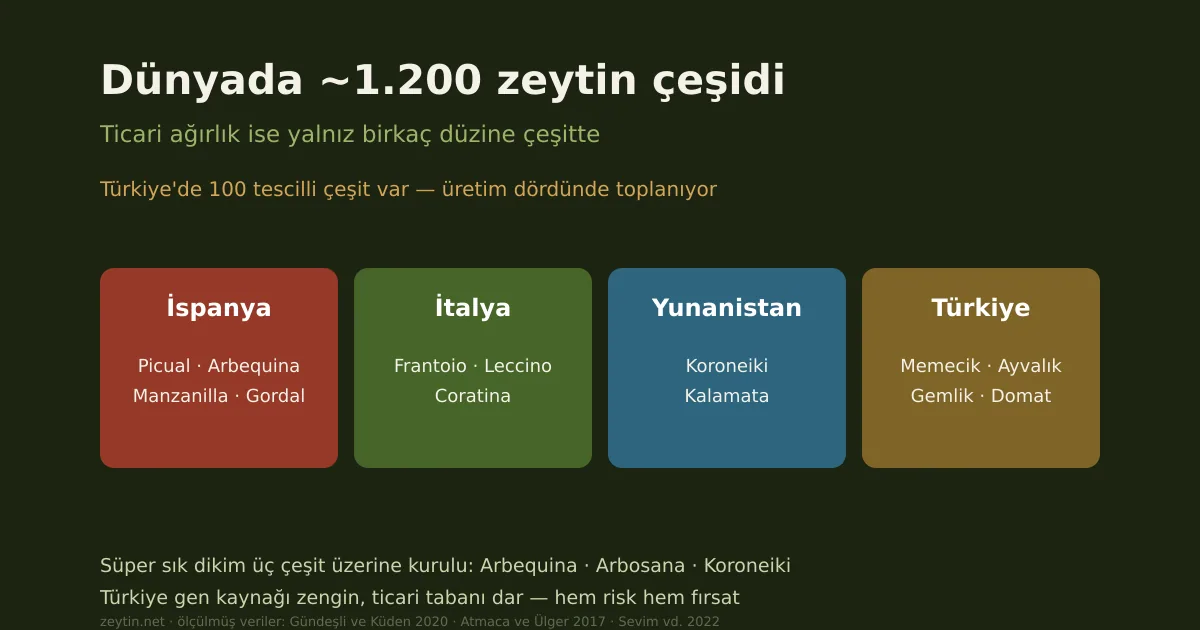
World olive varieties: from Picual to Kalamata
About 1,200 cultivars exist; commercial weight sits in a few dozen. Picual, Arbequina, Koroneiki, Kalamata, Frantoio — compared with Türkiye.
Article
World olive varieties: from Picual to Kalamata
About 1,200 cultivars exist; commercial weight sits in a few dozen. Picual, Arbequina, Koroneiki, Kalamata, Frantoio — compared with Türkiye.