Iron chlorosis in olives: why young leaves yellow on calcareous soil, and how long each iron fertilizer lasts
Iron chlorosis is yellowing between the veins of young leaves on calcareous, high-pH soil. The article reads a three-year siderite versus FeEDDHA trial in three Spanish orchards, the role of the rootstock, and the signs that tell iron apart from nitrogen, boron, potassium, Verticillium and root rot.
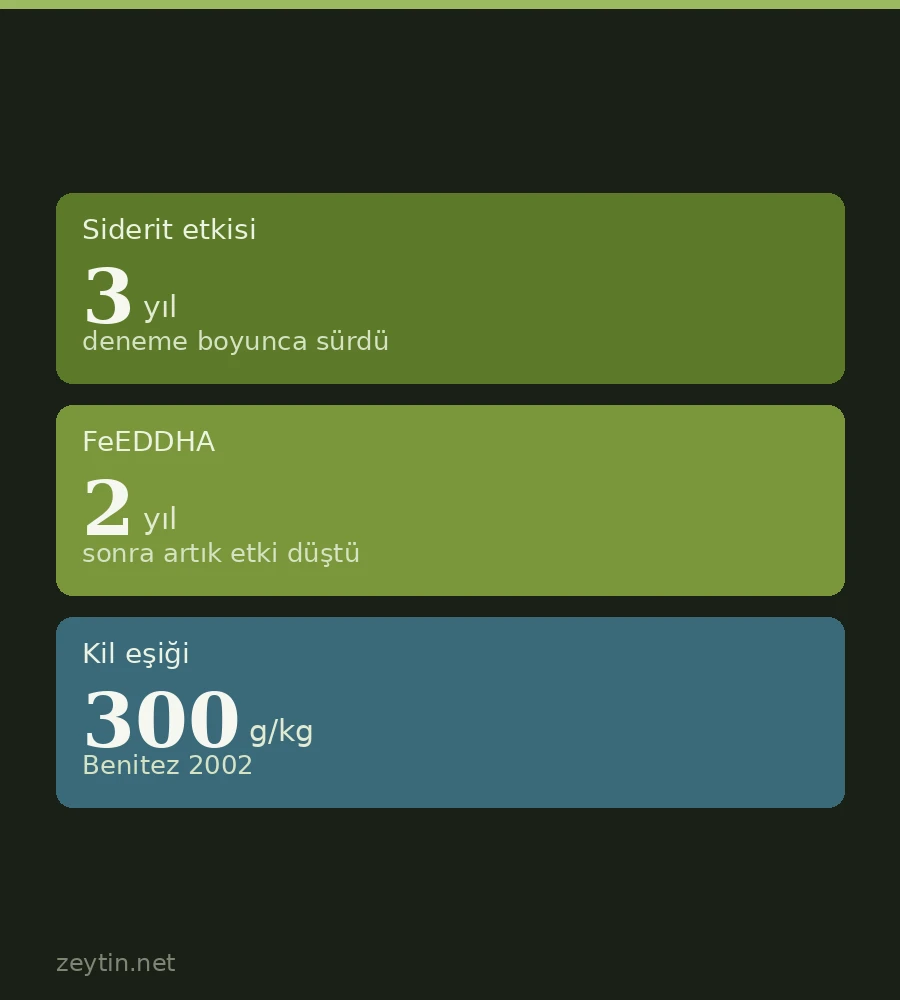
Short answer: Iron chlorosis is yellowing between the veins of young leaves, and it is most common on calcareous, high-pH soils; even when the soil holds iron, the tree cannot take it up. In a three-year trial in three orchards on calcium-rich soil in Spain, synthetic siderite applied to the soil kept its effect throughout the trial, while the residual effect of the FeEDDHA chelate fell markedly after the second year. In olives not every yellowing is iron: this article also lists the symptoms that separate iron from nitrogen, boron, potassium, Verticillium and root rot.
Why can't the tree take up iron the soil holds?
In the plant nutrition literature, iron deficiency is mainly associated with high-pH, calcareous soils, where soil iron becomes unavailable to the plant; El-Jendoubi and colleagues' 2014 paper in Frontiers in Plant Science puts it so. Because iron does not move within the plant, deficiency shows first in newly emerging leaves, usually between the veins; the veins stay green, and in severe cases the leaf can turn pale white. This symptom description is general plant nutrition knowledge; we did not make an olive-specific photo-atlas comparison.
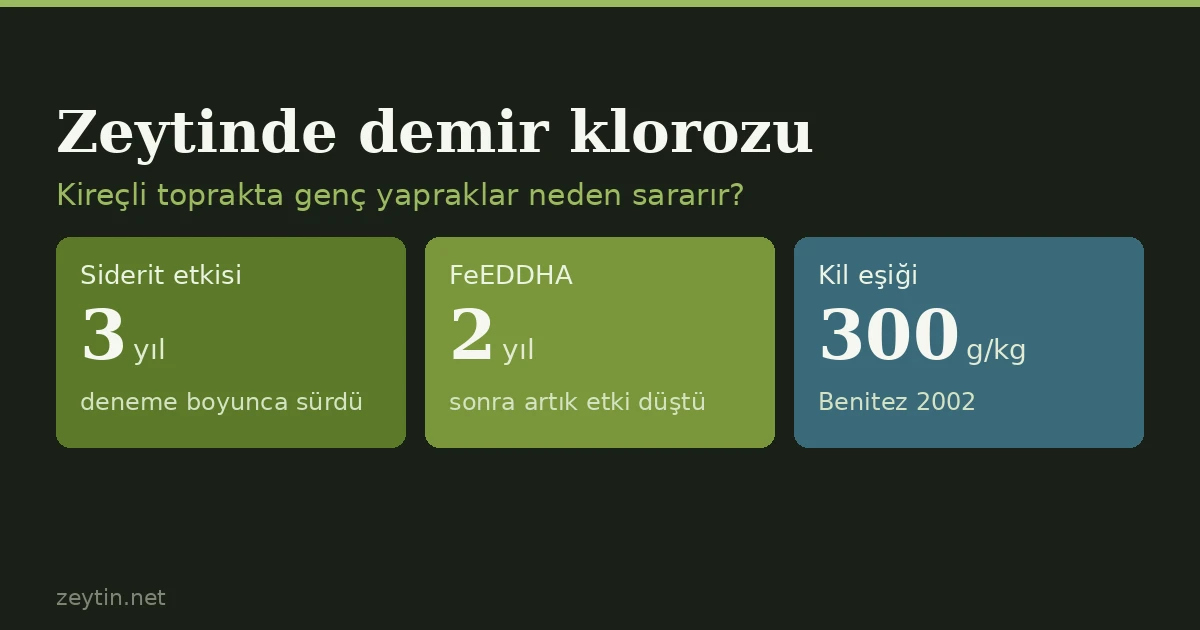
In olives the picture is one step more complicated. Benitez and colleagues' 2002 study (Nutrient Cycling in Agroecosystems) measured leaf chlorophyll with a SPAD meter in Hojiblanca, Manzanillo and Picual on highly calcareous soils in southern Spain. Chlorophyll was poorly correlated with the carbonate content and reactivity of the soil, but significantly correlated with clay content and oxalate-extractable iron. The separating levels were reported as 300 g/kg of clay and 0.35 g/kg of oxalate-extractable iron. The abstract does not give the direction of the relationship, so we state none. The three cultivars showed no significant difference in susceptibility. In other words there is no straight line of "more lime, more chlorosis"; the clay and the form of the iron are part of the story.
Cultivar or rootstock?
In 2003 Alcántara, Cordeiro and Barranco (Journal of Plant Physiology) tested different cultivars and scion-rootstock combinations in containers of calcium-rich soil under two regimes: with and without an iron chelate (FeEDDHA). The result: tolerance is mainly determined by the genotype of the rootstock. For calcareous land, this means adding "which rootstock?" next to "which cultivar?" when buying saplings. For rootstocks see our articles on wild-olive rootstock and grafting.
Which iron fertilizer lasts how long?
Sánchez-Alcalá and colleagues tested synthetic siderite (FeCO₃) in three Spanish orchards with calcium-rich soils between 2008 and 2011, in Scientia Horticulturae in 2012. The results:
| Measure | Finding |
|---|---|
| Leaf chlorophyll (SPAD) | Significantly higher in iron-fertilised trees |
| Leaf weight | Notable increase in most measurements |
| Siderite effect | Lasted through the entire three-year trial |
| FeEDDHA residual effect | Fell markedly after the second year |
The authors describe siderite suspensions as slow-release fertilizers that are simple to prepare on site and pose no toxicity concerns. We do not know whether this product is commercially available in Turkey; this is not a product recommendation but a report of one measured comparison.
For foliar application we have no olive data. In an experiment on sugar beet, El-Jendoubi and colleagues applied 2 mM iron sulphate with 0.1 percent surfactant to chlorotic leaves. The treated areas re-greened, while the effect on the untreated part of the same leaf was minor. We cannot carry a beet experiment straight over to olive; our inference is this: iron sprayed on the leaf re-greens what is on the leaf at that moment and does not protect shoots that emerge later. General reviews report that iron sulphate and EDTA work in soil up to about pH 7.1 and EDDHA up to pH 9; this is review-level information, not a result measured in olive.
Not every yellowing is iron
The same yellow look can come from other deficiencies and from diseases. The table below is a differential list drawn from the descriptions in the sources we read:
| What is seen | Possible cause | Source |
|---|---|---|
| Yellowing between veins of young leaves, veins green | Iron | General plant nutrition knowledge |
| Older leaves yellow or reddish and dropping early; annual shoot growth under 8 inches (about 20 cm) | Nitrogen | CDFA |
| Chlorosis at the tips of the youngest leaves, then dying tips and yellow bands; fruit may drop in July-August | Boron | CDFA |
| Pale green leaves, burned tips and sides, short internodes | Potassium | CDFA |
| Leaves on one or more branches wilt suddenly early in the season | Verticillium wilt | UC IPM |
| Thin canopy, dark roots, darkening at the root crown | Phytophthora root rot | UC IPM |
| Two-to-three-year-old leaves turning yellow and falling in spring | Natural leaf renewal | Olivarama, 2011 |
Three points of care. First, the section of the CDFA guidelines we read gives no symptom description for iron; we put iron in the table on general plant nutrition knowledge. Second, UC IPM writes that darkening of the xylem is frequently not apparent in olives with Verticillium, so cutting a branch and looking is not always a way to diagnose it. Third, root rot can also come with chlorosis: in 2020 Santilli and colleagues in Italy saw chlorosis with severe defoliation and wilt in about 40 percent of 15-year-old 'Nera di Gonnos' trees, and Phytophthora bilorbang was isolated from the roots. Before applying iron fertilizer it is therefore important to have leaf and soil analysis done and to check drainage. Related articles: leaf drop, nutrient deficiencies, leaf analysis, Verticillium wilt, root rots.
How is it diagnosed?
Looking is the first step but not enough alone. The CDFA guidelines recommend taking the leaf sample in July, because nutrient concentrations are most stable then. The sample is 80-100 mature leaves from the middle of non-bearing, current-season shoots, taken from different points of the canopy at similar heights. By the critical values in the guidelines, nitrogen below 1.4 percent is deficient and 1.5-2.0 is sufficient; potassium below 0.4 percent is deficient and above 0.8 sufficient; boron is deficient at 14 ppm and sufficient at 19-150 ppm. Iron does not appear in the table we read. For how and when to take a leaf sample see our leaf analysis article. In short: when you see yellowing between the veins, first rule out the other elements with leaf analysis, then look at the clay, lime and drainage of the soil.
Read with care
- All the olive studies come from southern Spain; there are no measurements from Turkey.
- The siderite trial was run in three orchards; the range of cultivars and soils is limited.
- The foliar iron data come from sugar beet; they are not measured for olive.
- The pH limits (7.1 and 9) come from a general review; they are not confirmed in olive.
Summary
- Iron chlorosis is yellowing between the veins of young leaves on calcareous, high-pH soil.
- Carbonate alone was not decisive; clay and the form of the iron were also related.
- Tolerance depends mainly on the rootstock: ask about it when buying saplings.
- In the Spanish trial siderite stayed effective for three years, and the FeEDDHA residual effect fell after the second year.
- Not every yellowing is iron; nitrogen, boron, potassium, Verticillium and root rot each come with their own signs.
One rating per visitor; you can change yours at any time. Ratings are real reader votes — no seeded or default scores.
Related
 Article
What does crop insurance cover for olives, and what does it cost?
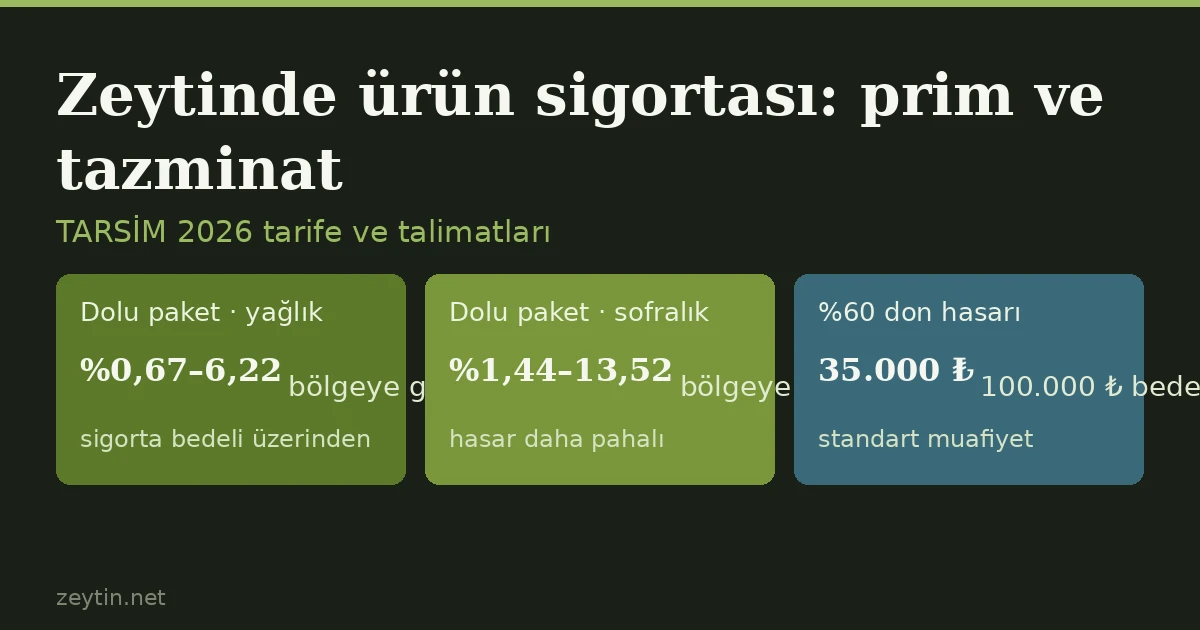
Olives can be insured twice: for the crop and for the tree. Under TARSİM's 2026 tariff the hail package runs from 0.67% to 6.22% for oil olives and 1.44% to 13.52% for table olives, while frost cover sits on its own tariff and is optional. What a claim pays is set by the deductible and coinsurance: 60% frost damage on the standard option pays 35% of the sum insured.
 Article
Organic olive growing: what a four-year trial found
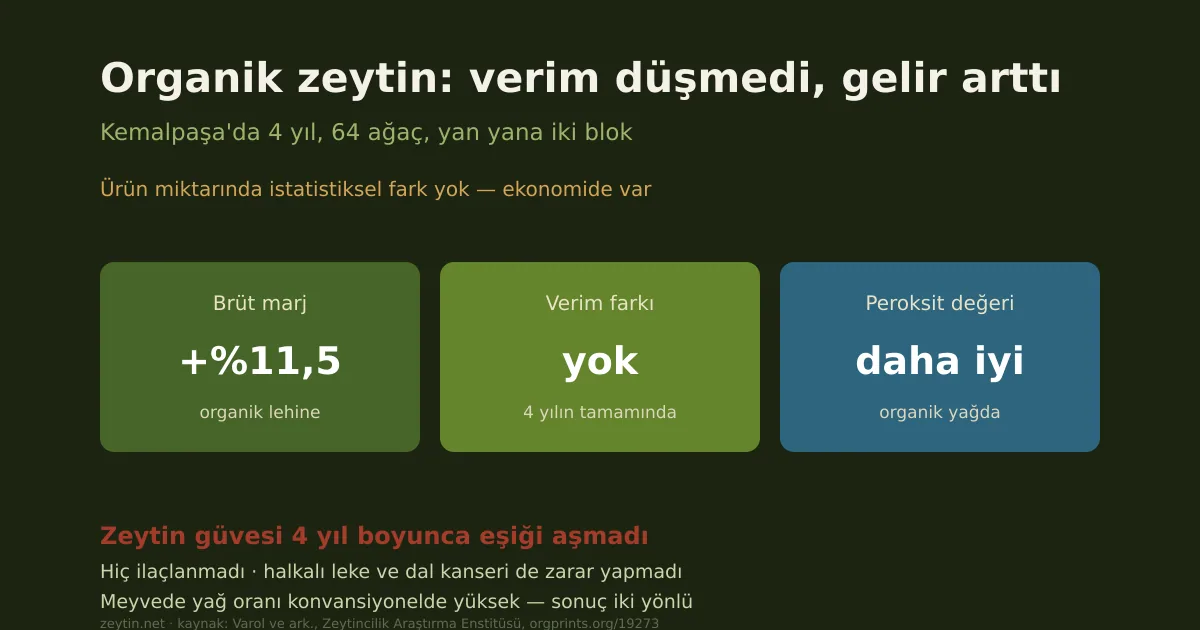
A four-year organic vs conventional trial at Kemalpaşa: no yield difference, 11.5% higher gross margin for organic, lower peroxide value, but higher fruit oil content under conventional management.
 Article
Frost damage in olive trees: signs, risk factors and what to do after a frost
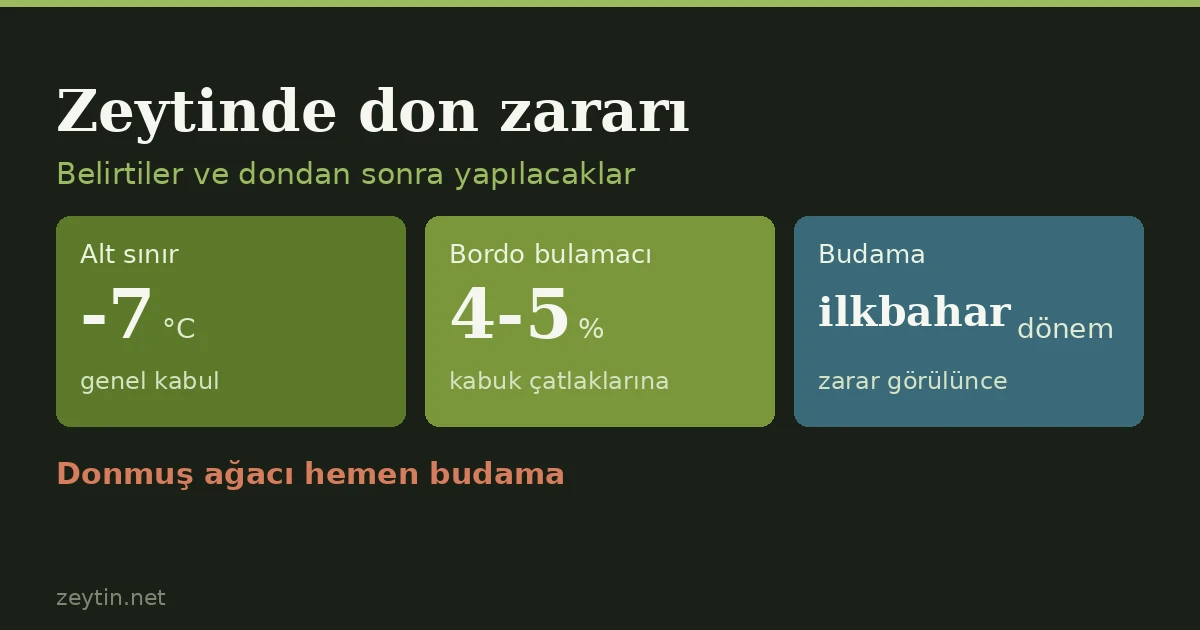
The generally accepted lower limit for olives is around -7 °C, but damage does not depend on the thermometer alone: how long the cold lasts, sudden drops, humidity, tree age and nutrition all matter. Here are the signs of frost damage on leaves, shoots, bark and fruit, ways to reduce the risk and which job to do when after a frost.
 Article
Will a burned olive tree grow back? What to do in an olive grove after a fire
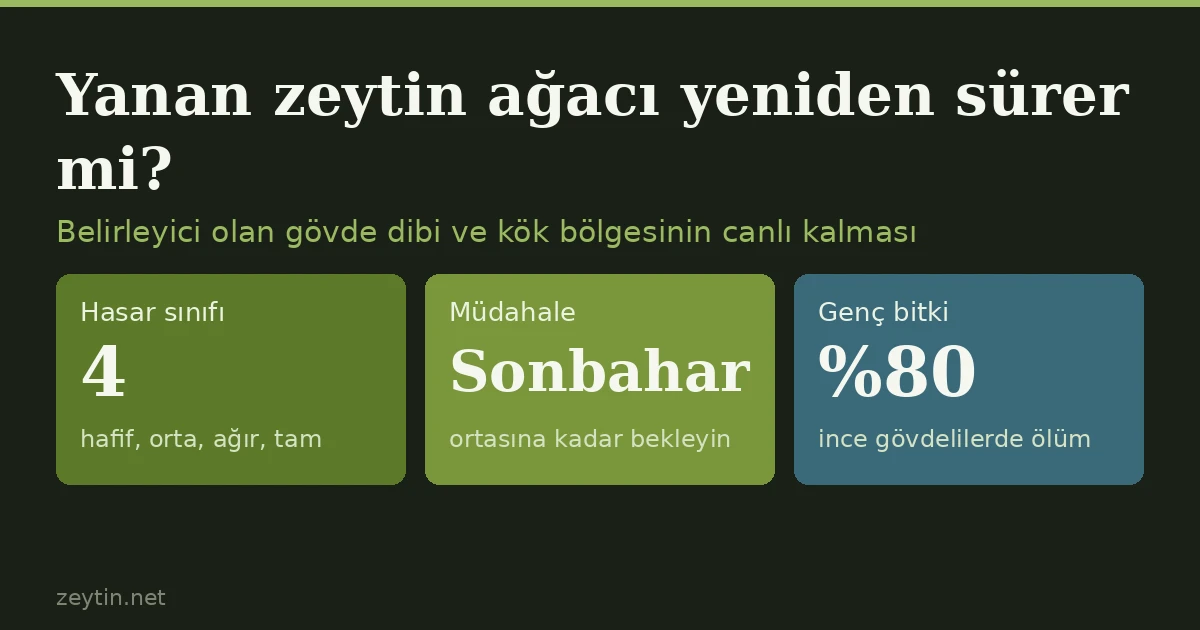
Thanks to the lignotuber at the base of its trunk, an olive usually resprouts after a fire. What matters is whether the root zone survived. Damage classes, why to wait, the graft union, watering before feeding, the law on cutting olive trees and insurance.