Gaza's olive report: 150,000 trees left of two million, production down 87.5%
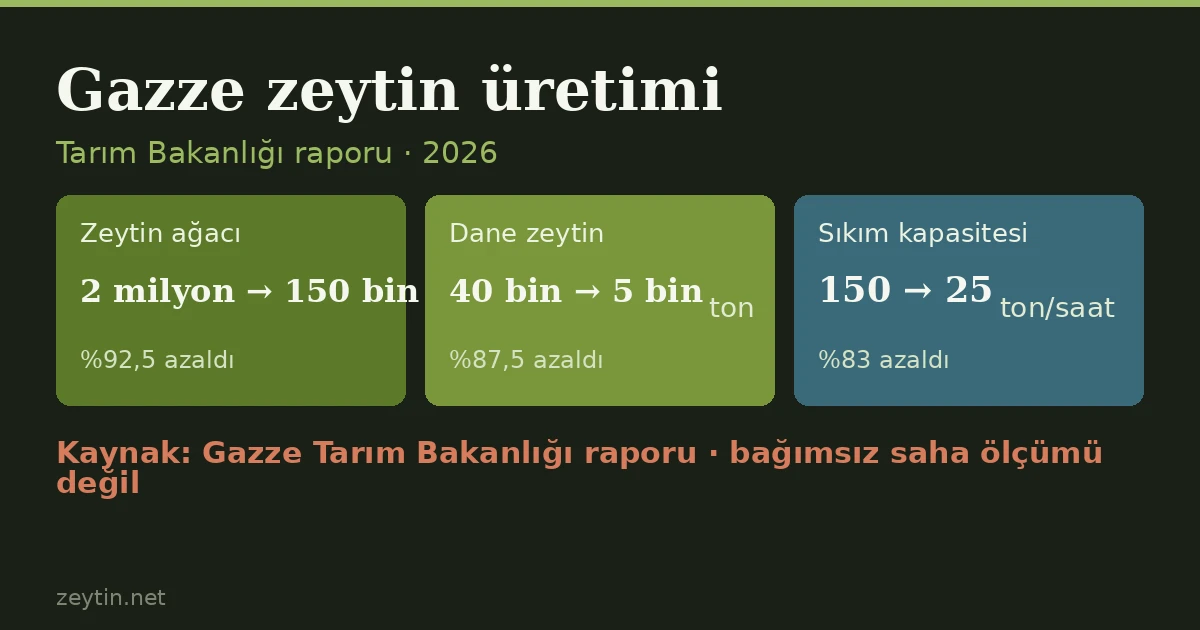
According to a report from Gaza's Ministry of Agriculture, olive groves have shrunk from 50,000 dunums to 5,000 and the olive crop from 40,000 tonnes to 5,000. The loss is not confined to the grove: milling capacity has fallen from 150 tonnes an hour to 25, and the number of growers from 20,000 to 1,000.
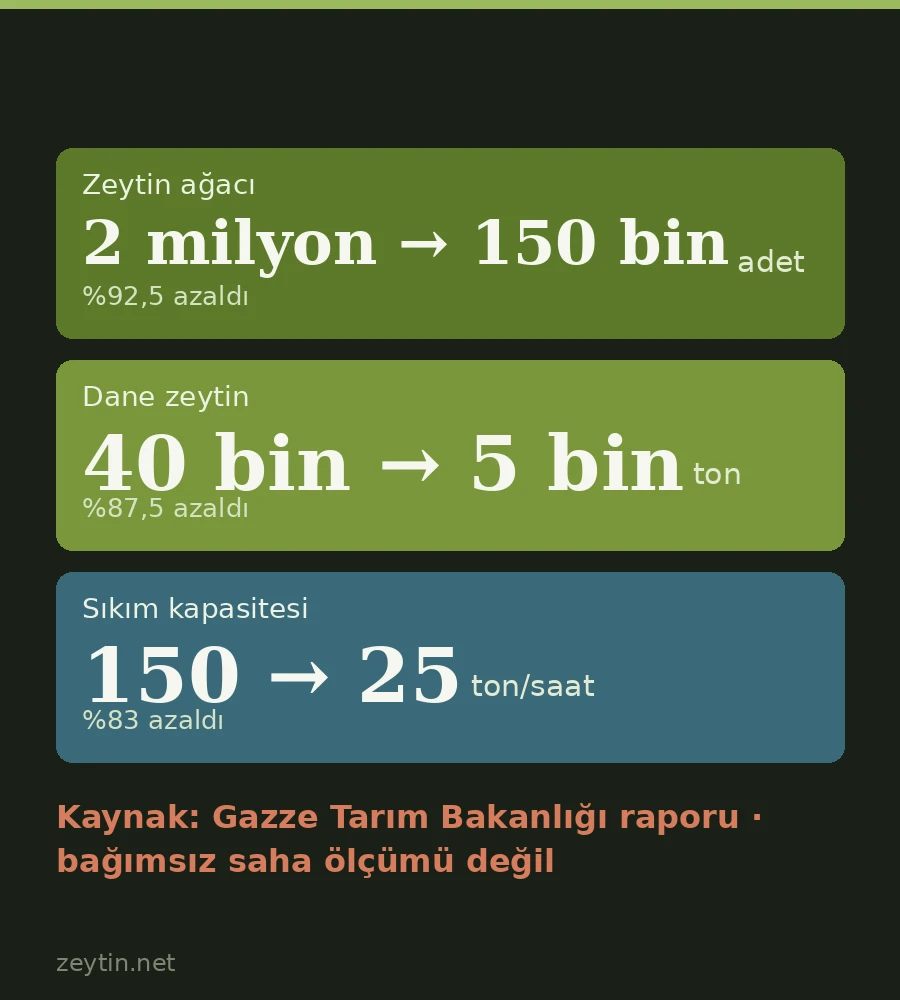
The Government Media Office in Gaza published the Ministry of Agriculture's report on olive production on 24 September. What it describes is not the loss of a single crop but the breaking of a chain that runs from the grove to the mill and from the mill to the market.
The olive is not a seasonal line item in Gaza. By the report's own framing, olive groves accounted for 55% of the territory's orchard area and 27% of all crop land, and olives made up 36% of orchard output. What has been lost is not one product among many; it is the trunk of the farming economy.
Land, trees, crop
| Indicator | Before | 2026 | Change |
|---|---|---|---|
| Olive grove area | 50,000 dunums | 5,000 dunums | −90% |
| Olive trees | ~2,000,000 | 150,000 | −92.5% |
| Olives | 40,000 t | 5,000 t | −87.5% |
| Olive oil | 5,000 t | 700 t | −86% |
A dunum is 1,000 square metres, so 50,000 dunums is 5,000 hectares and what remains is 500. All four lines point the same way but they do not fall at the same speed. Tree count drops fastest, fruit tonnage slowest. That gap carries information of its own: not every tree destroyed was of full bearing age.
The real variable is time. An olive tree takes years to reach commercial yield, a point the report stresses directly. The loss in productive infrastructure is not only this season's number but the number for several seasons to come. A replanted grove does not close last year's gap next year.
Milling and curing
The value of an olive does not end on the branch. It has to be milled, cured, packed. The report counts a separate contraction at each of those links.
| Link in the chain | Before | 2026 |
|---|---|---|
| Olive oil production facilities | 40 | 7 |
| Sites where milling takes place | 68 | 15 |
| Processing capacity | ~150 t/hour | 25 t/hour |
| Curing plants | 14 | 3 |
| Curing capacity | ~1,500 t | 200 t |
| Processing units | 10 | 1 |
There is a detail here that is easy to miss: the loss of capacity creates a bottleneck independent of the loss of fruit. Milling capacity has gone from 150 tonnes an hour to 25. Even with 5,000 tonnes of fruit in hand, the harvest window is narrow; olives left waiting heat up, acidity rises and the oil loses its grade. Part of the production that did survive therefore loses value at a stage after the tree.
Curing has been hit harder still: capacity down from 1,500 tonnes to 200, a seventh of what it was. Table olives were part of daily eating in Gaza. When that link breaks the product withdraws not only from the market but from the table.
The difference between two of the table's rows is worth noticing. "Production facilities" and "sites where milling takes place" are counted separately: the first fell from 40 to 7, the second from 68 to 15. Counting informal and temporary pressing points as well, then, every kind of place that turns an olive into oil has dropped to roughly a fifth. At the far end of the chain, processing units fell from 10 to 1, and the report records that some marketing and export channels that previously operated have stopped altogether.
Energy sits above capacity
The report's closing warning is that even the capacity still standing is not secure: shortages of both crop and energy threaten current processing capacity. Milling olives requires uninterrupted power or fuel; when the crusher, malaxer and decanter stop, fruit arriving from the grove waits.
For that reason the report argues that reviving the sector requires rebuilding not only production but energy, maintenance, service and market systems. Planting trees looks like the easiest part of the chain.
The human side
The number of growers has fallen from roughly 20,000 to 1,000, and the number of people employed in the sector from 3,000 to about 200. The report notes that women, who are heavily represented in harvesting, sorting, processing and marketing, have been directly affected by that contraction. Given how olive farming is staffed, this is the expected sequence: the loss of trees shows up first not in the grove but in seasonal labour.
Price and self-sufficiency
Olive and olive oil prices have risen by a factor of three to four, the report says. Olives that sold at 5 shekels a kilo (about $1.64) now sell at 20 shekels ($6.56).
The self-sufficiency figure is the sharper one. Gaza used to cover its own olive oil needs; the report says roughly 85% of current demand cannot be met. A 700-tonne crop does not substitute for a consumption pattern built on 5,000 tonnes. The fourfold price is simply what that gap looks like on the market — this is not a demand story, it is the absence of supply.
The regional frame
The olive map of the eastern Mediterranean is moving in two directions this season. To the north, Syria's crop is rising from 412,000 tonnes to 954,000, a picture of recovery. In the West Bank the constraint was never the harvest but access; we covered the fall of Palestinian olive oil output from 33,000 tonnes to 7,000 separately.
Gaza fits neither pattern. Syria has a season that fell and is coming back; the West Bank has a crop that cannot be sold. In Gaza what has fallen is the production base itself — trees, land, plant and workforce lost at the same time — which is why this number will not turn upward on its own next season.
Reading it carefully
⚠ The figures come from Gaza's own Ministry of Agriculture report. They are not an independent field measurement, nor have they been confirmed by an international body.
⚠ The baseline year is unstated. The report does not say which season the 40,000 tonnes and 2 million trees refer to. They point to a pre-war level, but no year is given.
⚠ The ratio of output to area is high. 50,000 dunums is 5,000 hectares; 40,000 tonnes of fruit on that area works out to 8 tonnes per hectare. A traditional rainfed Mediterranean grove yields about a third of that. The figure may describe irrigated, densely planted groves, but the report does not state the assumption.
⚠ Tree density is high too: 2 million trees across 5,000 hectares is 400 trees per hectare — the density of semi-intensive planting, not of a traditional grove.
⚠ Olives and olive oil are not the same thing; confusing them is as common an error as mistaking exchange volume for the harvest. The 5,000 tonnes of fruit and 700 tonnes of oil in this article are separate lines.
⚠ The 2026 output figure is a season assessment; the harvest in the territory is not complete.
One rating per visitor; you can change yours at any time. Ratings are real reader votes — no seeded or default scores.
Related
 Article
A 282-member doctors' cooperative puts sensors in the olive grove
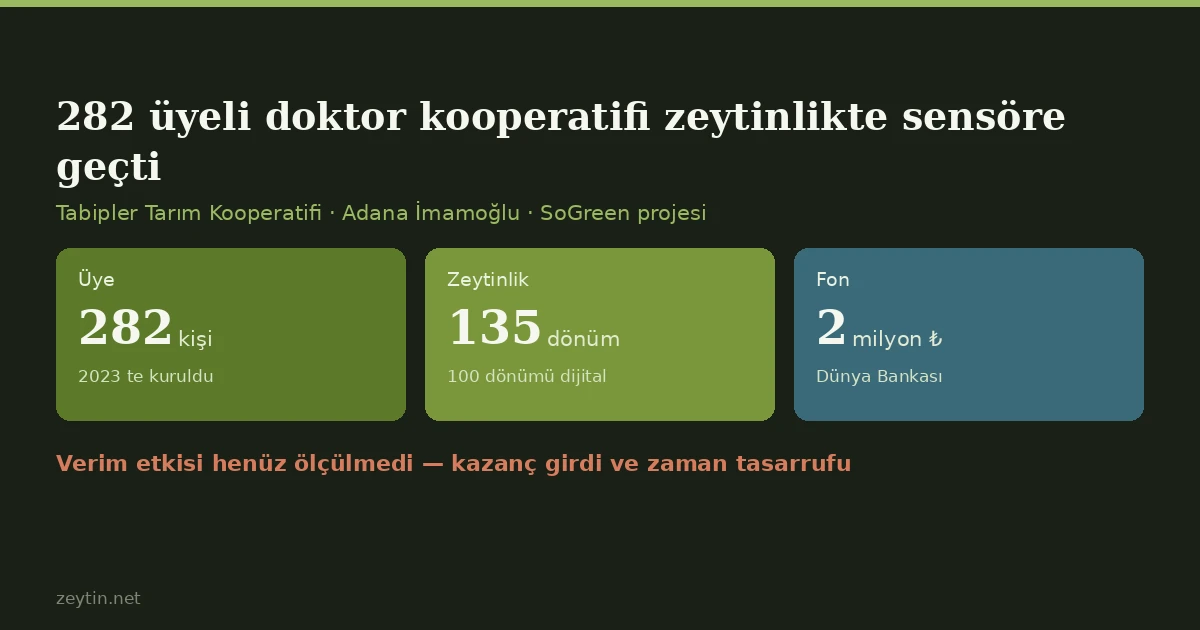
A cooperative founded by doctors in Adana is monitoring water and fertiliser with buried sensors across 100 of its 135 dönüm of bearing olive grove, funded with 2 million lira.
Article
A 282-member doctors' cooperative puts sensors in the olive grove
A cooperative founded by doctors in Adana is monitoring water and fertiliser with buried sensors across 100 of its 135 dönüm of bearing olive grove, funded with 2 million lira.
 Article
The EU's newest olive oil registration is in northern Italy: Olio dei Colli di Bologna gets PGI status
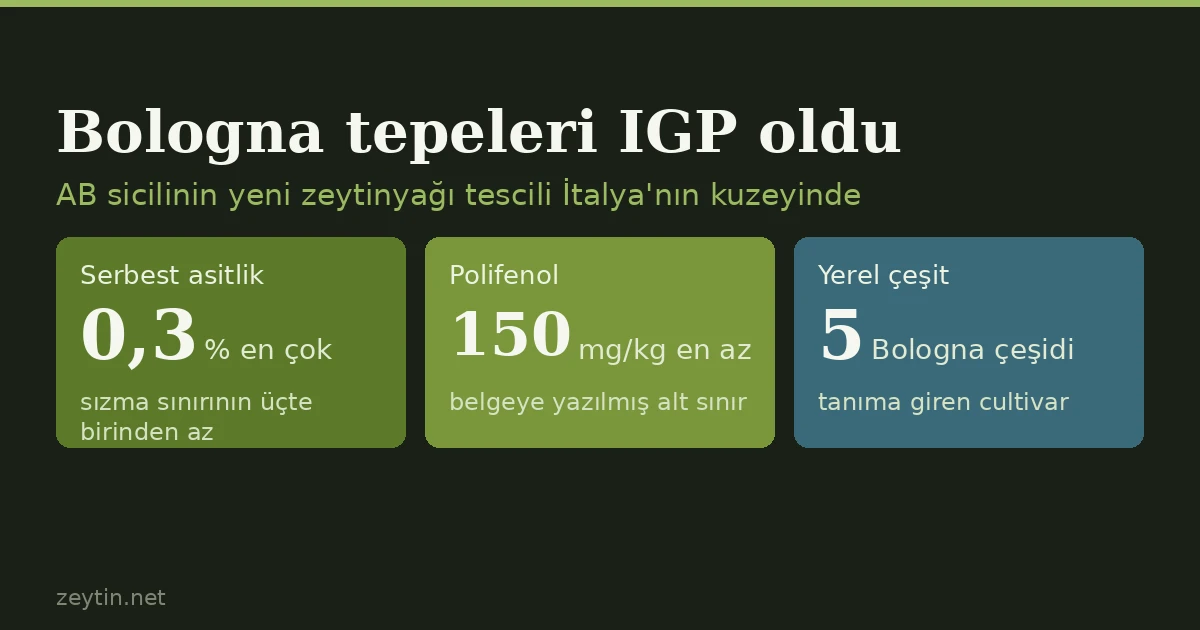
The European Commission has entered olive oil from the hills of Bologna into the Union register of geographical indications. The specification caps free acidity at 0.3 percent, well under a third of the legal limit for extra virgin, and writes five local Bolognese cultivars into the definition.
Article
The EU's newest olive oil registration is in northern Italy: Olio dei Colli di Bologna gets PGI status
The European Commission has entered olive oil from the hills of Bologna into the Union register of geographical indications. The specification caps free acidity at 0.3 percent, well under a third of the legal limit for extra virgin, and writes five local Bolognese cultivars into the definition.
 Article
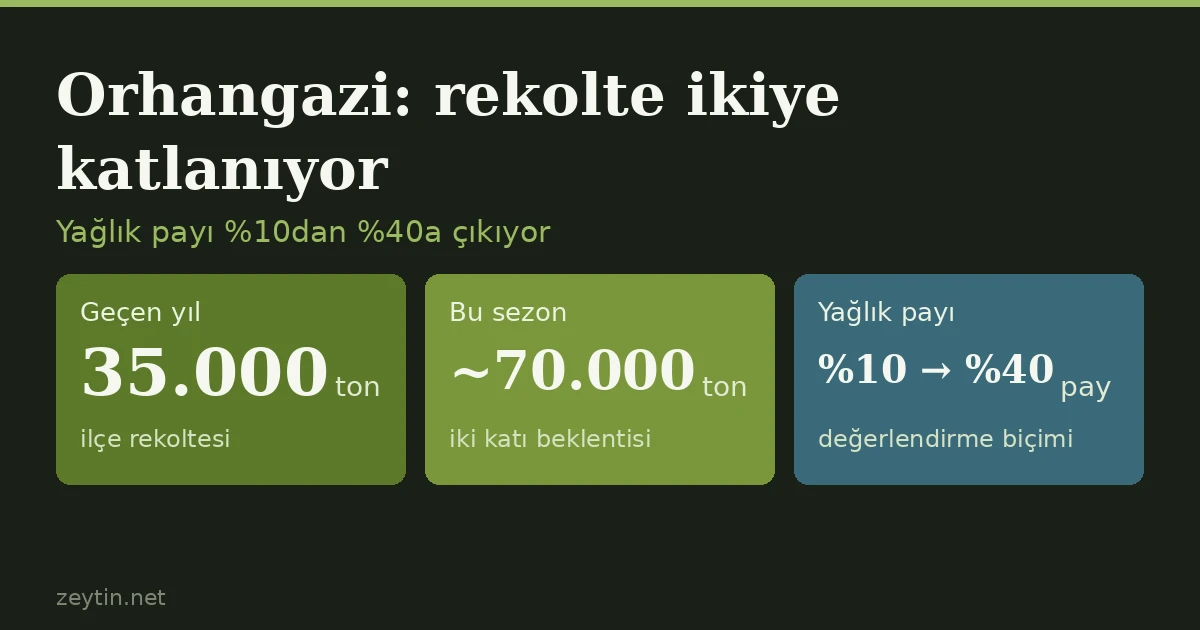
Orhangazi's crop is doubling: the oil olive share climbs from 10% to 40%
According to figures from the Orhangazi District Directorate of Agriculture and Forestry, last season's crop of roughly 35,000 tonnes could double this year. But in Türkiye's table olive heartland the real shift is in the split: the share pressed for oil is expected to rise from 10% to 40%. Mills are already in maintenance, and the grower's income now depends on fruit size.
Article
Orhangazi's crop is doubling: the oil olive share climbs from 10% to 40%
According to figures from the Orhangazi District Directorate of Agriculture and Forestry, last season's crop of roughly 35,000 tonnes could double this year. But in Türkiye's table olive heartland the real shift is in the split: the share pressed for oil is expected to rise from 10% to 40%. Mills are already in maintenance, and the grower's income now depends on fruit size.
 Article
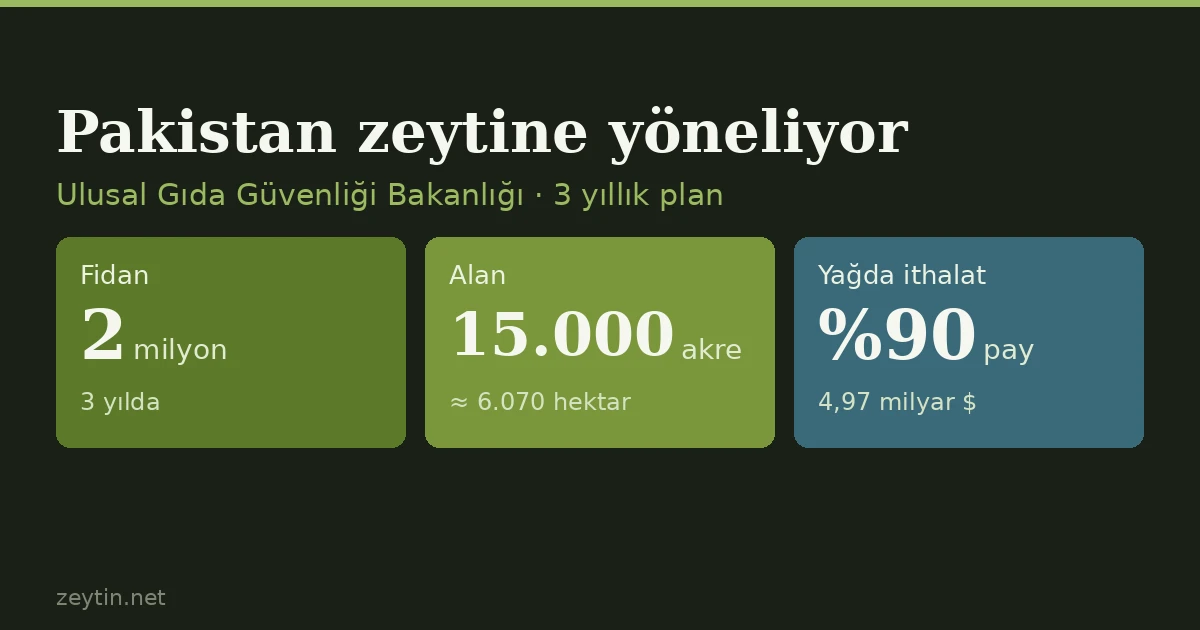
Pakistan to plant 2 million olive trees in three years to cut edible oil imports
Pakistan's Ministry of National Food Security and Research plans to establish olive groves on 15,000 acres (about 6,070 hectares) over three years and supply 2 million plants in that period. The country imports roughly 90 per cent of its edible oil; the import bill reached 4.97 billion dollars in 2024-25.
Article
Pakistan to plant 2 million olive trees in three years to cut edible oil imports
Pakistan's Ministry of National Food Security and Research plans to establish olive groves on 15,000 acres (about 6,070 hectares) over three years and supply 2 million plants in that period. The country imports roughly 90 per cent of its edible oil; the import bill reached 4.97 billion dollars in 2024-25.