How many times more is extra virgin than lampante oil? Spain 1.25 to 1.13, Italy 3.59 to 1.93: 56 weeks of producer prices
Weekly European Commission producer prices show the gap between extra virgin and lampante oil falling from 0.84 to 0.37 €/kg in Spain and from 6.68 to 2.49 €/kg in Italy between 12 October 2025 and 1 November 2026. The article sets out how it narrowed and what the data does not show.
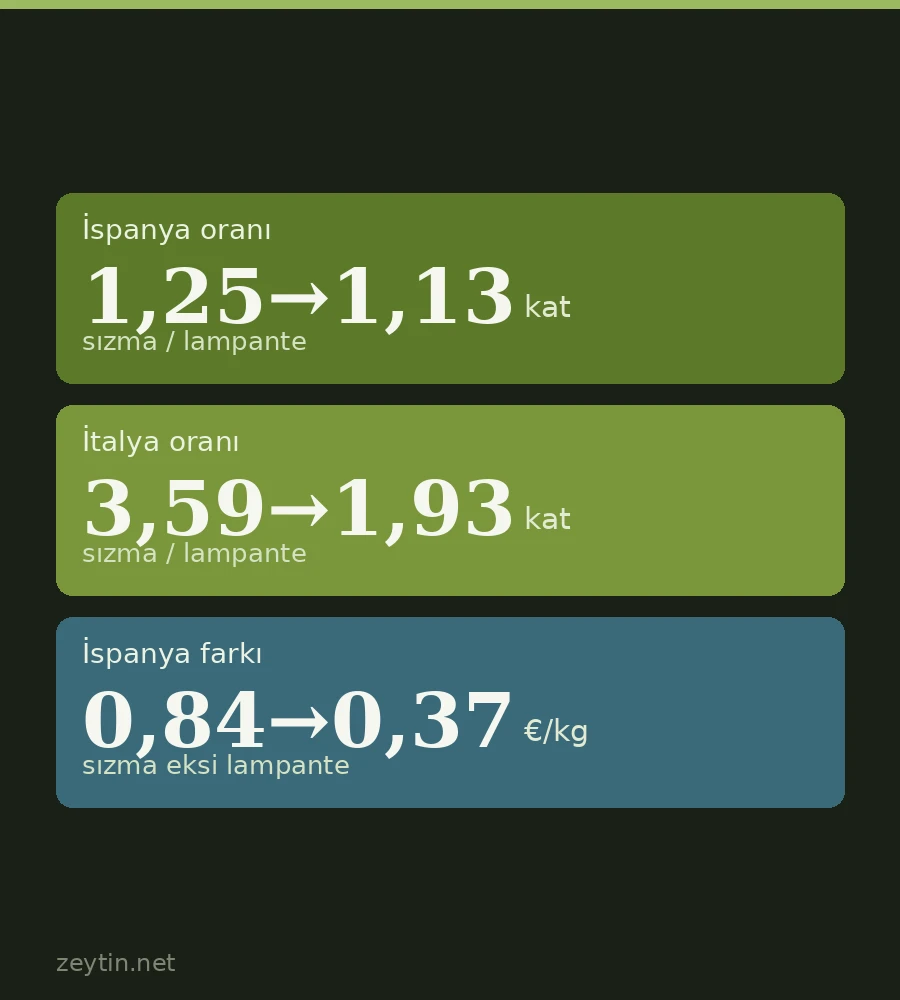
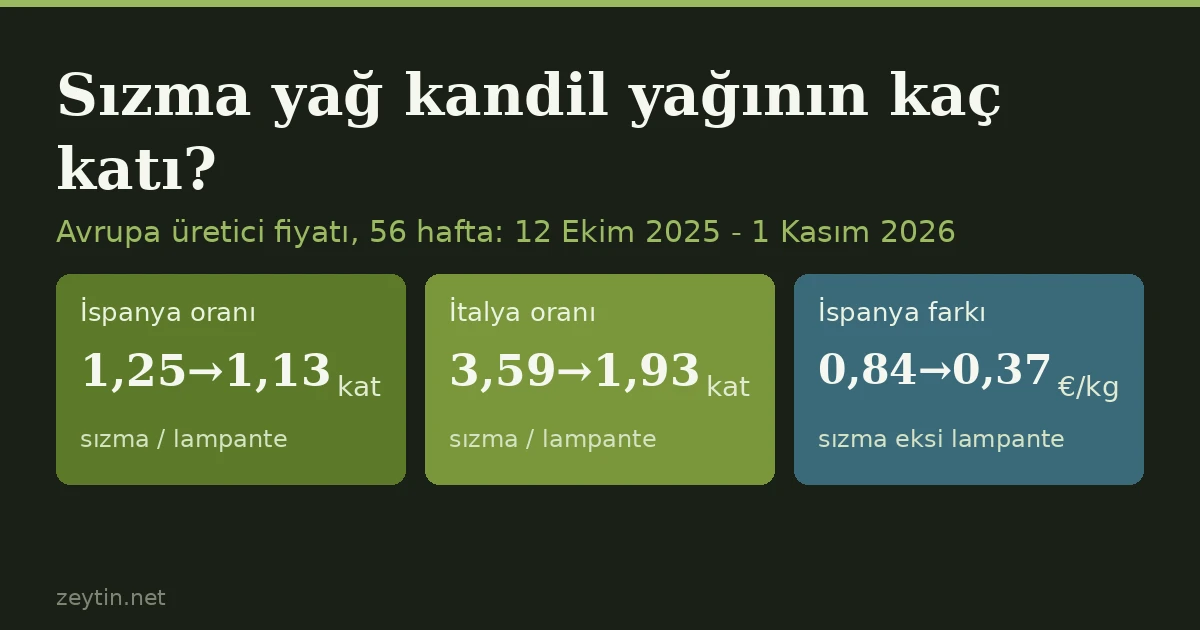
Short answer: According to the European Commission's weekly producer price data, the gap between extra virgin olive oil and lampante oil narrowed clearly in both Spain and Italy over the 56 weeks from 12 October 2025 to 1 November 2026. In Spain, extra virgin went from 1.25 times the lampante price to 1.13 times; in Italy, from 3.59 times to 1.93 times. The data does not say why it narrowed; below we set out what it shows and what it does not.
What is lampante, and why this comparison?
Lampante is the class of olive oil that is not fit for direct consumption and has to be refined. In the International Olive Council's trade standard, a virgin oil whose free acidity is above 2 per cent, or whose sensory defect exceeds a set limit, falls into this group. Extra virgin oil has free acidity of up to 0.8 per cent and no sensory defect. We explain what acidity and the other values in an analysis report mean in a separate article.
Putting the prices of these two classes side by side shows what it is worth in the market to climb a quality step. A large gap means a high premium for good oil; a small gap means the price scissors between good and bad oil has closed. Our data table holds a weekly series for both countries: extra virgin (up to 0.8 per cent acidity), virgin (up to 2 per cent) and lampante, in euros per kg.
Two countries in selected weeks
| Week | Spain extra virgin | Spain lampante | Gap | Ratio | Italy extra virgin | Italy lampante | Gap | Ratio |
|---|---|---|---|---|---|---|---|---|
| 12 Oct 2025 | 4.25 | 3.41 | 0.84 | 1.25 | 9.26 | 2.58 | 6.68 | 3.59 |
| 11 Jan 2026 | 4.49 | 3.61 | 0.89 | 1.25 | 6.82 | 3.04 | 3.78 | 2.24 |
| 12 Apr 2026 | 4.31 | 3.22 | 1.09 | 1.34 | 6.69 | 2.94 | 3.75 | 2.28 |
| 12 Jul 2026 | 3.86 | 2.91 | 0.95 | 1.32 | 5.41 | 2.81 | 2.60 | 1.93 |
| 11 Oct 2026 | 3.32 | 2.95 | 0.37 | 1.12 | 4.37 | 2.77 | 1.60 | 1.58 |
| 1 Nov 2026 | 3.17 | 2.79 | 0.37 | 1.13 | 5.18 | 2.69 | 2.49 | 1.93 |
"Gap" is extra virgin minus lampante and "ratio" is extra virgin divided by lampante; both are our own calculations, done in Python. The values in the table are rounded.
Spain: slowly, then a step
In Spain, extra virgin oil fell from 4.25 €/kg to 3.17 €/kg over the 56-week series, a drop of about 25.6 per cent. Lampante fell from 3.41 to 2.79 €/kg over the same period, about 18.1 per cent. Both reached the lowest values in the series in the last week, 1 November 2026. Because extra virgin fell faster, the gap narrowed.
It helps to split the series in two. From October 2025 to the middle of July 2026 the gap wandered roughly between 0.72 and 1.09 €/kg; the highest value was 1.09 € on 12 April 2026 (ratio 1.34). Then the gap of 0.95 € on 12 July dropped to 0.69 € in a single week: extra virgin slipped from 3.86 to 3.62 while lampante barely moved. From August on the gap wore away a little more each month, and in the second week of October it fell below 0.37 € (ratio 1.12), the lowest point of the series. The data does not say what caused any one step. Spain's new-season crop expectation is in a separate article of ours, and extra virgin prices may have reacted more strongly to a larger expected crop, but that is an assumption, not a result tested in any study.
The rungs of the ladder in the last week were: extra virgin 3.17, virgin (up to 2 per cent acidity) 2.93, lampante 2.79 €/kg. That is 0.24 between extra virgin and virgin, and 0.14 €/kg between virgin and lampante.
Italy: extra virgin halved, lampante unmoved
The Italian series is more striking. Extra virgin oil fell from 9.26 €/kg on 12 October 2025 to 5.18 €/kg on 1 November 2026, about 44.1 per cent. Lampante rose from 2.58 to 2.69 €/kg over the same period, about 4.3 per cent. The gap therefore went from 6.68 €/kg to 2.49 €/kg. On 11 October 2026 it hit its low of 1.60 €/kg (ratio 1.58); in the following two weeks extra virgin climbed from 4.37 to 4.78, and then to 5.18 on 1 November, and the gap opened again.
Two details limit interpretation. First, the Italian series repeats the same value for many weeks: extra virgin, for example, shows 6.73 € for five weeks between 8 March and 5 April. The series behaves like a price updated at intervals rather than a fresh transaction price each week. Second, the 6.72 € value on 28 June 2026 is a one-week jump that fits neither the 5.77 € before it nor the 5.35 € after it. We left that week in the data, but none of the figures above rests on it.
How much higher Italian extra virgin is than Spanish is a separate subject; Italy's extra virgin price was 2.18 times Spain's on 12 October 2025, fell to 1.32 times on 11 October 2026, and stood at 1.64 times in the last week. We discuss it in our article comparing Türkiye and Europe.
What these figures do not show
- They do not show the cause. The data does not say why the prices came closer. A larger expected crop, stocks, demand or classification differences are possible; we cannot tell from this series which weighed most.
- They do not show a single lot. These are national weekly producer prices; they do not reflect the quality, acidity or packaging of an individual batch.
- They do not apply directly to Türkiye. Turkish commodity exchanges register "crude" (ham) and extra virgin oil as separate items, and crude oil is not necessarily the same thing as lampante. Comparing the ratios here with the crude-to-extra-virgin ratio in Türkiye would be misleading.
- They are not a forecast. We do not say that the gap will narrow or widen from here.
Data and method
The series rests on weekly producer prices compiled by the European Commission from member states; our data table holds all 56 weeks between 12 October 2025 and 1 November 2026. The source's last update was the week of 1 November 2026, so this article describes the position up to that week. The gap is in euros per kilogram; for information only, at the ECB's reference rate of 13 November 2026 (1 euro = 55.67 lira), Spain's 0.37 €/kg is about 21 lira and Italy's 2.49 €/kg is about 139 lira. That is only a currency conversion, not a comparison with Turkish prices.
One rating per visitor; you can change yours at any time. Ratings are real reader votes — no seeded or default scores.
Related
 Article
How much is the olive pressing fee in 2026? Cash or a share of the oil?
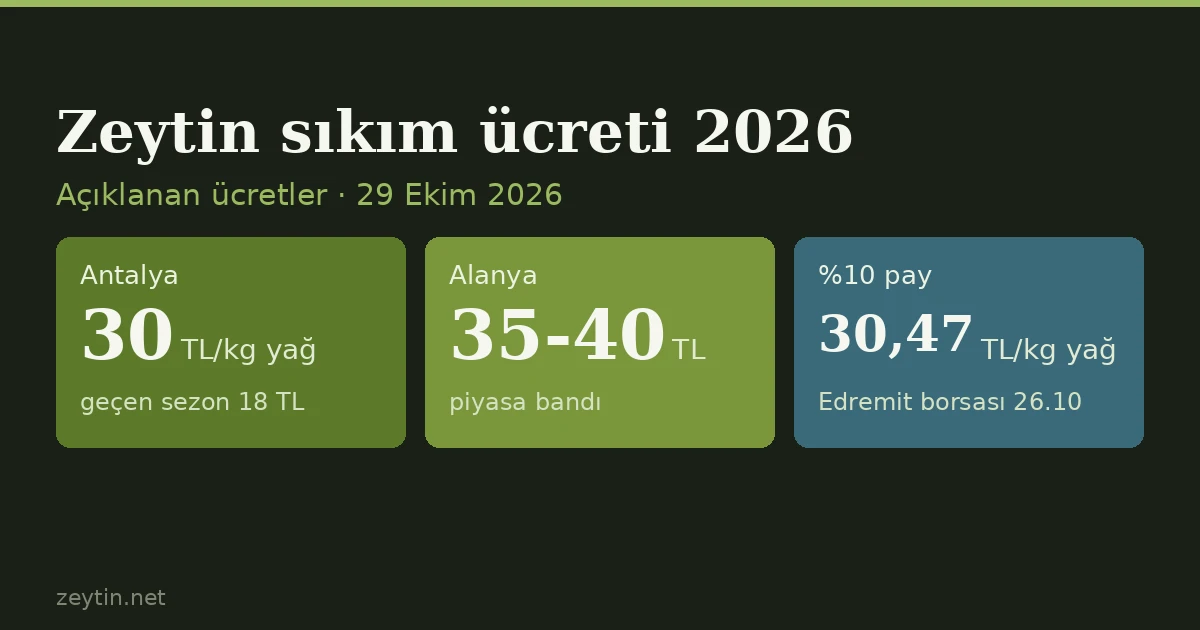
Pressing fees for 2026-27: 30 lira per kilo of oil in Antalya, 35–40 lira in Alanya, 4 lira in Osmaniye; in the Aegean mills mostly take a share of the oil. We compare the three payment methods by yield and current exchange price.
 Article
Rain in Andalusia, prices in Aydın: how Spain's drought set the price in Türkiye
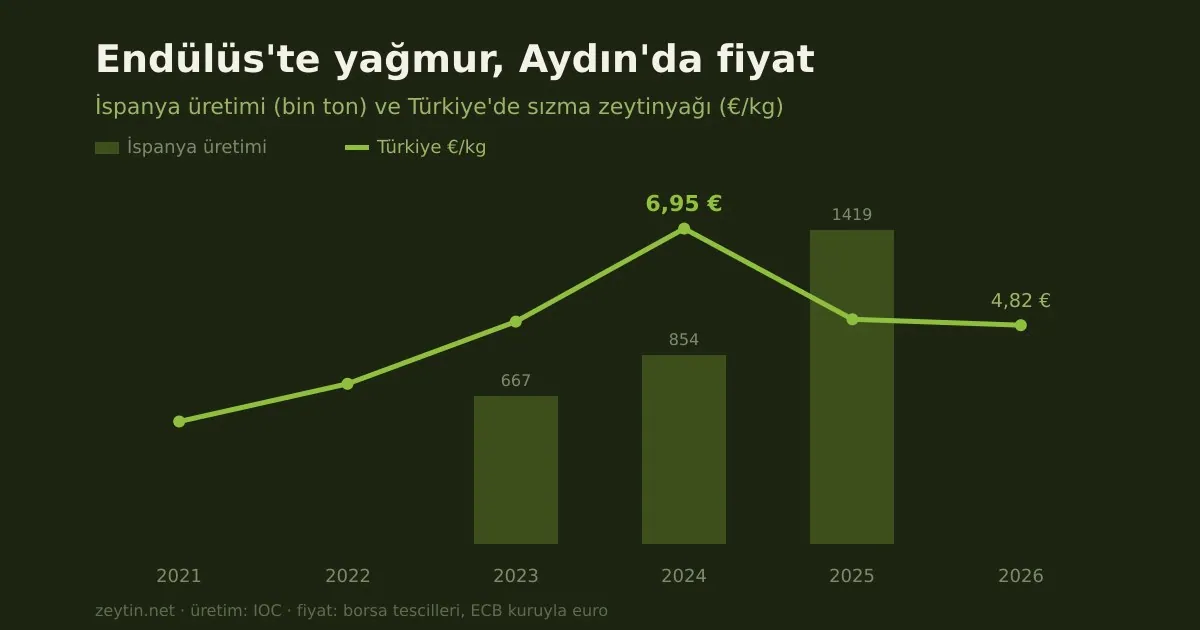
Spain makes 40% of the world's olive oil. Its output halved in 2022/23 and Türkiye's euro price went from €2.70 to €6.95.
 Article
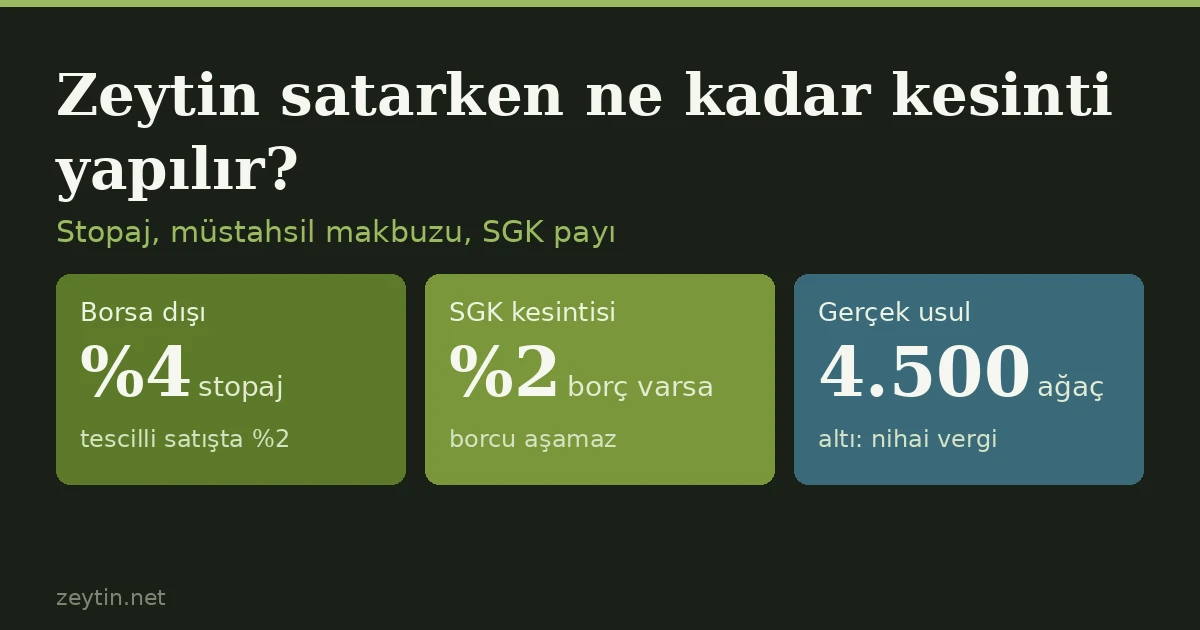
How much is deducted when you sell olives? Withholding tax, the producer receipt and the social security cut
Growers selling olives to a trader or cooperative have 4% of the price withheld as income tax, or 2% if the sale is registered on a commodity exchange; below 4,500 trees this is the final tax. Farmers with premium arrears also face a 2% social security deduction. The producer receipt, exchange fees and a worked example with Akhisar prices.
 Article
What temperatures can the olive withstand?
Ideal 15–20 °C, an upper limit of 40 °C (with irrigation), a lower limit of −7 °C. Temperature thresholds, chilling requirement, and the climate risk of production narrowed to four varieties.