Coratina olive: Italy's oil variety
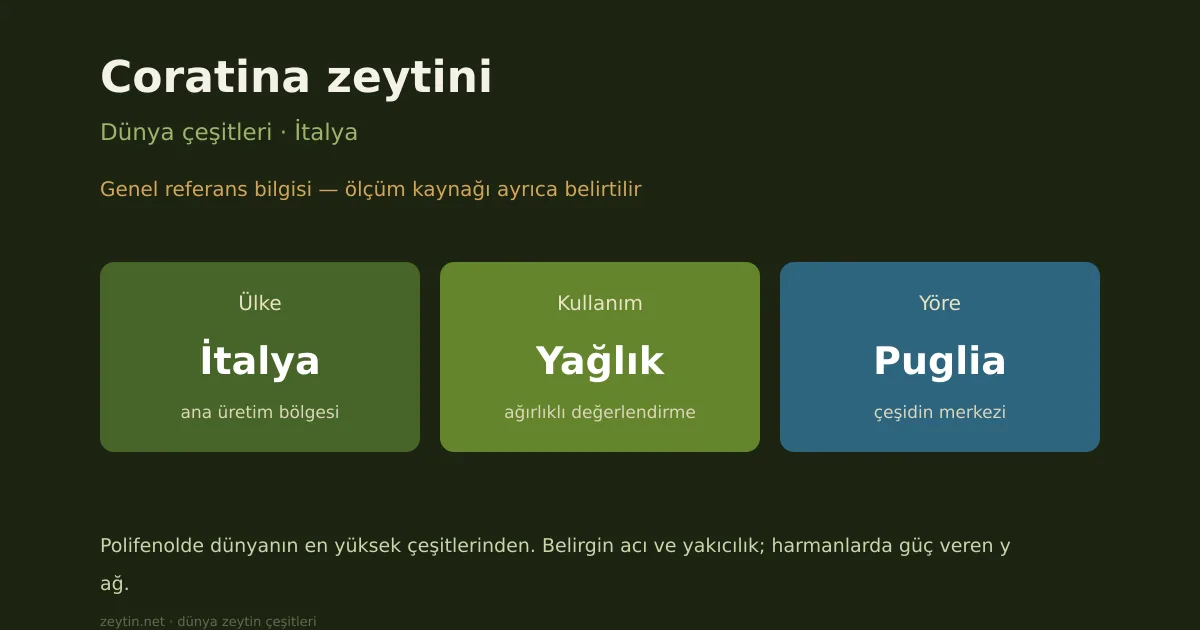
Among the highest-polyphenol varieties in the world. Distinctly bitter and pungent — the oil that gives blends their backbone.
In olive oil, "bitter" and "pungent" are not faults but measures. At the top of that scale stands Coratina: one of the highest-polyphenol varieties in the world.
Puglia's strength
Coratina is the main variety of Puglia, the heel of Italy. Much of Italian olive oil production comes from that region, and Coratina is its backbone.
Why so bitter?
Bitterness and the peppery catch in the throat are direct indicators of the phenolic compounds in olive oil — chiefly oleocanthal and oleuropein derivatives.
Coratina carries these at exceptionally high levels. The consequences:
- Long shelf life — phenols are natural antioxidants that delay oxidation.
- Strength in blends — mixed with mild varieties, it lends them structure and stability.
- A demanding taste — on its own, most consumers find it harsh.
On what those compounds are and why they matter: oleocanthal and polyphenols.
How should harshness be read?
Oils marketed as "smooth" and "light" are usually low in phenols. The mildness a consumer enjoys is often simply a shortage of antioxidants.
Coratina demonstrates the opposite: the sharpness people find uncomfortable is a measurable mark of quality. On reading the label: how to read an olive oil label.
Compared with Türkiye
Türkiye has no direct equivalent of Coratina; its native varieties generally give moderate bitterness. The closest are early-harvested Memecik and Ayvalık oils — early picking raises phenol levels. On the economics of that trade-off: is early harvest expensive or valuable?
Coratina in numbers
| Use | Oil |
| Oil content | 20-23% |
| Oleic acid | 77% |
| Total phenols | High |
| Fruit weight | 3.94 g |
| Stone | Heavy, very elongated |
| Ripening | Late and staggered |
| Entry into production | Medium-early |
| Self-fertility | Low — needs a pollinator |
| Cold | Tolerant |
| Susceptible to | Olive fly (highly), leaf spot (medium) |
Source: International Olive Council (IOC), World Catalogue of Olive Varieties. It covers 70,000 hectares in Puglia: 60,000 in Bari and 10,000 in Foggia.
The high phenol content described above sits alongside two further figures: 20-23% oil and 77% oleic acid. Together these are exactly what blenders look for — a good yield, a fatty-acid profile that resists oxidation, and a phenol load that can be carried into softer oils.
There is also a warning line: self-fertility is low. Planted alone, Coratina sets fruit poorly and needs a pollinator beside it — the same problem Domat has in Türkiye.
Related pages
Where it stands among measured varieties
et/çekirdek oranı 6,32'ten türetildi — kaynak: IOC Dünya Zeytin Çeşitleri Kataloğu — Avustralya denemesi 19
çeşit sayfası
IOC Dünya Zeytin Çeşitleri Kataloğu — Avustralya denemesi 1998-2004 (Tablo 4)
IOC Dünya Zeytin Çeşitleri Kataloğu — Avustralya denemesi 1998-2004 (Tablo 4)
Values are those published on each variety's own page; the comparison covers only varieties with a measured figure, so it is a comparison of what is known — not of every Turkish variety. See the full ranking and how it is built →
One rating per visitor; you can change yours at any time. Ratings are real reader votes — no seeded or default scores.
Related
 Article
Belluti olive
Belluti is a recorded variety of south-eastern Anatolia. No measured pomological data published.
Article
Belluti olive
Belluti is a recorded variety of south-eastern Anatolia. No measured pomological data published.
 Article
Arbequina olive: Spain's oil variety
The mainstay of super-high-density planting. Small canopy, small fruit, early bearing — the variety that changed modern olive growing.
Article
Arbequina olive: Spain's oil variety
The mainstay of super-high-density planting. Small canopy, small fruit, early bearing — the variety that changed modern olive growing.
 Article
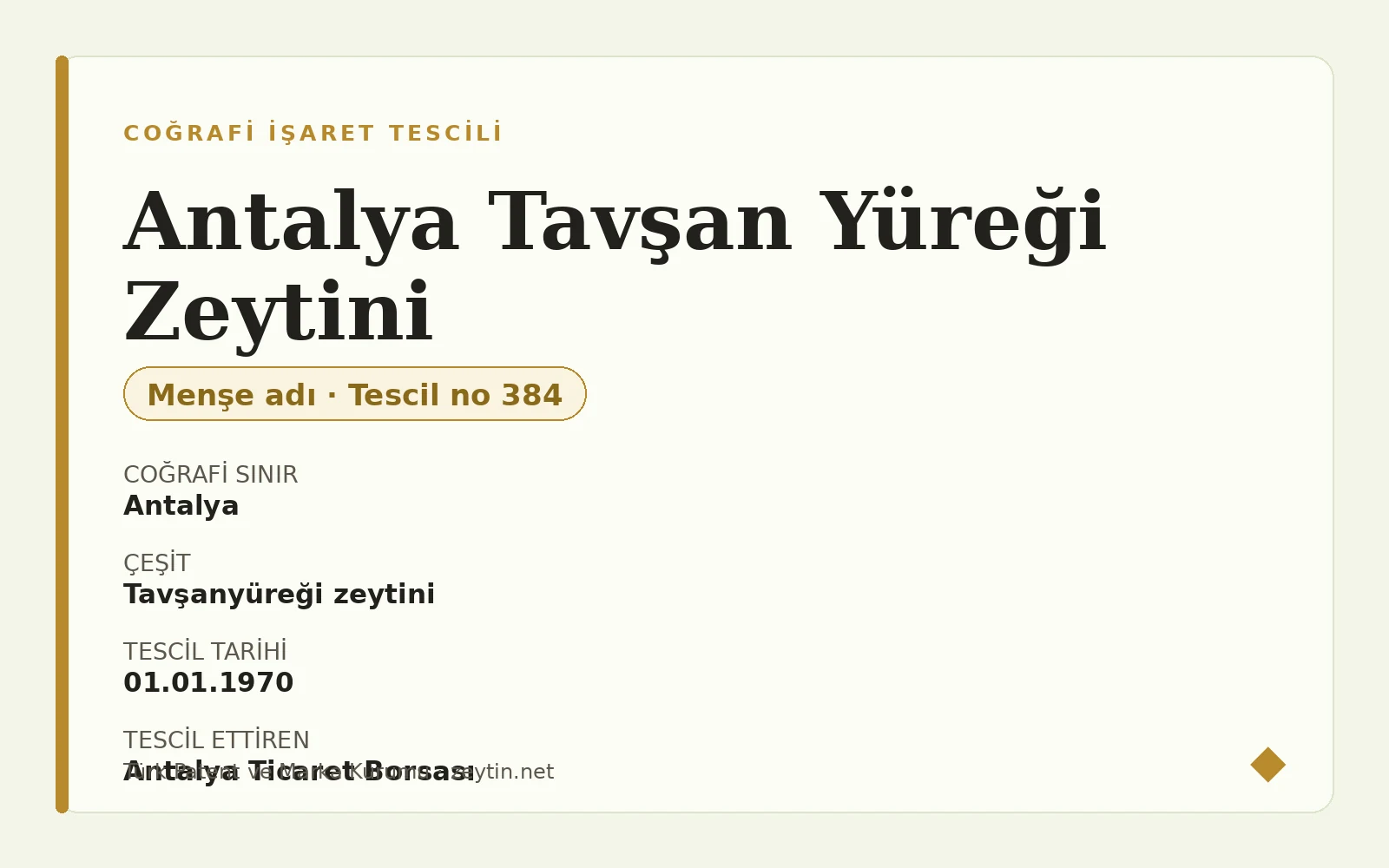
Antalya Tavşan Yüreği Olive: a registration named after the shape of its fruit
Registered in 2018. Fruit and stone are heart-shaped; picked green, its oil runs 9-20.2%, rising to 25% at black maturity.
Article
Antalya Tavşan Yüreği Olive: a registration named after the shape of its fruit
Registered in 2018. Fruit and stone are heart-shaped; picked green, its oil runs 9-20.2%, rising to 25% at black maturity.
 Article
Mavi olive
Mavi is a recorded variety of south-eastern Anatolia. No measured pomological data published.
Article
Mavi olive
Mavi is a recorded variety of south-eastern Anatolia. No measured pomological data published.