Antalya's crop is up 30%: of 70,000 tonnes of olives, 55,000-60,000 head for the mill
According to the Antalya Commodity Exchange, the province's olive crop is rising about 30% from some 55,000 tonnes last season to around 70,000 tonnes, with 13,000-14,000 tonnes of olive oil and 10,000-15,000 tonnes of brined fruit expected. Harvest opened on 15 September. There is movement on the registration front too: an EU application has been filed for the Tavşan Yüreği olive, and a geographical indication file is under way for the Beylik variety.
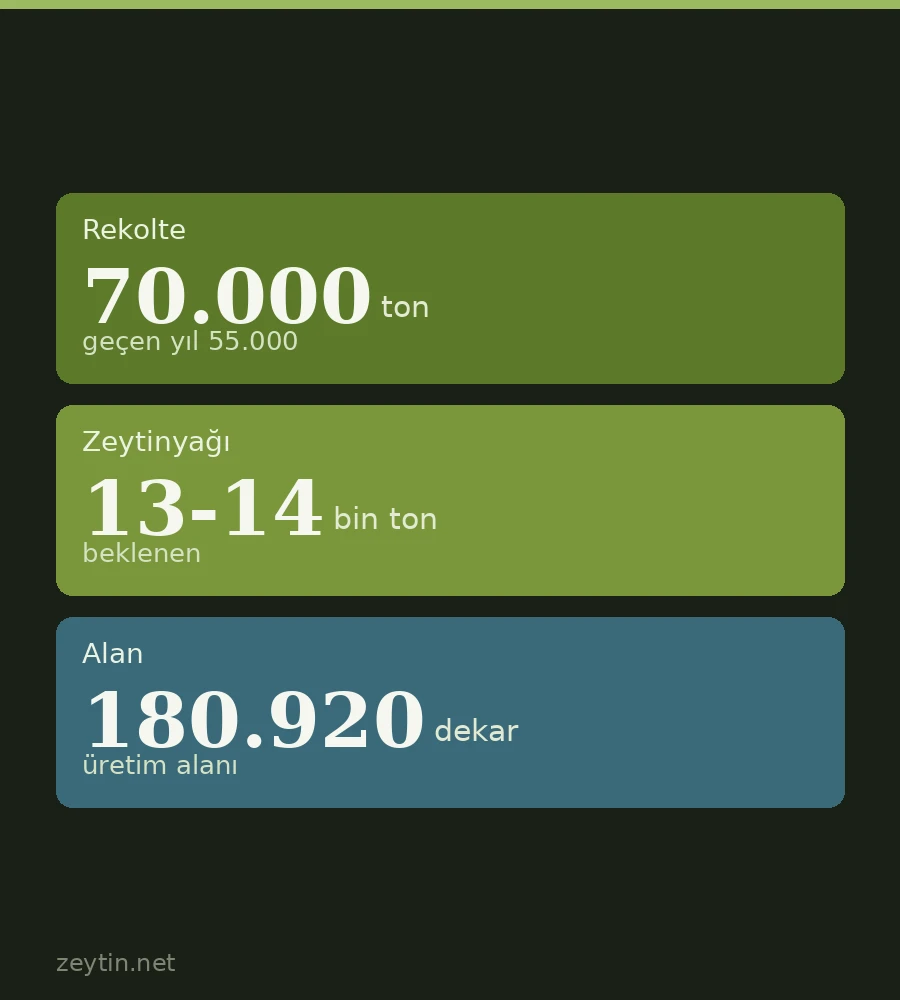
A province that gets far less attention than the Aegean or South Marmara on Türkiye's olive map is heading for one of its strongest seasons. According to figures released by the Antalya Commodity Exchange, the province's olive crop is rising roughly 30 percent, from around 55,000 tonnes last season to about 70,000 tonnes this year. The breakdown given by the exchange's chairman, Ali Çandır, puts 13,000-14,000 tonnes of olive oil and 10,000-15,000 tonnes of brined table fruit at the end of that harvest. Picking opened on 15 September at Zeytinpark in the Kepez district, and the province's olive area is reported at 180,920 decares (roughly 18,090 hectares).
As telling as the volume is the way the season is described: in Çandır's words, Antalya is in an "on" year for olives.
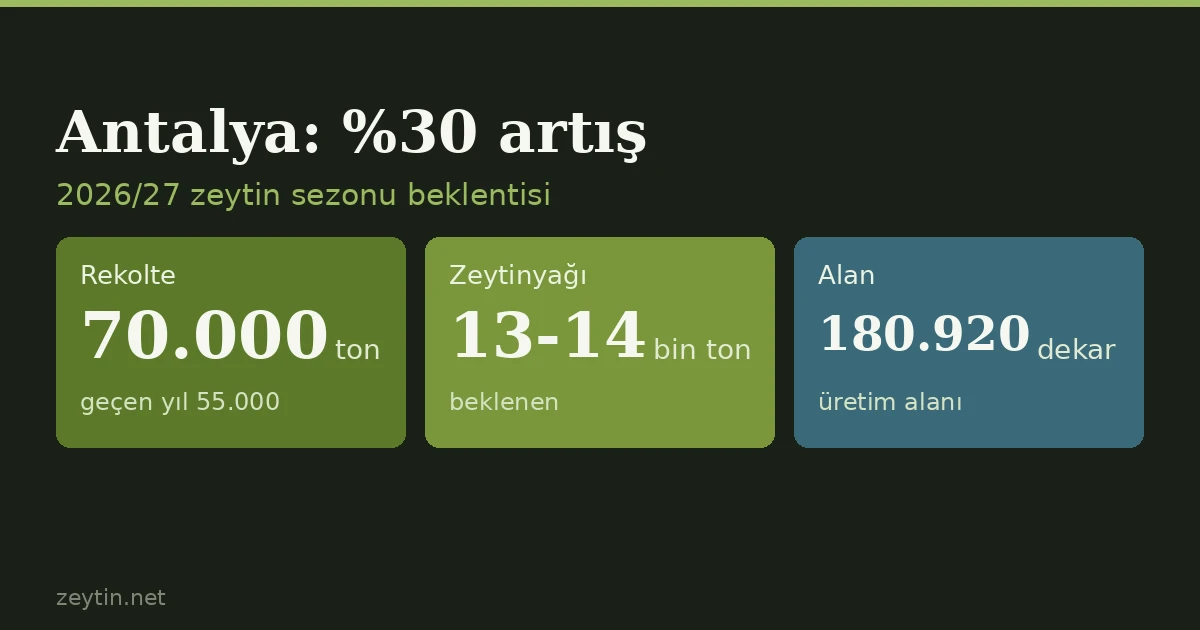
The figures
| Item | Value |
|---|---|
| Last season's crop | ~55,000 t |
| Expectation for this season | ~70,000 t |
| Increase | ~30% |
| Expected olive oil | 13,000-14,000 t |
| Expected brined table olives | 10,000-15,000 t |
| Olive area | 180,920 decares |
| Harvest opening | 15 September (Kepez) |
The figures come from the Antalya Commodity Exchange.
How 70,000 tonnes splits
Placing the two output figures side by side makes the arithmetic visible. If 10,000-15,000 tonnes go to the brining tanks, then 55,000-60,000 tonnes are left for the mill. Getting 13,000-14,000 tonnes of oil out of that volume implies an average extraction yield of 22-24 percent.
That is not impossible, but it sits at the optimistic end of the range. Yield moves roughly between 15 and 25 percent depending on variety, ripeness and pressing method, and fruit picked before oil accumulation is complete lands near the bottom of that band. In other words, the oil forecast depends not only on the crop materialising but on the fruit being picked at the right ripeness. We covered which olives should be picked at which stage in when to harvest olives and the maturity index.
The same two numbers can also be read against the area. Dividing 70,000 tonnes by 180,920 decares gives roughly 387 kilograms of fruit per decare. That is an average for the province rather than a figure for any individual grove — it includes young plantings not yet in full bearing as well as abandoned groves — but it is not a low average for an "on" year. Readers who want to compare it with their own groves should keep one thing in mind: yield per unit area depends heavily on planting density, and the same decare may carry 10 trees or 40. We examined that relationship in planting density: how many trees per decare.
A second caveat matters just as much: these are the sector's own expectations, not the official crop figure. Türkiye's 2026 crop assessment is still running in 41 provinces, and until the provincial commissions finish their work every number in circulation is an estimate. We explained why early-season volume and expectation data cannot stand in for the harvest itself in exchange volume is not the harvest.
Beylik joins Tavşan Yüreği
The second strand of the announcement concerns registration. The geographical indication for the region's own Tavşan Yüreği olive has been completed, and an application has been filed for European Union registration. A geographical indication file is also reported to be under way for the Beylik variety.
Tavşan Yüreği is an Antalya variety that takes its name from the shape of its fruit; we examined its registration file and distinguishing characteristics in the Antalya Tavşan Yüreği olive geographical indication and in our Tavşanyüreği variety page. Unlike national registration, EU registration extends protection into the single market, where most of Türkiye's table olive and olive oil exports compete. What a geographical indication does and does not deliver for the grower is the subject of our analysis twenty-five GIs: what are they actually doing. Beylik, on the other hand, is not registered yet, and it would be wrong to describe the variety as protected before the file is concluded.
An "on" year, water and climate
An "on" year comes from the olive tree's habit of loading one season and resting the next; we set out the mechanics of that swing in alternate bearing in olives. Still, attributing Antalya's 30 percent rise to biennial bearing alone would be incomplete: when grove management and the season's weather pull in the same direction, the increase compounds.
That is why the emphasis the announcement places on efficient water use and adaptation to climate change is worth noting rather than dismissing as boilerplate. Antalya grows olives in one of the basins where drought pressure is discussed most openly. It is true that the olive tolerates dry conditions, but fruit size and oil accumulation are both sensitive to water supply, and a shortfall in late summer shows up in the mill rather than in the tree. We looked at irrigation's effect on yield in olive irrigation and drip systems, and at the longer arc in climate change and the olive.
Picking in September, and the clock at the mill
A 15 September opening is early by Turkish standards. Early harvest means higher polyphenol content and lower acidity in the oil, but a lower extraction yield; we weighed that trade-off in is early harvest expensive or valuable.
In mid-September, Mediterranean temperatures are still high. Fruit that sits in a heap after picking warms up, fermentation starts, and free acidity climbs — a change that writes itself directly into the oil's grade through its acidity value. In a season when volumes rise, the queue outside the mill lengthens as well, and that queue is a quality problem, not merely a logistical one. The most practical quality variable in the grower's hands is the time between picking and pressing; the checklist in what to check when having olives pressed at a mill applies to this season too.
Why Antalya matters
Antalya produces both table olives and oil, and more than half of the 70,000 tonnes is expected to go to the mill. The same pattern is showing up elsewhere this year: in Orhangazi the crop is doubling while the oil share climbs from 10% to 40%. Read together, the two pictures suggest a national season that is generous in volume and demanding on milling capacity — which is exactly the combination that tests quality.
For how the season opened across the country, see the 2026/27 olive season opens with the first harvest; for the grower's cost picture as picking begins, see costs and carry-over stock before the harvest.
One rating per visitor; you can change yours at any time. Ratings are real reader votes — no seeded or default scores.
Related
 Article
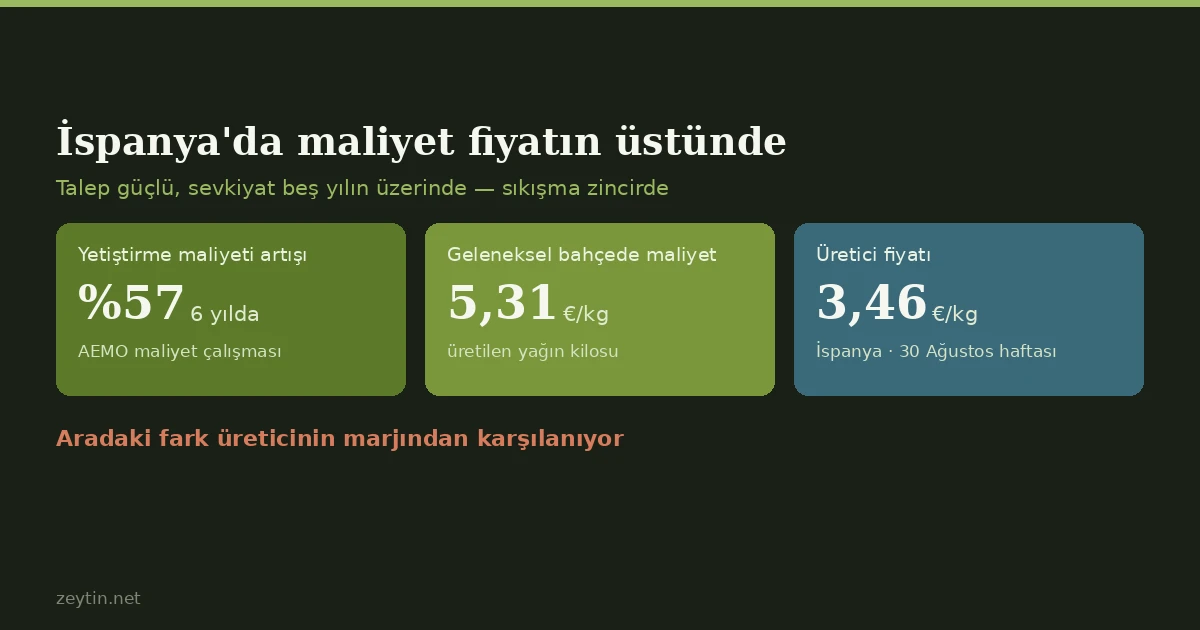
In Spain the cost sits above the price: €5.31 in a traditional grove, €3.46 at the gate
Olive cultivation costs have risen 57% in six years and reach €5.31 per kilogram in the most traditional groves, according to an AEMO study. The same week, Spain's producer price was €3.46. The Andalusian cooperative federation, with 342,000 members, is asking not for aid but for a change to the Food Chain Law.
Article
In Spain the cost sits above the price: €5.31 in a traditional grove, €3.46 at the gate
Olive cultivation costs have risen 57% in six years and reach €5.31 per kilogram in the most traditional groves, according to an AEMO study. The same week, Spain's producer price was €3.46. The Andalusian cooperative federation, with 342,000 members, is asking not for aid but for a change to the Food Chain Law.
 Article
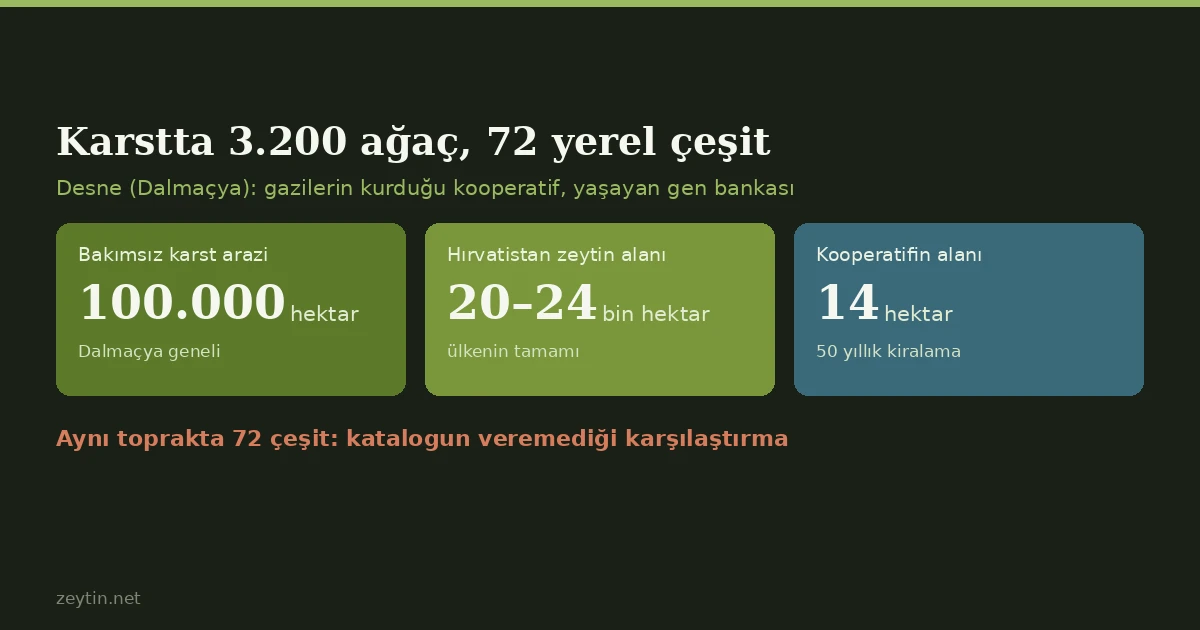
3,200 trees and 72 varieties on 14 hectares of stone: the cooperative turning Dalmatian karst into groves
Some 100,000 hectares of karst lie neglected in Dalmatia while all of Croatia has 20,000–24,000 hectares under olives. In Desne a veterans' cooperative has grown 3,200 trees of 72 native varieties on 14 hectares of rock — a grove that doubles as a natural laboratory for climate resilience.
Article
3,200 trees and 72 varieties on 14 hectares of stone: the cooperative turning Dalmatian karst into groves
Some 100,000 hectares of karst lie neglected in Dalmatia while all of Croatia has 20,000–24,000 hectares under olives. In Desne a veterans' cooperative has grown 3,200 trees of 72 native varieties on 14 hectares of rock — a grove that doubles as a natural laboratory for climate resilience.
 Article
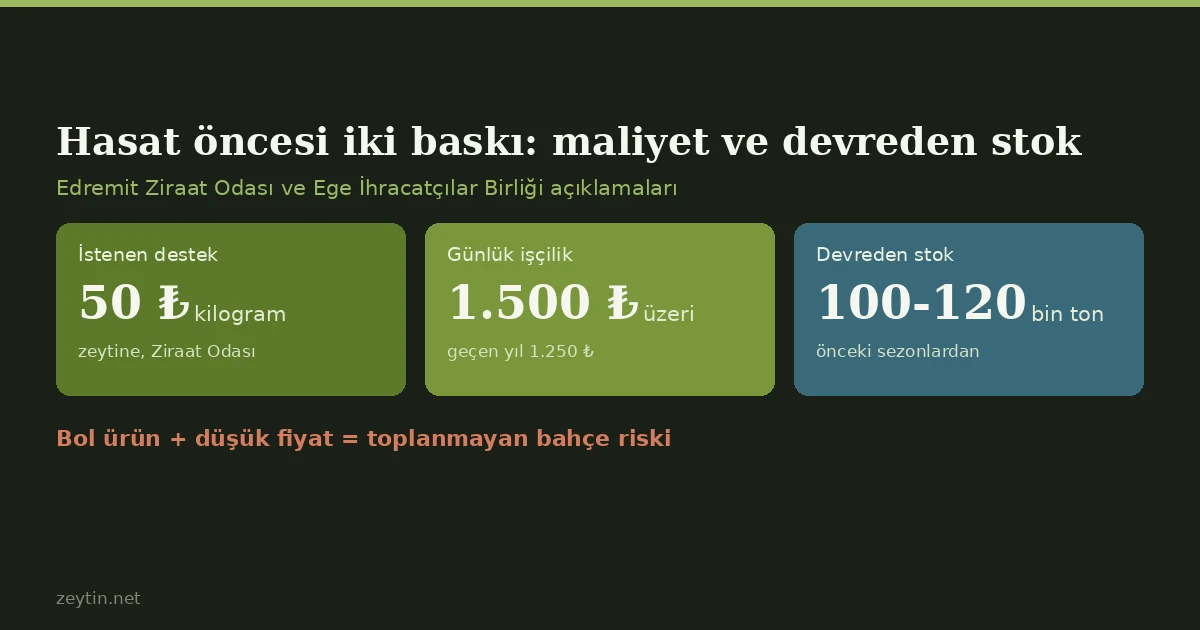
Two pressures before the harvest: costs and 100,000 tonnes carried over
The chamber of agriculture wants 50 lira per kilo; daily labour has passed 1,500 lira. Exporters report 100,000-120,000 tonnes carried over from previous seasons.
Article
Two pressures before the harvest: costs and 100,000 tonnes carried over
The chamber of agriculture wants 50 lira per kilo; daily labour has passed 1,500 lira. Exporters report 100,000-120,000 tonnes carried over from previous seasons.
 Article
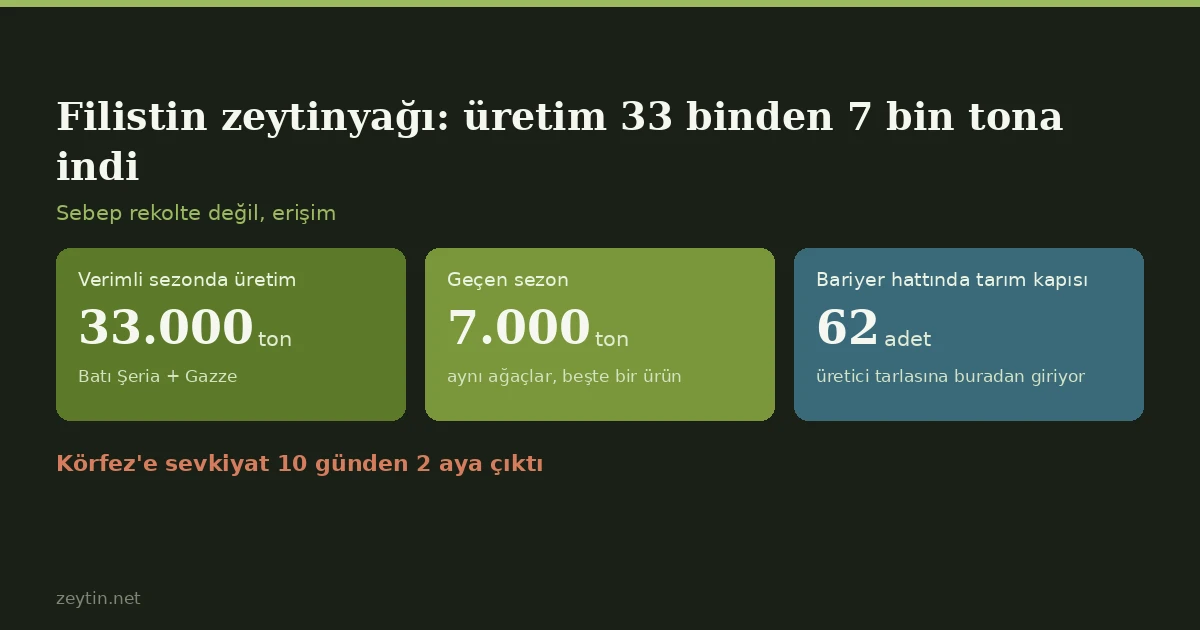
Palestinian olive oil: output down from 33,000 to 7,000 tonnes — the cause is access, not the crop
In a productive season Palestine yields 33,000 tonnes of olive oil; last season it produced 7,000. Seventy per cent of the groves sit in the northern West Bank, reached through 62 agricultural gates, and shipping times have gone from ten days to two months.
Article
Palestinian olive oil: output down from 33,000 to 7,000 tonnes — the cause is access, not the crop
In a productive season Palestine yields 33,000 tonnes of olive oil; last season it produced 7,000. Seventy per cent of the groves sit in the northern West Bank, reached through 62 agricultural gates, and shipping times have gone from ten days to two months.