Andalusia bans night harvesting again for 2026/27: 8,127 birds counted on 137 hectares
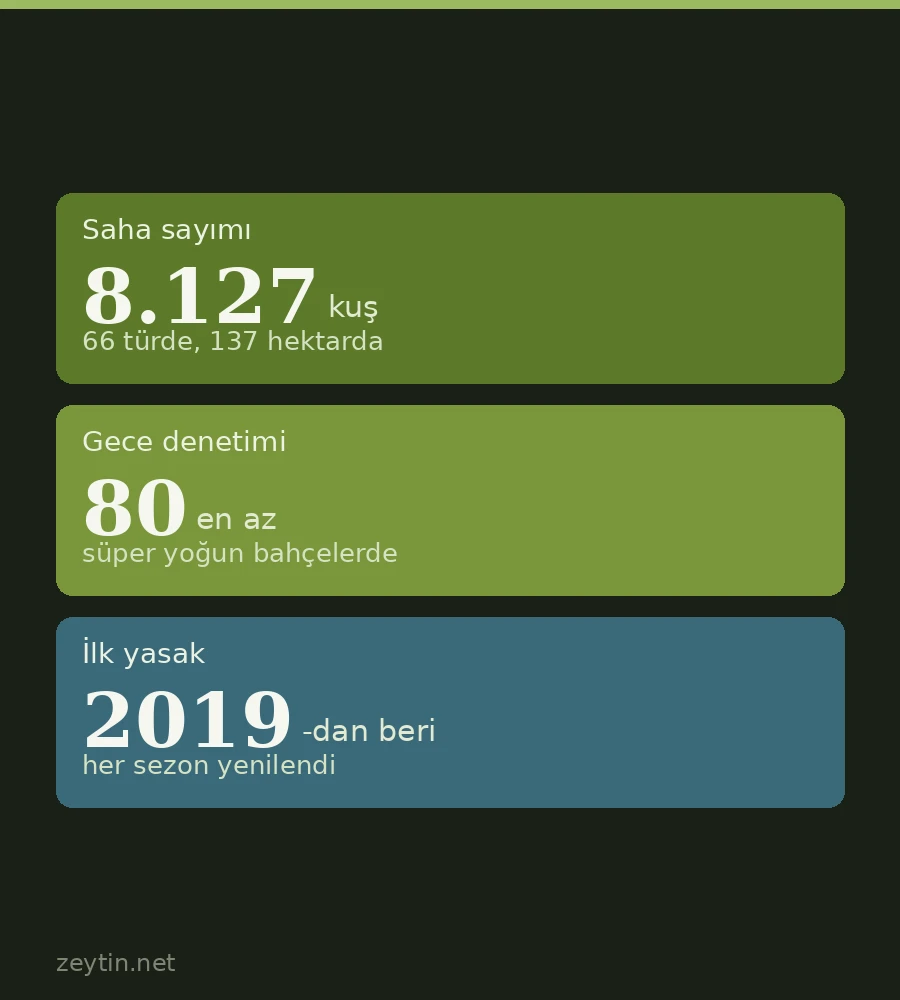
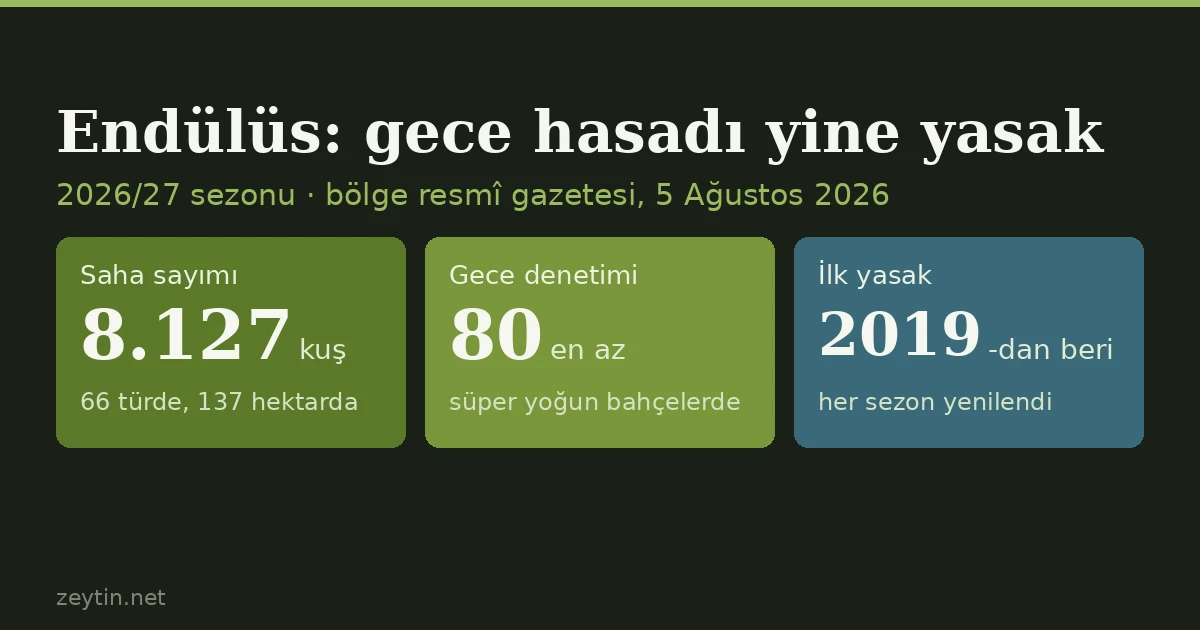
Andalusia has again suspended night-time mechanical harvesting in super-intensive hedgerow olive groves for the 2026/27 season. The resolution is dated 30 July 2026, was published in the regional official gazette on 5 August and is valid for one year. The justification is field counting: 8,127 birds from 66 species on 137 hectares. The suspension was first introduced in 2019 and has been renewed every season since.
The world's largest olive oil producing region will again not allow harvesting machines to work at night this season.
The Directorate General for Forest Policy and Biodiversity, part of the Andalusian regional government's Ministry of Sustainability and Environment, has suspended mechanical olive picking between sunset and sunrise in super-intensive — technically hedgerow (en seto) — olive groves for the 2026/27 season. The resolution is dated 30 July 2026 and was published in the region's official gazette on 5 August 2026, in issue 150. It is valid for one year.
The ban does not target all olive groves, but one specific production system: orchards where trees are planted in continuous rows like a hedge and are harvested by straddle harvesters that drive over the row. Traditional orchards, where branches are beaten or shaken, fall outside the scope of the decision.
The justification rests on counting
The basis of the decision is not an estimate but field work. According to the announcement, 44 field controls were carried out in productive hedgerow olive groves in the region; 8,127 birds belonging to 66 different species were recorded across 137 hectares of representative area.
The result is not one-sided either. In 30% of the monitored area the negative effect on birds was found to be "null or very low". In the rest, the effect was clear. The justification also notes that the deterrent measures tried so far — bird-scaring systems — have not been enough to reduce that effect. In other words, the reason for the ban is not night work as such, but the failure to neutralise its side effect with a technical fix.
The mechanism is straightforward. Birds are not nocturnal. A bird that has chosen the canopy of an olive tree to roost and feed in loses its orientation when confronted with the powerful lights and noise of a machine, and cannot escape. The harvester, which pulls fruit off the branch with an air current, takes the bird with it.
The ban is not new; it has been renewed for seven seasons
It is easy to read this as a first, but it is not. Andalusia first suspended night harvesting by a resolution dated 8 October 2019, for the 2019-2020 season, as a precautionary measure intended to allow the impact to be measured. The suspension has been renewed every season since. The 2026/27 decision is the latest link in that chain.
The figure that started the debate also dates from 2019. A study by Portugal's nature conservation institute estimated that night-time mechanical harvesting killed roughly 2.6 million birds a year in Andalusia and a further 96,000 in Portugal. The species affected included thrushes above all, along with legally protected species whose populations are already declining.
How it will be enforced
Enforcement does not look like it will stay on paper this season. According to the announcement, at least 80 night inspections will be carried out at super-intensive olive farms between sunset and sunrise. The inspections will be distributed across provinces roughly in proportion to the hedgerow olive area in each.
The only exemption is not commercial but scientific: research and development projects authorised by the ministry, testing "alternative methods or procedures that could make this farming practice compatible with biodiversity conservation", are excluded.
Four legal texts are cited as the basis of the decision: Spain's Law 42/2007 on Natural Heritage and Biodiversity, the European Union's Directive 2009/147/EC on the conservation of wild birds, Andalusia's Law 5/2011 on Olive Growing, and Andalusian Law 8/2003 on Wild Flora and Fauna.
Why it matters beyond Spain
For two reasons. The first is supply. Andalusia expects 1,261,200 tonnes of olive oil this season — 24% more than last season, and several times Türkiye's entire annual output. Any constraint that enters the harvest calendar of a volume that large affects the timing of world supply. Closing the night shift means the work has to fit into daylight hours, which tightens machinery and labour planning.
The second is method. Hedgerow super-intensive planting is a model spreading across the Mediterranean — Türkiye included — on the promise of high yields and low harvesting costs. The Andalusian case shows that this model has an environmental limit as well as an economic one, and that the limit can be drawn by regulation. The bill for a harvesting method is charged not only to the tree and the oil, but to everything living inside the orchard.
The decision is valid for one year. It will be reassessed next summer, and the outcome of that assessment will depend on whether any of the alternative methods being tried turns out to work.
One rating per visitor; you can change yours at any time. Ratings are real reader votes — no seeded or default scores.
Related
 Article
Two pressures before the harvest: costs and 100,000 tonnes carried over
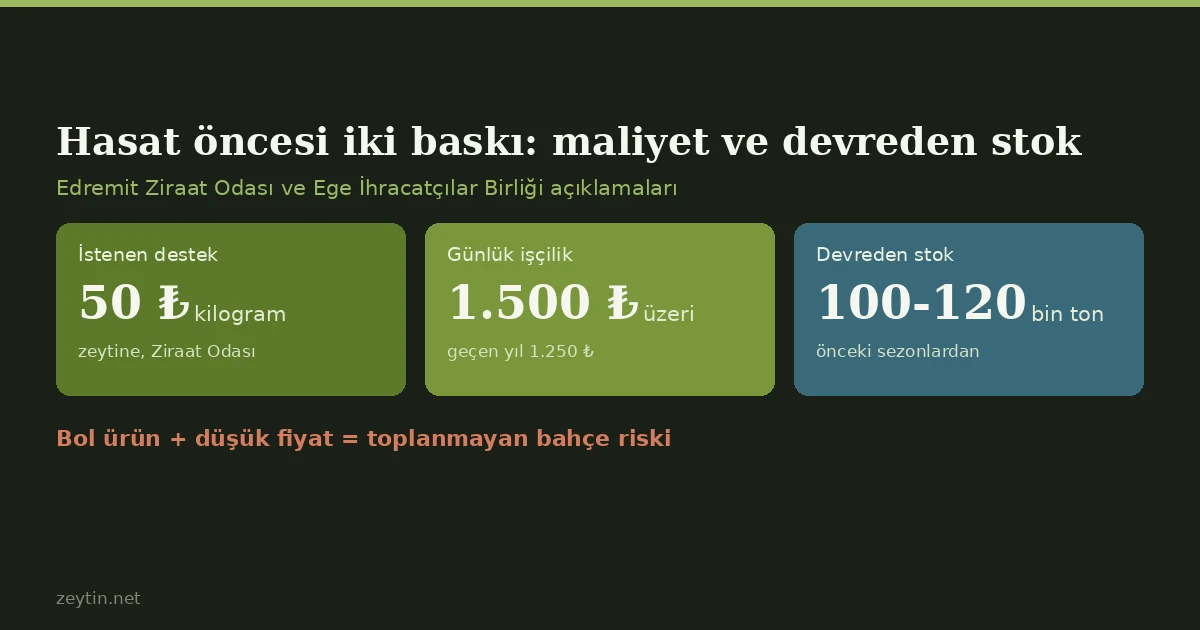
The chamber of agriculture wants 50 lira per kilo; daily labour has passed 1,500 lira. Exporters report 100,000-120,000 tonnes carried over from previous seasons.
Article
Two pressures before the harvest: costs and 100,000 tonnes carried over
The chamber of agriculture wants 50 lira per kilo; daily labour has passed 1,500 lira. Exporters report 100,000-120,000 tonnes carried over from previous seasons.
 Article
The EU's newest olive oil registration is in northern Italy: Olio dei Colli di Bologna gets PGI status
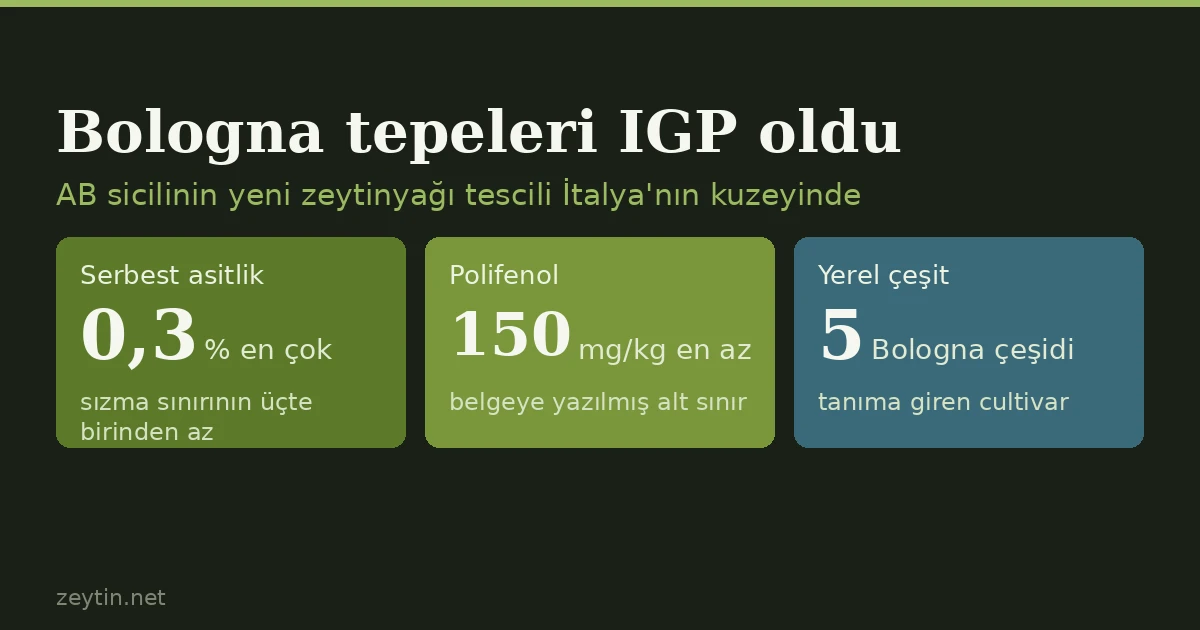
The European Commission has entered olive oil from the hills of Bologna into the Union register of geographical indications. The specification caps free acidity at 0.3 percent, well under a third of the legal limit for extra virgin, and writes five local Bolognese cultivars into the definition.
Article
The EU's newest olive oil registration is in northern Italy: Olio dei Colli di Bologna gets PGI status
The European Commission has entered olive oil from the hills of Bologna into the Union register of geographical indications. The specification caps free acidity at 0.3 percent, well under a third of the legal limit for extra virgin, and writes five local Bolognese cultivars into the definition.
 Article
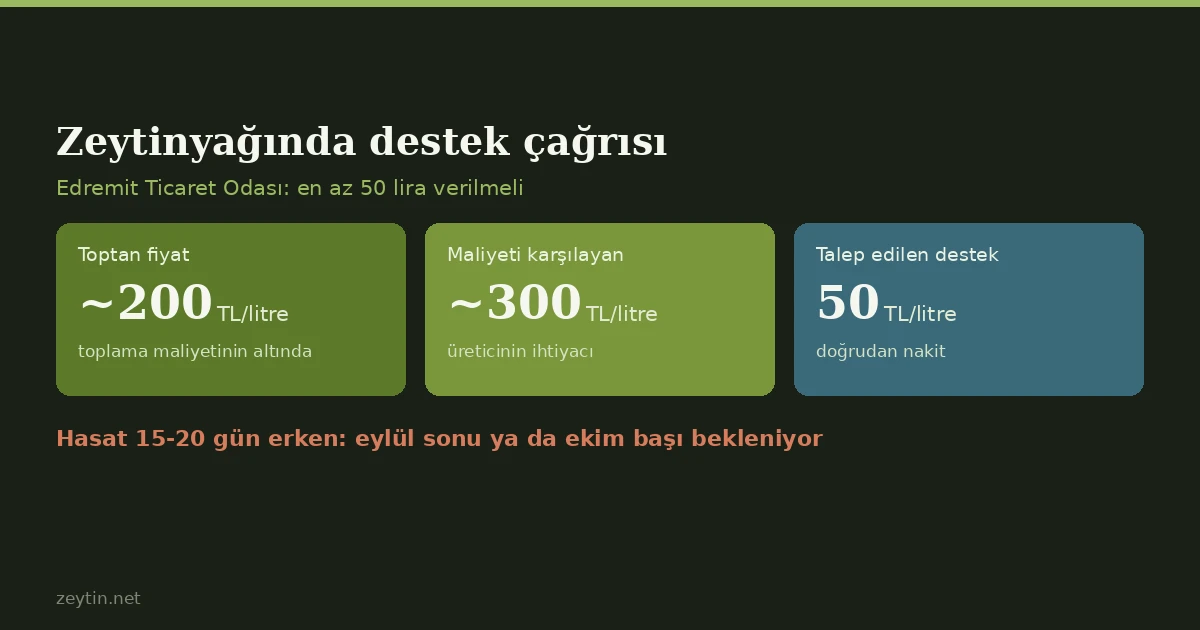
Edremit Chamber: olive oil needs at least 50 lira per litre in support
Chamber President Ahmet Çetin says the wholesale price has fallen to 200 lira, below the cost of picking. The level needed to cover costs is 300 lira. Harvest is expected 15-20 days early.
Article
Edremit Chamber: olive oil needs at least 50 lira per litre in support
Chamber President Ahmet Çetin says the wholesale price has fallen to 200 lira, below the cost of picking. The level needed to cover costs is 300 lira. Harvest is expected 15-20 days early.
 Article
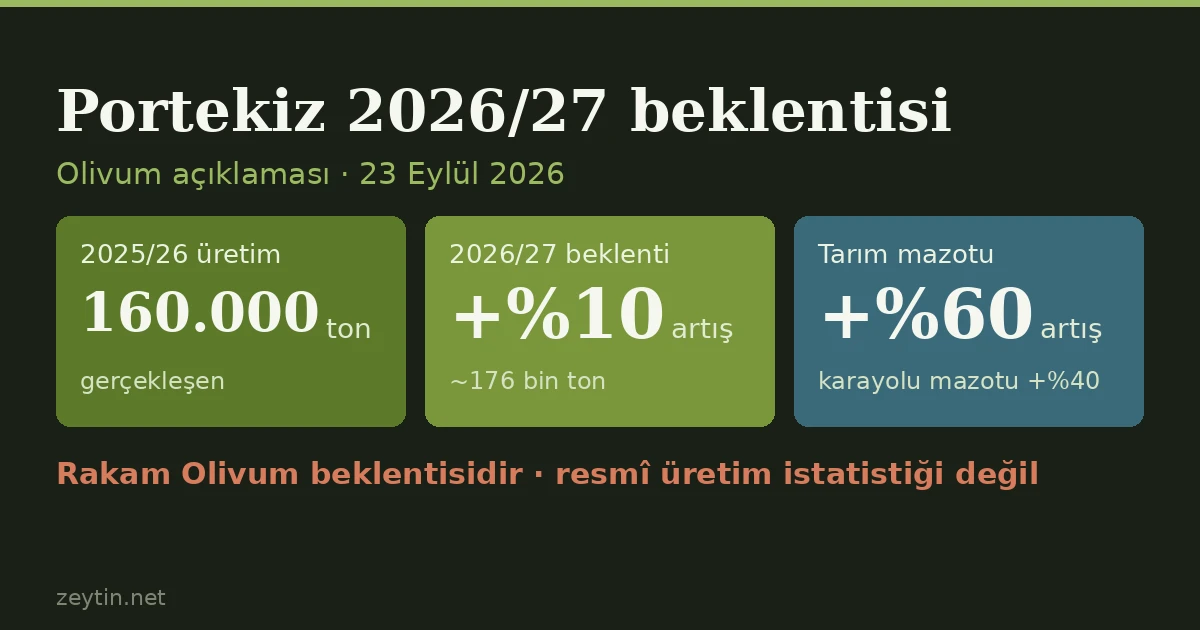
Portugal heads back to 177,000 tonnes: output up 10%, farm diesel up 60%
Portugal's olive association Olivum expects production to rise by about 10% in 2026/27 — a return from 160,000 tonnes to the 177,000 of two years ago. The same statement records a 60% rise in the price of agricultural diesel.
Article
Portugal heads back to 177,000 tonnes: output up 10%, farm diesel up 60%
Portugal's olive association Olivum expects production to rise by about 10% in 2026/27 — a return from 160,000 tonnes to the 177,000 of two years ago. The same statement records a 60% rise in the price of agricultural diesel.