Why is high-polyphenol olive oil expensive, and why do its producers still struggle?
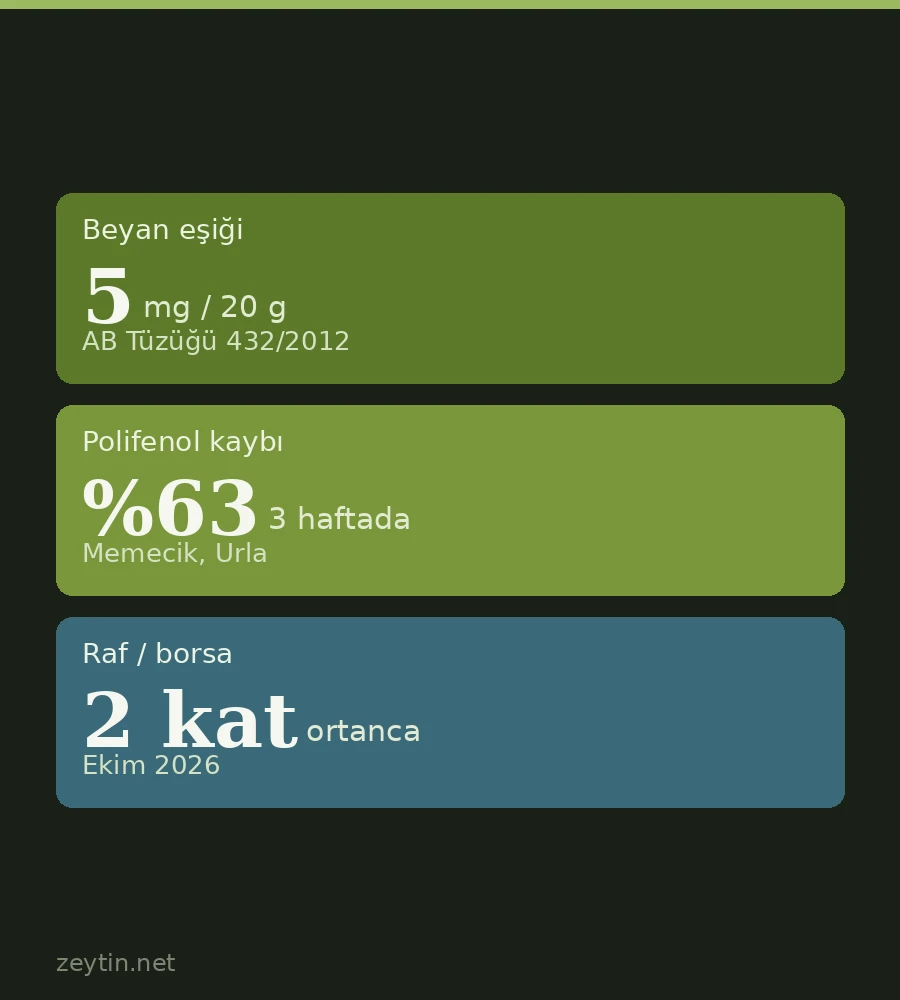
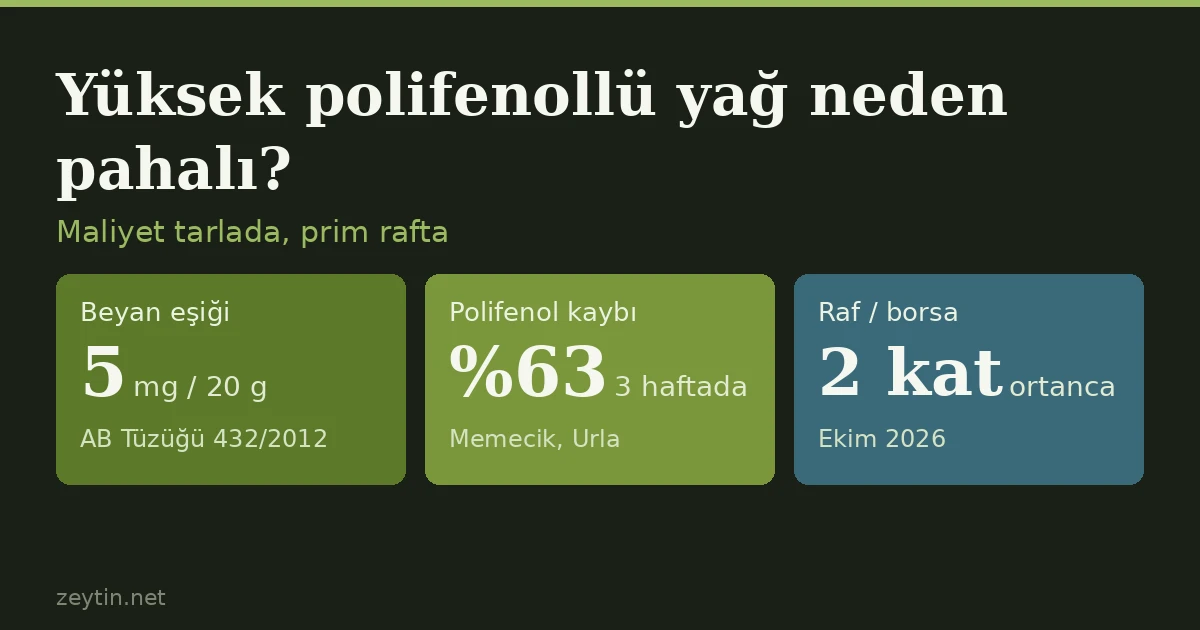
The EU's only olive oil health claim requires 5 mg of hydroxytyrosol per 20 g. In Memecik, total polyphenols drop 63% in three weeks, the regulation names no test method, and the shelf median is twice the bulk price: the premium forms on the shelf, the cost in the grove.
Two bottles on the same shelf can both say "extra virgin" and still differ fivefold in price. The expensive one usually makes the same promise: early harvest, high polyphenols, a bitter and peppery oil. Consumers find this oil expensive, and yet it is often not profitable for the people who grow it. This article looks for the reasons behind both, using measured figures.
First, a definition: what does "high polyphenol" measure?
In the European Union, a health claim can appear on olive oil only under Commission Regulation (EU) No 432/2012 of 16 May 2012. The list holds exactly one claim for olive oil: "Olive oil polyphenols contribute to the protection of blood lipids from oxidative stress."
The conditions are narrow:
- The oil must contain at least 5 mg of hydroxytyrosol and its derivatives (oleuropein complex, tyrosol) per 20 g. That works out to 250 mg per kilogram.
- The consumer must be told that the benefit comes from a daily intake of 20 g (basis: the European Food Safety Authority's 2011 opinion).
"High polyphenol" has no legal meaning; this threshold does. What these compounds are is covered in oleocanthal and polyphenols.
Cost one: a narrow harvest window
Polyphenols fall quickly as the fruit ripens. One of the clearest Turkish measurements comes from Ege University research project 2005/BİL/020, using Memecik olives from Urla (2006-2007 season):
| Harvest date | Maturity index | Total polyphenols (mg/L) |
|---|---|---|
| 16 October 2006 | 0.01 | 615.38 |
| 27 October 2006 | 0.16 | 500.00 |
| 7 November 2006 | 0.71 | 224.65 |
| 30 November 2006 | 1.21 | 111.01 |
| 16 January 2007 | 3.81 | 53.32 |
Source: Ege University Scientific Research Project 2005/BİL/020, final report. Total polyphenols are not the same measurement as the regulation's "hydroxytyrosol and its derivatives"; the table shows the trend, not the claim threshold.
From mid-October to early November, in three weeks, total polyphenols in the oil drop 63%, to just over a third; by mid-January they are below a tenth of the starting value. So a high-polyphenol oil means picking the whole grove within a few weeks and milling the same day. Labour and mill slots get squeezed into the period everyone wants at once.
In those same weeks the fruit's oil content is still rising. A 2022 review by Sevim, Varol and Köseoğlu (Journal of Agricultural Faculty of Bursa Uludağ University) notes that oil content increases from October to December and peaks as the skin turns black. Early-picked olives mean more fruit per kilo of oil. In a farm survey from the Aegean, 94.27% of the cost of olive oil was the olives themselves (what does a kilo of olives cost to produce). Every point of yield goes straight into cost; we worked that out in is early harvest expensive or valuable?
Cost two: keeping the polyphenols
Polyphenols keep declining after milling, so the real expense of a high-polyphenol oil is getting it to the shelf intact. The International Olive Council's 2018 storage guidelines (COI/BPS/Doc. No 1) recommend:
- holding the oil in stainless-steel tanks until bottling,
- filling the headspace with an inert gas such as nitrogen or argon, keeping that protection during bottling where possible,
- keeping storage, distribution and shop temperatures between 13 and 25 °C,
- light-proof packaging and cartons.
These investments fall on the producer who keeps oil in their own store for months and bottles it; with bulk delivery, storage passes to the buyer, and so does the premium. According to an estimate cited in the same review (Sevim, 2011), quality is determined 30% by ripeness, 30% by extraction technology, 20% by variety, 10% by storage and 5% each by harvest method and transport.
Cost three: proving it
Using the claim means showing the threshold has been met. According to a 2019 study by Tsimidou and colleagues (Molecules), the regulation does not specify how the 5 mg should be measured. The HPLC method the International Olive Council adopted in 2009 (COI/T.20/Doc. No 29), the authors write, uses a "rather ambiguous" quantification approach for this purpose.
A 2017 note on CORDIS, the European Commission's research portal, says standard chromatographic methods need expensive equipment and trained staff; the €5 million OLEUM project looked for a simpler test for that reason. For the other lines of a lab report, see how to read an olive oil lab report.
In quality regions, passing the threshold is not rare. Bellumori and colleagues (Molecules, 2019) measured 108 virgin oils from Tuscany and Apulia. By the paper's tables, 13 samples fell short; its conclusions put those reaching the threshold at "approximately 75%". So 75% to 88% of the Italian samples were above it. In well-made oil, crossing the threshold is not scarce; a premium appears only when it is proven and communicated.
Where does the premium form?
There is no separate price series for high-polyphenol oil. Neither Turkish commodity exchange registrations nor the European Commission's weekly producer prices record polyphenols as a grade. Grades are set by acidity and sensory analysis; polyphenols are not part of the classification.
What we can measure is the gap between bulk and shelf:
| Indicator | Value | Source |
|---|---|---|
| Exchange, extra virgin | ₺200.46/kg (≈₺183.6/L) | Nazilli Commodity Exchange registration, 8 October 2026 |
| Shelf, cheapest extra virgin | ₺249.00/L | Our supermarket table, 10 October 2026 |
| Shelf, median extra virgin | ₺362.00/L | 24 products, 7 chains |
| Shelf, most expensive extra virgin | ₺1,239.90/L | Organic-labelled, 500 ml |
| Claim threshold | 5 mg / 20 g | EU Regulation 432/2012 |
Litre values use a density of 0.916 kg/L. Current figures are on the [market page](/en/sector/market).
The shelf median is about twice the bulk price; the most expensive product is about 6.8 times. That gap is not the grower's; it goes to whoever bottles, builds a brand and distributes. The grower who sells in bulk carries the full cost of early harvest and receives the same "extra virgin" exchange price as everyone else. Where value added stays along the chain is measured in from olive to oil: the price gap.
Do geographical indications and state support close the gap?
Geographical indications. Our list has 23 Turkish geographical indications with "olive oil" in their name. One of them, Milas Olive Oil, was also registered in the EU on 23 December 2020. According to a European Commission study announced on 27 April 2020, in 2017 GI products sold at 2.85 times the value of comparable products for wine, 2.52 for spirits and 1.5 for agricultural products and foodstuffs. That rate is not specific to olive oil. A 2013 meta-analysis by Deselnicu and colleagues (Journal of Agricultural and Resource Economics) found the premium lower for olive oil and wine, where branding offers another route to differentiation. There is no public series measuring the premium for GI olive oil in Türkiye; we covered this in detail in twenty-five GIs: what are they actually doing?
Support. In the Ministry of Agriculture and Forestry's unit-price table for the 2026 production year, olives appear among per-decare payments. Certified sapling support has a coefficient of 5, which at the table's coefficient value of 310 TL comes to 1,550 TL per decare. The coefficient value was raised to 367 TL per decare in September 2026 by Presidential Decision No 11781; at the same coefficient this support would be 1,835 TL per decare (our calculation). Organic farming and good agricultural practice support are also paid per decare by product group. The table has no item tied to oil quality, harvest timing or polyphenol content: support rewards area, not the quality of the oil.
So who gains?
- The higher price has three real sources: a narrow harvest window, protection after milling and measurement.
- The premium forms on the shelf. Exchange prices and official price series do not see polyphenols.
- So the premium stays with the producer who bottles their own oil, has it analysed and can explain it to buyers. Cooperatives, shared storage and shared laboratories are the tools that make this threshold reachable for small growers.
- For the bulk seller, high polyphenols are a cost nobody pays for.
In short
High-polyphenol olive oil is expensive because it comes from early-picked fruit with less oil, fast milling, inert-gas and temperature-controlled storage, and costly analysis. The only legal yardstick in the EU is 5 mg of hydroxytyrosol and its derivatives per 20 g. Growers struggle because the cost arises in the grove while the premium arises on the shelf. In Türkiye, neither the exchange price nor state support separately rewards the quality of the oil.
One rating per visitor; you can change yours at any time. Ratings are real reader votes — no seeded or default scores.
Related
 Article
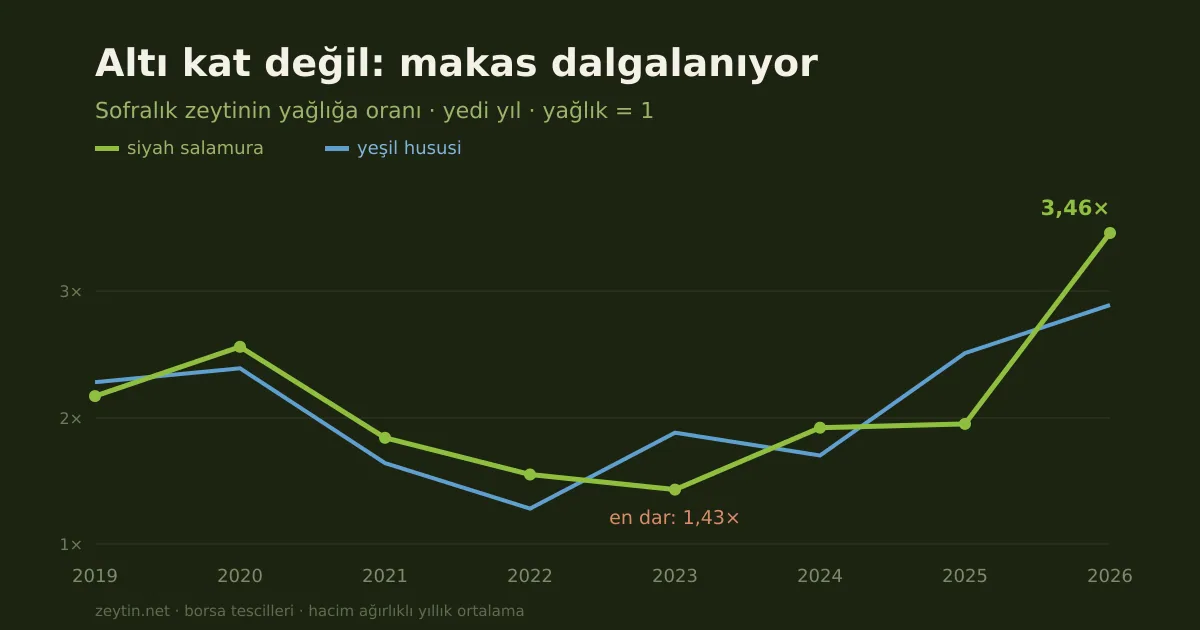
Was it six times? Seven years of the table olive gap
How many times the oil price does a table olive fetch? Over seven years the ratio ranged 1.43 to 3.46, never below 1.
 Article
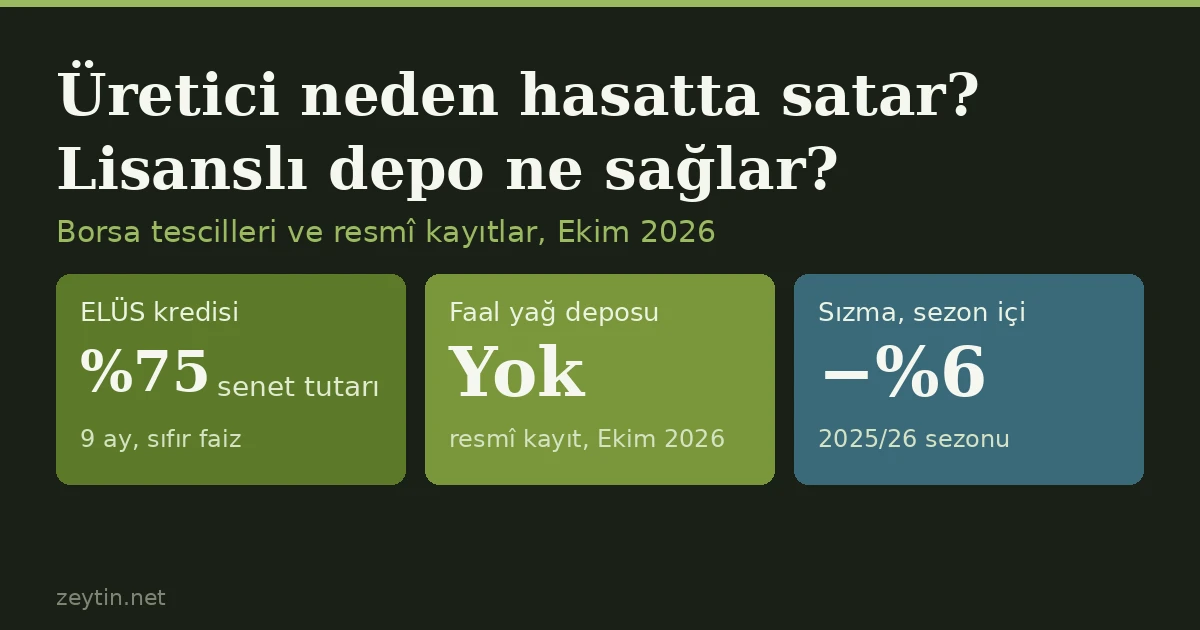
Why do small olive growers sell at harvest? What do licensed warehouses and electronic receipts offer?
Exchange records show that prices do not bottom out at harvest every year; the real issue is the cost of waiting. Licensed warehouses and electronic receipts (ELÜS) are the legal way to raise cash without selling the oil: interest-free loans up to 75% of the receipt, storage fee support and tax exemptions. But as of October 2026, official records show no licensed olive oil warehouse with an operating permit.
 Article
The energy burned at the field edge: olive pruning residue
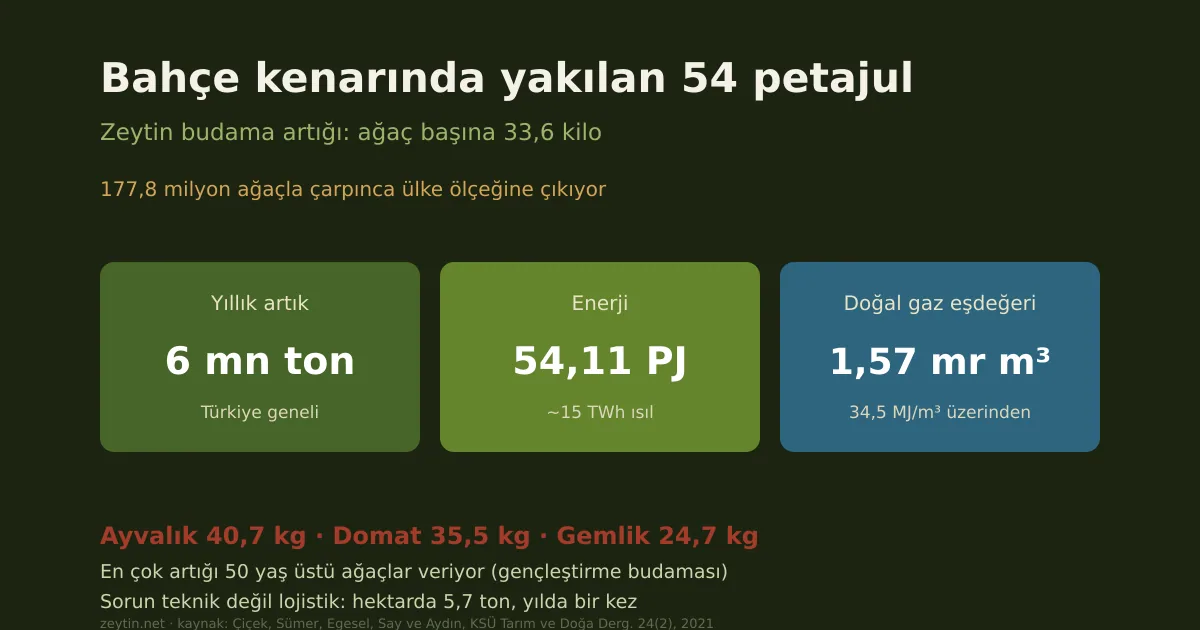
One olive tree yields 33.6 kg of prunings a year. Across 177.8 million trees that is 6 million tonnes of residue and 54.11 PJ of energy — equivalent to 1.57 billion m³ of natural gas.
 Article
Two thirds of our exports are table olives: the $260 million picture
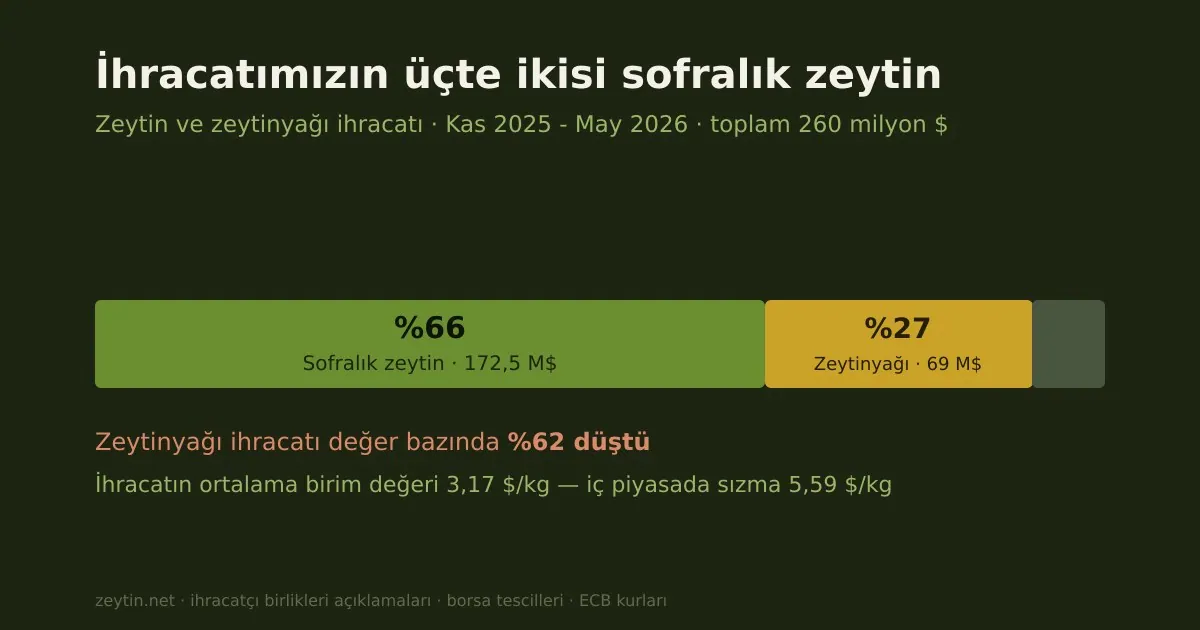
In 2025-26, 66% of exports were table olives and 27% oil. Average unit value $3.17/kg — the added value sits inside the packaging.