That white film on your olive brine: mould or yeast?
The white layer that forms on home-brined olives is usually not mould but a film-forming yeast — though that does not make it harmless. There are visible criteria for telling them apart. Together with the pH and salt ceilings the Turkish Food Codex sets for brine, here is what can be saved and what has to be thrown out.

You open the jar and there is a white layer on the surface of the brine. Search online and you will find the answer split in two: "harmless, skim it off" and "it has gone mouldy, throw it out." Both are correct, depending on the case. And you can tell the difference by looking.
Short answer
| Appearance | What it is | What to do |
|---|---|---|
| Thin, flat, smooth cream-white film; covers the surface or forms patches; looks like crinkled paper | Film-forming yeast | Remove, correct, carry on |
| Fuzzy, raised, growing in colonies; green, bluish, grey or blackish | Mould | Discard |
The distinguishing criteria are texture and colour. A yeast film is two-dimensional — a skin sitting on the liquid that does not grow upward. Mould is three-dimensional: it rises like fluff and almost always carries a colour other than white.

Yeast is "harmless" but not innocent
This is where most advice stops short. Film-forming yeasts are ordinary residents of table olive fermentation; species such as Wickerhamomyces anomalus and Candida boidinii are frequently isolated from this environment. Finding yeast in your jar is not in itself a sign of disaster.
But here is what it does: it consumes lactic acid. What protects brined olives is not only salt but, arguably more, the acidity produced by fermentation. When yeast eats that acid, the pH rises — and a rising pH opens the door to the genuinely dangerous organisms. Yeast is not the damage itself; it is the doorway to the damage.
That is why "just skim it, it's fine" is only half an answer. Removing the film erases the symptom, not the cause.
There is one cause: oxygen at the surface
Both film-forming yeasts and moulds need air. Both appear only at the surface, because the interior of the brine is oxygen-free. So the source of the problem is almost always the same:
- Olives have risen above the brine and are in contact with air.
- The jar is opened frequently, admitting fresh air each time.
- The brine has evaporated and the level has dropped.
- The container is standing somewhere warm.
If even a single olive sits above the surface, sooner or later something will grow on it.
The numbers: pH and salt
Here we have regulation rather than guesswork. The Turkish Food Codex Table Olive Communiqué (No: 2014/33) sets ceilings for the brine of packaged olives. For olives not given a heat treatment:
| Processing type | Salt (max) | pH (max) |
|---|---|---|
| Natural · turning colour / black | 8% | 5.0 |
| Natural · green | 7% | 4.3 |
| Treated · turning colour / black | 8% | 4.5 |
| Treated · green | 7% | 4.3 |
⚠ The salt figure in this table is an upper limit, not a target — it does not say "add at least this much salt", it says "do not exceed this." The pH ceiling works protectively in the other direction: the lower the pH, the safer the environment.
Industrial trials show where the safe side lies. In an industrial-scale study published in Foods in 2025, Campus et al. measured that fermentation of "Tonda di Cagliari" olives with a starter culture brought the pH below 4.2 even at ambient temperature, while uninoculated batches under the same conditions stayed above 4.5 and Enterobacteriaceae could not be controlled.
The lesson for a home jar is this: below pH 4.2 is the safe zone. If you cannot measure pH, use indirect signs — if the brine smells sour and tastes sharply acidic, fermentation is working; if it is flat, bland and characterless, it is not.
What to do
1. Remove the film. Skim it from the surface with a clean spoon; do not plunge the spoon in and stir it through.
2. Submerge the olives. Put a clean plate, a glass weight or a small water-filled bag on top and keep everything under the brine. This is the critical step.
3. Add olive oil on top. A finger-thick layer of oil seals the surface from air and largely prevents a new film from forming.
4. Keep it cool and dark. A pantry or the fridge, not a warm kitchen shelf.
5. Do not reduce the salt. Deciding to make a refreshed brine "a bit less salty" weakens the preservative.
6. Open the jar as little as possible. Every opening is fresh oxygen.
When to throw it out
Do not try to rescue a jar showing any of the following:
- Fuzzy, coloured mould — green, blue, grey, black.
- Bad smell — rancid butter, sour cheese, drains. This is the signature of the undesirable fermentation that takes over once pH has risen.
- Softening and sliminess — if the fruit disintegrates between your fingers or the brine strings, the texture has collapsed.
- Blisters, swelling or gas pockets under the skin of the fruit.
- Brine that has turned thick and milky. Sediment at the bottom is normal; milky turbidity is not.
⚠ The advice to "cut off the mouldy part and eat the rest" does not apply to food held in liquid. Do not think of it like trimming a corner of cheese: the invisible extensions of the mould and the compounds it produces disperse through the brine. The colony you can see is the tip of it.
How to prevent it from the start
The best intervention is never needing one. We have covered the steps for setting up a brine separately; in short: choose sound, undamaged fruit, clean the jar and lid thoroughly, submerge the olives completely from the outset, seal the surface with a layer of oil, and keep the container cool.
Reading notes
⚠ The pH and salt values above are limits set for packaged commercial products. Home brining does not fall under this communiqué; they are quoted here to give a sense of the safe range, not as a requirement for home production.
⚠ That a white layer is yeast cannot be confirmed by eye, only strongly suspected. If you are in doubt, discarding is the right call; a jar of olives is not worth the risk.
⚠ The pH 4.2 threshold comes from an industrial trial, measured with a specific variety under controlled conditions. In a home jar the aim is to move in the same direction, not to expect the identical number.
One rating per visitor; you can change yours at any time. Ratings are real reader votes — no seeded or default scores.
Related
 Article
Arbequina olive: Spain's oil variety
The mainstay of super-high-density planting. Small canopy, small fruit, early bearing — the variety that changed modern olive growing.
Article
Arbequina olive: Spain's oil variety
The mainstay of super-high-density planting. Small canopy, small fruit, early bearing — the variety that changed modern olive growing.
 Article
Mission olive: United States's table and oil variety
America's historic variety: carried by the Spanish missions, it built California's black table olive industry.
Article
Mission olive: United States's table and oil variety
America's historic variety: carried by the Spanish missions, it built California's black table olive industry.
 Article
The Olive Sector in Turkey: Structure, Exports and Challenges
Production, exports, business structure and price: the Turkish olive sector in figures, and where the chain breaks.
Article
The Olive Sector in Turkey: Structure, Exports and Challenges
Production, exports, business structure and price: the Turkish olive sector in figures, and where the chain breaks.
 Article
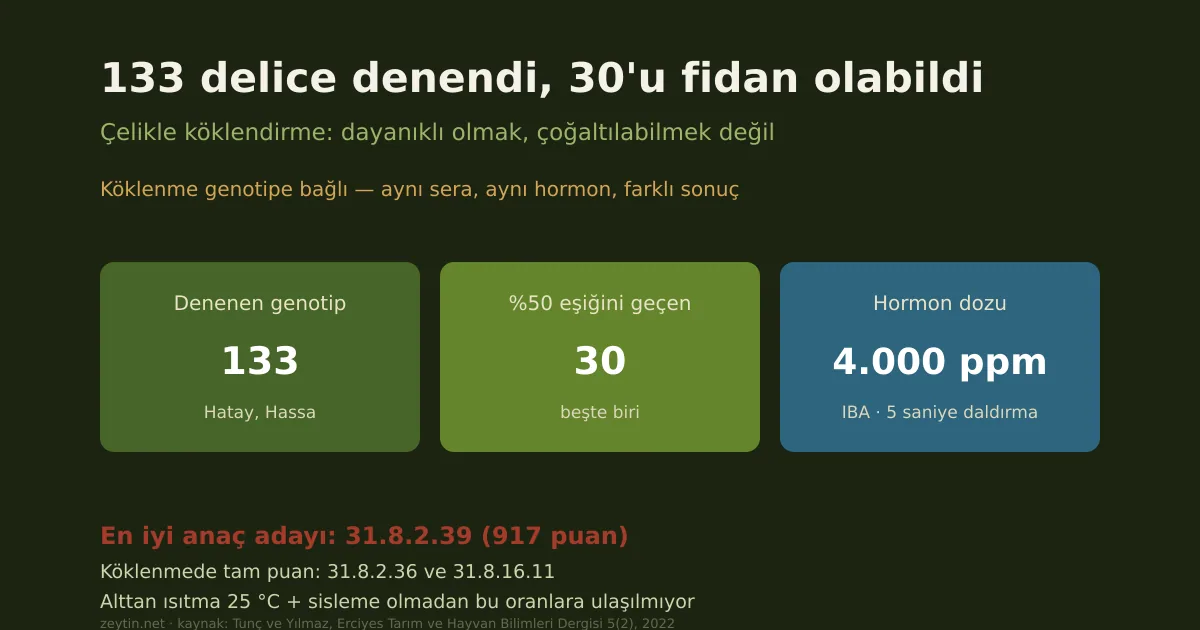
Rooting olive cuttings: 30 of 133 wild olives made it
In Hassa, Hatay, 133 wild olive genotypes were rooted from cuttings and only 30 cleared the 50% threshold. Rooting depends on the genotype, not the technique.
Article
Rooting olive cuttings: 30 of 133 wild olives made it
In Hassa, Hatay, 133 wild olive genotypes were rooted from cuttings and only 30 cleared the 50% threshold. Rooting depends on the genotype, not the technique.