Where do olives grow in Türkiye, and where don't they?
What limits the olive is frost, not a provincial border. Where it grows in Türkiye, with cold thresholds and altitude limits.
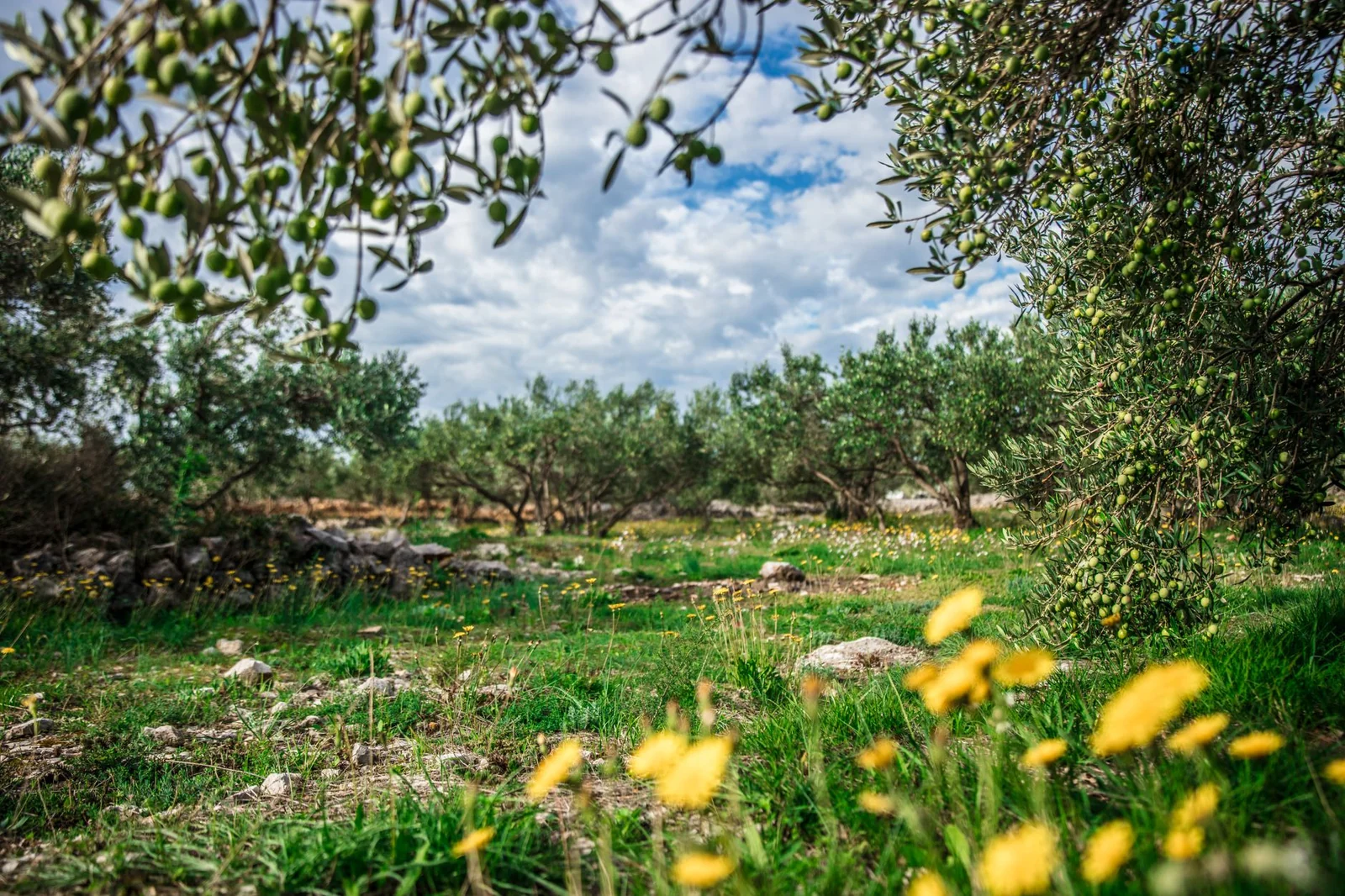
Olives do not grow everywhere in Türkiye, but they cover a far wider area than most people assume. What draws the line is not provincial borders but climate — more precisely, the coldest night of winter.
The short answer
Olives are grown commercially in four regions of Türkiye: the Aegean, the Mediterranean, Marmara and the Southeast. There is limited production in parts of the Black Sea coast as well.
Where they do not grow is most of Central Anatolia and nearly all of Eastern Anatolia. The reason, in one word, is frost.
Why not in some provinces?
The olive is a tree of the Mediterranean climate: it wants a mild, wet winter and a hot, dry summer. Three thresholds constrain it.
1. Winter cold. Olive trees begin to suffer damage around −7 °C. Below −12 °C young wood and even whole trees can be lost. Winter nights in Erzurum, Kars and Sivas fall well below that regularly; planting olives there is not a gamble but a certain loss.
2. Altitude. Temperature falls with height. Olives are generally grown economically below 800 metres. Groves reach 500-600 metres in the Aegean; the Central Anatolian plateau averages above 1,000.
3. Late spring frosts. Even a tree that survives winter loses its whole crop to a frost during flowering. In transitional zones the tree lives but does not crop reliably — and reliability is what commercial production depends on.
By contrast the olive is exceptionally drought-tolerant. It can go months without water in summer and holds on in stony, poor soil. What kills it is not thirst but cold.
Where do olives grow in Türkiye?
| Region | Main areas | Chiefly used for |
|---|---|---|
| Aegean | Aydın, İzmir, Muğla, Manisa, Balıkesir (Gulf of Edremit) | Mostly oil |
| Marmara | Bursa (Gemlik), Çanakkale, Balıkesir | Mostly table |
| Mediterranean | Antalya, Mersin, Hatay, Adana, Kahramanmaraş | Mixed |
| Southeast | Gaziantep, Kilis, Şanlıurfa, Mardin | Oil and table |
| Black Sea (limited) | Parts of the Artvin, Rize and Trabzon coasts | Local consumption |
Türkiye's olive heartland is the Aegean; the largest share of production comes from the Aydın-İzmir-Muğla-Manisa-Balıkesir line. Ayvalık and Edremit are the heart of that map.
In which provinces do olives not grow?
Answering by listing provinces would mislead, because the boundary is climatic and in some provinces changes from district to district. The accurate framing is this:
Where commercial olive growing is not possible:
- Nearly all of Eastern Anatolia — Erzurum, Kars, Ardahan, Ağrı, Van, Bitlis, Muş, Erzincan, Bingöl, Hakkâri. Winter temperatures sit far below the olive's tolerance.
- Most of Central Anatolia — Konya, Kayseri, Sivas, Yozgat, Çorum, Kırşehir, Nevşehir, Aksaray, Niğde. High altitude and hard winters.
Borderline areas: olives do grow in some valley floors of Elazığ, Malatya, Adıyaman and Diyarbakır thanks to microclimates. The lower reaches of the Euphrates and Tigris valleys run a few degrees warmer than the plateau around them, and sometimes that is enough. There olives are found in particular valleys rather than across the province.
The Black Sea's special case: the climate is mild but too wet for olives. The absence of summer drought both lowers fruit quality and raises disease pressure. Even so, groves exist in drier microclimates such as Artvin's Çoruh valley, and locally they are old.
At what temperature does an olive tree freeze?
The thresholds worth knowing in practice:
| Temperature | Effect |
|---|---|
| −3 °C | Ripe fruit may be damaged; an unharvested crop is lost |
| −7 °C | Damage begins in leaves and thin wood |
| −10 °C | Serious loss in young trees; branch dieback |
| below −12 °C | Even old trees can die; recovery depends on resprouting |
Thresholds vary with variety, the tree's age, the duration of the frost and the tree's water status at the time. A brief dip and a prolonged freeze do not have the same effect.
One remarkable property of the olive: even when killed back by frost it usually does not die at the root. Even with the trunk dead it sends up new shoots from the base and becomes a tree again over the years. That is part of why centuries-old groves still stand in Anatolia.
Can I plant an olive tree in my garden?
Three questions decide it:
1. How cold does winter get? If recent records approach −10 °C it is risky; if they pass −12 °C, don't.
2. What is the altitude? Above 800 metres the tree may live but do not expect a reliable crop.
3. Does the soil hold water? Olives want stony, free-draining ground; in heavy clay that holds water the roots rot.
If those are right, planting is feasible. But an olive takes four to five years to start bearing and eight to ten to reach full yield; if you are planting for fruit rather than ornament, budget that time from the start.
For ornamental planting in cold regions, growing in a pot and bringing it indoors for winter works — with low expectations of fruit.
Summary
- Olives grow commercially in the Aegean, Marmara, Mediterranean and Southeast.
- They do not grow in most of Eastern and Central Anatolia; the reason is frost.
- The critical threshold begins at −7 °C; below −12 °C the tree is lost.
- Valley microclimates in provinces like Elazığ, Malatya and Diyarbakır are exceptions.
- What kills the olive is not drought but cold; it is remarkably tolerant of thirst.
Related reading: How to grow an olive tree · Ayvalık and Edremit · Olive varieties
One rating per visitor; you can change yours at any time. Ratings are real reader votes — no seeded or default scores.
Related
 Article
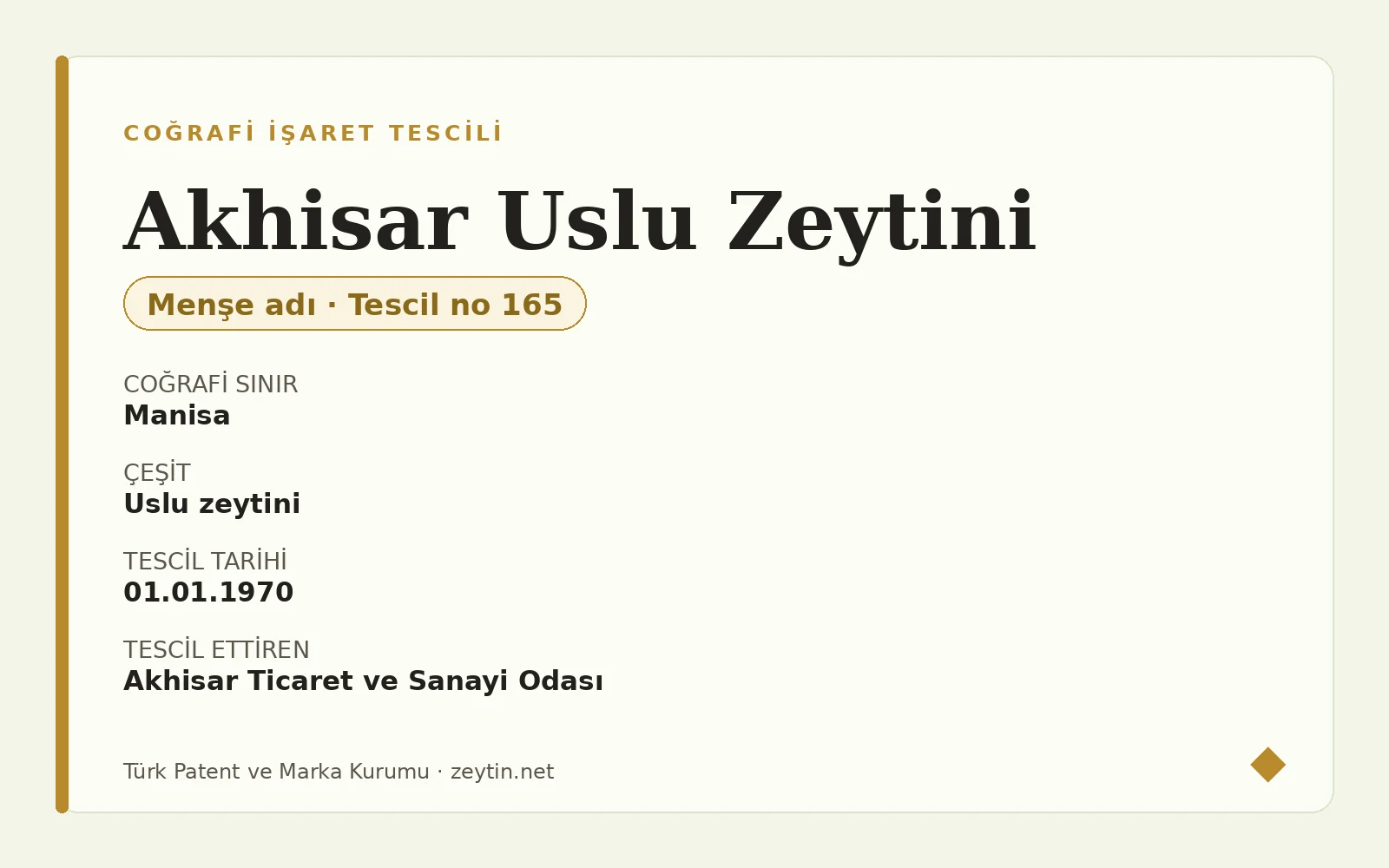
Akhisar Uslu Olive: the measured specification of a black table olive
Registered in 2010 as a designation of origin. The certificate defines the Uslu cultivar in figures — and corrects a published error: the flesh ratio is 85.17%.
Article
Akhisar Uslu Olive: the measured specification of a black table olive
Registered in 2010 as a designation of origin. The certificate defines the Uslu cultivar in figures — and corrects a published error: the flesh ratio is 85.17%.
 Article
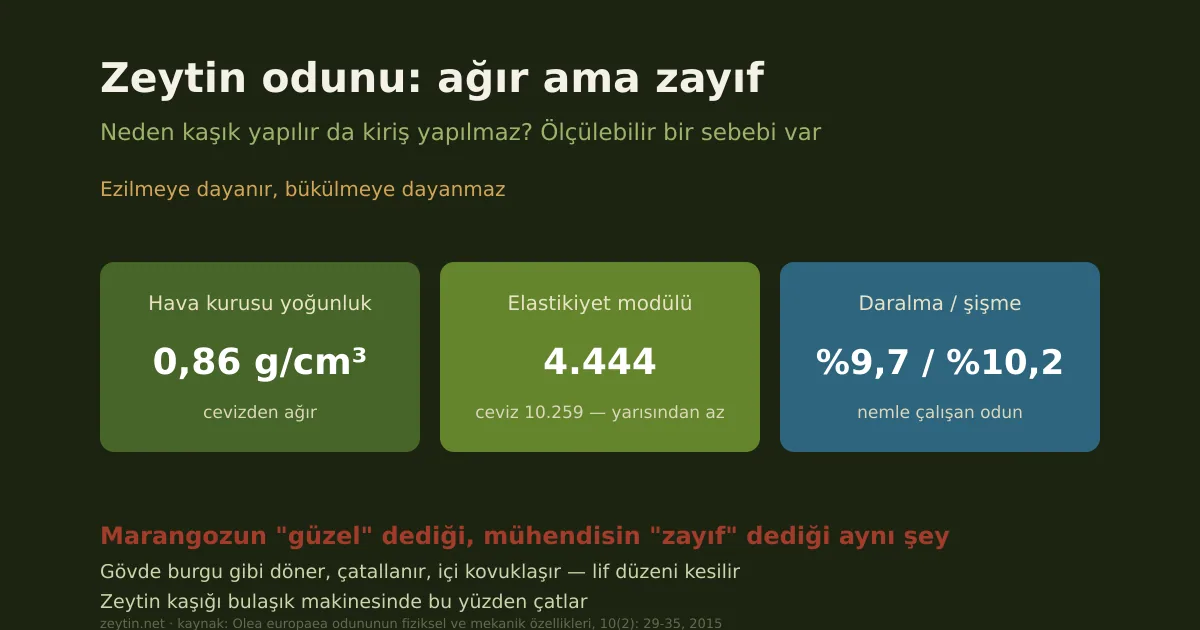
Olive wood: why spoons and not beams?
At 0.86 g/cm³ air-dried it is denser than walnut, yet its modulus of elasticity of 4,444 N/mm² is less than half walnut's. It resists crushing but not bending.
Article
Olive wood: why spoons and not beams?
At 0.86 g/cm³ air-dried it is denser than walnut, yet its modulus of elasticity of 4,444 N/mm² is less than half walnut's. It resists crushing but not bending.
 Article
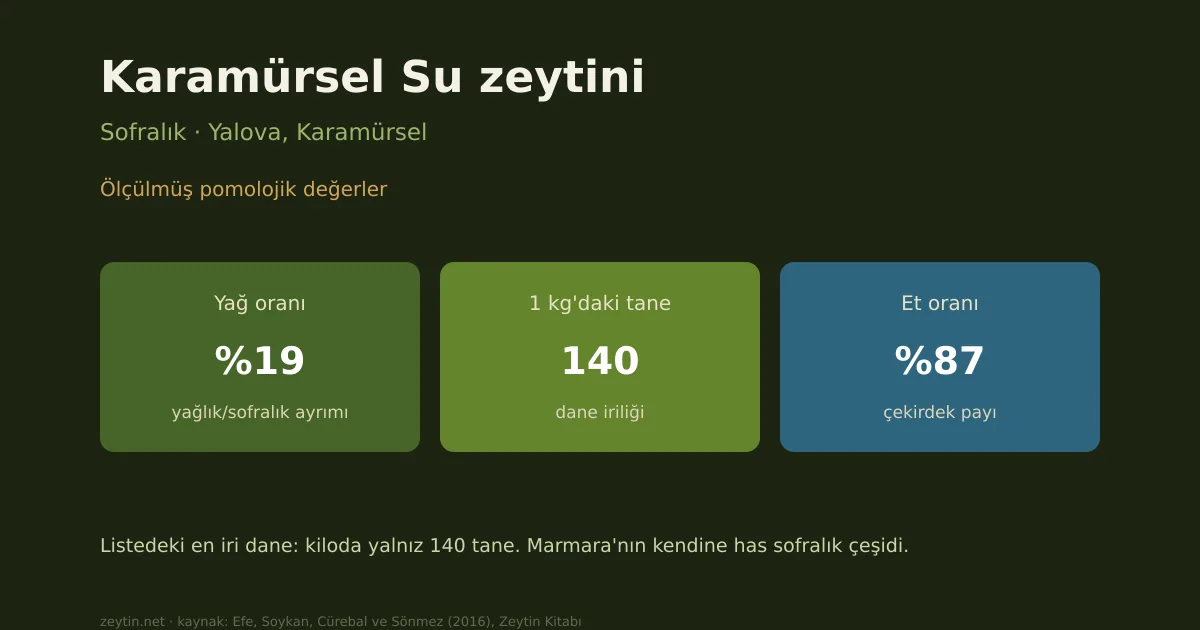
Karamürsel Su olive: characteristics, oil content and growing areas
The largest fruit on the list: only 140 per kilo. Marmara's own distinctive table variety.
Article
Karamürsel Su olive: characteristics, oil content and growing areas
The largest fruit on the list: only 140 per kilo. Marmara's own distinctive table variety.
 Article
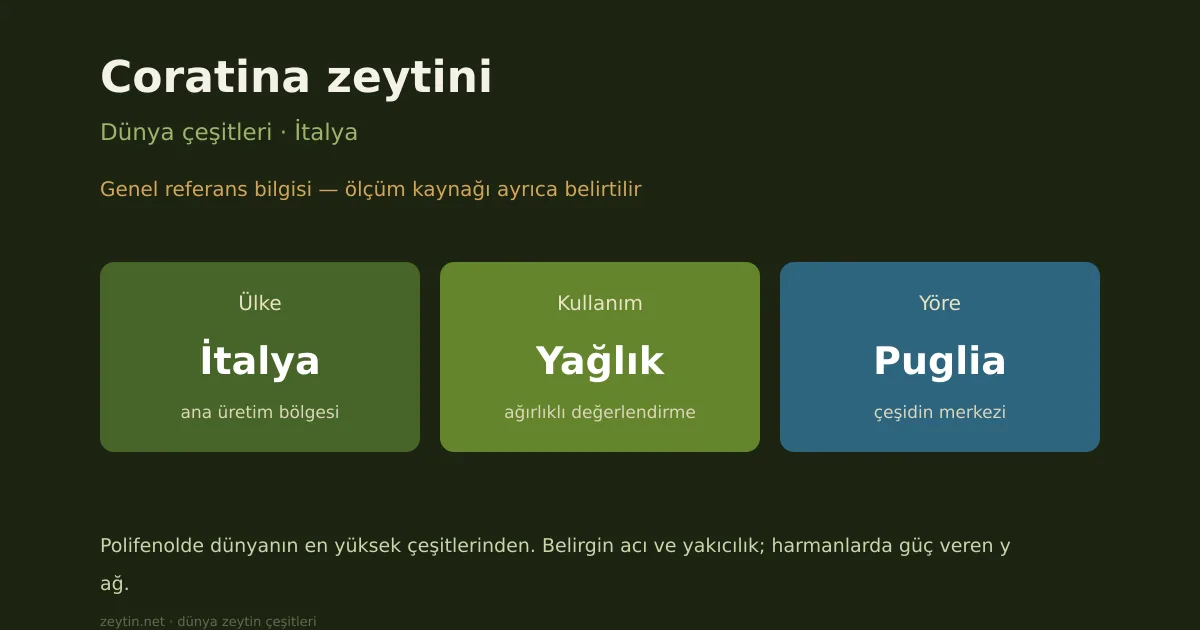
Coratina olive: Italy's oil variety
Among the highest-polyphenol varieties in the world. Distinctly bitter and pungent — the oil that gives blends their backbone.
Article
Coratina olive: Italy's oil variety
Among the highest-polyphenol varieties in the world. Distinctly bitter and pungent — the oil that gives blends their backbone.