What is riviera olive oil? How it differs from extra virgin, and what the label means
Riviera is not a grade of quality but the name of a blend: refined olive oil mixed with virgin olive oil fit for direct consumption. Under the Turkish Food Codex its free acidity may not exceed 1.0 and its peroxide value 15. What refining removes, what the label is obliged to say, and the real answer to the frying question.
Short answer: riviera is not an olive variety, a region or a grade of quality. It is the name given to a blend of refined olive oil and virgin olive oil fit for direct consumption. It therefore contains two different oils: one processed in a plant to strip away its defects, the other coming straight from the fruit.
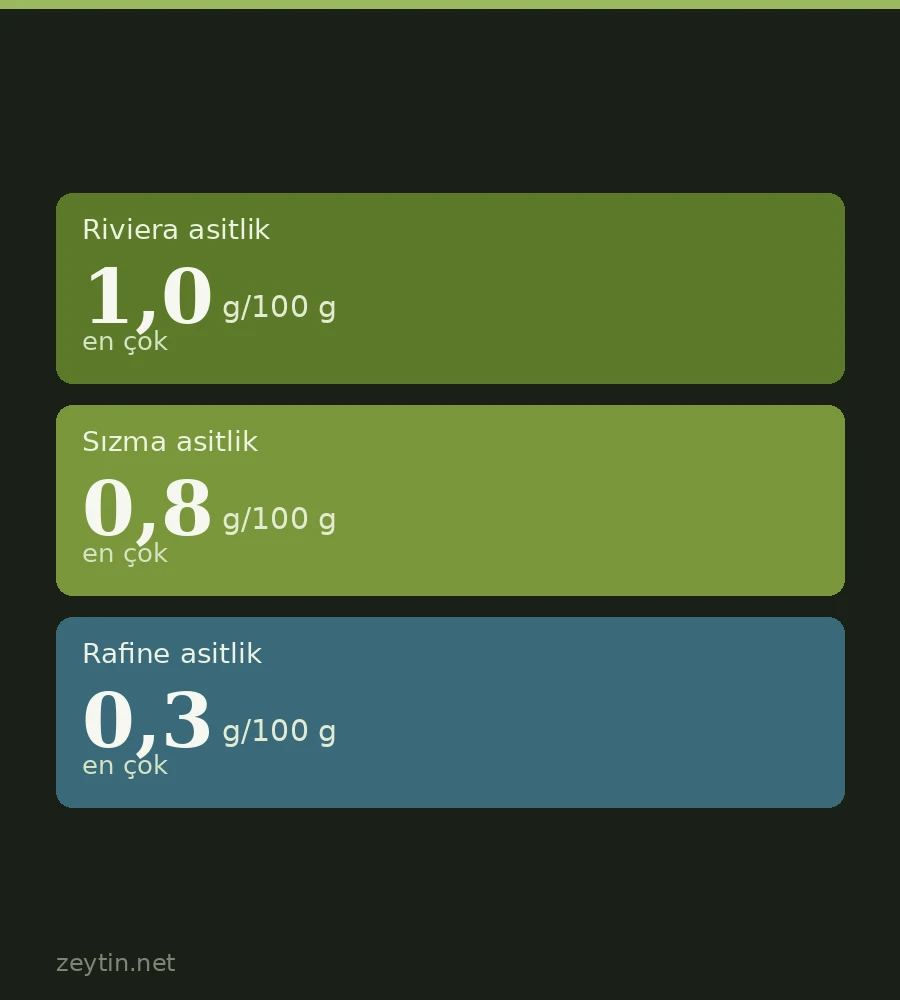
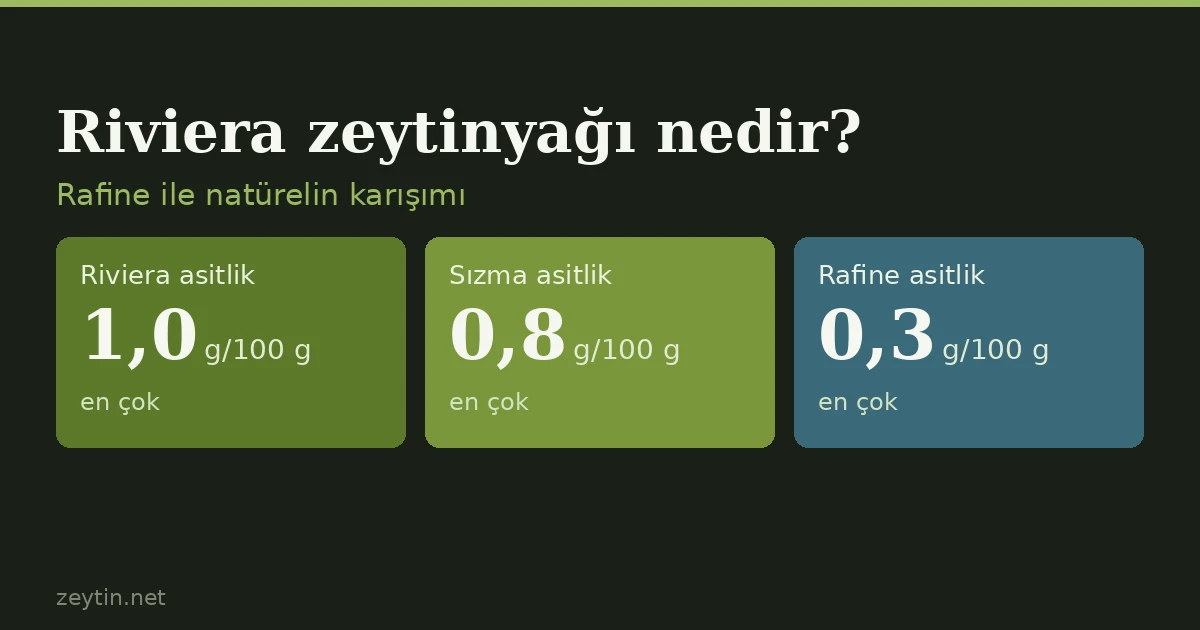
In Türkiye this definition is not a matter of marketing choice. It is set out in the Turkish Food Codex Regulation on Olive Oil and Pomace Oil, under which the free acidity of riviera olive oil may not exceed 1.0 gram per 100 grams and its peroxide value may not exceed 15 meq O₂/kg.
The classes and their limits
Every name you see on the shelf is defined in the regulation, and each carries a numerical limit.
| Class | Free acidity (max) | Peroxide (max) | Direct consumption |
|---|---|---|---|
| Extra virgin olive oil | 0.8 g/100 g | 20 meq O₂/kg | yes |
| Virgin olive oil | 2.0 g/100 g | 20 meq O₂/kg | yes |
| Crude (lampante) olive oil | above 2.0 | — | no |
| Refined olive oil | 0.3 g/100 g | 5 meq O₂/kg | yes |
| Riviera olive oil | 1.0 g/100 g | 15 meq O₂/kg | yes |
| Refined pomace oil | 0.3 g/100 g | 5 meq O₂/kg | yes |
| Pomace oil (blend) | 1.0 g/100 g | 15 meq O₂/kg | yes |
The most striking line in that table is refined olive oil: its acidity limit, 0.3, is lower than that of extra virgin. At first glance this looks like a contradiction. How can the oil regarded as lower in quality carry the lower acidity figure?
The answer lies in what free acidity actually measures. Acidity is not a measure of flavour but an indicator of how far the raw material has degraded. Refining removes that acidity chemically. In a refined oil, therefore, low acidity is the result of processing rather than a sign of quality.
How riviera is made
The chain runs in three steps.
1. Crude oil. Some oils do not come out fit for direct consumption: acidity above 2.0, or a sensory defect. The cause is usually not the olive itself but what happened to it — fruit picked off the ground, damage from the olive fruit fly, or a load left to ferment in the heap. In the regulation this oil is called crude (lampante) olive oil and it cannot reach the shelf.
2. Refining. The crude oil is processed by methods that do not alter its triglyceride structure: free fatty acids are neutralised, and colour compounds and odours are removed. What remains is an oil with acidity below 0.3, almost without smell or colour. This is refined olive oil.
3. Blending. Refined oil on its own is flat. Virgin olive oil fit for direct consumption is therefore added, giving the blend colour, aroma and some character. The result is riviera.
The proportion of the blend is not fixed in the regulation; it is left to the producer. Two brands' riviera need not be the same product: one may contain considerably more virgin oil, another may sit near the limit. Because the ratio does not appear on the label, the only practical clue available to the consumer is smell — a riviera with a higher virgin share smells more distinctly of olive oil.
What refining removes
Refining does not only remove defects. In the same process, olive oil's most valuable components largely disappear as well:
- Polyphenols. These give the oil its bitterness and the peppery catch at the back of the throat, and they also protect the oil against oxidation. In refined oil they are effectively absent.
- Aroma compounds. The volatiles behind notes of grass, green almond and tomato leaf are stripped out during processing.
- Chlorophyll and carotenoids. The pigments, which is why refined oil looks pale yellow.
What refining does not remove is the fatty acid composition. The oleic acid share is largely preserved. Riviera therefore resembles extra virgin as a fat, but not as a fruit juice.
We covered how pressing preserves these components in how cold-pressed olive oil is made and the role of the mixing stage in what is a malaxer.
What the label is obliged to say
There is a little-known rule here: riviera may not be sold on the label as "olive oil" alone. The regulation requires a statement that the product is a blend of refined olive oils and virgin oils obtained directly from olives.
In practice bottles carry wording such as "Riviera", "olive oil" or "olive oil for cooking". The surest way to know what you are holding is not the large type on the front but the class name on the back. We went through the whole label step by step in how to read an olive oil label.
Pomace oil is not riviera. Its definition looks similar, but the raw material differs: pomace oil is extracted with solvents from the paste left after pressing. It is a separate class and must be labelled "pomace oil". We covered where pomace sits in production in olive mill waste water and pomace.
There is no class called "riviera" abroad
The name does not appear in international legislation. In European Union rules and in the International Olive Council's classification, the same product is written out by its definition: olive oil composed of refined olive oil and virgin olive oils. On English-language labels this usually appears as "olive oil" or "pure olive oil".
"Riviera" is a commercial designation established in Türkiye. Because the Turkish Food Codex uses the name, it has a legal counterpart here, but someone looking for "riviera" on a bottle abroad will not find it. The wording to look for is the blend statement on the label.
This distinction has a practical consequence: for Turkish olive oil going to export, the class name is written according to the legislation of the destination market. A product sold as riviera domestically is sold under a different name, with the same content, abroad.
Riviera or extra virgin for frying?
The usual argument runs: "riviera has a higher smoke point, so it suits frying." A refined oil does have a higher smoke point than a virgin one, because the free fatty acids and sediment that pull the smoke point down are removed during refining.
But smoke point is not the only criterion. The second factor determining how an oil holds up in frying is oxidative stability, and here the picture reverses: polyphenols protect the oil against oxidation, and refined oil has no such protection. That is why extra virgin olive oil stands up well to repeated heating despite its lower smoke point.
The practical conclusion is that both oils can be used for frying. The sensible reason to choose riviera is not durability but neutrality and price — in some dishes the aroma of olive oil is simply not wanted.
The price gap is smaller than you think
The consumer's arithmetic usually runs "extra virgin is expensive, riviera is cheap". Wholesale prices do not fully support it. In our analysis of the price gap between extra virgin and riviera, based on commodity exchange registrations, the gap between the two classes averaged around 13% over seven years and fell to about 4% in some years. If the gap on the shelf looks large, its source is packaging and marketing rather than raw material.
We explained how to read exchange prices in how to read olive oil exchange prices, and how price and quality can come apart in adulterated olive oil priced above the real thing.
Frequently asked
Is riviera healthy? Because the fatty acid composition is preserved, its basic properties resemble those of extra virgin. But since polyphenols are effectively absent, the antioxidant contribution associated with olive oil does not come through riviera. Calorie content is identical across the classes; see how many calories in olive oil.
Where does the name come from? It is a commercial designation and does not indicate geographic origin. An oil labelled riviera has no necessary connection to Italy.
Is riviera fake? No. It is a legal class defined in the regulation and fit for direct consumption. The problem starts when riviera is sold while being described as extra virgin.
Does it need different storage? Protection from light and heat applies to every class. The detail is in how to store olive oil.
One rating per visitor; you can change yours at any time. Ratings are real reader votes — no seeded or default scores.
Related
 Article
Olive Oil
The difference between extra virgin, virgin, refined and riviera; what acidity means, how cold pressing works and how to store oil.
Article
Olive Oil
The difference between extra virgin, virgin, refined and riviera; what acidity means, how cold pressing works and how to store oil.
 Article
What to check when having your olives pressed at a mill: a grower's checklist
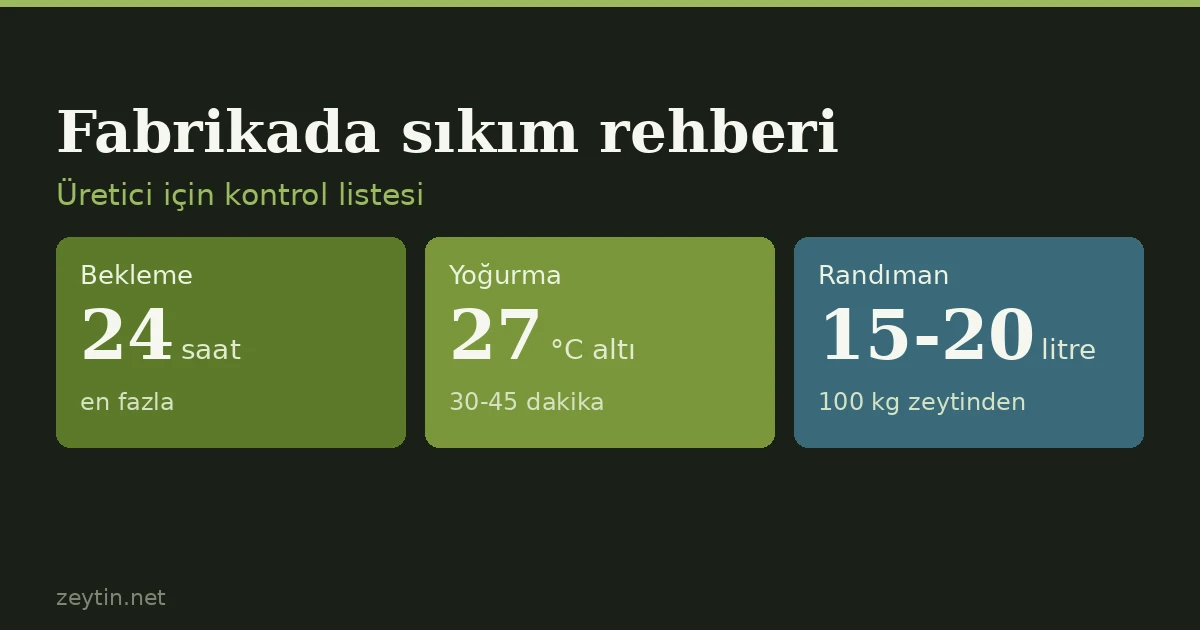
The same olives can give a very different oil when pressed at a different mill under different conditions. From what to do before bringing olives in to two-phase versus three-phase systems, kneading temperature, yield, milling fees and the questions to ask when collecting the oil, here is what a grower having olives pressed needs to know.
Article
What to check when having your olives pressed at a mill: a grower's checklist
The same olives can give a very different oil when pressed at a different mill under different conditions. From what to do before bringing olives in to two-phase versus three-phase systems, kneading temperature, yield, milling fees and the questions to ask when collecting the oil, here is what a grower having olives pressed needs to know.
 Article
How Cold-Pressed Olive Oil Is Made
From tree to bottle: washing, crushing, malaxation and separation. Why the temperature must stay below 27°C.
Article
How Cold-Pressed Olive Oil Is Made
From tree to bottle: washing, crushing, malaxation and separation. Why the temperature must stay below 27°C.
 Article
Ceyhan Olive Oil: harvest defined as “no green fruit left on the tree”
Registered in 2022. The certificate defines harvest not by calendar but by the state of the tree: when no green fruit remains and oil content peaks.
Article
Ceyhan Olive Oil: harvest defined as “no green fruit left on the tree”
Registered in 2022. The certificate defines harvest not by calendar but by the state of the tree: when no green fruit remains and oil content peaks.