What is Cercospora leaf spot of olive? How it differs from peacock spot, the grey mould under the leaf, and protection before the rains
Cercospora leaf spot is a fungal disease that leaves yellow-brown areas above the leaf and dark grey mould below, and leads to early leaf drop. The article reads the University of California guideline, a 2002 Apulian trial and a piece by Pachioli: how it differs from peacock spot, when infection happens, when protection starts and what the sources cannot tell us.
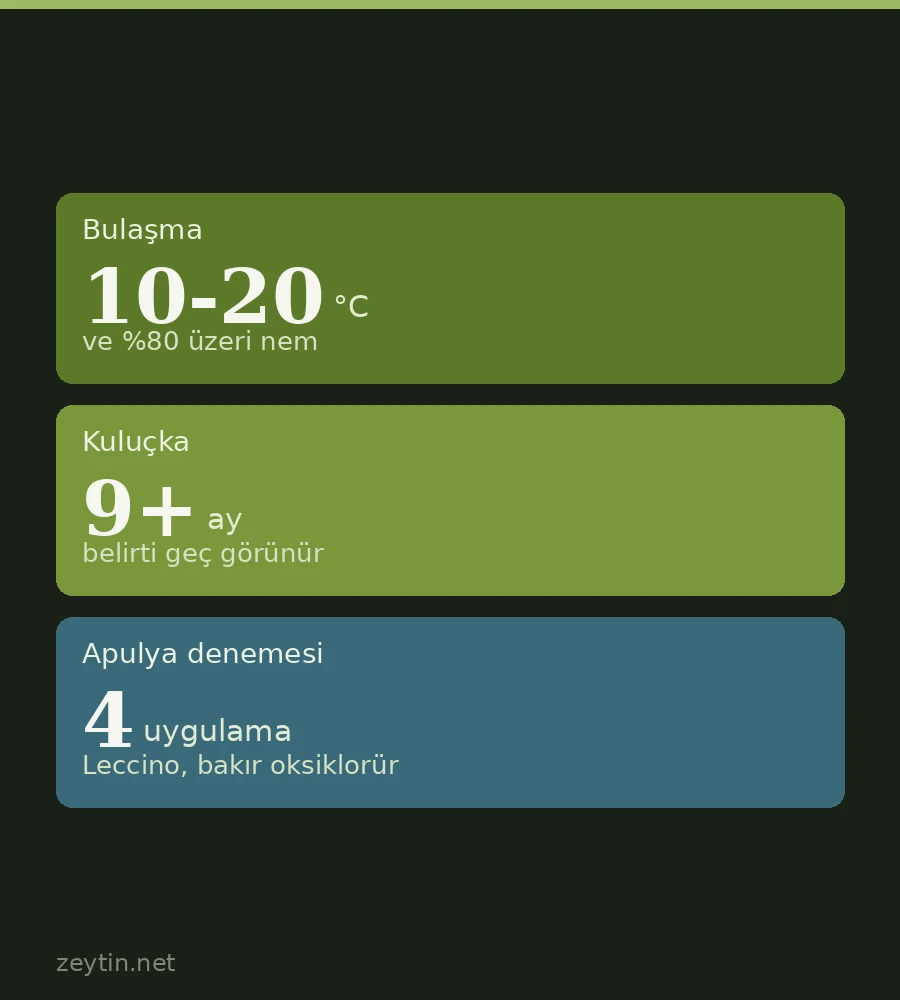
Short answer: Cercospora leaf spot is a fungal disease that leaves yellowing and browning patches on the upper side of an olive leaf and a dark grey mould on the underside. Once infected leaves fall early, the tree is weakened. It moves through the same wet season as peacock spot, but it is a different fungus with different symptoms and a different protection schedule. This article reads three sources side by side: the University of California's pest management guidelines (UC IPM), a trial reported from Apulia in 2002, and a piece by the Italian author Silverio Pachioli. None of them measures the situation in Turkey; we say so again at the end.
Which fungus, and under which names?
The UC IPM guidelines give the causal agent as Mycocentrospora cladosporioides and list Cercospora cladosporioides as a synonym. Pachioli's article writes the same fungus as Pseudocercospora cladosporioides. According to these sources they are different names for one pathogen, so whichever you meet, the same disease is meant. In Italy the disease is called "piombatura", a word that points to lead: the name comes from the underside of the leaf turning lead grey.
What shows on the leaf and the fruit?
- Upper surface: UC IPM says leaves look slightly chlorotic, more in some cultivars than others. Pachioli describes irregular yellow zones that later turn brown and necrotic.
- Underside: according to UC IPM, the underside of some leaves is discoloured by the spore stage of the fungus and looks covered with "black dust". Pachioli describes the same surface as lead grey because of the fungal fruiting structures.
- Which leaves: Pachioli writes that the most evident symptoms are on old leaves on the lower branches. Nigro and colleagues, reporting the Apulian trial, say both mature leaves and young leaves about 4-5 months old were affected.
- Fruit: UC IPM reports small brown lesions on fruit and uneven ripening. The Apulian study recorded fruit symptoms in Coratina, Leccino and Frantoio, with the form of the symptoms depending on cultivar and fruit maturity.
How does it differ from peacock spot?
A table makes the two easier to tell apart. The details of peacock spot are in our peacock spot article; the peacock spot column here comes from UC IPM's own guideline.
| Criterion | Peacock spot | Cercospora leaf spot |
|---|---|---|
| Fungus | Spilocaea oleaginea | Mycocentrospora (Pseudocercospora) cladosporioides |
| On the leaf | Black circular spots 2.5-12 mm across on the upper side, with a yellow halo | Yellowing and brown dead areas above; dark grey mould below |
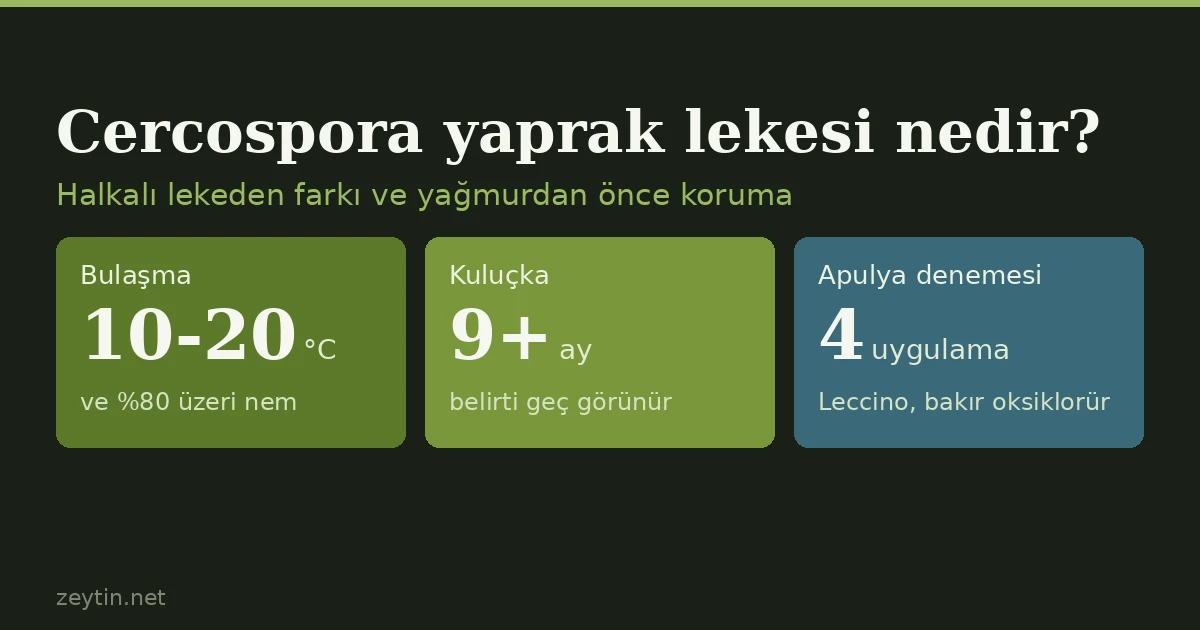
| Infection | In autumn, roughly 2-27 °C, optimum roughly 14-24 °C; about 48 hours of leaf wetness needed | Linked to rain, mostly in winter; develops most at 10-20 °C and above 80 percent humidity |
| Summer | The UC guideline does not state it | According to UC IPM, inactive in California's warm, dry summers |
UC IPM writes that peacock spot losses start mostly with spots on the upper side of leaves on the lower branches, that cultivars differ in susceptibility, and that none is exempt. The temperatures were given in Fahrenheit in UC IPM (35-80 °F, optimum 58-75 °F); the Celsius figures are our conversion. The guideline adds that at warmer temperatures infection can occur with as little as 14 hours of wetness.
Why do symptoms appear late, and how much damage is done?
Pachioli writes that the incubation period can exceed nine months, so the result of today's infection may be seen much later. UC IPM likewise says new infections are associated with rainfall and mostly happen in winter. The guideline ties the disease especially to humid coastal growing areas; because high temperatures limit spore germination and growth, the disease stays inactive in California's warm, dry summers.
The damage comes through leaf loss. In 2002 Nigro and colleagues reported severe leaf drop in Apulia over the previous three years, with the disease showing up in both young and intensive groves. Pachioli writes that early leaf fall can cost up to 20 percent of the following year's production and that oil from such trees can show high peroxide levels. Both figures come from a review-style article rather than a peer-reviewed measurement, so they should be read as "can". We explain what peroxide means in our peroxide article.
UC IPM adds a comparison: in coastal parts of Europe this fungus is harder to control than peacock spot and needs a stricter programme.
When is protection applied?
The sources agree on one point: protection starts before the rain, not after the disease is seen.
- UC IPM: apply a preventive treatment after harvest but before the winter rains begin, and again in spring if rainy weather persists. The guideline lists three copper groups: Bordeaux mixture, fixed copper and copper sulphate. All three are multi-site contact products and can be used in organic farming with restrictions.
- Nigro and colleagues (2002): in the cultivar Leccino, four treatments with copper oxychloride were needed to reduce the disease effectively: February, April, end of August and end of September.
- Pachioli: recommends a series of four treatments for susceptible cultivars: February, April, end of August and end of September or October. Besides copper he mentions some strobilurins, triazoles and dodine as effective active ingredients.
⚠ This article gives no product names or doses. The sources were written for other countries; approved products and timing in Turkey vary by region. Before any application consult your provincial or district directorate of agriculture and follow the label exactly. For the general calendar see our spray calendar article.
What these sources do not say
- None of the sources measures how widespread or severe the disease is in Turkey. UC IPM describes California and Nigro and colleagues describe Apulia.
- We could read only the abstract of the Nigro study; the four-treatment result is given for one cultivar (Leccino) and one copper compound. The same result cannot be assumed for other cultivars or products.
- Pachioli's 20 percent and peroxide statements are the weakest evidence here; his article cites no basis for them.
- Leaves yellow and fall for many other reasons, so leaf drop alone does not point to this disease. We collected the other causes in our leaf drop article. For a sure diagnosis, take a leaf sample to the directorate's laboratory.
Summary
- Cercospora leaf spot leaves yellow-brown areas above and dark grey mould below, and leads to early leaf drop.
- It can be confused with peacock spot; the difference is the sharp black circular spots with a yellow halo in peacock spot.
- Infection happens in the wet, mild-to-cool season; symptoms can appear months later.
- According to the sources, protection starts before the rain; copper is the group named most often.
- In Turkey, the advice of the competent authority governs product and timing.
For general care after harvest see our post-harvest care article, and for another leaf disease our anthracnose article.
One rating per visitor; you can change yours at any time. Ratings are real reader votes — no seeded or default scores.
Related
 Article
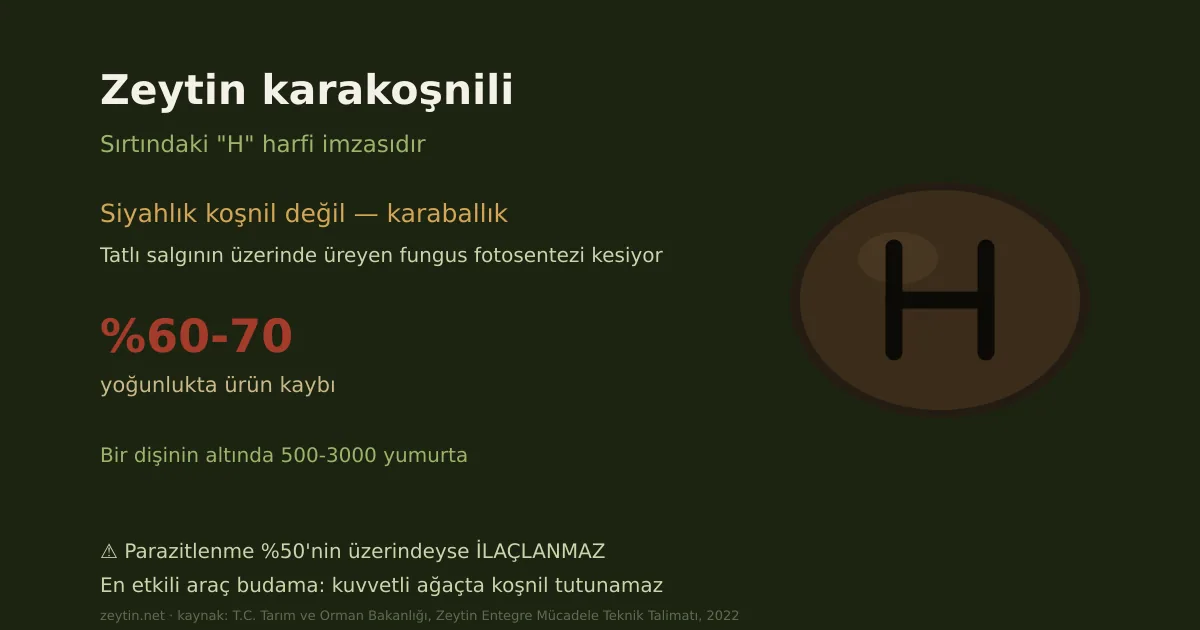
Olive black scale and sooty mould: the H on its back
The olive pest behind sooty mould: a scale with an H on its back. Losses of 60-70%; if parasitism tops 50%, do not spray.
 Article
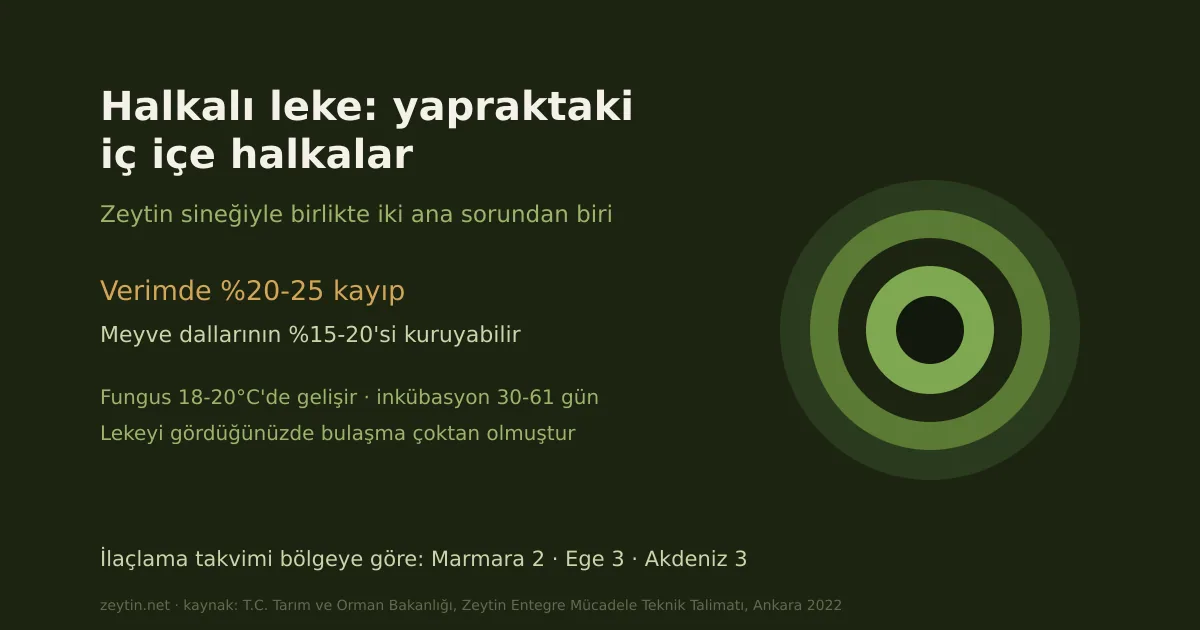
Olive peacock spot: symptoms and a region-by-region spray calendar
The commonest of olive tree diseases: concentric rings on the leaf, shedding, a shrubby tree. Yield falls 20-25%; spray timing varies by region.
 Article
What are olive rust mites? Pitted, curled leaves and rusty fruit
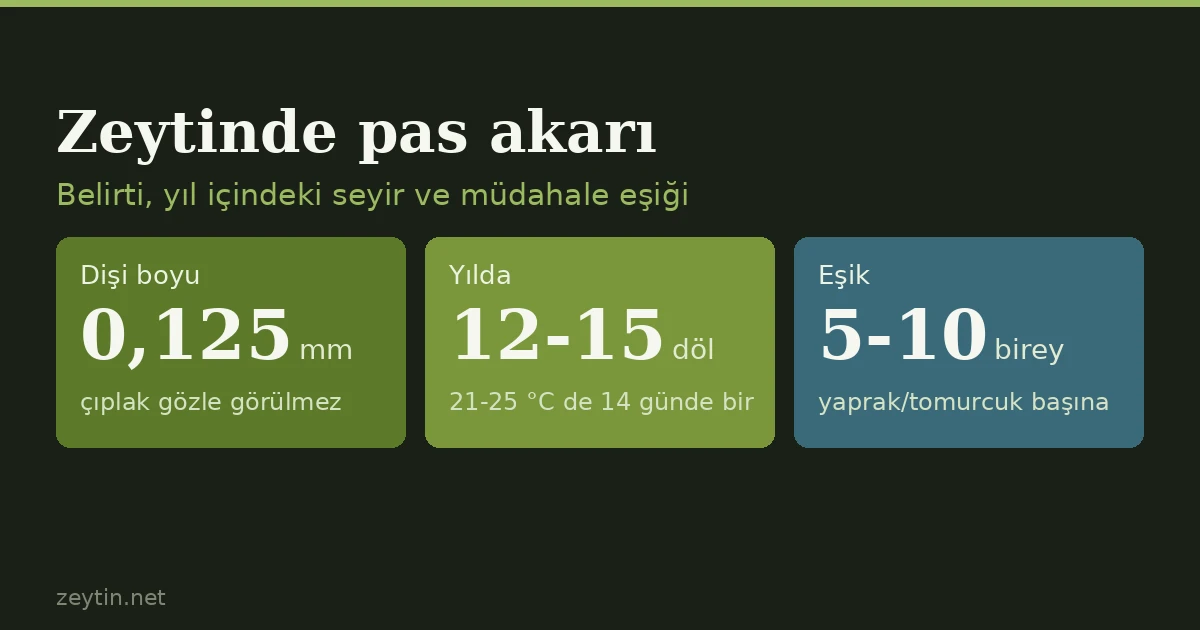
Olive rust mites are eriophyid mites about a tenth of a millimetre long, invisible to the naked eye. They cause pits, blisters and curling on young leaves, blackened buds, misshapen fruit and a rusty skin. Under Türkiye's ministry guidance they are counted weekly from April; an average of 5-10 mobile individuals per leaf or bud is the spray threshold. In Hatay, 64 per cent of orchards were found infested.
 Article
The olive moth: three generations, three kinds of damage
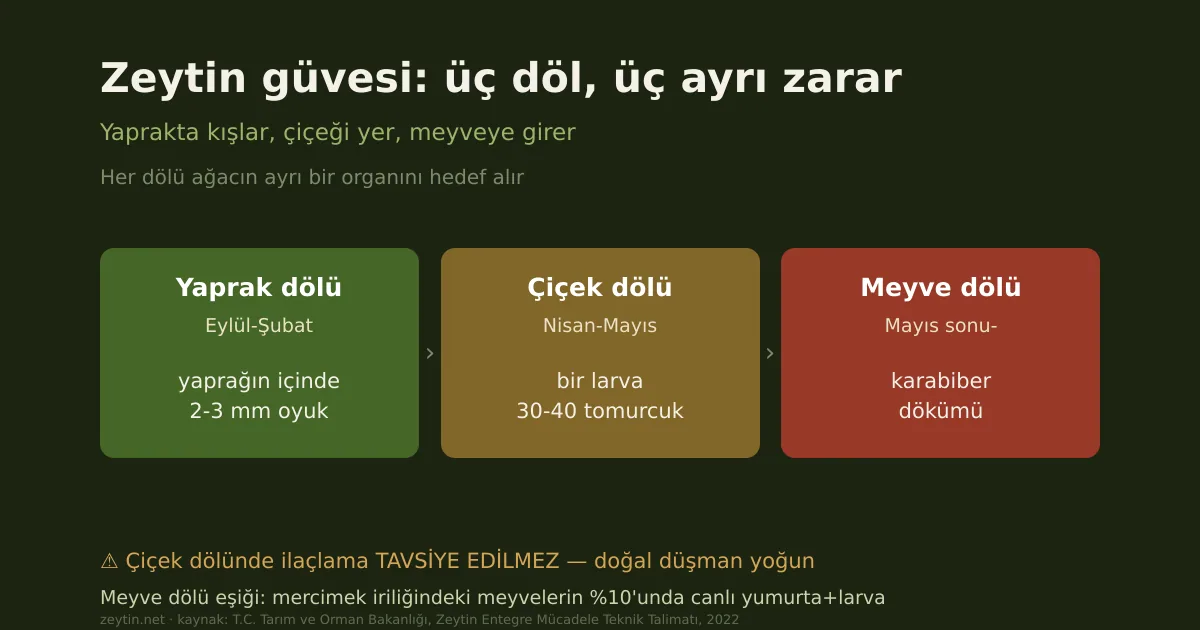
The olive pest with three generations: it winters in the leaf, eats the flowers, enters the fruit. One larva can take 30-40 buds.