What Does Acidity Mean in Olive Oil?
The 0.3% or 0.8% on the label has nothing to do with sour taste. Acidity tells you the condition of the fruit before pressing.
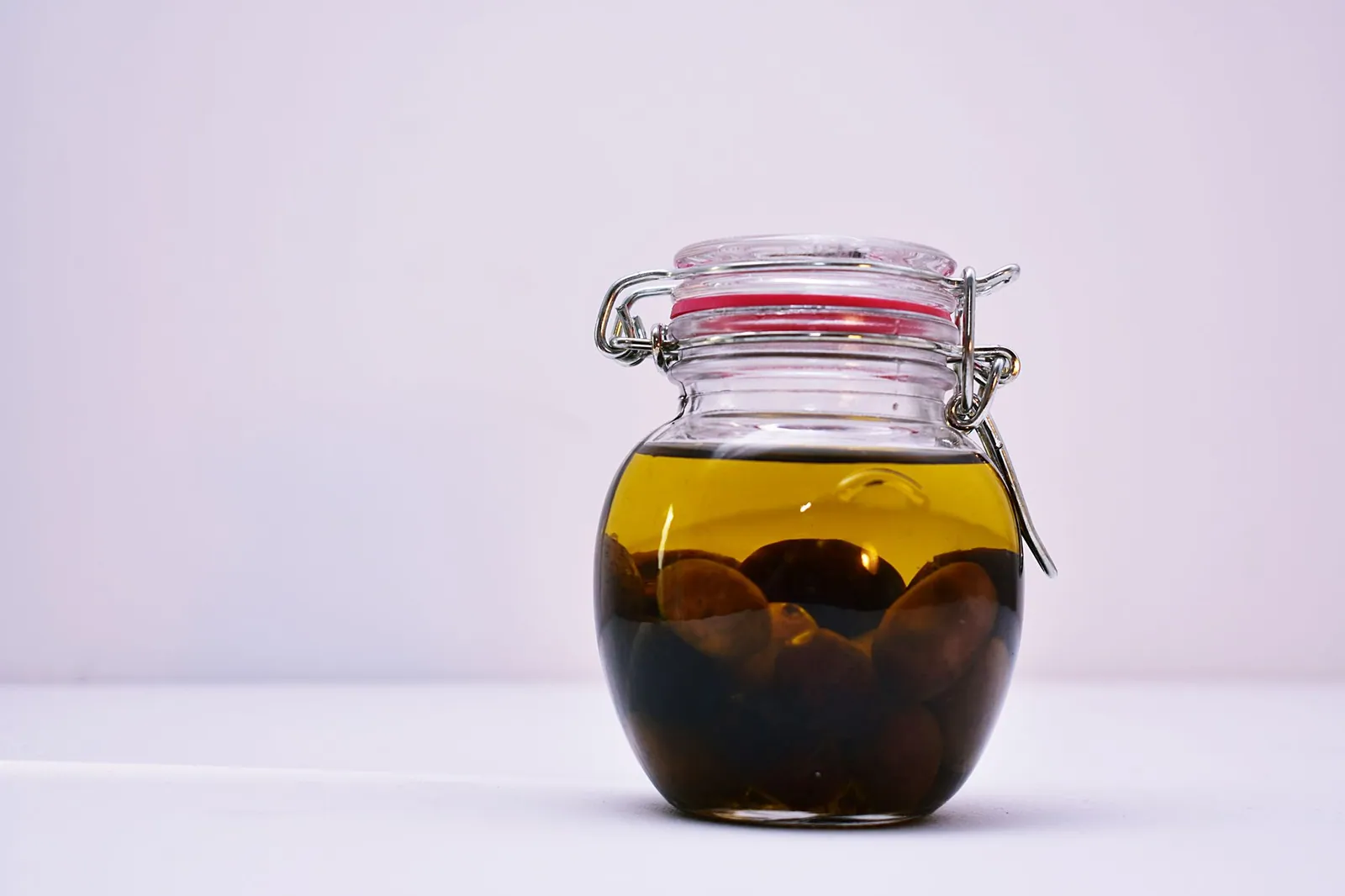
The "0.3% acidity" printed on olive oil bottles gives many people the wrong idea: they assume the oil is sour. In fact the figure describes not taste but the chemical state of the oil. Low acidity is a sign that the olives were picked sound and processed quickly; high acidity shows that the fruit or the oil has started to deteriorate.
The short answer: what should acidity be?
| Acidity | What it means |
|---|---|
| 0.1% – 0.3% | Very good; sound fruit, quick milling, careful storage |
| 0.3% – 0.5% | The usual range for a good extra virgin oil |
| 0.5% – 0.8% | Still within the extra virgin limit |
| 0.8% – 2.0% | Virgin grade; not extra virgin |
| Above 2.0% | Lampante oil; cannot be sold for eating without refining |
Most good extra virgin oils on the market fall between 0.2% and 0.5%.
What are free fatty acids?
Olive oil consists of fat molecules called triglycerides. When fruit is bruised, left waiting or goes mouldy, these molecules begin to break down and free fatty acids are released. The figure on the label is the percentage of those free acids expressed as oleic acid. Oleic acid is used because it is the most abundant fatty acid in olive oil.
So low acidity means: the olives were picked sound, processed quickly and given no chance to deteriorate.
Is olive oil acidic? Acid or base?
In everyday speech, "acidic" brings to mind foods with a low pH such as lemon or vinegar. For olive oil that comparison is misleading. pH is a property of watery solutions; olive oil contains almost no water, so it has no pH in the way lemon juice does. The "acidity" on the label shows not sourness or an effect on the stomach but how far the fat molecules have broken down.
In other words, olive oil is a food classified as neither acid nor base. The idea that "high-acidity oil burns the stomach" has nothing to do with this number. The peppery feeling in the throat comes from polyphenols and is often a sign of good oil.
Limits
- Extra virgin: at most 0.8%
- Virgin: at most 2.0%
- Riviera (blend of refined and virgin): at most 1.0%
- Refined olive oil: falls below 0.3%, but this is achieved by refining
What raises acidity?
- Olives picked from the ground or bruised
- A long gap between harvest and milling (ideally within 24 hours)
- Olive fruit fly damage
- Fruit left in sacks in warm, airless conditions
- Oil stored on its sediment somewhere warm and bright
Once an oil's acidity has risen, it cannot be brought down later; blending or filtering does not remove free fatty acids. The only process that genuinely lowers acidity is neutralisation, which is a step in refining.
Is high-acidity oil harmful?
Acidity is first of all a quality measure, not a direct indicator of a health hazard. A virgin oil at 1% acidity is not as good as extra virgin, but it is not harmful to eat either. The reason lampante oil cannot be sold without refining lies less in its acidity than in the defective smells and tastes common in such oils and in the damaged fruit they come from. What really deserves attention is oil that, along with its acidity, smells rancid, mouldy or fermented. Such oil should not be used; the signs of spoilage are described in how to store olive oil.
Is the acidity of organic or early harvest oil different?
Organic certification documents the growing method; it does not by itself determine acidity. If olives from an organic grove were picked off the ground and left for days, the oil's acidity can be high. Early harvest oils usually have low acidity, because sound green fruit has deteriorated less. In both cases, what decides is the health of the fruit and the time from harvest to milling.
Is acidity enough on its own?
No. Low acidity is necessary but not the only criterion. A refined oil can also be brought down to 0.2% acidity by chemical treatment, but its polyphenols and aroma are long gone. So judging by acidity alone is misleading: first look at the grade (is it extra virgin?), then at the number.
Other quality indicators
Alongside acidity, an analysis report includes:
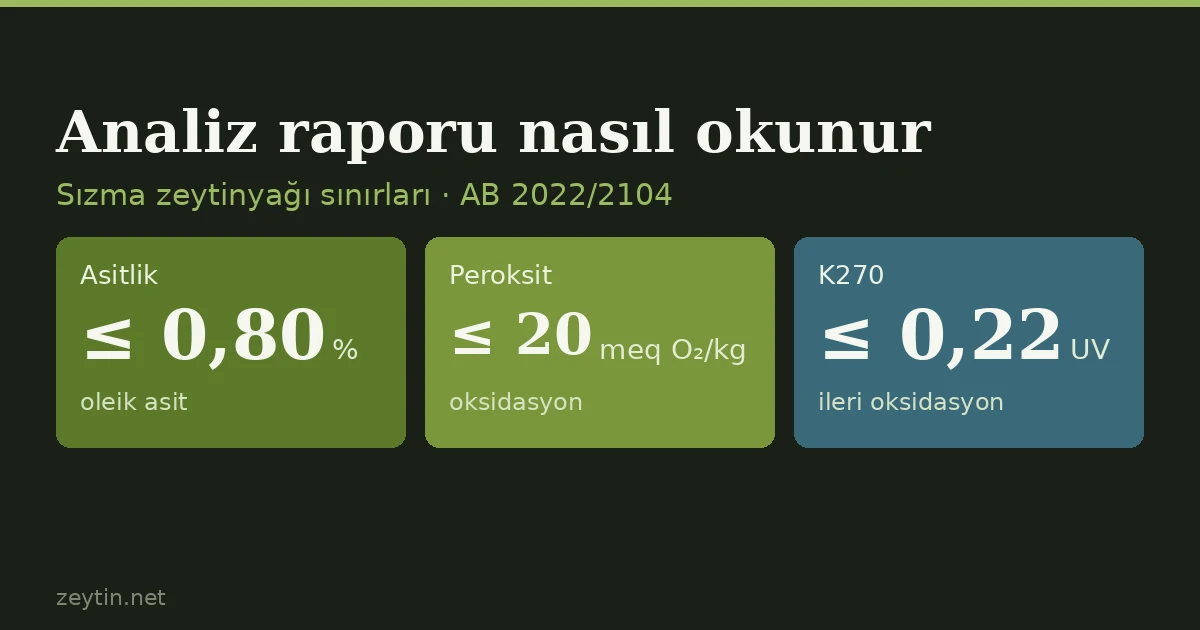
- Peroxide value: shows how oxidised the oil is. It must be at most 20 meq O₂/kg for extra virgin oil; good oils are below 10.
- K232 and K268/K270: ultraviolet absorbance values. They reveal whether an oil has been refined and its oxidation history.
- Delta-K: a value that shows whether blending has taken place.
- Sensory analysis: a trained tasting panel. Even if the chemical values are fine, the oil does not qualify as extra virgin if the panel finds a defect. What the panel looks for is explained in tasting olive oil.
How is acidity measured?
Measurement is done in a laboratory by titration. The oil sample is dissolved in a solvent and its free acids are neutralised with a base solution; the amount used gives the acidity percentage. The method is defined by international standards; it cannot be judged by eye or by taste.
Quick test kits and portable devices on the market can give a rough idea, but they do not replace an official analysis. For trade or labelling, a result from an accredited laboratory is needed.
Why doesn't it affect taste?
At these levels, free fatty acids themselves have no taste. You would not notice a difference on the palate between two oils at 0.2% and 0.7% acidity. Taste is shaped by polyphenols, volatile aroma compounds and the degree of oxidation.
That is why the logic of "low acidity so it tastes mild" is wrong. An early harvest, high-polyphenol, bitter and peppery oil usually has very low acidity too; the two are separate things.
The link with harvest time
Oil from green olives harvested early (October to early November) has low acidity and high polyphenols, but yield is low. With late harvest (December-January) the fruit ripens and yield rises, but acidity tends to climb and polyphenols fall.
Producers choose between the two: quality or yield. That is a major reason for price differences. On commodity exchanges the price of oil is also set largely by acidity; see how to read olive oil exchange prices.
Can the number on the label be trusted?
The acidity figure shows the value at bottling. As the oil is exposed to light and heat over its shelf life, the value rises. So an oil labelled 0.3% that has sat in a hot warehouse for six months is no longer at that value.
Under European Union rules, if acidity is stated on the label, the peroxide value, wax content and ultraviolet absorbance must be stated alongside it. The reasoning behind the rule is that a small acidity figure highlighted on its own can be misleading.
That is why the harvest date is a more useful piece of information than acidity. For the other lines on a label, see how to read an olive oil label.
One rating per visitor; you can change yours at any time. Ratings are real reader votes — no seeded or default scores.
Related
 Article
How to read an olive oil lab report: acidity, peroxide, K232, K270 and ΔK
The rows of figures on an olive oil lab report look cryptic at first. What do free acidity, peroxide value, K232, K270, ΔK, ethyl esters and sensory analysis measure, what are the limits for extra virgin and virgin grades, and how do you interpret a report using a worked example?
Article
How to read an olive oil lab report: acidity, peroxide, K232, K270 and ΔK
The rows of figures on an olive oil lab report look cryptic at first. What do free acidity, peroxide value, K232, K270, ΔK, ethyl esters and sensory analysis measure, what are the limits for extra virgin and virgin grades, and how do you interpret a report using a worked example?
 Article
Aydın Memecik Olive Oil: bitterness and pungency written into the definition
Registered in 2020. Total phenols > 100 mg/kg, peroxide ≤ 18, defect median 0. Intense fruit aroma with pronounced bitterness and pungency.
Article
Aydın Memecik Olive Oil: bitterness and pungency written into the definition
Registered in 2020. Total phenols > 100 mg/kg, peroxide ≤ 18, defect median 0. Intense fruit aroma with pronounced bitterness and pungency.
 Article
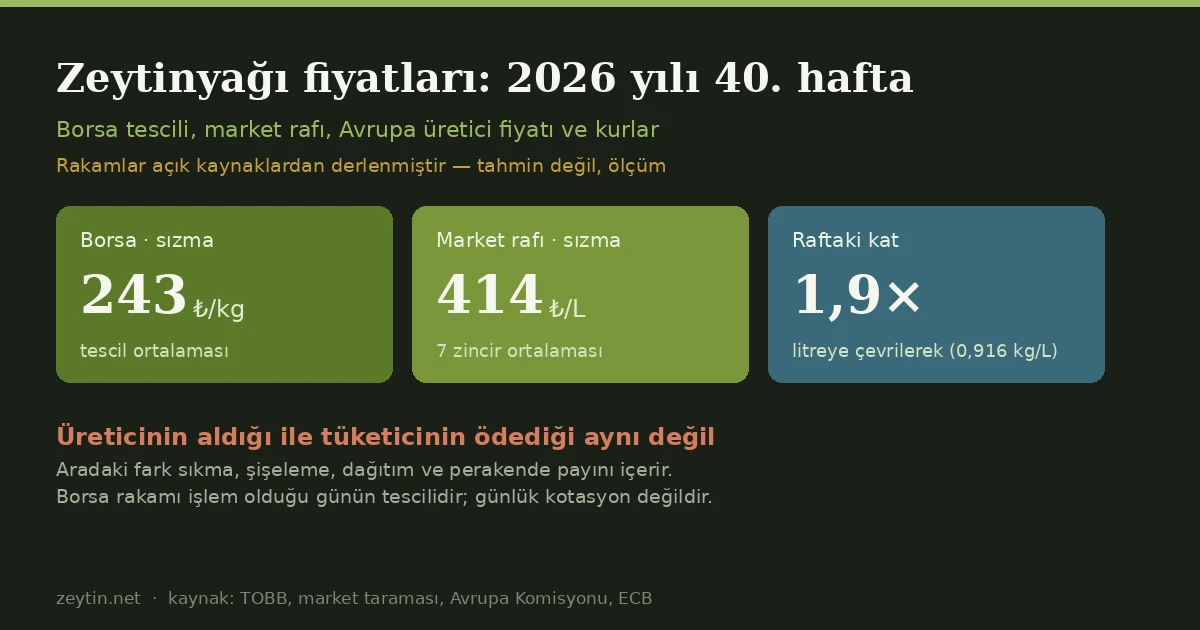
Olive Oil Prices: Week 40 of 2026
Week 40 of 2026: Turkish exchange prices, European producer prices and exchange rates side by side.
Article
Olive Oil Prices: Week 40 of 2026
Week 40 of 2026: Turkish exchange prices, European producer prices and exchange rates side by side.
 Article
Bayramiç Olive Oil: aroma compounds defined as percentages
Registered in 2022. The certificate defines aroma by compound rather than adjective: hexanal 36.15%, E-2-hexenal 26.14%. Iodine value 80-93.
Article
Bayramiç Olive Oil: aroma compounds defined as percentages
Registered in 2022. The certificate defines aroma by compound rather than adjective: hexanal 36.15%, E-2-hexenal 26.14%. Iodine value 80-93.