Tunisia's output falls from 500,000 to 300,000 tonnes — revenue may hold
Tunisia's National Chamber of Olive Producers expects olive oil output to fall from 500,000 to 300,000 tonnes in 2026/27, citing alternate bearing. Revenue is still expected to match last season because prices are higher. Türkiye's most direct bulk competitor is shrinking.
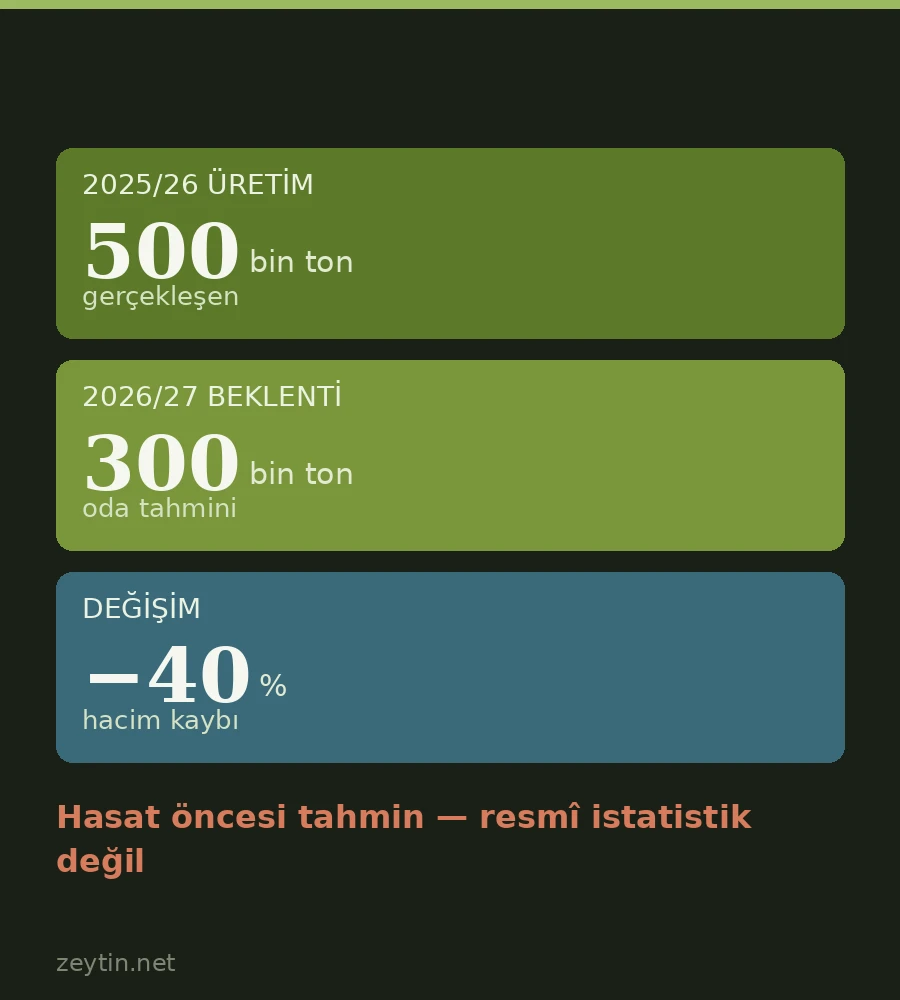
When we covered Tunisia's 368,000-tonne export season, we noted that an unusually large crop stood behind that volume. That season has now closed. Najeh Saïdi Hamed, president of Tunisia's National Chamber of Olive Producers, gave the new season's forecast to Mosaique FM: 300,000 tonnes.
The number
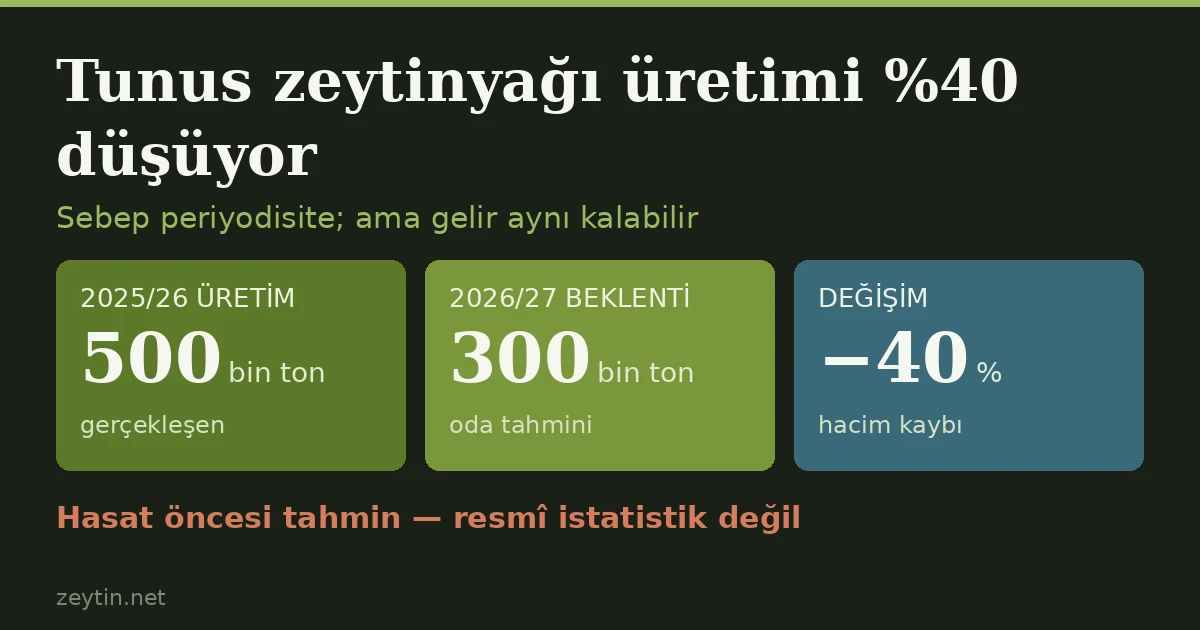
| Season | Olive oil production |
|---|---|
| 2025/26 (actual) | 500,000 t |
| 2026/27 (forecast) | 300,000 t |
| Change | −40% |
For scale: Tunisia exported 368,000 tonnes in the first nine months of last season. Exports take more than three quarters of production — Tunisia is not a country that consumes what it makes, it is a country that sells it. A 200,000-tonne drop in output comes straight out of exportable volume.
The cause is the cycle, not drought
Hamed attributes the decline to alternate bearing: an olive tree that carries a heavy crop follows it with a light year while it recovers. This is not an external shock like disease or drought; it is the tree's own rhythm.
The distinction has a practical consequence. A drought-driven fall can persist into the following year; a cycle-driven fall is normally followed by a recovery. This is the bottom of a swing, not a permanent loss.
The real news is in the second sentence
Hamed's second statement matters more than the first: while output falls 40%, revenue is expected to match last season, because international prices are higher.
This is the basic mechanism of the olive oil market, and it works in reverse too: a big crop does not rescue income. That is precisely what Türkiye experienced last season — volume rose while export value fell.
Tunisia's expectation is the same equation read from the other direction: volume falls, unit price rises, total revenue holds. What reaches the grower's pocket depends, in both cases, on how much price compensates for volume.
⚠ This is an expectation, not a guarantee. The assumption that prices will rise depends on the rest of the Mediterranean not producing a large crop at the same time.
What it means for Türkiye
1. Our most direct bulk competitor is shrinking. Roughly 86% of Tunisia's exports are bulk. Turkish exporters compete for the same tanks, not the same shelves: the bulk market feeding Spanish and Italian bottlers. Removing 200,000 tonnes of supply from that market opens room for Turkish oil.
2. The ground under the Andalusian dispute is shifting. We covered Andalusia's objection to North African imports last week; Tunisia was the main source of the supply being complained about. That supply is now contracting. The grounds for a protection measure weaken — though the request itself, once set in motion as a regulatory process, may continue.
3. Algeria does not fill the gap. Algeria's record expectation of 150,000 tonnes sounds large but is smaller than the 200,000 tonnes Tunisia is losing, and Algeria consumes most of its output domestically. Across North Africa, supply is falling on net.
Reading with care
⚠ 300,000 tonnes is a forecast made before harvest. In olives, pre-harvest estimates and final figures diverge widely; we have written separately about why mistaking exchange volume for the harvest misleads — the same caution applies to forecasts.
⚠ The figure is olive oil, not olives. Table olives are a separate account.
⚠ The statement comes from a trade chamber president, not a statistical agency. End-of-season figures from ONAGRI, Tunisia's official agricultural observatory, may differ; last season's export data came from ONAGRI.
One rating per visitor; you can change yours at any time. Ratings are real reader votes — no seeded or default scores.
Related
 Article
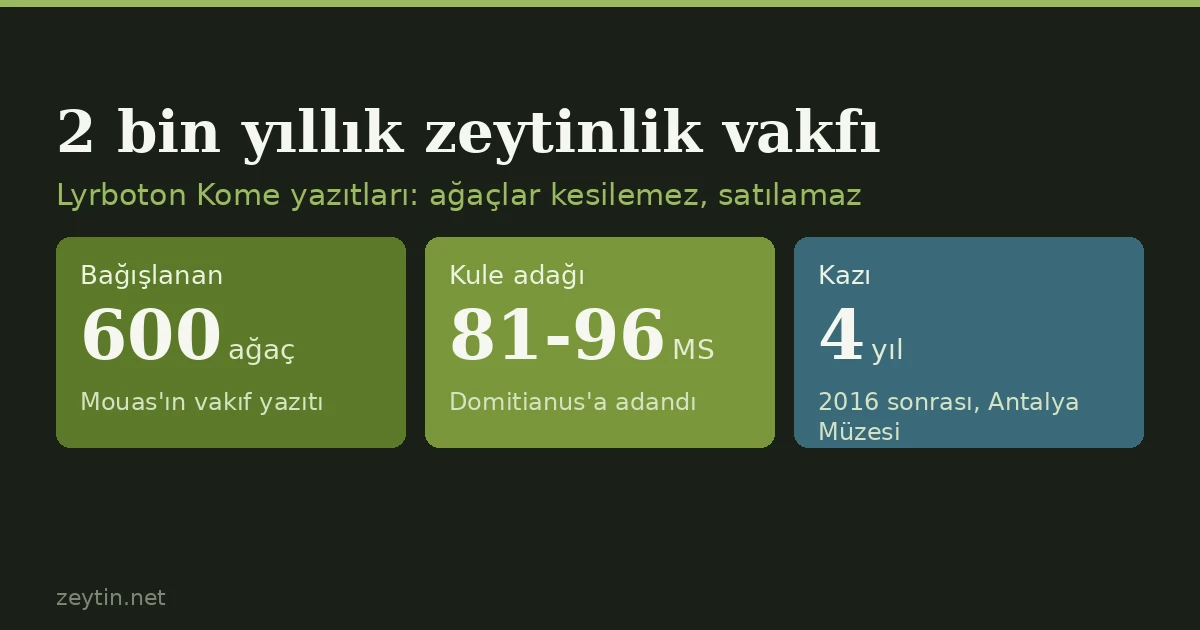
A 2,000-year-old olive grove endowment in Antalya: 600 trees, “never to be cut or sold”
The excavation results from Lyrboton Kome in Antalya have been presented. Inscriptions record a family endowing its farm and 600 olive trees in perpetuity, with an explicit clause: these trees can never be cut, sold or put to another use.
Article
A 2,000-year-old olive grove endowment in Antalya: 600 trees, “never to be cut or sold”
The excavation results from Lyrboton Kome in Antalya have been presented. Inscriptions record a family endowing its farm and 600 olive trees in perpetuity, with an explicit clause: these trees can never be cut, sold or put to another use.
 Article
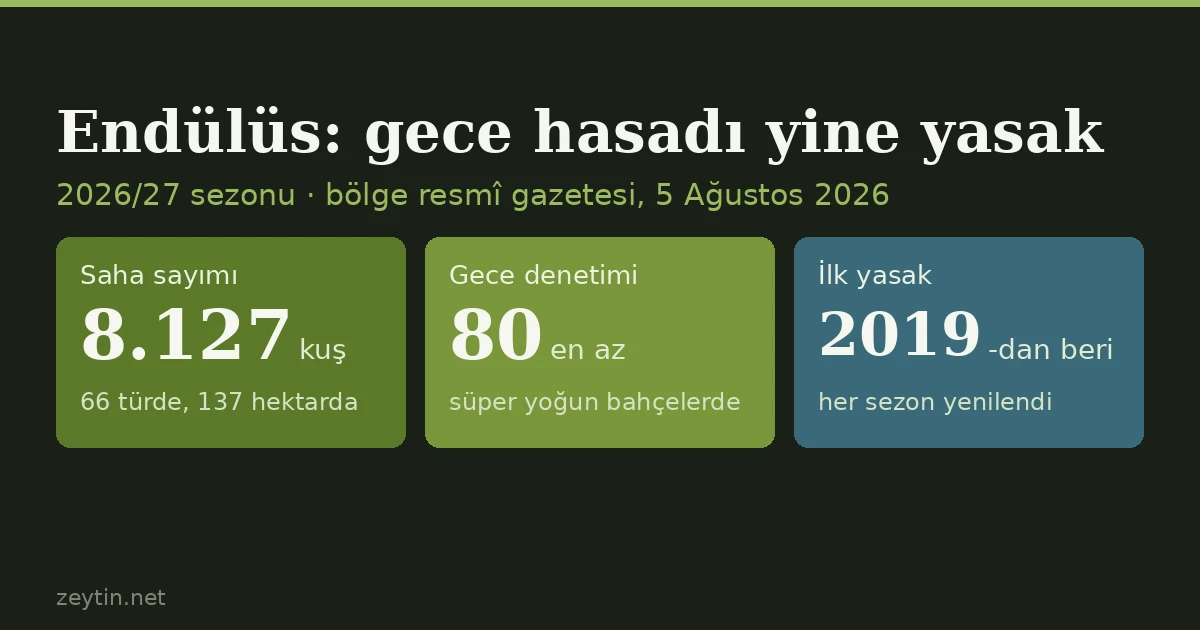
Andalusia bans night harvesting again for 2026/27: 8,127 birds counted on 137 hectares
Andalusia has again suspended night-time mechanical harvesting in super-intensive hedgerow olive groves for the 2026/27 season. The resolution is dated 30 July 2026, was published in the regional official gazette on 5 August and is valid for one year. The justification is field counting: 8,127 birds from 66 species on 137 hectares. The suspension was first introduced in 2019 and has been renewed every season since.
Article
Andalusia bans night harvesting again for 2026/27: 8,127 birds counted on 137 hectares
Andalusia has again suspended night-time mechanical harvesting in super-intensive hedgerow olive groves for the 2026/27 season. The resolution is dated 30 July 2026, was published in the regional official gazette on 5 August and is valid for one year. The justification is field counting: 8,127 birds from 66 species on 137 hectares. The suspension was first introduced in 2019 and has been renewed every season since.
 Article
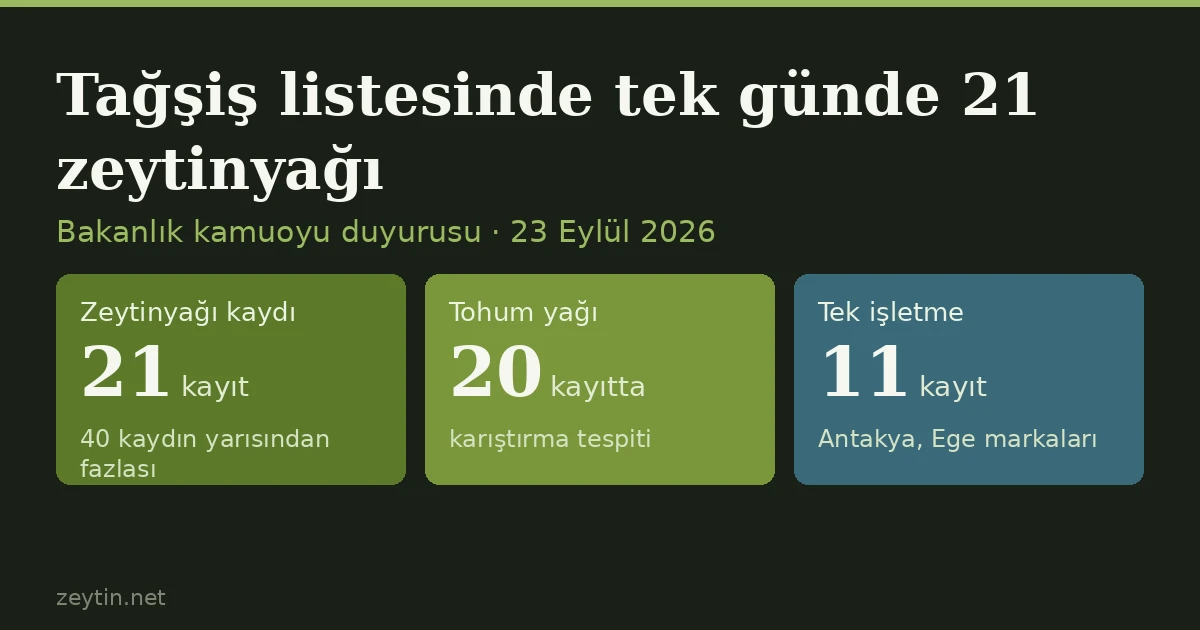
Twenty-one olive oils on the ministry's adulteration list in one day, eleven from a single Antakya business
Of the 40 records added to Turkey's counterfeit-and-adulteration list on 23 September 2026, 21 are olive oil, and 20 of those were found to contain seed oil. Eleven records belong to a single business registered in Antakya, marketing under Aegean origin names such as Ayvalık, Akçay-Altınoluk and Kazdağları. Sixteen of the containers were five litres.
Article
Twenty-one olive oils on the ministry's adulteration list in one day, eleven from a single Antakya business
Of the 40 records added to Turkey's counterfeit-and-adulteration list on 23 September 2026, 21 are olive oil, and 20 of those were found to contain seed oil. Eleven records belong to a single business registered in Antakya, marketing under Aegean origin names such as Ayvalık, Akçay-Altınoluk and Kazdağları. Sixteen of the containers were five litres.
 Article
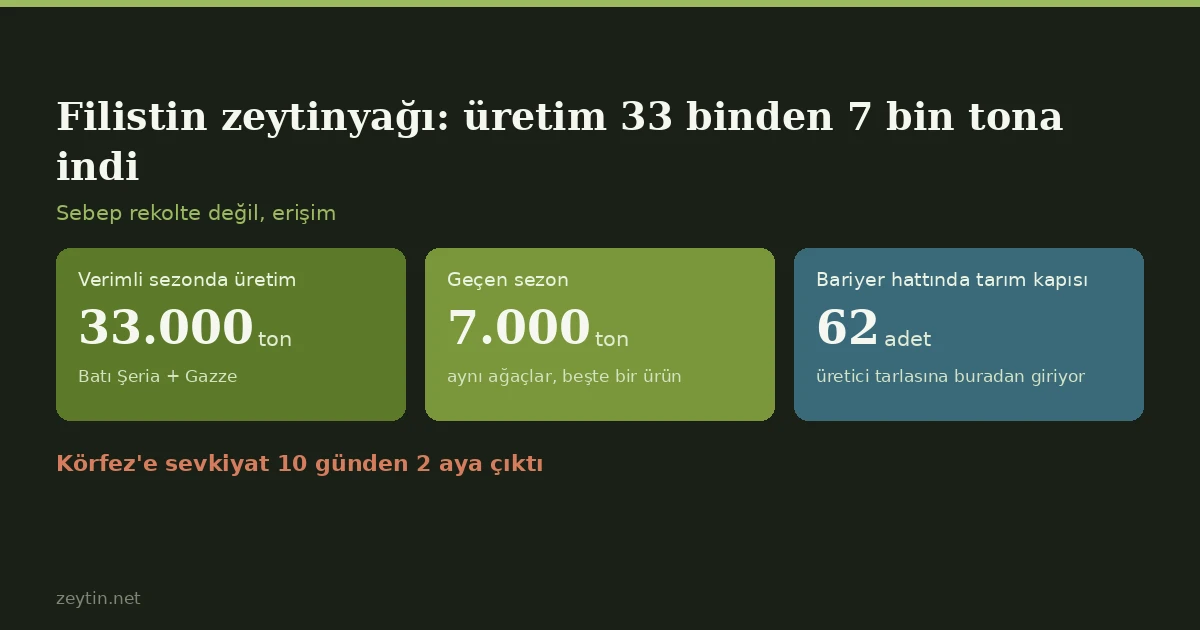
Palestinian olive oil: output down from 33,000 to 7,000 tonnes — the cause is access, not the crop
In a productive season Palestine yields 33,000 tonnes of olive oil; last season it produced 7,000. Seventy per cent of the groves sit in the northern West Bank, reached through 62 agricultural gates, and shipping times have gone from ten days to two months.
Article
Palestinian olive oil: output down from 33,000 to 7,000 tonnes — the cause is access, not the crop
In a productive season Palestine yields 33,000 tonnes of olive oil; last season it produced 7,000. Seventy per cent of the groves sit in the northern West Bank, reached through 62 agricultural gates, and shipping times have gone from ten days to two months.