Structural problems of Turkish olive growing
157 million trees but 5% of world output: low yield, old trees, harvest mechanisation, missing data, the support gap and informality.
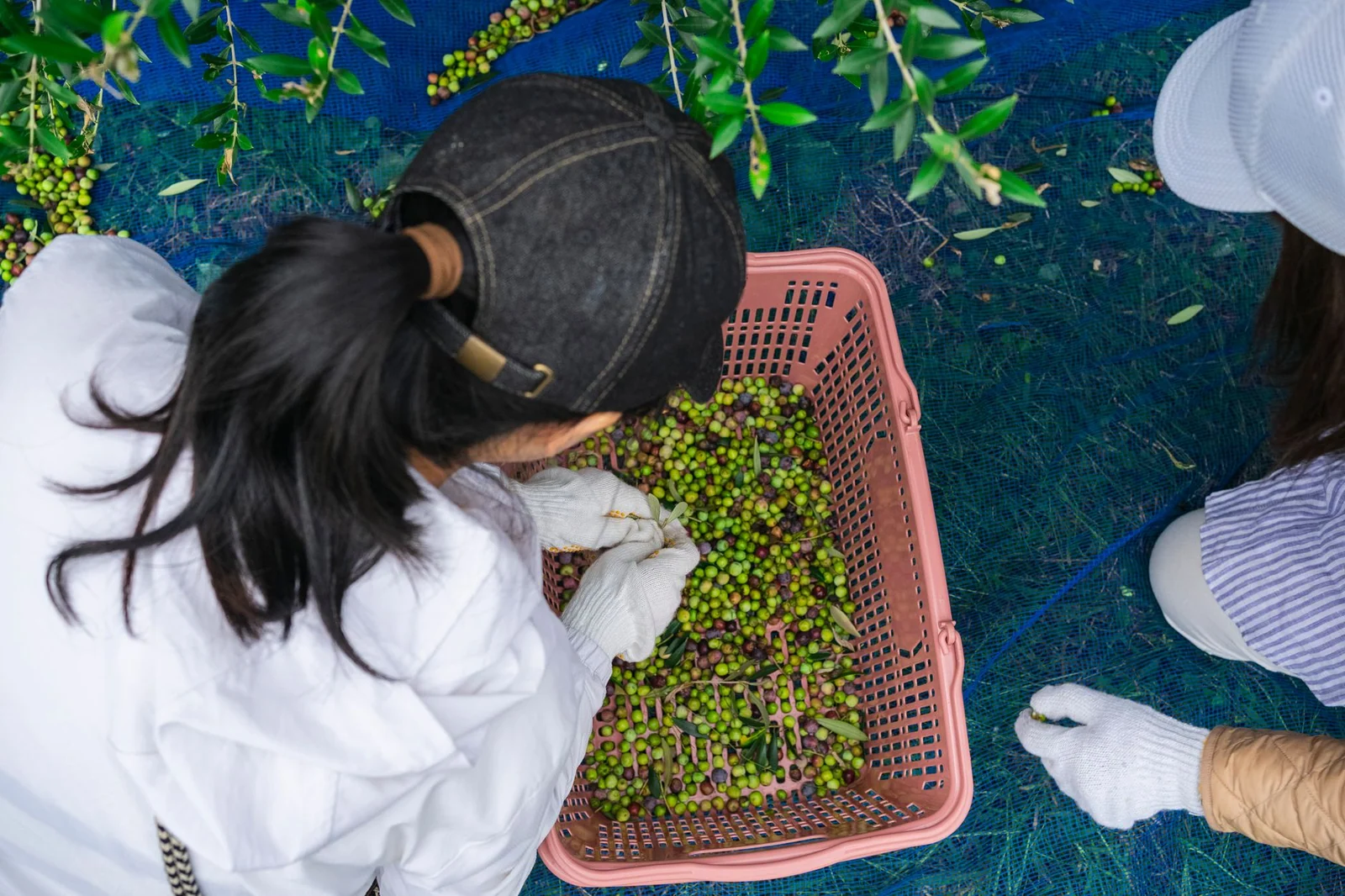
Turkey is one of the world's largest olive producers. The number of trees rose from 87 million in 1995 to 157 million by 2012, and production takes place in 41 provinces. Yet olive oil output averages 150,000 tonnes — only 5% of world production.
That contrast is the story of the sector's structural problems: the trees are there, the yield is not.
1. Low yield per tree
In traditional groves the yield runs at 10–15 kg per tree. Modern high-density orchards can produce several times that.
The reasons are not single:
- The share of old trees. Around 60% of the sector consists of old trees unsuited to modern harvesting.
- Lack of pruning and rejuvenation. An unmaintained tree yields less and stays open to disease.
- Irrigation. The olive tolerates drought, but without water it will not give a high yield.
2. Harvesting stays manual
The terrain of traditional groves is often unsuited to modern harvesting machinery: sloping ground, irregular spacing, old trees whose canopies have grown into one another.
Where machinery cannot go, harvesting falls to hand labour. That has two consequences:
- Costs rise. Harvesting is among the largest cost items in olive production.
- Harvest is delayed. Late-picked fruit raises acidity and lowers oil quality. What spoils what: what does acidity mean in olive oil.
3. The data isn't reliable
This is the sector's quietest problem. Crop forecasts rest largely on expert observation; tree counts and production figures for table olives and oil are not kept current.
Without data:
- The grower waits on a price without knowing how large the crop will be
- The exporter cannot plan stock
- The policymaker cannot judge what to support
The proposed remedy is a genuine database built on a geographic information system: how many trees in which province, of which variety, at what age.
4. The support gap
In the European Union the premium runs at around 1 euro per kilogram for olive oil and 20 euro cents for table olives. Support in Turkey sits markedly below that level.
The gap shapes not only the grower's income but competitiveness: two products meet in the same market having been produced under different levels of support.
5. Informality and adulteration
Unrecorded consumption is widespread in both table olives and olive oil. On top of that come adulterated products: cotton, canola and safflower oil blended and sold as olive oil.
There are two victims here: the honest producer and consumer trust. What a label tells you, and what to look for: how to tell good olive oil.
6. The wild olives left unused
Turkey holds some 80 million wild olive (delice) trees, and they are not being put to use. Grafting them into production is a faster and cheaper route than establishing new groves.
What can be done
The measures that recur across the sources:
1. A reliable database built on a geographic information system
2. Development of climate-resilient clones of local varieties
3. A nationwide pruning and rejuvenation programme
4. More quality-control laboratories
5. Promotion to grow domestic consumption
6. Bringing wild olives into production by grafting
Where production concentrates
Olives are grown in 41 of Turkey's 81 provinces — half the country. But the weight of production sits in a few regions:
| Region | Share | Leading varieties |
|---|---|---|
| Aegean | 53% | Memecik, Ayvalık, Erkence |
| Mediterranean | 23% | Sarı Ulak, Adana Topağı, Halhalı |
| Marmara | 18% | Gemlik, Edincik Su |
| Southeast | 6% | Kilis Yağlık, Nizip Yağlık |
| Black Sea | 0.2% | — |
The table also shows a risk: more than half of production sits in one region. A drought, frost or disease striking the Aegean shakes national output directly. The same narrowness exists on the variety side — three varieties make up three quarters of the tree stock: olive varieties.
Only a quarter of the fruit reaches the table
About 27% of the olives grown are processed as table olives; the rest goes to oil.
That ratio explains two things:
- Why variety recognition is low. Fruit that goes to oil carries no variety name on the bottle; the consumer does not know Memecik is 45% of the country.
- Where the value added is lost. Table olives leave more value per kilogram, yet most production takes the lower value-added route.
Consumption stays in the producing regions
Olive oil consumption is largely confined to the regions that produce it. With the domestic market not widening, the grower is left with a single buffer: exports.
Growing domestic consumption is not merely a marketing question — it is a question of price stability. A broad home market would absorb some of the supply shock created by alternate bearing.
The scale of holdings
Olive growing in Turkey is carried out mainly by small family holdings. Small scale produces its own consequences:
- Machinery investment cannot be met alone
- Produce is sold individually, without bargaining power
- There is no capacity to store — the crop is sold at the post-harvest price
Cooperative organisation is the main instrument that could change this picture; the effect of structures such as Marmarabirlik on grower prices is one example.
Further reading
This page sets out the general frame. Two problems are treated separately:
Sources
- EGİAD Yarın — Turkey's olive sector: problems and proposed solutions
- Zeytin Dostu Association — olive growing in Turkey
- TurkStat — production and tree-stock statistics
One rating per visitor; you can change yours at any time. Ratings are real reader votes — no seeded or default scores.
Related
 Article
Marmarabirlik purchase prices: what the grower actually receives in Marmara
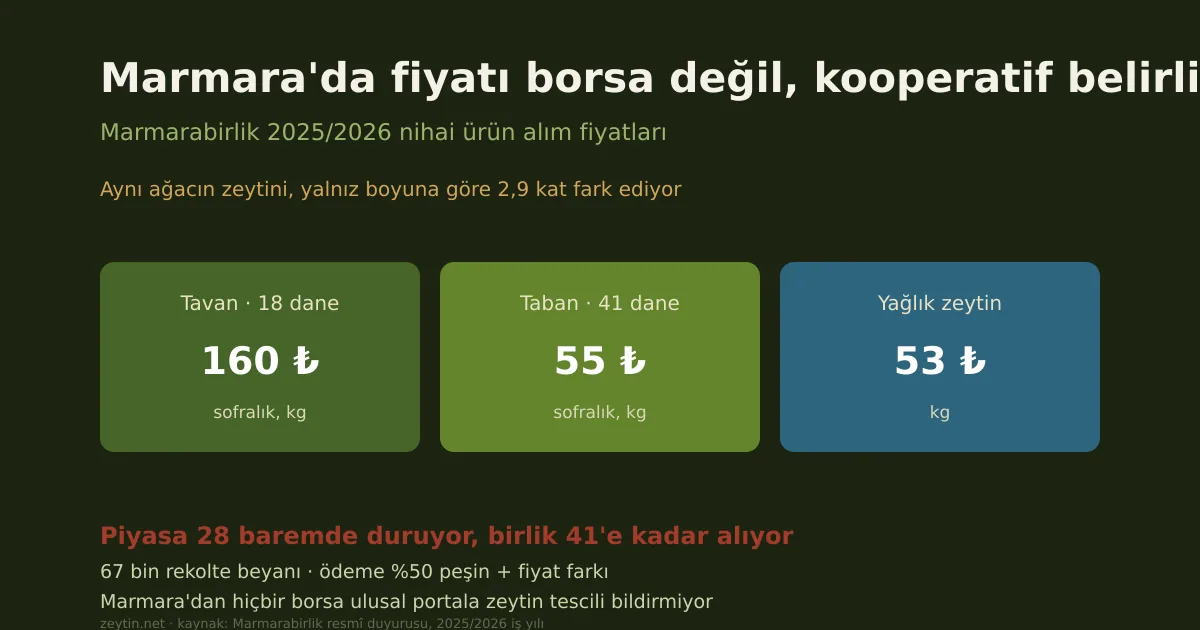
The 2025/2026 season: 160 ₺ for calibre 18, 55 ₺ for calibre 41, 53 ₺ for oil fruit. Size alone changes the price 2.9×, and the union buys down to calibre 41 where the market stops at 28.
Article
Marmarabirlik purchase prices: what the grower actually receives in Marmara
The 2025/2026 season: 160 ₺ for calibre 18, 55 ₺ for calibre 41, 53 ₺ for oil fruit. Size alone changes the price 2.9×, and the union buys down to calibre 41 where the market stops at 28.
 Article
Exchange volume is not the harvest: what the 2023 record actually recorded
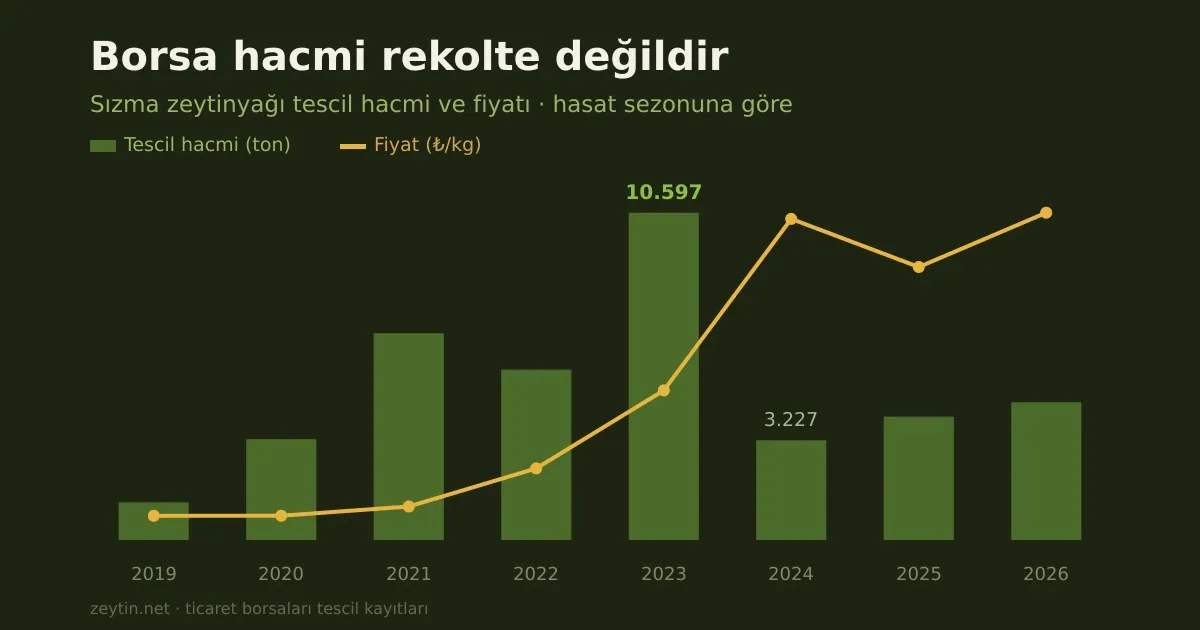
10,597 tonnes registered in 2023, down to 3,227 the next season. Harvest collapse or a change of channel? The data cannot tell them apart.
Article
Exchange volume is not the harvest: what the 2023 record actually recorded
10,597 tonnes registered in 2023, down to 3,227 the next season. Harvest collapse or a change of channel? The data cannot tell them apart.
 Article
Vegetation water and pomace: olive oil's waste problem
Processing 1.5–2 million tonnes of olives yields 1 million tonnes of vegetation water and 1 million tonnes of pomace. Waste, or resource?
Article
Vegetation water and pomace: olive oil's waste problem
Processing 1.5–2 million tonnes of olives yields 1 million tonnes of vegetation water and 1 million tonnes of pomace. Waste, or resource?
 Article
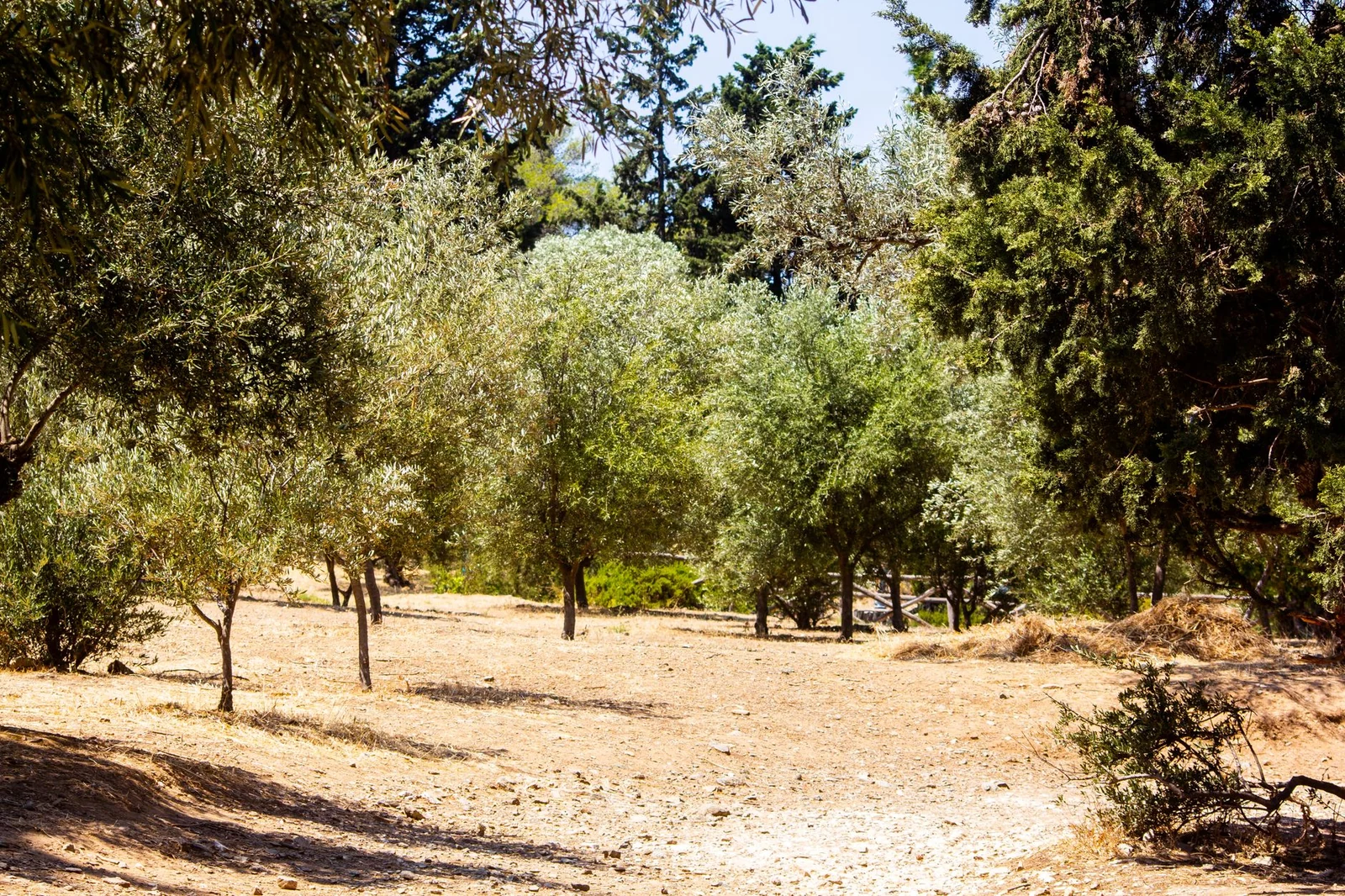
The olive grove beside the factory: Bursa soils measured
43 PCB congeners measured in 7 Bursa olive groves: 5.82-18.71 ng/g against a 200 ng/g limit. No serious pollution — but the point near the steel works reads three times the rural one.
Article
The olive grove beside the factory: Bursa soils measured
43 PCB congeners measured in 7 Bursa olive groves: 5.82-18.71 ng/g against a 200 ng/g limit. No serious pollution — but the point near the steel works reads three times the rural one.