Spain publishes its olive oil withdrawal order: the percentage is due by 15 November, capped at 20% of the crop
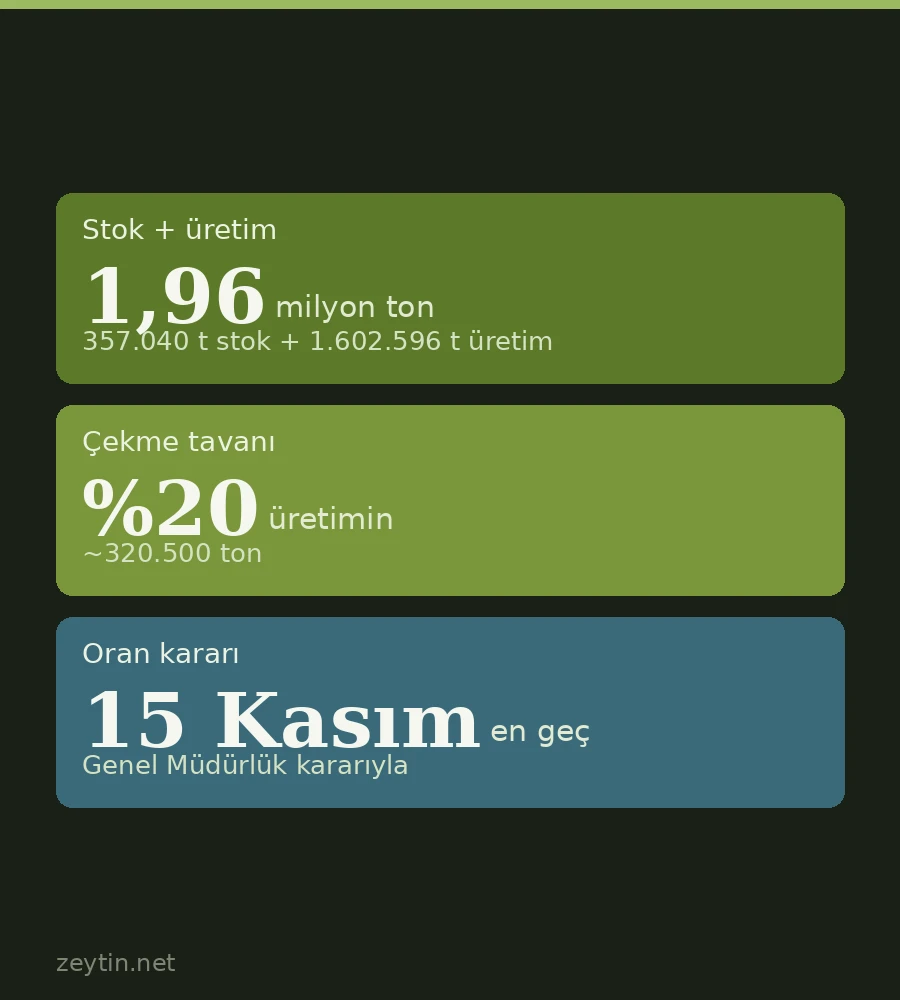
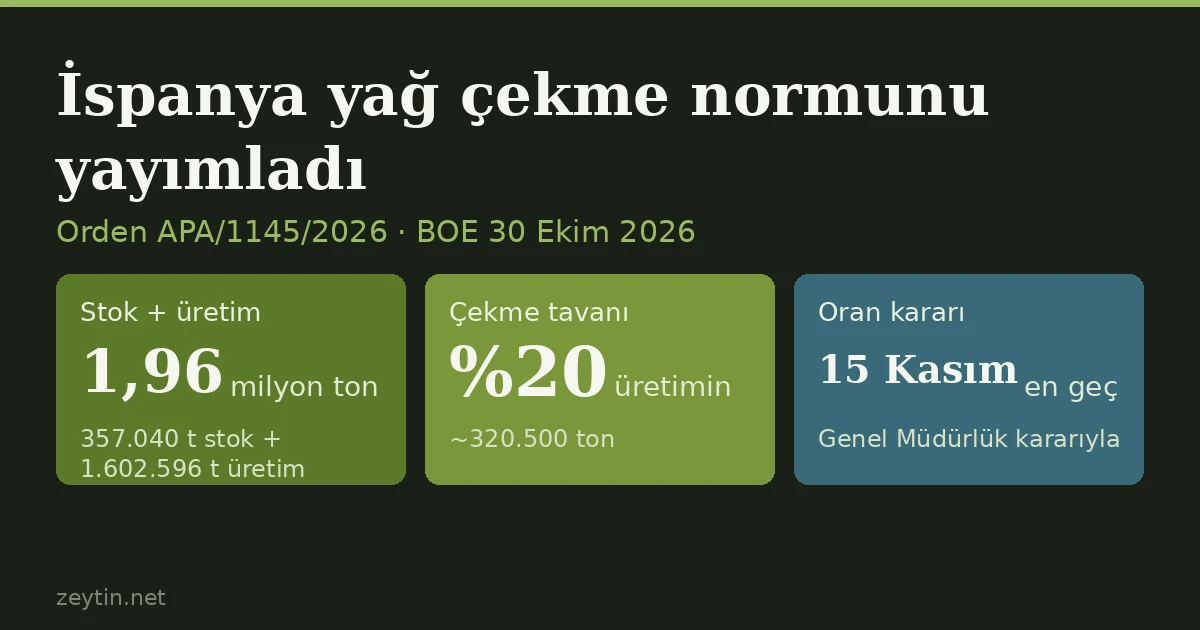
Spain's Order APA/1145/2026 was published in the BOE on 30 October. A separate resolution due by 15 November will set the share mills must store, capped at 20% of estimated production. The season opened with 357,040 tonnes of stocks and a 1,602,596-tonne crop estimate.
Spain's Ministry of Agriculture, Fisheries and Food has turned months of discussion into law. Order APA/1145/2026, signed on 29 October and published in the Official State Gazette (BOE) on 30 October 2026, sets out the olive oil marketing standard for the 2026/27 season, which runs from 1 October 2026 to 30 September 2027. It entered into force the following day.
One point needs stressing at the outset: the published order does not yet tell any mill to set aside a single litre. The percentage to be withdrawn, and the date on which withdrawal starts, will be fixed in a separate resolution by the Directorate-General for Agricultural Production and Markets. Under the order, that resolution must be published in the BOE no later than 15 November 2026.
Why the order exists
The preamble describes the situation plainly. After two seasons of normal output, the spring of 2026 brought mild temperatures and abundant rain to Spain's main olive-growing areas, which produced good flowering and good fruit set. The 2026/27 harvest, it says, could therefore come in substantially above the average of recent seasons, and the order is adopted in anticipation of an oversupply that could destabilise the market. It will apply only if that oversupply is confirmed in the coming months.
The legal basis is Article 167a of the EU's common market organisation regulation (Regulation 1308/2013), which allows producing member states to set marketing rules that regulate supply, and Spain's Royal Decree 84/2021, which puts that article into practice. The EU rule also sets limits: such standards may not fix prices, even indicative ones, may not apply to any transaction after the first sale, and may not block an excessive share of the production normally available in a season. The Spanish mechanism therefore acts on the timing of supply rather than on price.
What the order says
Article 4 sets the trigger. For withdrawal to happen, opening stocks plus estimated production for 2026/27 must reach or exceed 120 per cent of the average of the same sum over the previous six seasons. Stocks are taken from the ministry's olive oil market information system, SIMO; production estimates come from the figures reported by the autonomous communities.
Article 5 sets the quantity. The percentage will be calculated from the difference between the season's estimated resources and 120 per cent of the average of the two highest marketing figures of the last six seasons. The definition of "resources" is worth noting: it adds the average imports of the last six seasons to stocks and production. Whatever the arithmetic produces, there is a ceiling: the withdrawal may not exceed 20 per cent of estimated production.
The obligation falls on the mills that produce olive oil. Each mill must store the share resulting from the percentage, applied to the output it declares to SIMO every month, in its own facilities or in rented ones, and keep it off the market until the following marketing season. The stored oil must appear as such in the monthly SIMO declarations. The mill owner decides which category of oil to set aside. The autonomous communities will carry out the checks, the ministry will draw up a control plan with them, and breaches fall under the olive oil sanctions in Article 23 of Law 30/2022.
Article 11 leaves a way back. From 31 December 2026, using revised production estimates, the ministry will assess whether the conditions still hold and what effect the measure is having on demand, prices and market stability. Where appropriate, it can amend the quantity to be withdrawn by a new resolution, but only downwards.
We described the draft version of the standard, and the objections raised by Spain's competition authority, the CNMC, in an earlier article. The two calculations in Articles 4 and 5 are unchanged from the draft text discussed there.
The inputs to the calculation
According to the ministry, the autonomous communities' estimates add up to 1,602,596 tonnes, 23 per cent more than last season; if confirmed, that would be the fourth-largest crop on record. The figure matches the official estimate published on 1 October. The missing piece of the calculation, the carry-over stock, has also arrived: SIMO data published on 28 October show the season opened with 357,040 tonnes in store, 23.3 per cent more than a year earlier.
| Item | Quantity |
|---|---|
| Production estimate | 1,602,596 t |
| Opening stocks (SIMO) | 357,040 t |
| Stocks + production | 1,959,636 t |
| Withdrawal ceiling (20% of production) | ~320,500 t |
The total confirms the figure of "around 2 million tonnes" discussed in early October. What the ministry has not yet published is the six-season comparison that shows whether the 120 per cent trigger has been met, or the import average that enters the resources figure. It is therefore not possible to work out today what percentage will be withdrawn. That number will come from the resolution due by 15 November.
The pressure behind the order comes from prices. On 10 October the farm organisations ASAJA, COAG and UPA, together with Cooperativas Agro-alimentarias, asked the government for urgent intervention. According to the European Commission data this site tracks, the producer price of extra virgin olive oil in Spain stood at €3.24/kg in the week of 25 October.
The European scale
Preliminary estimates presented to the International Olive Council's Advisory Committee on 29 October put European Union production for 2026/27 at about 2.4 million tonnes: 1.6 million tonnes from Spain, 300,000 from Greece, 280,000 from Italy and 195,000 from Portugal. Spain alone accounts for two thirds of EU output, and the 20 per cent ceiling corresponds to more than Greece's entire expected crop. The IOC stresses that these figures remain estimates and may be revised as the season progresses.
What it means for Turkey
The decision matters to Turkish growers and exporters because Spain sets the floor of the world price. Extra virgin olive oil was registered on the Edremit commodity exchange at ₺304.73/kg on 26 October. At the European Central Bank's reference rate of 30 October that is roughly €5.46/kg, about 1.7 times the Spanish producer price for the same period. Because the dates and quality definitions do not match exactly, the ratio is approximate, but Turkish exporters' own figures show how hard this season is proving in foreign markets.
If Madrid announces a high percentage, part of the supply will sit in storage for a season and the pressure on prices may ease. If the percentage is low, or the trigger is not met, close to 2 million tonnes will reach the market at the same pace. Either way, the date to watch is 15 November.
One rating per visitor; you can change yours at any time. Ratings are real reader votes — no seeded or default scores.
Related
 Article
Edremit's ETOLAB tasting panel wins ISO 17025 accreditation: why the report matters in the US
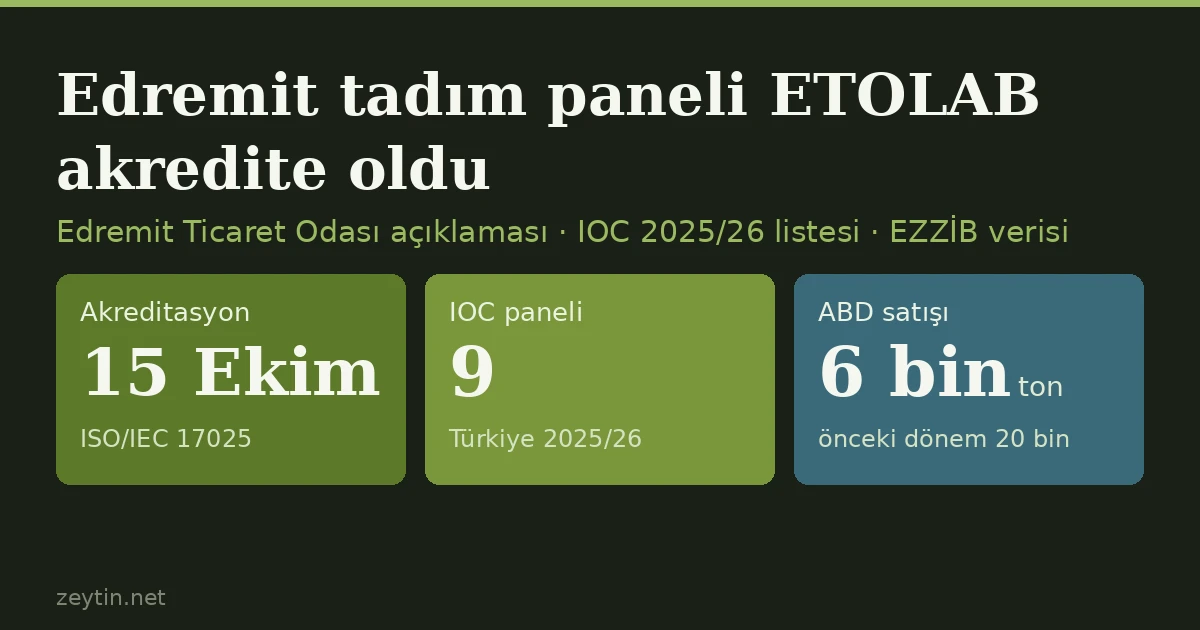
ETOLAB, the olive oil sensory analysis laboratory of the Edremit Chamber of Commerce, completed ISO/IEC 17025 accreditation on 15 October 2026. The panel is one of nine Turkish panels on the International Olive Council's 2025/26 list. The chamber says accredited reports will help Edremit and Havran producers sell to the United States, where Turkish olive oil sales fell from 20,000 to 6,000 tonnes this season.
 Article
The world's largest bottler is for sale: a €500 million race for Deoleo
Deoleo, owner of Bertolli and Carbonell, holds 22% of global bottled olive oil sales. Italy's Coricelli leads at €500 million, Spain's Dcoop cooperative at €470 million. The Spanish government regards the company as nationally strategic. Because Deoleo is a major bulk buyer, the outcome matters to Turkish exporters too.
 Article
Adulterated olive oil costs more than the real thing: price is no longer a sign of authenticity
Diker, president of the Edremit Chamber of Agriculture, says adulterated oils sold online now exceed the wholesale price of genuine oil: wholesale starts at 240 lira, the fake sells above 300. Our exchange data complicates the picture — genuine extra virgin in Aydın is already 307.60 lira.
 Article
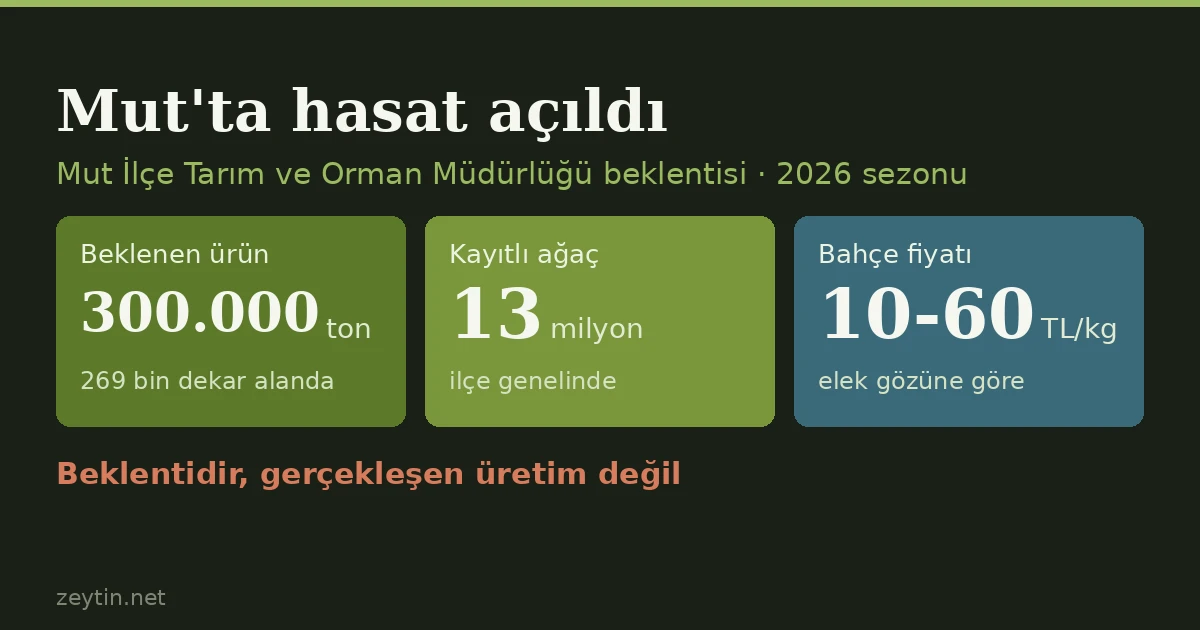
Harvest opens in Mut: 300,000 tonnes expected, orchard prices start at 10 lira
Mut's district agriculture directorate reports 300,000 tonnes expected from 269,000 decares, with orchard prices ranging from 10 to 60 lira by sieve size. Yield is high but growers are unhappy with prices. Set against our own Mersin figures the tonnage leaves an unresolved measurement gap, and we report it as such.