Menemen Municipality's olive oil mill leaves service fees unchanged: capacity above 40 tonnes a day, busy season expected to run to mid-February
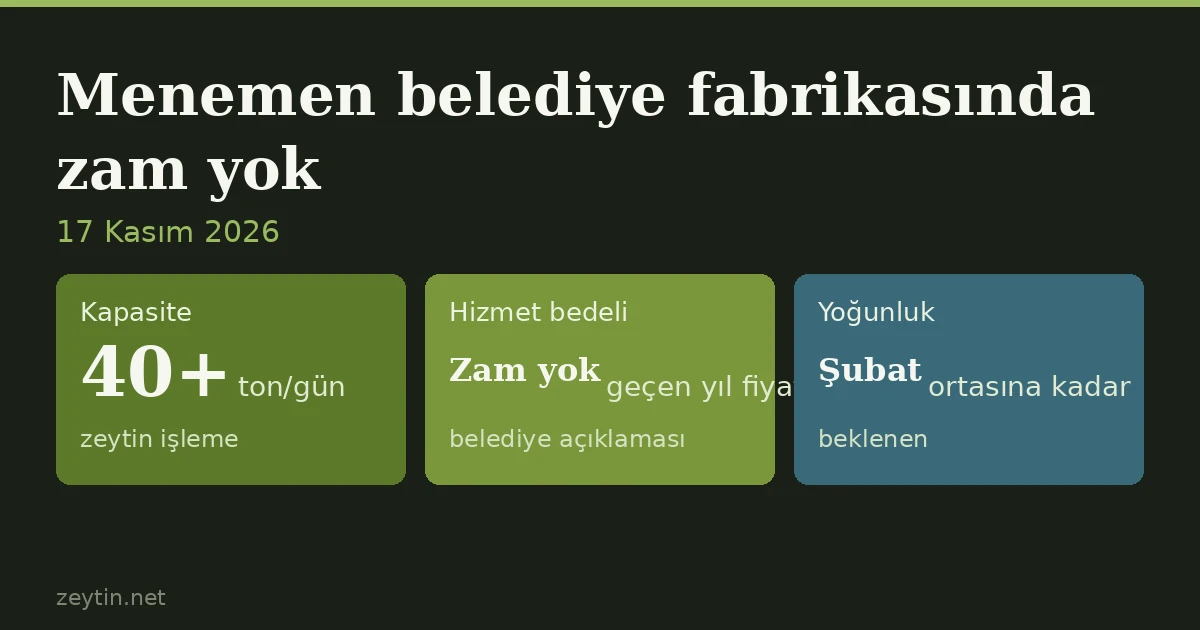
In Menemen, İzmir, the municipality's olive oil mill in Emiralem is serving growers from Menemen, other İzmir districts and Manisa. According to Mayor Aydın Pehlivan, service fees were not raised and last year's prices were kept. The report does not give the fee in lira; daily capacity is above 40 tonnes.

In Menemen, İzmir, the Menemen Municipality Olive Oil Mill is serving growers at last year's prices again in the new harvest. According to reports dated 17 November 2026, Mayor Aydın Pehlivan instructed that the plant's service fees not be raised. The mill in Emiralem can process more than 40 tonnes of olives a day, and grower interest is expected to last until mid-February.
What the report says
| Item | As stated in the report |
|---|---|
| Location | Emiralem, Menemen (İzmir) |
| Daily processing capacity | More than 40 tonnes of olives |
| Growers coming | Menemen villages, other İzmir districts, Manisa |
| Service fee | No increase, last year's price kept |
| Duration of the busy period | Expected until mid-February |
| Reasons for choosing it (as worded in the report) | Reasonable price, hygienic production environment, service quality |
What is the price in lira?
The report does not answer this: it does not say how many lira the service fee is per kilogram or per tonne, or whether it is taken in cash or as a share of the oil. So we have "last year's price was kept" but not the price itself. For that reason we relay Menemen only as a policy, without a numerical comparison with other districts. In our article on Aydın pressing fees we reported that fees vary from district to district, with Bozdoğan asking 3.50-5 lira per kilogram; where Menemen's fee falls in that range, we do not know. How a pressing fee is calculated is explained in the pressing fee guide.
History of the plant
The report also tells the history of the mill. The Emiralem plant had been seized over debts and put up for sale by enforcement proceedings before Pehlivan took office. After standing closed for two years, it was brought back into municipal hands through the mayor's initiative and, in the report's words, put back into service "with an investment of 3 million TL at the figures of the time"; it has served growers for four years. This is the report's account; the report contains no document or independent source on the enforcement process or the investment amount.
What did the mayor say?
Aydın Pehlivan said they are serving growers at last year's prices and invited all olive growers to the mill. He said the plant was opened so that growers could have their olives pressed safely and obtain good-quality olive oil; he added that support for agriculture would continue to grow and was not limited to olives but covered many crops, from strawberries to wheat.
Why does this matter?
This season growers' biggest complaints are low buying prices and high costs. The reports show growers in Gemlik talking about 25-30 lira for oil olives and Marmarabirlik about 40 lira for oil olives. Keeping the pressing fee unchanged while buying prices fall holds one of the grower's cost items at last year's level; how much relief that gives cannot be calculated because the fee itself is not known.
What the report does not say
- The amount of the service fee in lira and how it is collected (cash or share of oil).
- The quantity of olives processed so far this season or the state of the queue at the mill.
- Fees at private mills in Menemen and how the municipal mill compares with them.
- Any measured data on grower satisfaction; the statement in the report is a general assessment.
What to watch
If the municipality or the plant announces the fee or the quantity processed during the season, Menemen's policy can be compared in numbers. Until then the only conclusion is this: Menemen Municipality's mill says it has not raised its pressing service fee this year.
One rating per visitor; you can change yours at any time. Ratings are real reader votes — no seeded or default scores.
Related
 Article
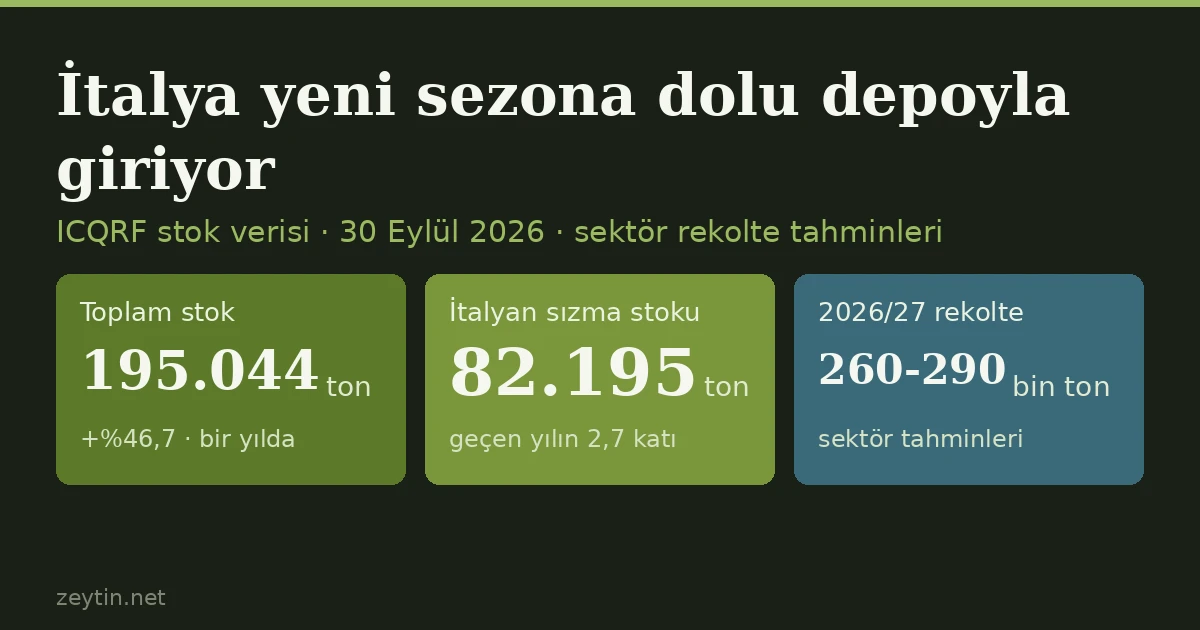
Italy enters the new season with full tanks: 195,000 tonnes in stock, a 260,000-290,000 tonne crop expected
ICQRF's Frantoio Italia register shows 195,044 tonnes of olive oil in Italian storage on 30 September 2026, up 46.7% in a year; Italian extra virgin stocks of 82,195 tonnes are 2.7 times last year's. Sector estimates put the 2026/27 crop at 260,000-290,000 tonnes, 11-20% below Ismea's 325,000. With stocks added, though, the supply of Italian oil is not shrinking: in the European Commission series Italian extra virgin fell from €9.26 to €4.37 a kilo in a year, and the gap with Spain narrowed from €5 to €1.
 Article
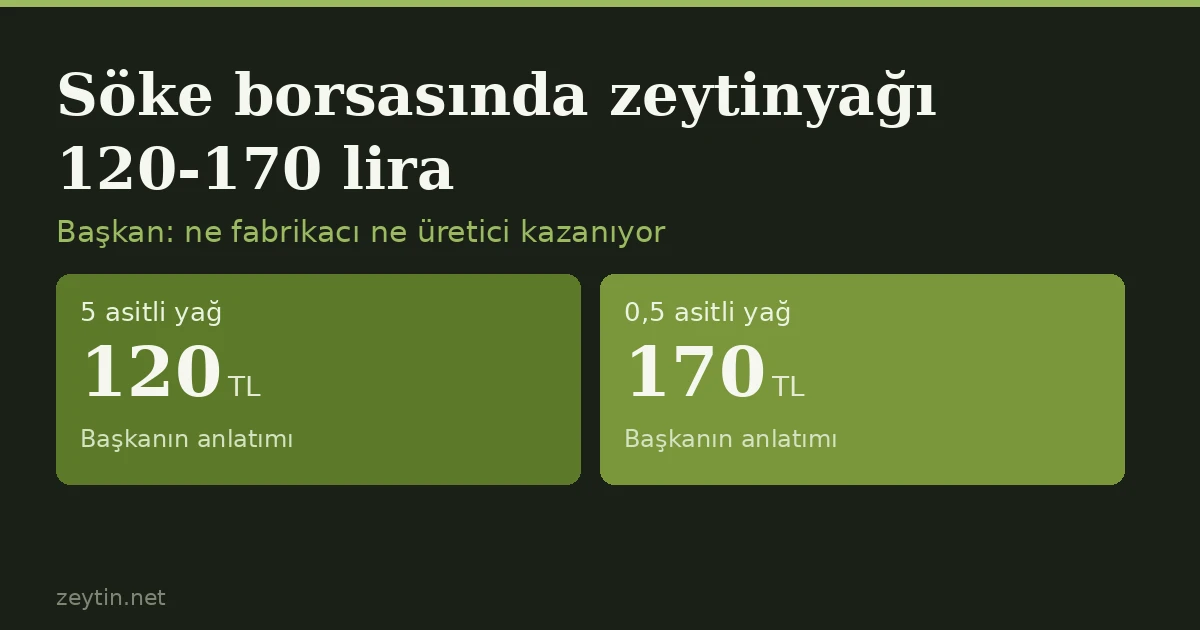
Söke Commodity Exchange chair: olive oil at 120-170 lira, "neither the mill nor the grower is earning"
Söke Commodity Exchange chair Ahmet Nejat Sağel said oil with 5 per cent acidity trades at 120 lira and 0.5 per cent oil at 170 lira, and called for state support. The Memecik harvest is expected at the end of November. His account of 180,000 tonnes of Spanish oil being held back may match Spain's 12 per cent mandatory withdrawal.
 Article
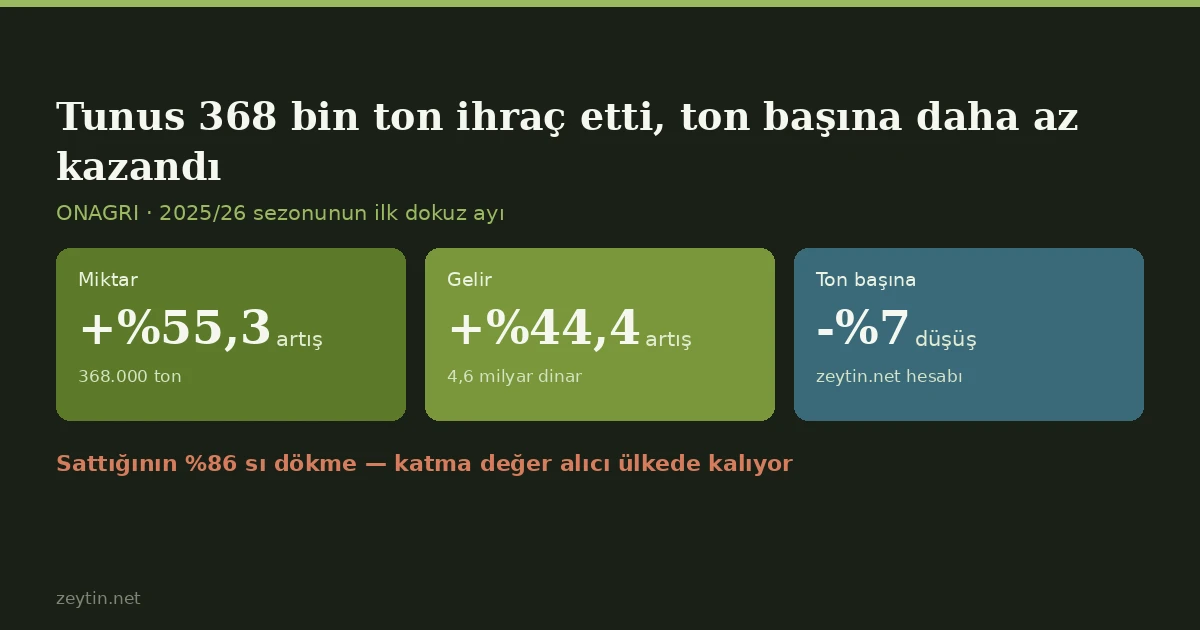
Tunisia exported 368,000 tonnes of olive oil — but earned less per tonne
Tunisia's agriculture observatory ONAGRI reports olive oil exports up 55.3% by volume and 44.4% by value in the first nine months of 2025/26. The gap between the two means about 7% less earned per tonne.
 Article
Andalusia moves against North African imports: 76% of what arrives is extra virgin
Andalusia's farm sector objects that more than 76% of the olive oil imported into the region in early 2026 was extra virgin. The regional minister has requested exceptional measures under Article 195 of the EU regulation. Türkiye could meet the same door.