Kilis Yağlık olive: characteristics, oil content and growing areas
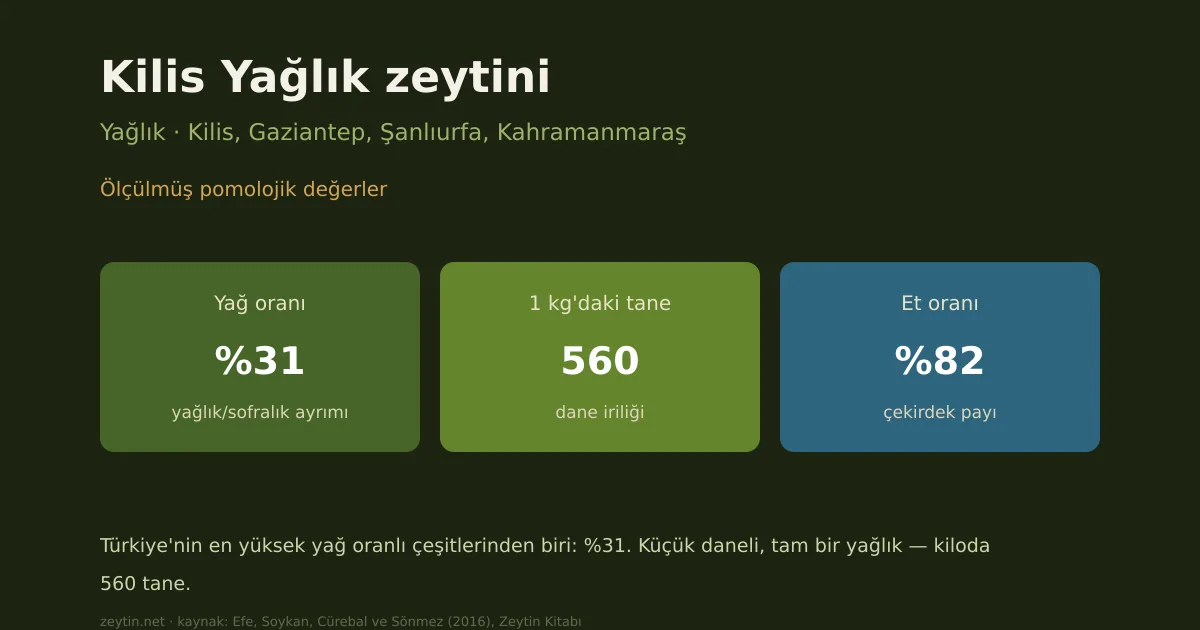
One of Türkiye's highest oil-yielding varieties at 31%. Small-fruited and purely for oil — 560 fruits per kilo.
If you want to know how much oil an olive can give, Türkiye's answer is Kilis Yağlık: 31%. That is among the highest figures measured in the country, and it explains the variety's name — yağlık means "for oil".
Kilis Yağlık in numbers
| Oil content | 31% |
| Fruits per kilo | 560 |
| Flesh ratio | 82% |
| Use | Oil |
| Main areas | Kilis, Gaziantep, Şanlıurfa, Kahramanmaraş |
Source: Efe, Soykan, Cürebal and Sönmez (2016), Zeytin Kitabı. Fields the source leaves blank are shown as "—"; nothing has been estimated.
When does it flower and ripen?
| Flowering | 20 May – 4 June |
| Fruit set | 25 May – 9 June |
| Green maturity | October |
| Black maturity | Second half of November |
Source: Olive Integrated Pest Management Technical Instruction, TAGEM. Dates shift with region and year; flowering is later at higher altitude.
What does 31% oil mean?
Kilis Yağlık, together with Kalem Bezi, has the highest oil content of Türkiye's varieties. For comparison:
| Variety | Oil content | Fruits per kg |
|---|---|---|
| Kilis Yağlık | 31% | 560 |
| Kalem Bezi | 31% | 450 |
| Gemlik | 29–30% | — |
| Saurani | 29% | 340 |
| Nizip Yağlık | 27% | 455 |
At 560 fruits per kilo it has the smallest fruit on the list. That is not a fault but the definition of an oil variety: small fruit means more skin-and-flesh surface per unit weight and denser oil. It is also why the variety is unsuited to the table.
The southeast's oil belt
Kilis Yağlık is the main oil variety along the Kilis, Gaziantep, Şanlıurfa and Kahramanmaraş belt. The region's other two major varieties are Nizip Yağlık and Halhalı.
Genetic work places Kilis Yağlık within over 60% similarity of Domat, Gemlik, Manzanilla and Nizip Yağlık.
In short
Kilis Yağlık is among Türkiye's highest oil-yielding varieties (31%) and has the smallest fruit at 560 per kilo. It is unsuited to the table; its value is entirely in oil. With Nizip Yağlık and Halhalı, it carries the southeast's oil production.
Where it stands among measured varieties
çeşit sayfası
çeşit sayfası
Zeytin Kitabı — Efe, Soykan, Cürebal, Sönmez (2016), Kitabevi Yay. s.37-80
Zeytin Kitabı — Efe, Soykan, Cürebal, Sönmez (2016), Kitabevi Yay. s.37-80
Zeytin Kitabı — Efe, Soykan, Cürebal, Sönmez (2016), Kitabevi Yay. s.37-80
Values are those published on each variety's own page; the comparison covers only varieties with a measured figure, so it is a comparison of what is known — not of every Turkish variety. See the full ranking and how it is built →
One rating per visitor; you can change yours at any time. Ratings are real reader votes — no seeded or default scores.
Related
 Article
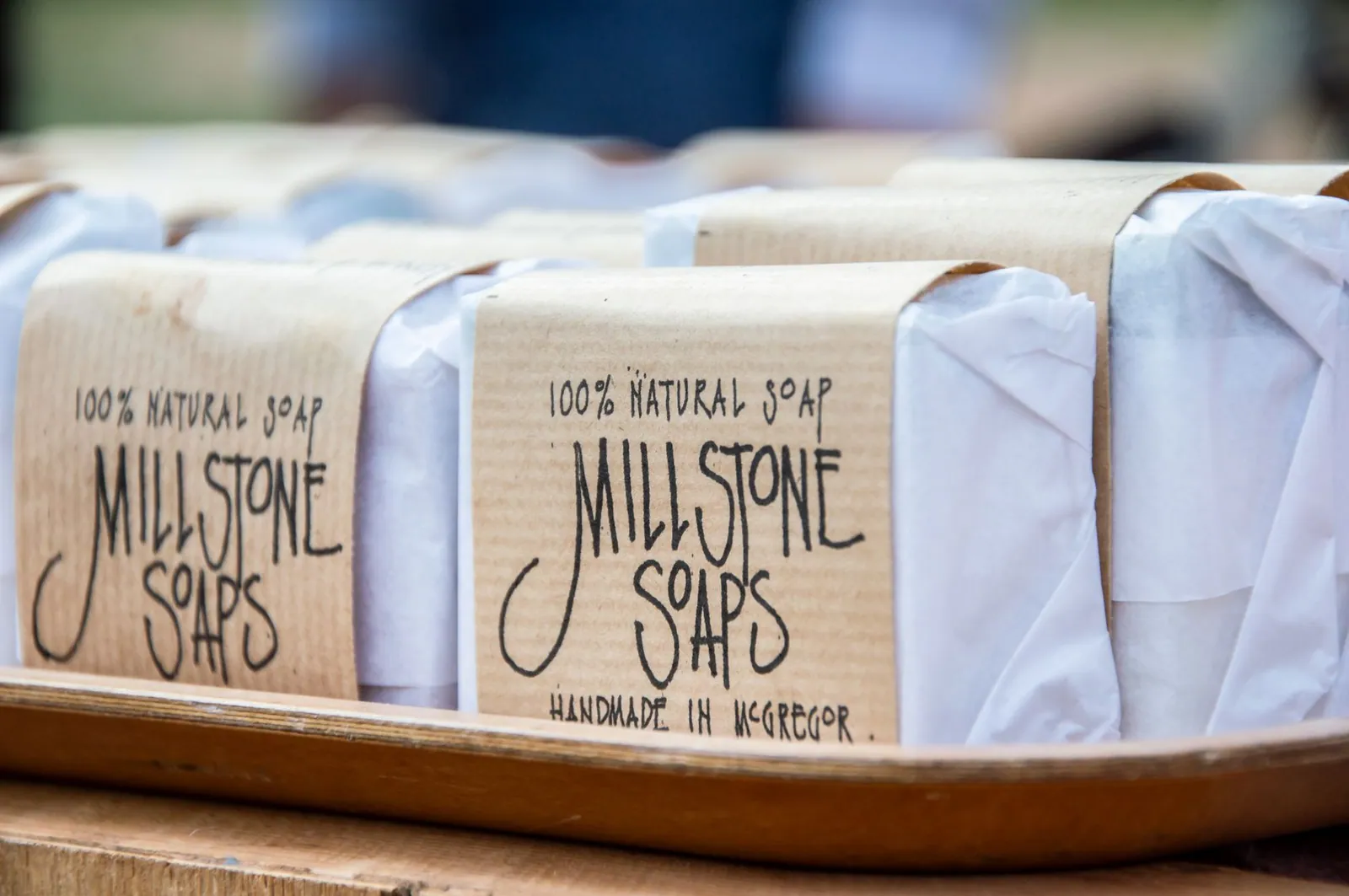
Products from Olive
Table olives, oil, pomace, leaf and soap: what is made from each part of the tree, and what each is good for.
Article
Products from Olive
Table olives, oil, pomace, leaf and soap: what is made from each part of the tree, and what each is good for.
 Article
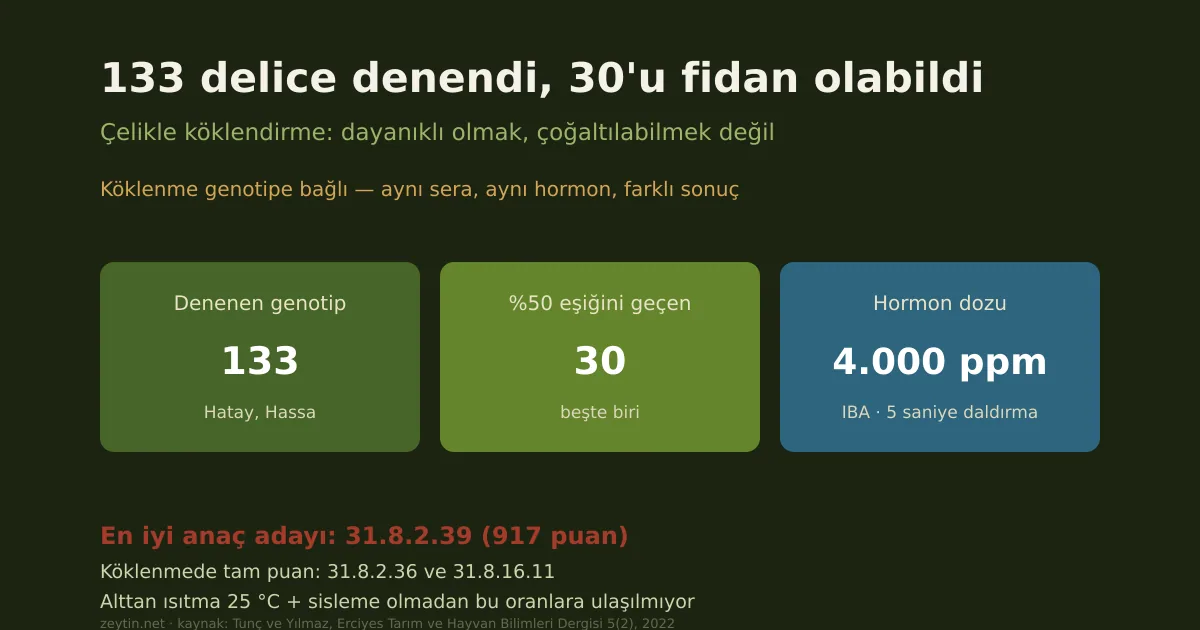
Rooting olive cuttings: 30 of 133 wild olives made it
In Hassa, Hatay, 133 wild olive genotypes were rooted from cuttings and only 30 cleared the 50% threshold. Rooting depends on the genotype, not the technique.
Article
Rooting olive cuttings: 30 of 133 wild olives made it
In Hassa, Hatay, 133 wild olive genotypes were rooted from cuttings and only 30 cleared the 50% threshold. Rooting depends on the genotype, not the technique.
 Article
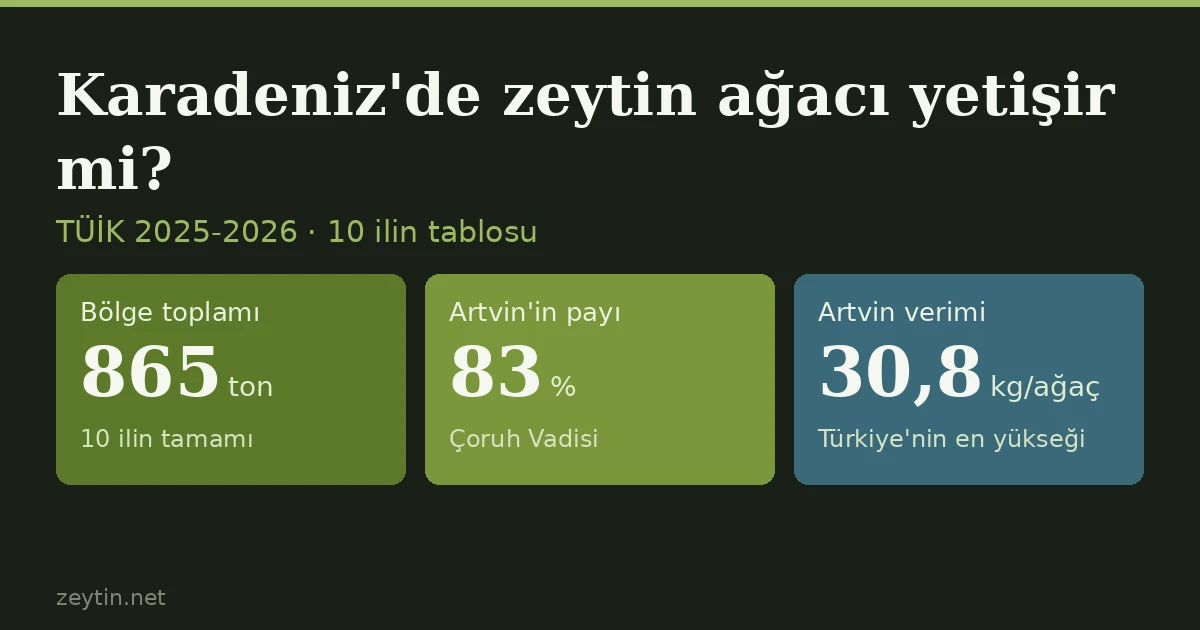
Do olive trees grow on the Black Sea coast?
Ten Black Sea provinces produce 865 tonnes between them, 83 per cent of it in Artvin. Trabzon gets 98 tonnes from 36,000 trees; Samsun none from 13,000. The obstacle is humidity, not cold.
Article
Do olive trees grow on the Black Sea coast?
Ten Black Sea provinces produce 865 tonnes between them, 83 per cent of it in Artvin. Trabzon gets 98 tonnes from 36,000 trees; Samsun none from 13,000. The obstacle is humidity, not cold.
 Article
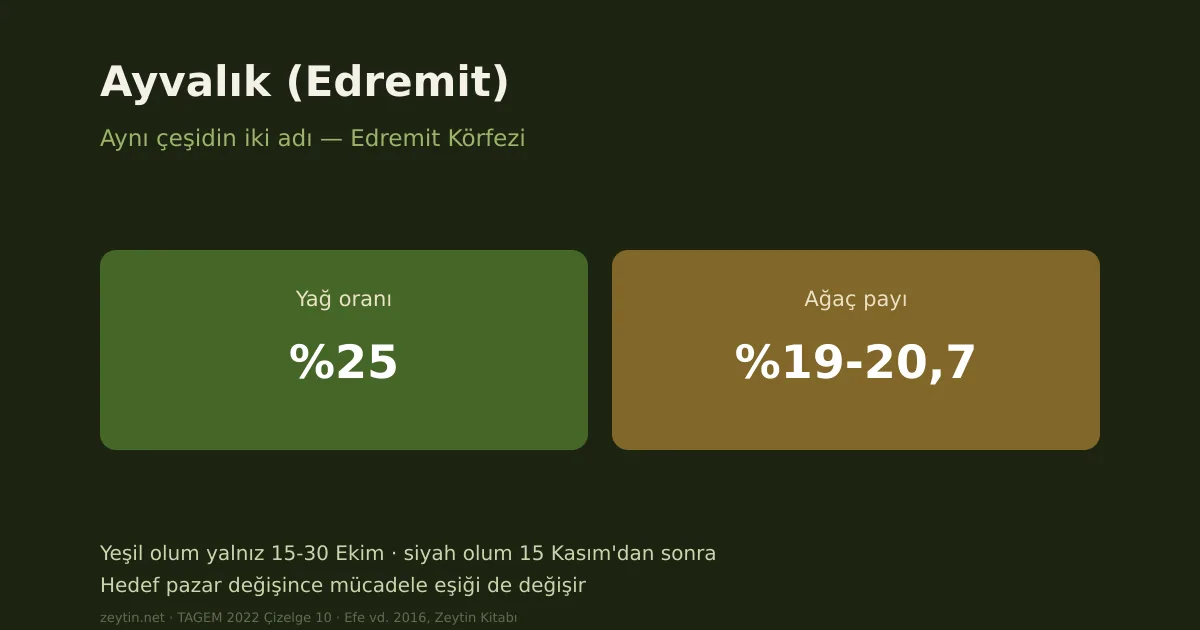
The Ayvalık (Edremit) olive: one variety, two names
19-20.66% of the tree stock, second after Memecik. 25% oil. Green maturity only between 15 and 30 October; black maturity after 15 November, among the latest.
Article
The Ayvalık (Edremit) olive: one variety, two names
19-20.66% of the tree stock, second after Memecik. 25% oil. Green maturity only between 15 and 30 October; black maturity after 15 November, among the latest.