Can fallen olives be used for oil?
Fallen olives can be milled, but they must be collected and pressed separately. In measured studies their oil usually ends up lampante, with acidity of 2.4-5.3%, and mixing it with tree-picked fruit downgrades the whole batch. Spain's vuelo/suelo distinction and the advice in Turkey.
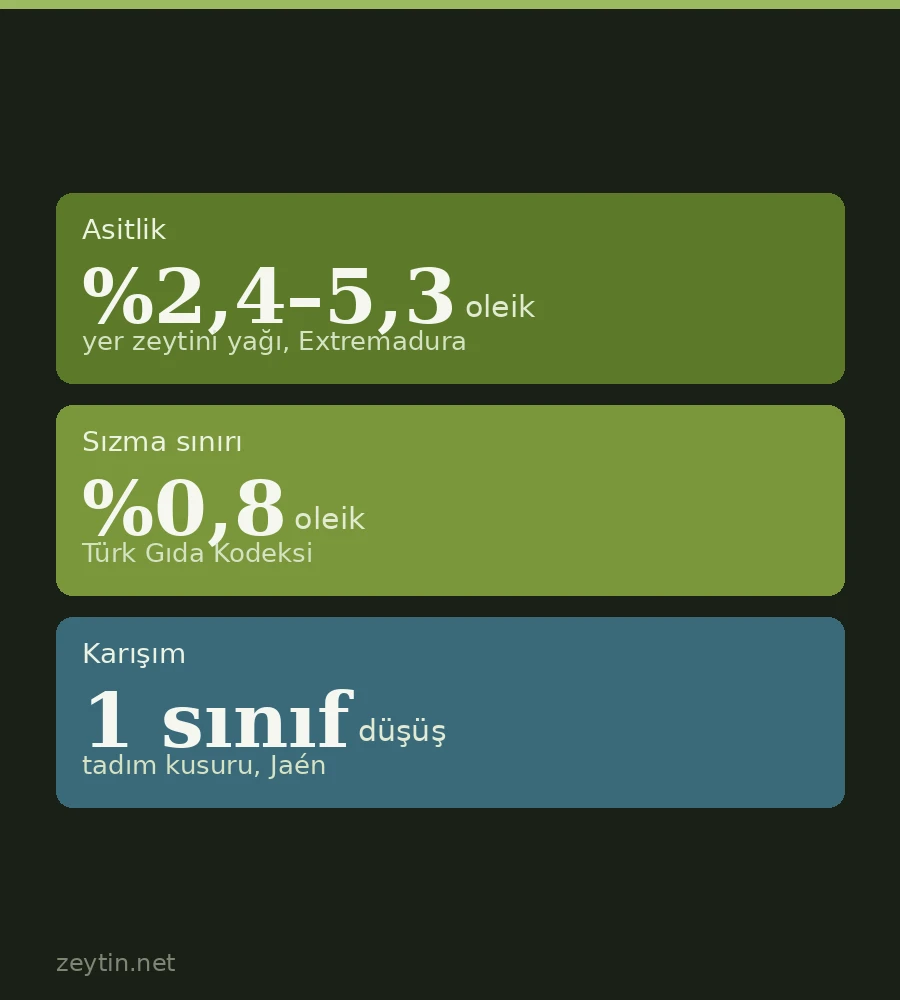
Short answer: olives that have fallen to the ground can be used for oil, but only if they are picked up separately and milled separately. Fruit that has touched the soil, been bruised and lain on the ground for days gives oil with higher acidity and musty, earthy defects. In measured studies such oil usually ends up not as extra virgin but as lampante olive oil, which cannot be sold for eating without refining. The real damage comes from mixing: ground olives that go into the same batch as sound, tree-picked fruit can drag the whole batch down a grade.
It is one of the questions growers ask most often in the harvest weeks. Below we set out the limits first, then the measurements, and finally what to do in practice.

The figures
| Parameter | Extra virgin | Virgin | Lampante |
|---|---|---|---|
| Free acidity (% oleic acid) | ≤ 0.8 | ≤ 2.0 | > 2.0 |
| Peroxide value (meq O₂/kg) | ≤ 20 | ≤ 20 | — |
| Ethyl esters (mg/kg) | ≤ 35 | — | — |
| Median of defects (tasting panel) | 0 | ≤ 3.5 | > 3.5 |
Oil whose acidity exceeds 2 per cent, or whose median of defects in a tasting panel exceeds 3.5, is classed as lampante and cannot go straight to the table; it has to be refined first. The categories are explained in more detail in what is lampante olive oil and in our guide to the Turkish olive oil and pomace oil communiqué.
Why do olives fall?
Much of the fruit that drops is already in poor condition. According to a farmer training publication from Turkey's Ministry of Agriculture and Forestry, olive fruit fly larvae cause fruit to rot and fall, and raise the acidity of the oil. Over-ripening, rain and wind also bring fruit down. So an olive on the ground is, on average, in worse shape than one on the branch even before it touches the soil. The causes of fruit drop are covered in why do olives drop from the tree.
Once on the ground, three more things happen. The fruit is bruised by the impact and its skin splits; fungi and bacteria from the soil get in through the wound; and fermentation begins while it lies on damp earth. As Gabriel Beltrán of IFAPA, the Andalusian agricultural research institute in Jaén, puts it, the longer the fruit stays on the ground, the further the deterioration goes.
What the measurements show
The Andalusian study. In a study published in the Journal of the Science of Food and Agriculture in 2016, Beltrán and colleagues milled olives from the same orchards picked from the tree and from the ground, separately and mixed. Oil from ground-picked olives fell into the lampante category; its ethyl esters were the highest of all samples, though still below the legal limit. The mixed batch stayed within the extra virgin limits on chemical parameters, yet it was downgraded to "virgin" because of sensory defects. The researchers' conclusion was clear: the two kinds of fruit must be harvested and processed separately. According to the Andalusian science news network's account of the work, the defects found in ground-olive oil were musty, humid and earthy notes and the "fusty/muddy sediment" defect that comes from fruit left piled up.
The Extremadura study. In a six-week study of the Verdial de Badajoz variety published in the journal Foods in 2020, Carrapiso and colleagues found that every oil obtained from ground-picked olives exceeded the extra virgin limit of 0.8 per cent, with acidity between 2.4 and 5.3 per cent. Oils from tree-picked olives all stayed within the limit. Total phenols and oxidative stability were lowest in ground-olive oil, while volatile compounds associated with musty, fusty and muddy defects were higher.
The problem, in other words, is not just acidity. An oil with borderline acidity can still fail the tasting panel. The defects are described in tasting olive oil: defects and positive attributes, and what acidity actually measures in what does acidity mean in olive oil.
How Spain separates them
In Spanish, tree olives are called "vuelo" and ground olives "suelo". A resolution of the Andalusian regional government dated 27 October 2003 on "recommended practices" defines the difference: an olive picked from the tree, or one that falls onto a net or sheet that keeps it from touching the soil, is a tree olive; any other olive is a ground olive. The resolution sets two rules: a mixture of ground and tree olives counts as ground olives, and the two must be received, graded and processed separately at the mill, on separate lines.
That resolution is a recommendation; Spain's national quality standard for olive oil, adopted in 2021, contains no such obligation. Geographical indications are stricter. The specification for "Aceite de Jaén" accepts only fruit picked directly from the tree for the protected oil and requires ground and tree olives to be unloaded separately at the mill.
The detail about nets matters. An olive that lands on a net has not touched the soil and therefore counts as a tree olive. That is exactly what a harvest net is for; see what is an olive harvest net.
What is recommended in Turkey?
There is no provision in Turkish law that requires ground olives to be kept apart; what counts is the category of the oil itself. But official and institutional advice points the same way:
- The harvest guide of the Osmaniye Provincial Directorate of Agriculture and Forestry describes picking from the ground as "definitely not recommended", saying the resulting oil will have high acidity, cannot be used as edible oil, and that high-acidity oil from fallen olives is used for soap-making.
- In a warning sent to growers during the 2022 harvest, the Manisa Provincial Directorate of Agriculture and Forestry asked that fallen olives be collected separately, transported separately and never mixed with other olives.
- Marmarabirlik, the Marmara olive growers' cooperative union, also advises its members to store and mill fallen olives separately.
- A field survey of 116 growers in Foça, published in 2021, likewise recommends collecting fallen olives without delay and harvesting and transporting them separately from tree olives.
What to do in the orchard
1. Do not leave fallen fruit lying. Every day on the ground spoils the oil a little more. In orchards with fly damage or wind drop, the cheapest course is to gather the fallen fruit often, before the main harvest.
2. Use separate crates and transport them separately. Fallen olives should not travel in sacks or in the same crates as tree olives. On transport, see olive harvest: crates or sacks.
3. Ask for a separate batch at the mill. If you have your own olives milled, have the fallen fruit pressed as a separate batch; if it gets mixed in, the grade of all your oil may drop. How mills keep batches apart is explained in do batches get mixed at the olive mill.
4. Keep the oil apart and have it tested. Oil from fallen olives should not be combined with table oil before it has been analysed. If it turns out to be lampante, its outlets are a refinery or soap; our olive oil soap guide describes one use for it.
5. Watch for fly-damaged fruit as well. The effect of fly-infested fruit on oil is a separate subject: fly-damaged olives: what happens to the oil.
6. Harvest onto nets. Fruit knocked down with poles or rakes does not touch the soil if it lands on a net. The methods are compared in how are olives harvested.
Summary
Fallen olives are not rubbish, but they do not make extra virgin oil either. In measured studies their oil usually falls into the lampante category, with acidity that can exceed 2 per cent and musty, earthy and fusty defects in the tasting. Mixed with tree olives, the loss does not stay with the fallen fruit: the whole batch loses value. That is why both Spanish practice and official advice in Turkey come down to the same rule: collect them separately, carry them separately, mill them separately.
One rating per visitor; you can change yours at any time. Ratings are real reader votes — no seeded or default scores.
Related
 Article
The Ayvalık Olive Oil designation of origin: the chemical profile in the certificate
Registered in 2007. The certificate carries tables of fatty acids, sterols and phenolics — the ranges within which an oil counts as Ayvalık Olive Oil are set out in figures.
 Article
Geyikli Olive Oil: a registration that names its pollinators
Registered in 2020. From the Ayvalık cultivar; the certificate also records Gemlik and Hanım Parmağı as pollinators in the groves. Limits are set on 16 aroma compounds.
 Article
Aydın Memecik Olive Oil: bitterness and pungency written into the definition
Registered in 2020. Total phenols > 100 mg/kg, peroxide ≤ 18, defect median 0. Intense fruit aroma with pronounced bitterness and pungency.
 Article
What are zeytinyağlılar? The logic of Turkish dishes cooked in olive oil
Zeytinyağlılar are Turkish dishes in which vegetables or pulses are cooked with little water in plenty of olive oil until they absorb their own juices, then eaten cold at room temperature. They contain no meat, can be made a day ahead and taste better the next day. Vegetable dishes, stuffed leaves and vegetables, pilaki beans and Aegean wild greens are the four main families.