Can dogs and cats eat olives? Pits, salt and garlic fillings
Olives are not considered toxic to dogs or cats: they are not on the ASPCA list and the AKC says they are not toxic. The risks lie in the pit (choking, intestinal blockage), the salt, garlic and marinated fillings and olive oil (pancreatitis). How much is too much, whether cats really love olives, and when to see a vet.
Short answer: the olive itself is not considered poisonous to dogs or cats, but the olives on your table are not dog or cat food. The problem is rarely the fruit; it is what comes with it: the pit, the salt from the brine, garlic and spiced fillings, the oil poured over the top. A plain, pitted olive eaten now and then causes no trouble in most animals. Stuffed, marinated or unpitted olives are best kept away from them.
Below we set out what veterinary sources actually say, how serious each risk is, and which signs mean a trip to the vet.
Are olives toxic?
The ASPCA, which runs an animal poison control centre in the United States, publishes plant lists for dogs and cats. The olive tree (Olea europaea) does not appear on them at all, neither in the toxic nor in the non-toxic section. Two plants with "olive" in their names are on the list, both in the non-toxic section: "Russian olive" and "autumn olive", which belong to the genus Elaeagnus. They are not true olives; only the names are similar.
The American Kennel Club (AKC), in an article updated in March 2025, is more explicit: olives are not toxic to dogs, and plain, unsalted olives given in moderation do not cause problems. The same article adds that a dog fed a complete and balanced diet does not need the extra nutrients in olives. So an olive is not a "healthy supplement" — at best it is a harmless treat.
Nor should a toxic relative mislead you. The ASPCA lists privet (Ligustrum), which belongs to the same family as the olive, as toxic; but jasmine, from the same family, is listed as non-toxic. Family resemblance tells you nothing here.
Risk one: the pit
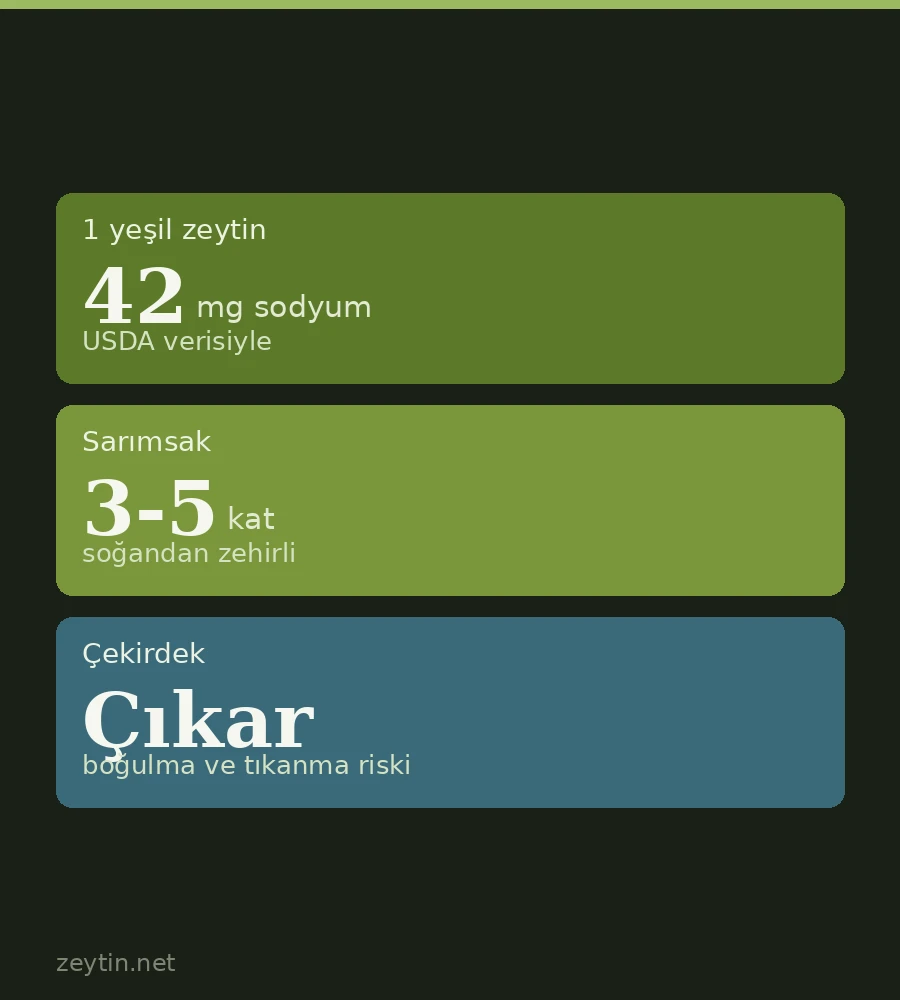
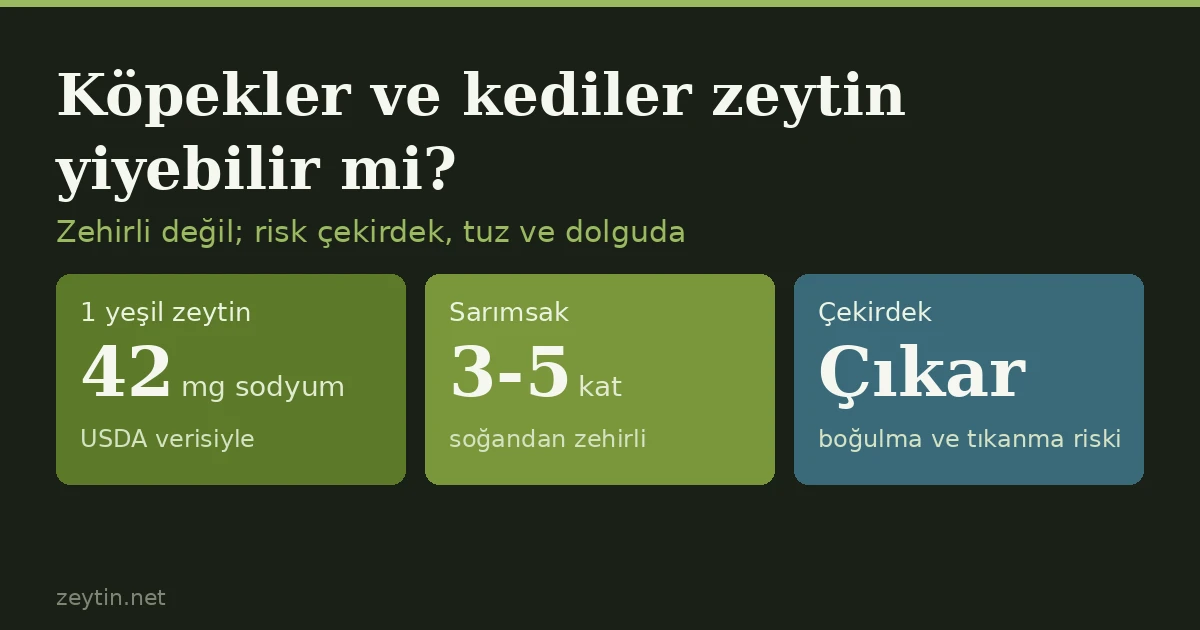
This is the danger veterinary sources stress most. According to the AKC, an olive pit can cause choking, block a dog's airway and lodge in the intestinal tract; a dog that tries to crunch it can also crack a tooth.
Intestinal blockage depends on the size of the animal. Pet Poison Helpline, writing about peach pits, notes that a pit swallowed by a small-breed dog or a cat can cause a gastrointestinal obstruction. An olive pit is smaller than a peach stone, but a small animal's gut is narrow too. The Merck Veterinary Manual notes that dogs are more likely than cats to swallow foreign bodies. A study published in 2025 of 261 dogs with foreign bodies in the upper digestive tract lists fruit seeds among the common causes.
We did not find a published case report of an olive pit causing a blockage in a dog; the risk follows from general foreign-body knowledge. What happens when a person swallows a pit is covered in our article on what happens if you swallow an olive pit.
Risk two: salt
Brined olives are salty. The US Department of Agriculture's food database gives 1,556 mg of sodium per 100 g of pickled green olives and 735 mg for canned ripe (black) olives. Using the database's own weight of 2.7 g for one green olive, each olive carries about 42 mg of sodium, or roughly 0.1 g of salt. Salt levels in olives sold in Turkey vary by product; the range is on our page on the nutritional profile of olives.
Serious salt poisoning takes a large dose. According to the Merck Veterinary Manual, the acute lethal dose of salt in dogs is about 4 g per kilogram of body weight, and clinical signs can appear after 2-3 g per kilogram. On that basis, a 10 kg dog would need several hundred green olives to reach the threshold for signs. One or two olives dropped from the table will not cause salt poisoning.
That is not a "safe amount". Salty food makes animals thirsty; on the same page Merck says salt poisoning is unlikely as long as the body's sodium-regulating mechanisms are intact and fresh drinking water is available. The picture changes for animals with heart or kidney disease on a salt-restricted diet; for them the decision belongs to their vet. The signs are vomiting, diarrhoea, weakness, muscle tremors and seizures. We found no source giving a per-kilogram dose for cats.
Risk three: fillings, marinades and alcohol
Very often the real hazard is what has been put inside or on top of the olive.
- Garlic. According to Merck, cats are the species most susceptible to garlic and onion poisoning, followed by dogs, and garlic is 3-5 times more toxic than onion. Raw, cooked or dried makes no difference. The signs stem from the destruction of red blood cells and often appear several days later: weakness, pale gums, dark urine.
- Cheese fillings. PetMD lists olives stuffed with blue cheese among those that should not be shared; mouldy cheeses can contain a mould toxin that can be harmful to dogs.
- Alcohol. The AKC says a dog should never be given olives that have been soaked in alcohol, such as those from a cocktail.
- Spiced dressings and oil. The AKC notes that olives coated in garlic, seasonings or oils carry additional risks.
So garlicky or marinated olives from a breakfast plate do not count as "plain olives".
What about olive oil?
Olive oil is not toxic, but it is a fatty food. The ASPCA warns that fats can cause vomiting and diarrhoea and, in some pets, pancreatitis. Merck likewise names raiding the bin and eating large amounts of table scraps as a common risk factor for pancreatitis in dogs. PetMD goes further and says even a single helping of olive oil can trigger pancreatitis; that is a warning to take seriously for animals with a history of pancreatitis and for overweight pets.
Nor does a pet's diet need olive oil. According to Merck, dogs and cats must get linoleic acid from their food, and it is abundant in corn and soybean oil; olive oil contains about 10 g per 100 g, which is less. Cats additionally need arachidonic acid, which is absent from vegetable oils altogether and found only in the fat of meat, poultry and eggs. Adding olive oil to pet food does not make up for anything missing; it only adds calories.
Why do some cats seem drawn to olives?
It is often said that some cats approach olives the way they react to catnip. The scientific basis for this is thin. A 2017 study that measured how 100 cats responded to plants (Bol and colleagues, BMC Veterinary Research) tested catnip, valerian and two other plants; it did not test olives.
The only peer-reviewed paper we could find on the subject appeared in the journal Pets in 2025, written by employees of a feed additive company; its topic is how olive extract affects the palatability of dry cat food. The introduction suggests that olives contain compounds similar to the active substance in catnip. According to an unreviewed internal trial by the company, more than 70 per cent of cats approached the olive products, but only 19 per cent ate olives and 24 per cent ate olive oil, with no link to how they responded to catnip. The claim that "cats love olives" is not supported by these data.
How much?
The AKC gives no number. PetMD says one or two plain, pitted olives are unlikely to harm a dog. On the UK website of a pet food company, a veterinarian suggests less than a whole olive a couple of times a week for a cat. These are the sources' suggestions; if your animal's weight, age or health is different, ask your vet. If you want to cut the salt, soaking olives in water works, as shown in our article on how to reduce the salt in olives. Removing the pit is essential in every case.
When to see a vet
- If the pit was swallowed and vomiting, loss of appetite, abdominal pain or inability to pass stools follow: there may be a blockage, so do not wait.
- If the animal ate something very salty and starts drinking excessively, vomiting, has diarrhoea or trembles.
- If it ate garlic-stuffed olives, especially a cat: because signs can appear days later, talk to your vet even if the animal seems fine.
- If it knocked over and drank a bowl of olive oil, or vomiting and abdominal pain start after a fatty meal.
Using olive leaves as feed for farm animals is a separate matter, covered in can olive leaves be used as animal feed.
Summary
- Olives are not considered toxic to dogs or cats; they are not on the ASPCA list and the AKC says they are not toxic.
- The dangers are the pit (choking, intestinal blockage, broken teeth), the salt, garlic fillings and the oil.
- One or two plain, pitted olives cause no trouble in most animals; stuffed, marinated or alcohol-soaked olives should not be given.
- Adding olive oil to pet food does not supply anything a balanced diet lacks.
One rating per visitor; you can change yours at any time. Ratings are real reader votes — no seeded or default scores.
Related
 Article
Where is quality lost in table olives?
Variety choice, harvest technique, fermentation control, sterilisation and the pre-packing check are each a separate point of loss. The structural problem is scale and inspection.
 Article
Aydın Yamalak Sarısı Olive: a table fruit reaching 11 grams
Registered in 2021. At 6-11 g the fruit is among Turkey's largest table olives. It is propagated by grafting onto wild rootstock and harvested in late September.
 Article
Leccino olive: Italy's oil variety
Frantoio's blending partner. A softer profile with notable cold and disease tolerance.
 Article
Where do olives grow in Turkey? The picture in 45 provinces
The Aegean alone produces half the national crop; ten Black Sea provinces together manage 865 tonnes. In 46 provinces there is no commercial production at all.