What happens if you swallow an olive pit? In children, in adults, and when to see a doctor
A swallowed olive pit usually passes through the gut on its own; 80-90% of ingested foreign bodies do. The real risk is a small child inhaling it. Rare cases of bowel obstruction and pits in the appendix, whether the pit is poisonous, how many pits pitted olives may legally contain (Codex and the Turkish Food Codex), and the symptoms that need a doctor.
Swallowing an olive pit by accident is common and usually harmless: the pit is not digested and leaves in the stool within days. Two situations deserve attention. One is a pit going down the windpipe, which matters most in small children. The other, much rarer, is a pit getting stuck in the oesophagus or the intestine.
The short answer
An adult who swallows one pit and has no breathing or swallowing trouble and no abdominal pain usually needs to do nothing. The pit will most likely pass on its own.
Young children are different. For them the bigger danger is inhaling the pit, not swallowing it. If a small child has swallowed one, check with a doctor even if there are no symptoms.
What happens to a swallowed pit
An olive pit is a hard, woody shell with a small seed inside. Stomach acid does not dissolve it, so the pit travels through the gut intact. Depending on the variety, it weighs roughly 0.27 g (Arbequina) to 1.05 g (Çilli and Belluti). Measurements by variety are in what is an olive pit good for.
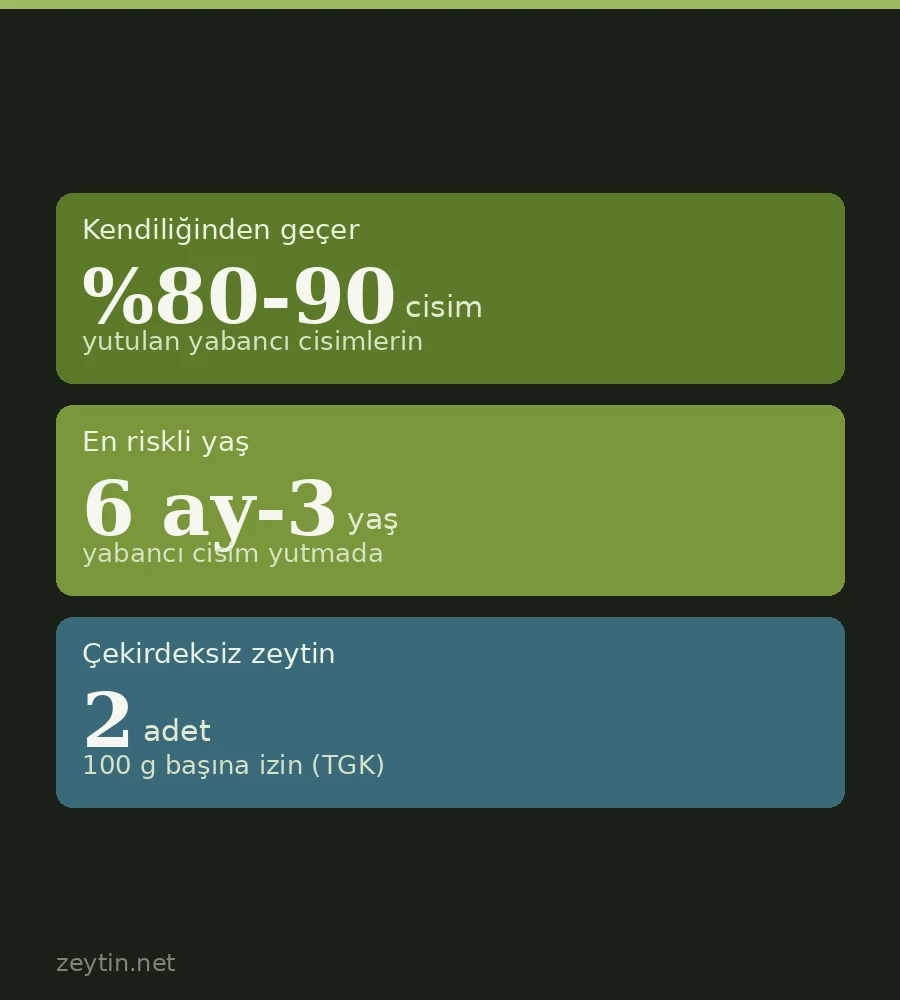
MedlinePlus, the US National Library of Medicine's patient service, says an object that reaches the stomach will probably pass through the whole digestive tract, often within a week and in most cases without harm.
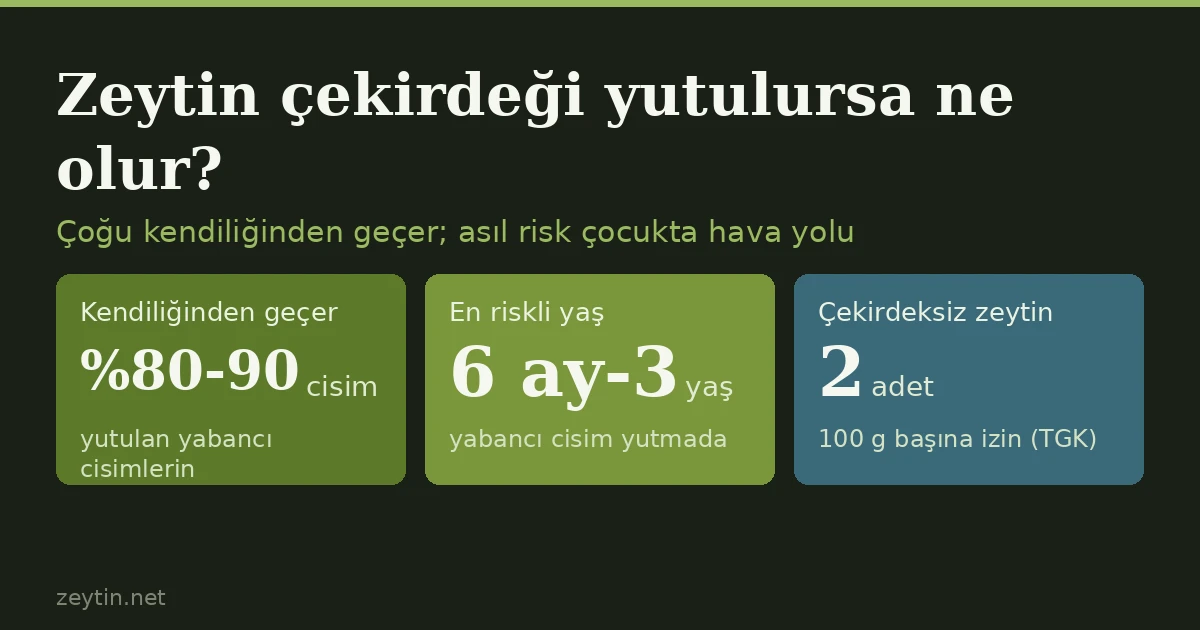
A 2014 review in the World Journal of Gastrointestinal Endoscopy puts numbers on it: 80-90% of ingested foreign bodies pass spontaneously, about 10-20% need endoscopic removal and fewer than 1% need surgery. These figures cover all foreign bodies, from coins to bones; there is no olive-specific figure.
The real danger: the airway
MedlinePlus says children aged 6 months to 3 years are the most likely to swallow foreign objects. Alberta Health Services in Canada adds that children under 4 are more likely to choke while eating: they may lack back teeth, may swallow food whole, and have small airways.
The NHS advises always removing hard stones from fruit and cutting small round fruits into quarters; the UK Department for Education gives the same rules for children aged 5 and under. Neither guide names olives, but olives fit the description exactly: small, round, with a hard stone. Give young children pitted olives cut into quarters. For weaning, see also when can babies have olive oil.
Adults are not immune. A 2025 case report in Cureus describes a 77-year-old man in intensive care with acute respiratory failure. A chest CT found a foreign body in a right lower lobe bronchus; rigid bronchoscopy removed it, and it was an olive pit. The authors link adult cases to older age and heavy drinking, and note they can go unnoticed until recurrent chest infections appear.
Getting stuck: rare but documented
The medical literature does contain cases of olive pits causing trouble in the gut. These are single reports; they show what can happen, not how often.
- Small bowel obstruction: in a 2024 Cureus case, a 70-year-old woman had seven olive pits blocking the last part of her small intestine. After three days of non-surgical treatment failed, they were removed surgically; she later said she had swallowed several olives whole. The authors write that fruit-pit obstruction is rarely reported and more likely with an undiagnosed bowel problem such as a tumour or inflammatory bowel disease.
- Blocked stomach outlet: a 1996 report in the journal Endoscopy is titled "Olive pit pyloric obstruction".
- Pits in the appendix: a Turkish study of 9,480 appendix specimens removed between 2010 and 2021 (Turk Patoloji Dergisi, 2023) found plant seeds in 47, one of them a recognisable olive seed. The authors note that large seeds like olive pits can block the appendix.
- Seeds that build up: a 2019 systematic review of "seed bezoars" (packed masses of seeds) covered 153 patients. In 78% the mass was in the rectum, and constipation was the commonest complaint. Its one olive-seed case came from Turkey.
Swallowing one pit is not the same as habitually swallowing many.
Pit shape varies too. The International Olive Council's variety catalogue lists the Picual pit tip as acute and Arbequina's as rounded. The 2014 review notes that sharp-pointed objects such as needles, toothpicks and bones have the highest perforation rates. Olive pits are far less sharp, but not all are round.
Is the olive pit poisonous?
The worry usually comes from apricot kernels. In 2016 the European Food Safety Authority (EFSA) warned that their amygdalin turns into cyanide in the body, and that more than three small raw kernels in one serving can exceed the safe level for an adult. The kernel is the seed inside the cracked stone.
Olives are not in the rose family (Rosaceae) with apricots, almonds and apples. A 2014 Food Chemistry study found 0.1-17.5 mg of amygdalin per gram in rose-family seeds. The same study notes that amygdalin has been reported in the olive family (Oleaceae), but it did not test olive seed, so there is no basis for saying olive pits contain none. Studies of olive stones highlight phenolic compounds such as nüzhenide and oleuropein.
A pit swallowed whole keeps its seed sealed inside the shell. Our search of the medical literature found no reported poisoning from olive pits. Nor is there safety data supporting cracking them open to eat the seed.
Can pitted olives still contain pits?
Yes. International standards and Turkish rules both allow a small margin:
| Standard | What counts | Limit |
|---|---|---|
| Codex standard for table olives (CXS 66-1981), green and oxidation-darkened olives | Whole pits or fragments over 2 mm long | 1% of fruit |
| Codex, olives turning colour and natural black olives | Same | 2% of fruit |
| International Olive Council, sliced, chopped and similar styles | A pit or pit fragment | 1 per 300 g of olive flesh |
| Turkish Food Codex, Table Olive Communiqué (2014/33) | Fragments over 5 mg or whole pits | 2 per 100 g |
The International Olive Council's trade standard uses the same percentages. So one in 100 pitted green olives, or two in 100 natural black ones, may hold a pit or fragment and still meet the standard. Bear that in mind with children. On portions, see how many olives should you eat a day.
When to see a doctor
| Symptom | What it may mean | What to do |
|---|---|---|
| Cannot breathe, speak or cough; face turning blue | Blocked airway | Call 112 (Turkey and EU) now |
| Drooling, unable to swallow saliva, chest or neck pain | Pit stuck in the oesophagus | Go to A&E now |
| Persistent cough or wheezing | Pit may have gone into the airway | See a doctor |
| Abdominal pain, vomiting, fever | Pit stuck in the gut, or another complication | See a doctor |
| Blood in the stool or rectal bleeding | The pit may have caused bleeding on its way through | See a doctor |
| No symptoms (adult) | Will most likely pass on its own | Wait; see a doctor if any symptom above appears |
| No symptoms (young child) | Usually passes | Check with a doctor; watch the stools |
Drooling suggests the oesophagus may be completely blocked. The same 2014 review says no object should stay in the oesophagus more than 24 hours after the patient presents.
This article is general information, not a substitute for medical advice. If in doubt, especially with a child, contact a health professional.
One rating per visitor; you can change yours at any time. Ratings are real reader votes — no seeded or default scores.
Related
 Article
Olive oil and brain health: what a 92,000-person study and the randomised evidence say
The headlines about olive oil and the brain are bold; the evidence is more measured. In a 92,383-person cohort followed for 28 years, more than 7 g a day was associated with a 28% lower risk of dementia-related death. The randomised PREDIMED trial points the same way.
 Article
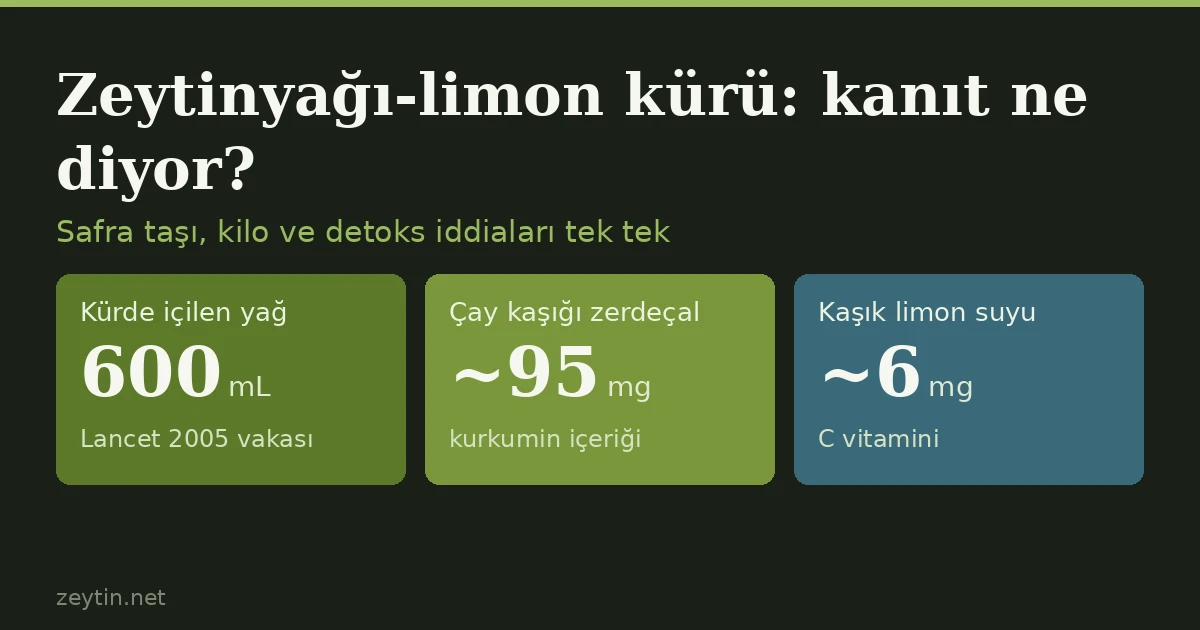
Does an olive oil and lemon cleanse work? What the evidence says
No measured benefit as a mixture: no evidence it flushes gallstones, slims or detoxes; the 'stones' after a flush are soap-like lumps of oil.
 Article
Can you put olive oil on your hair? What the evidence says on dandruff, hair loss and lice
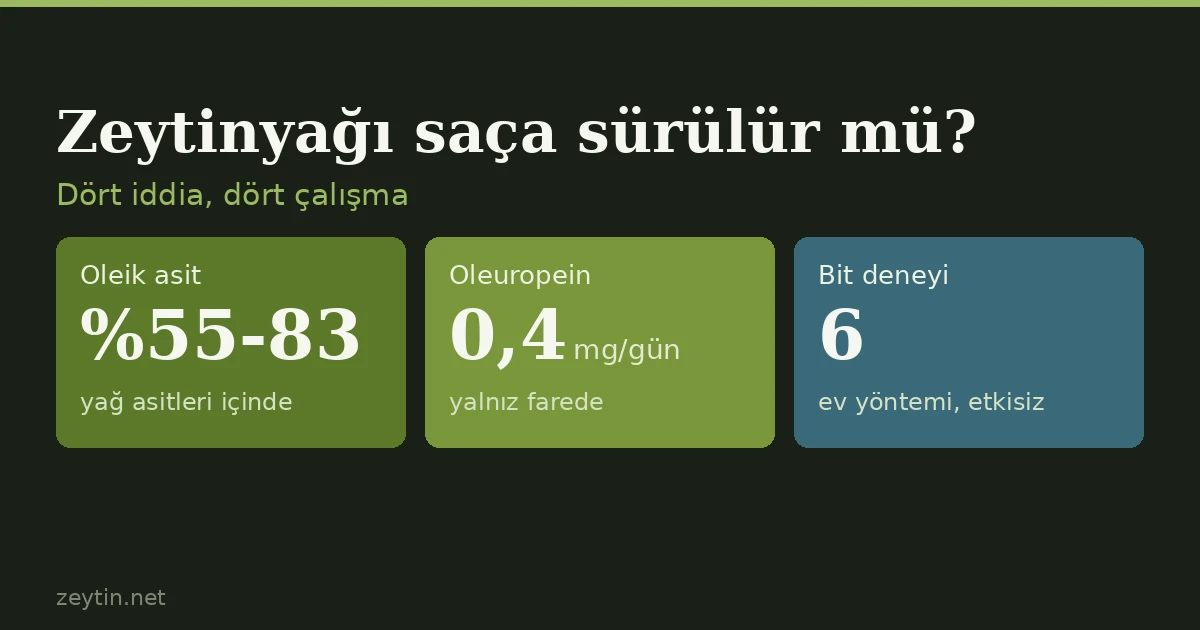
It can go on the hair shaft: it coats the surface and partly passes into the fibre. The only regrowth evidence is a mouse study with pure oleuropein. Oleic acid can irritate a dandruff-prone scalp, and olive oil did not kill lice in the lab.
 Article
Olive pollen allergy: the quiet cause of May to July
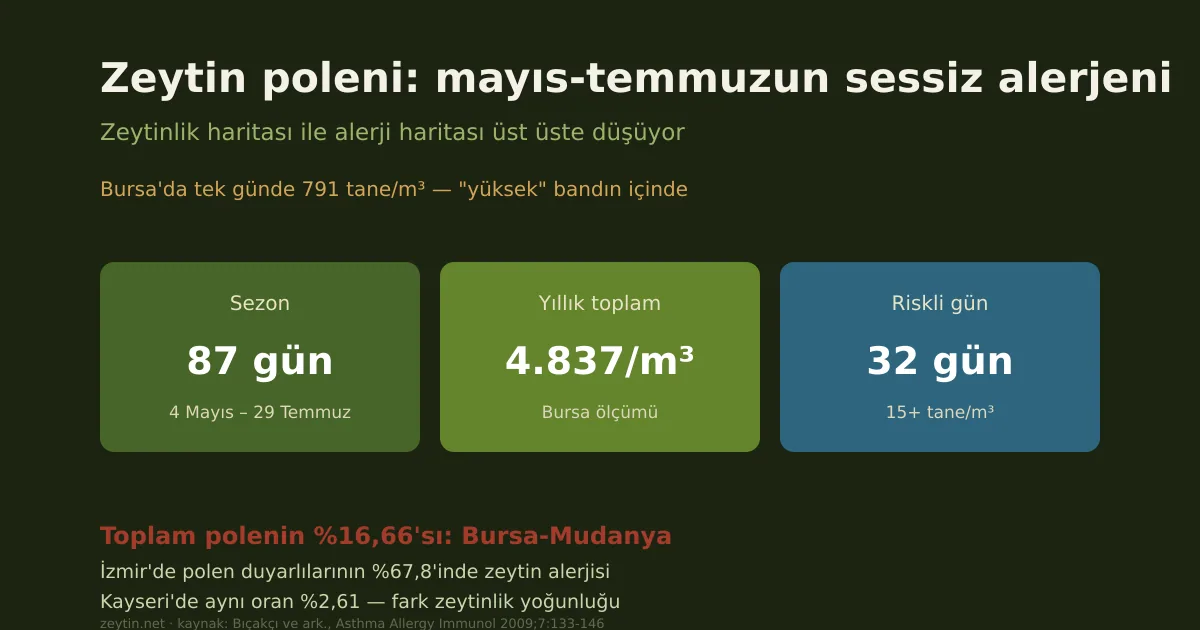
Olive pollen fills the air across western Türkiye from May to July. Bursa recorded 791 grains/m³ in one day over an 87-day season; 67.8% of pollen-sensitised patients in İzmir react to it.