The Çelebi olive family: seven types, two separate geographies
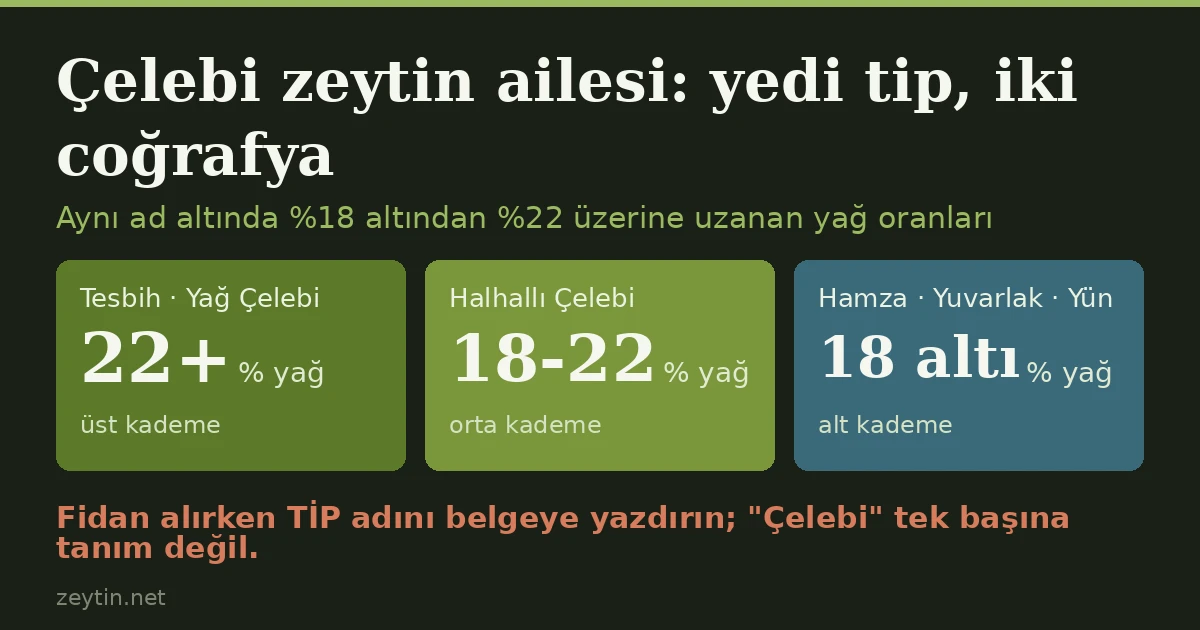
Çelebi is not one variety but a family name. Tesbih Çelebi yields above 22 percent oil while Hamza, Yuvarlak and Yün Çelebi stay under 18. Measured values for seven types.
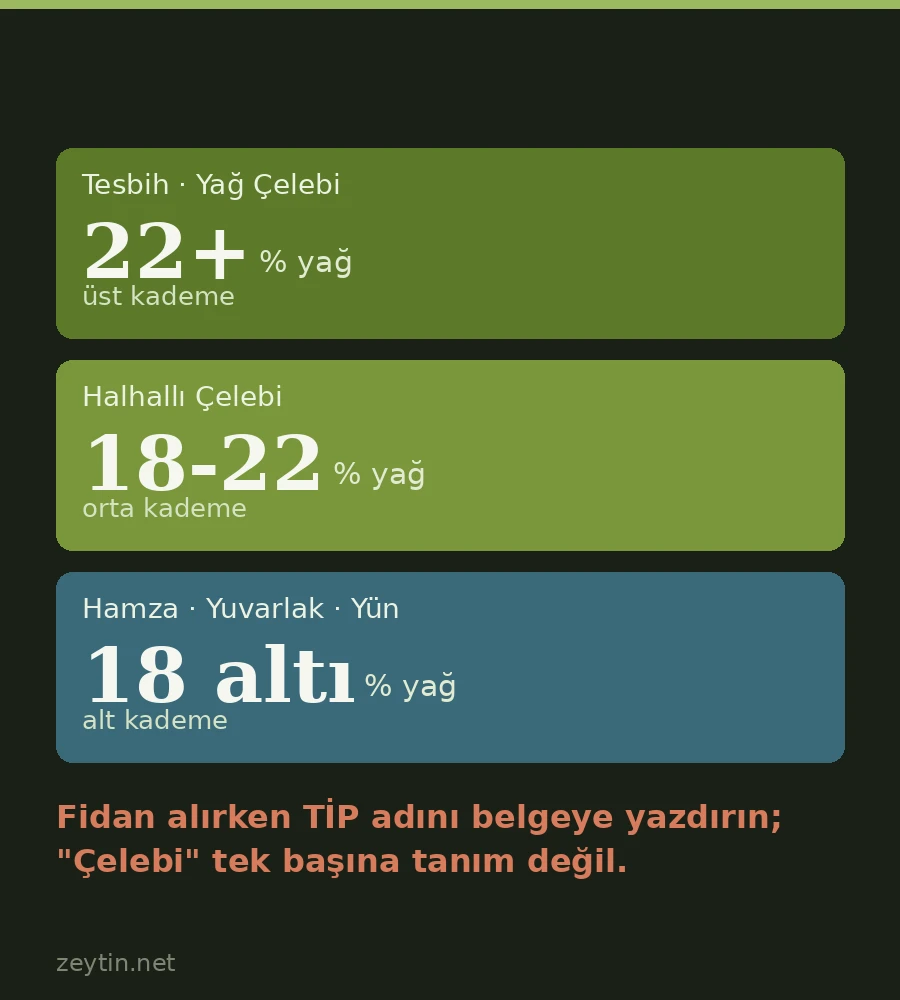
Olive variety names often do not point to a single plant. "Çelebi" is one of the clearest cases: at least seven types are named under it, with oil contents that differ markedly. When a grower says "I planted Çelebi", yield cannot be estimated without knowing which Çelebi.
Three tiers by oil content
| Type | Oil content |
|---|---|
| Tesbih Çelebi | above 22% |
| Yağ Çelebi | above 22% |
| Halhallı Çelebi | 18-22% |
| Hamza Çelebi | under 18% |
| Yuvarlak Çelebi | under 18% |
| Yün Çelebi | under 18% |
The gap is not small. At least four points separate the top tier from the bottom — a difference that translates directly into oil produced from the same tonnage of fruit. In an oil-producing grove, choosing the type matters as much as choosing the variety.
Two geographies, one name
The second layer of confusion is regional. In our records Kan Çelebi and Yağ Çelebi are tied to Southeastern Anatolia, while plain "Çelebi" is tied to Bursa and İznik. The plant meant by "Çelebi" in Marmara is not the plant meant by "Çelebi" in Gaziantep.
This is common in Türkiye. The same variety may carry different names in different districts, and different varieties may share a name. That is why we keep the district field separate for every record on our variety pages.
Measured values for Yağ Çelebi
The most fully measured member of the family is Yağ Çelebi. Our records give oil content above 22 percent, flesh ratio 85 percent, fruit length 25 mm, width 16 mm and 230 fruits per kilogram. Use is recorded as oil, district as Gaziantep.
At 230 fruits per kilogram the fruit is medium-large — for comparison, Eğriburun records 390 and Sarı Haşebi 338. As the count falls the fruit grows larger; in oil use this measure matters less than for table olives, but it still affects harvest and processing efficiency.
Why not separate pages?
For most of these types we hold only oil content; fruit dimensions, chilling requirement and self-fertility have not been measured. Opening a page on a single figure gives the reader a gap rather than information. Treating them as a family makes comparison possible and brings the naming confusion into view.
As new measurements arrive, types can be split onto their own pages. Until then this page keeps the answer to "which Çelebi" in one place.
Why is naming confusion so common?
Olives have been grown in Anatolia for thousands of years, and variety names mostly arose from local use rather than any scientific register. Types named in one village for fruit shape ("Tesbih", prayer bead), in another for a downy look ("Yün", wool) and in another for colour ("Kan", blood) were gathered over time under a single family name.
For the grower the consequence is concrete: not knowing what you are buying. If types yielding under 18 percent and above 22 percent circulate under one name, the grove's income estimate is wrong from the start. This is not unique to Çelebi — a separate "Yuvarlak Halhalı" type is recorded for Halhalı and noted as self-sterile, while the main record carries a different value.
Use within the family
Our records list Yağ Çelebi's use as oil, and that appears to hold for the family: oil content above 22 percent is high for table use, because oily fruit softens faster in brine. The lower tier under 18 percent is inefficient for oil, while its dimensions have not been measured well enough for table use.
So in practice the family serves one channel: oil. When planning a grove, the type's oil content matters more than any table potential.
The Gaziantep axis
Our records place Yağ Çelebi in Gaziantep. The same province grows high-oil varieties such as Nizip Yağlık and Kilis Yağlık — the latter topping the national ranking at 31 percent. Beside those strong neighbours the Çelebi family sits second; these are the varieties a grower planting for oil in the region needs to compare.
For the region's varietal range and measured values, see our oil content ranking.
When planting
Ask for the type name to appear on the invoice and the label. "Çelebi" alone is not a sufficient description; whether it is Tesbih, Hamza or Yün directly sets your oil content. In certified sapling purchases the type is written into the document — the only record that can be verified later.
One rating per visitor; you can change yours at any time. Ratings are real reader votes — no seeded or default scores.
Related
 Article
Do olive trees grow on the Black Sea coast?
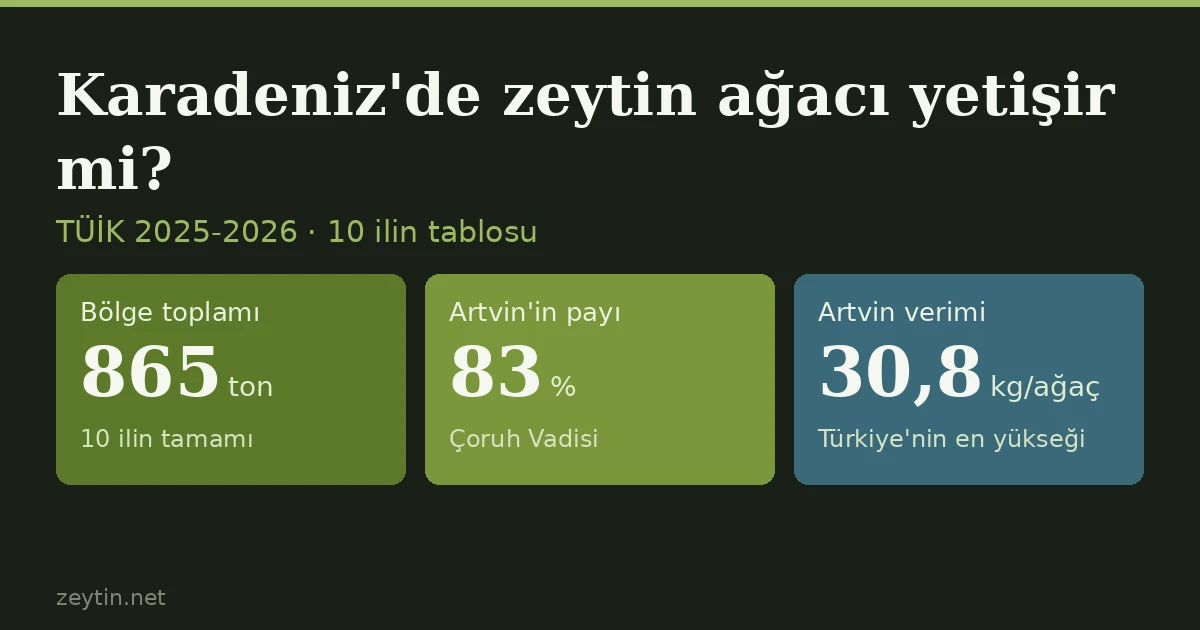
Ten Black Sea provinces produce 865 tonnes between them, 83 per cent of it in Artvin. Trabzon gets 98 tonnes from 36,000 trees; Samsun none from 13,000. The obstacle is humidity, not cold.
Article
Do olive trees grow on the Black Sea coast?
Ten Black Sea provinces produce 865 tonnes between them, 83 per cent of it in Artvin. Trabzon gets 98 tonnes from 36,000 trees; Samsun none from 13,000. The obstacle is humidity, not cold.
 Article
Olive wood: why spoons and not beams?
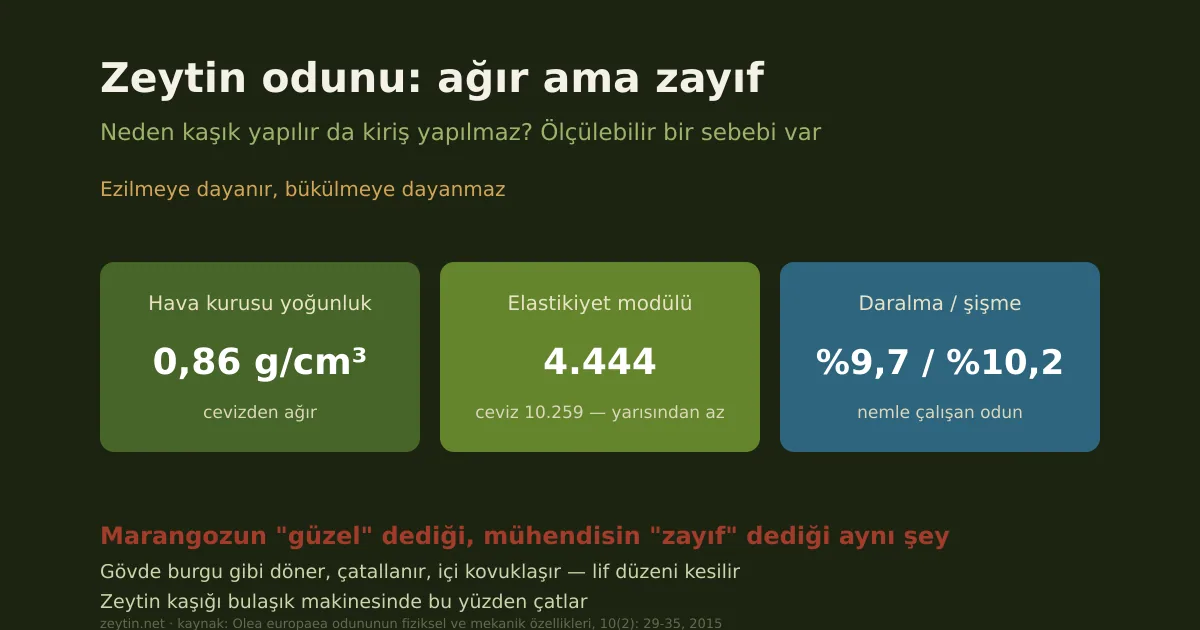
At 0.86 g/cm³ air-dried it is denser than walnut, yet its modulus of elasticity of 4,444 N/mm² is less than half walnut's. It resists crushing but not bending.
Article
Olive wood: why spoons and not beams?
At 0.86 g/cm³ air-dried it is denser than walnut, yet its modulus of elasticity of 4,444 N/mm² is less than half walnut's. It resists crushing but not bending.
 Article
Melkebazi olive
Melkebazi is a recorded variety of south-eastern Anatolia. No measured pomological data published.
Article
Melkebazi olive
Melkebazi is a recorded variety of south-eastern Anatolia. No measured pomological data published.
 Article
Tavşanyüreği olive
Tavşanyüreği is a recorded variety of the Mediterranean. Described in the source.
Article
Tavşanyüreği olive
Tavşanyüreği is a recorded variety of the Mediterranean. Described in the source.