Spain's olive oil producer price falls to €3.06 while shelf prices drop at half the pace
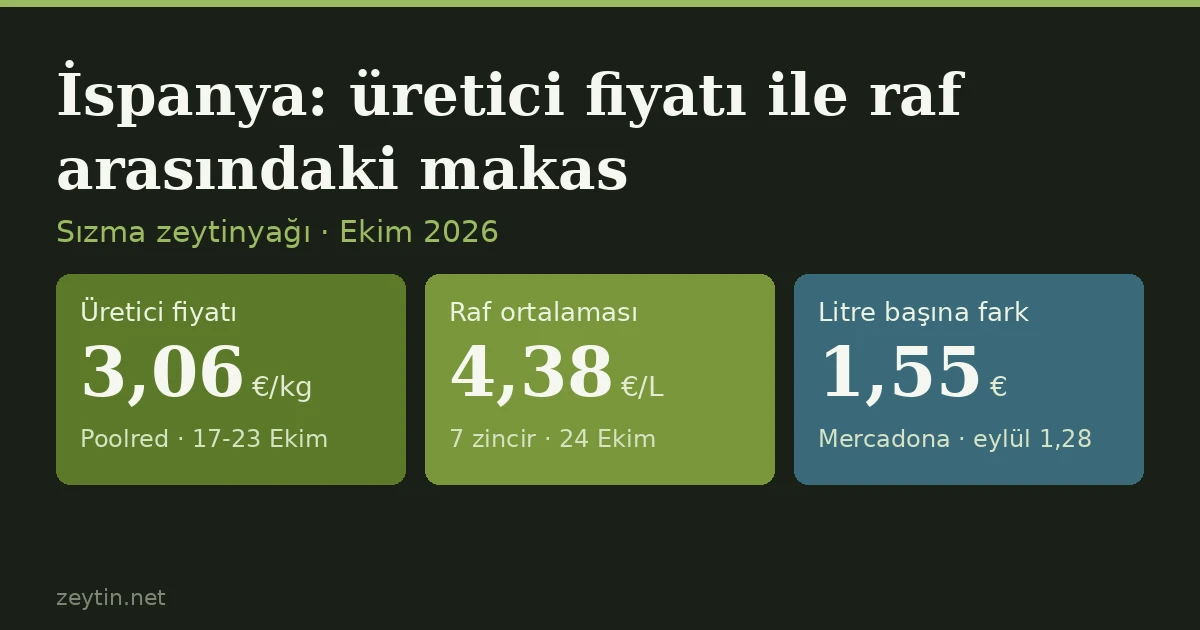
Poolred data show the Spanish producer price of extra virgin olive oil at €3.06/kg in 17-23 October, about 12% below early September. Seven chains' own-label bottles fell 6.7% on average to €4.38 per litre. At Mercadona the per-litre gap widened from €1.28 to €1.55.
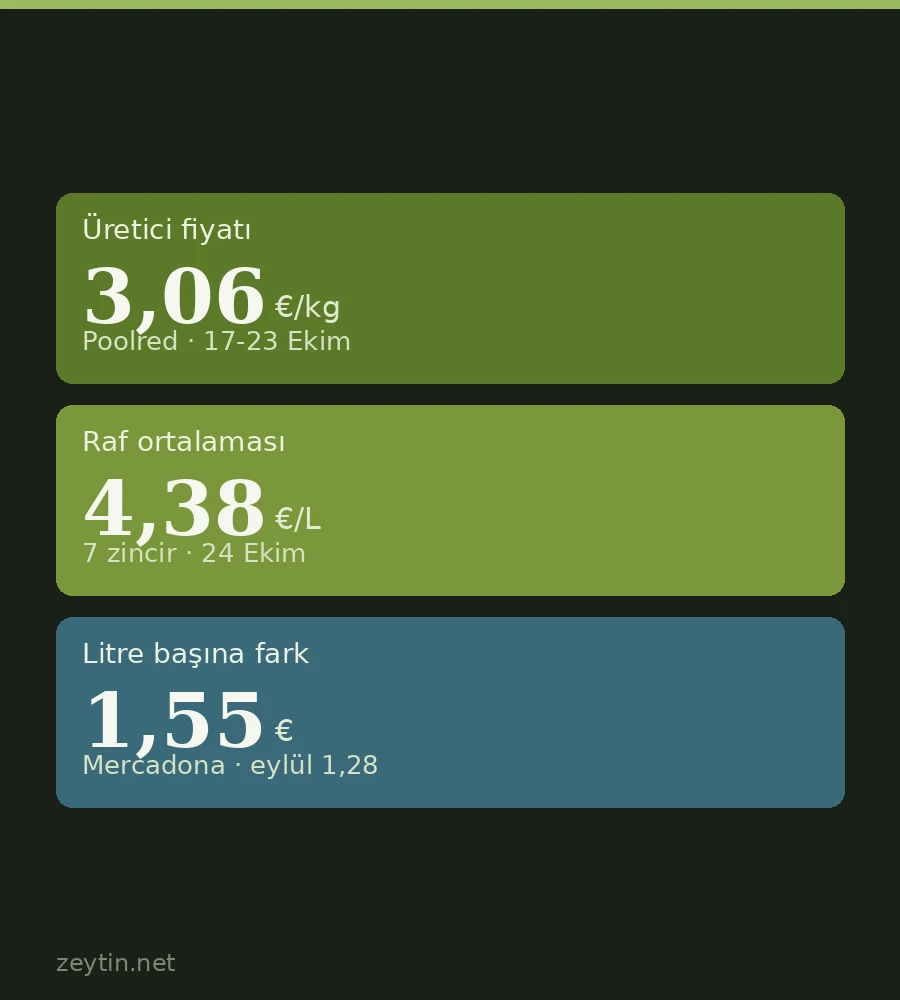
In Spain, olive oil is getting cheaper at the mill gate faster than it is getting cheaper on the supermarket shelf. According to the Jaén-based Poolred price system, the average producer price of extra virgin olive oil fell to €3.06 per kilogram in the week of 17-23 October. In the same days, the big retail chains were selling their own-label one-litre bottles of extra virgin for €4.15 to €4.75. Since early September, only about half of the fall in producer prices appears to have reached the shelf.
Producer prices: another 4.4% in two weeks
Poolred's previous reading, for the week of 3-9 October, put extra virgin at €3.20. The new figure of €3.06 is a 4.4% drop over two weeks. In the latest week, virgin olive oil averaged €3.01 and lampante, the grade that has to be refined before sale, €2.83. Andalusia's regional price observatory reported €3.17 for extra virgin in 12-18 October, and Spain's Ministry of Agriculture €3.31 for 5-11 October. The sources cover different sets of transactions and periods, so the numbers do not line up exactly, but they all point the same way.
The longer series shows how deep the slide has been. In the European Commission's weekly producer price series, which this site tracks, Spanish extra virgin stood at €3.26/kg in the week to 18 October. A year earlier, in the same week, it was €4.24, a fall of 23%. Since the end of August alone, the decline is 5.7%.
The reason is no secret. The Ministry of Agriculture's first official crop estimate, published on 1 October, puts the 2026/27 harvest at 1,602,596 tonnes of olive oil. With carry-over stocks, supply is approaching two million tonnes, which encourages buyers to wait. Harvesting has only just started, so the number of transactions is still small.
Shelf prices: down, but by less
A chain-by-chain comparison published in the Spanish retail press makes it possible to set early-September prices next to those of 24 October for the same product: each chain's own-label one-litre bottle of extra virgin olive oil.
| Chain | Early September (€/L) | 24 October (€/L) | Change |
|---|---|---|---|
| Mercadona | 4.45 | 4.35 | −2.2% |
| Consum | 4.45 | 4.15 | −6.7% |
| Dia | 4.65 | 4.35 | −6.5% |
| Eroski | 4.65 | 4.35 | −6.5% |
| Carrefour | 4.70 | 4.34 | −7.7% |
| Hipercor | 4.95 | 4.35 | −12.1% |
| Alcampo | 4.99 | 4.75 | −4.8% |
The average across the seven chains fell from €4.69 to €4.38, or 6.7%. Over the same period, the producer price fell from a band of €3.45-3.48 at the end of August to €3.06, roughly 12%. Shelf prices are moving, but at about half the speed of producer prices. Larger formats are a little cheaper: Carrefour's five-litre container works out at €4.04 per litre and Mercadona's three-litre one at €4.05.
Consumption figures explain why the subject is watched so closely in Spain. According to the Alimentación en España yearbook of the state-owned company Mercasa, Spaniards bought 5.6 litres of olive oil per person last year and spent €44.90 on it, an average of about €8 per litre across all categories. A difference of 30 to 60 cents on the shelf is something households notice.
The gap per litre
Producer prices are quoted per kilogram and shelf prices per litre, so the units have to be aligned first. Olive oil is lighter than water: one litre weighs about 0.916 kilograms (we explain the conversion in a separate article). On that basis, bulk oil at €3.06/kg is worth €2.80 per litre.
- Against Mercadona's €4.35 bottle, the gap is €1.55 per litre. In early September the same gap was €1.28.
- Over the same weeks, the share of the bulk oil in the shelf price fell from about 71% to 64%.
- Against the cheapest shelf price (Consum, €4.15) the gap is €1.35; against the most expensive (Alcampo, €4.75) it is €1.95.
Not all of that gap is margin. Bottles, labels, filling, transport, tax and store costs add a largely fixed charge per litre. But when the fixed part stays the same and the gap widens, it means cheaper bulk oil is reaching the shelf with a delay. One possible explanation is that bottlers are still working through oil bought in more expensive months; the chains themselves have not commented.
The November decision and Turkey
There is also a policy side. Spain will decide in the first half of November whether to apply, for the first time, a marketing rule that would take part of the crop off the market in a surplus year. In a report published on 5 October, the competition authority CNMC warned that such a withdrawal could push prices up and hurt consumers (we covered the report here). If a withdrawal is ordered, the floor under bulk prices rises, and the slow decline in shelf prices could stop there.
For Turkish producers, the comparison looks like this. On 22 October, extra virgin olive oil was registered on the Edremit Commodity Exchange at ₺270 per kilogram. At the European Central Bank's rate for 23 October (€1 = ₺55.67), that is €4.85, about €1.6 above Spain's producer price of €3.26 in the European Commission series for the same week. It is a single registered trade, not an average. Still, it is a reminder that the world floor that shapes export prices is currently being set in Spain, just above €3. Weekly figures are collected in our olive oil price bulletin.
What to watch in the coming weeks
- Poolred's weekly extra virgin average. As the harvest speeds up, the number of transactions will rise. Whether the price breaks below €3 will be the first signal.
- The ministry's November decision. If a withdrawal percentage is announced, how far bulk prices recover will decide whether shelf prices keep falling.
- The chains' next round of price changes. Since early September, most chains have cut by 24 to 36 cents and Hipercor by 60 cents. Whether the gap narrows will show in the next round.
One rating per visitor; you can change yours at any time. Ratings are real reader votes — no seeded or default scores.
Related
 Article
"Jewels of the Adriatic": four countries choose to compete on quality, not volume
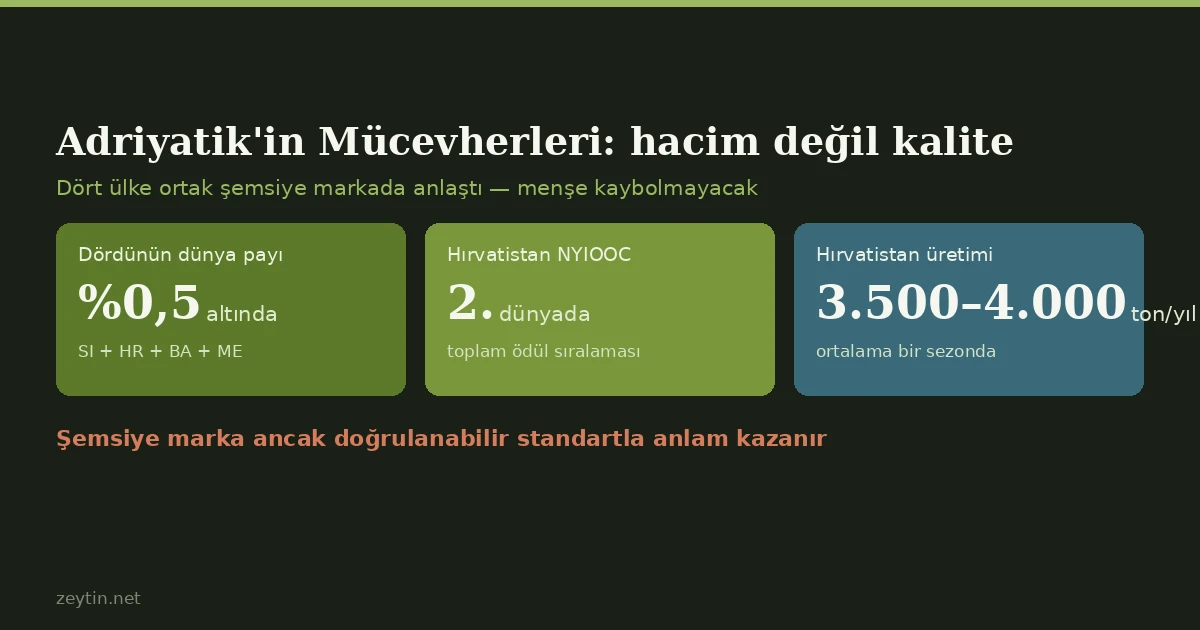
Slovenia, Croatia, Bosnia and Herzegovina and Montenegro together produce under 0.5% of the world's olive oil — yet Croatia finished second worldwide at the NYIOOC. A panel in Mostar proposed a shared umbrella brand: origin stays, common rules are the condition.
 Article
Pakistan to plant 2 million olive trees in three years to cut edible oil imports
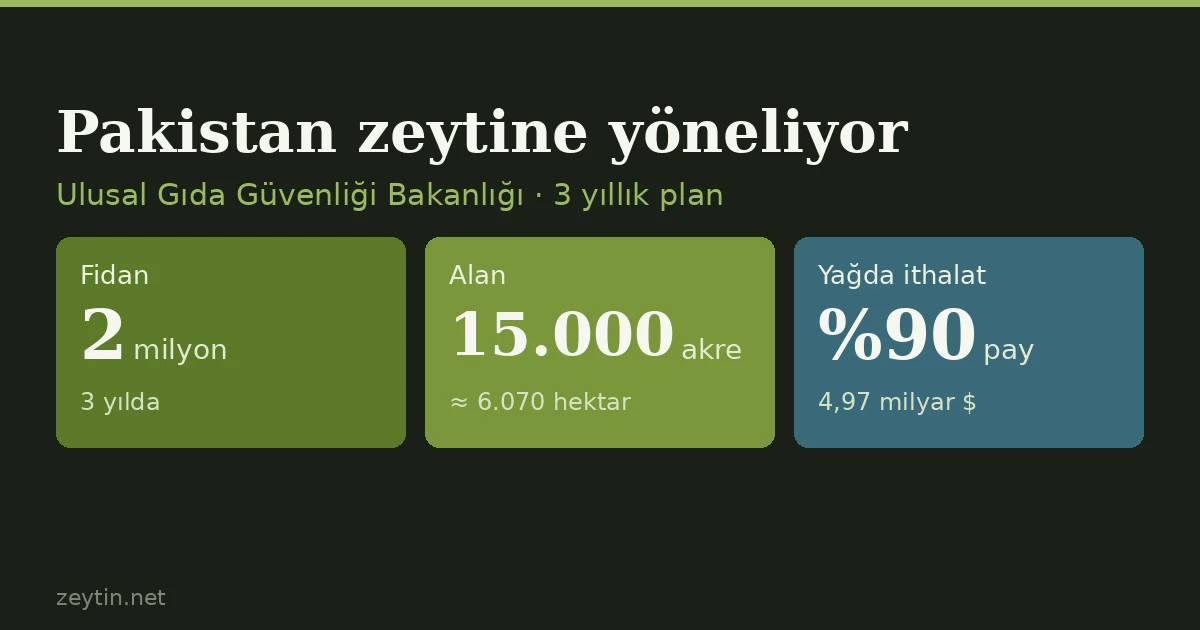
Pakistan's Ministry of National Food Security and Research plans to establish olive groves on 15,000 acres (about 6,070 hectares) over three years and supply 2 million plants in that period. The country imports roughly 90 per cent of its edible oil; the import bill reached 4.97 billion dollars in 2024-25.
 Article
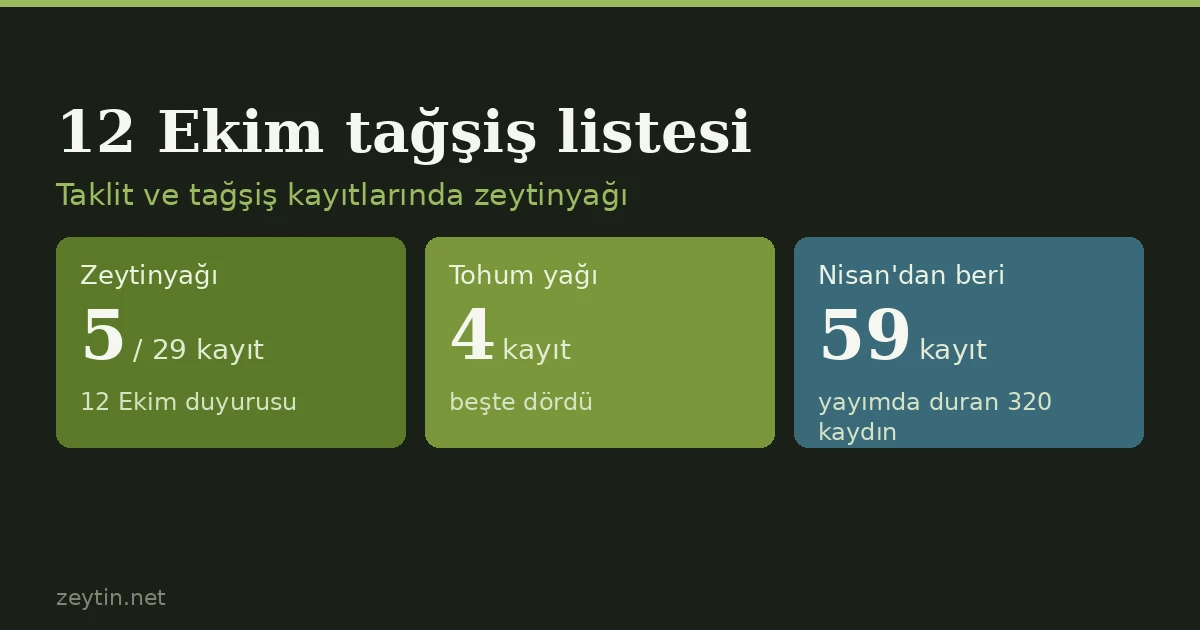
12 October adulteration list: five of 29 records are olive oil, four with seed oil
The ministry's 12 October 2026 notice added 29 records to Türkiye's counterfeit-and-adulteration list, five of them olive oil: four with seed oil blended in, one with lower-grade olive oil. Of the 320 records currently published, 59 are olive oil, and Manisa's count rose from one to three.
 Article
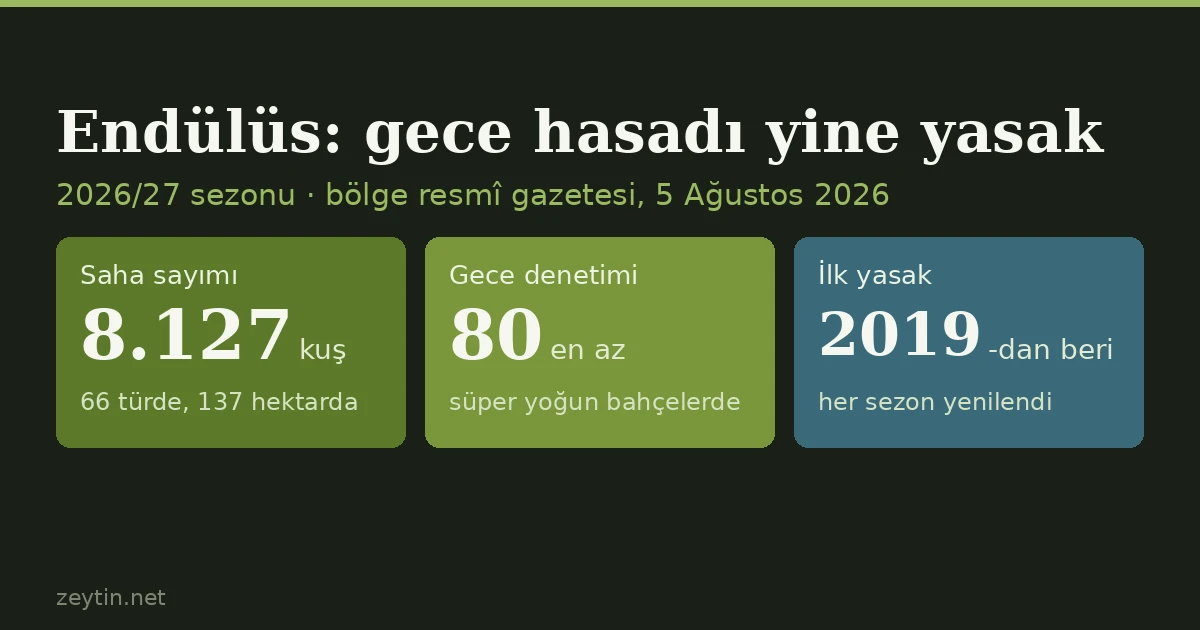
Andalusia bans night harvesting again for 2026/27: 8,127 birds counted on 137 hectares
Andalusia has again suspended night-time mechanical harvesting in super-intensive hedgerow olive groves for the 2026/27 season. The resolution is dated 30 July 2026, was published in the regional official gazette on 5 August and is valid for one year. The justification is field counting: 8,127 birds from 66 species on 137 hectares. The suspension was first introduced in 2019 and has been renewed every season since.