Skilled operators for olive mills: training ends in Milas, Muğla trains women operators
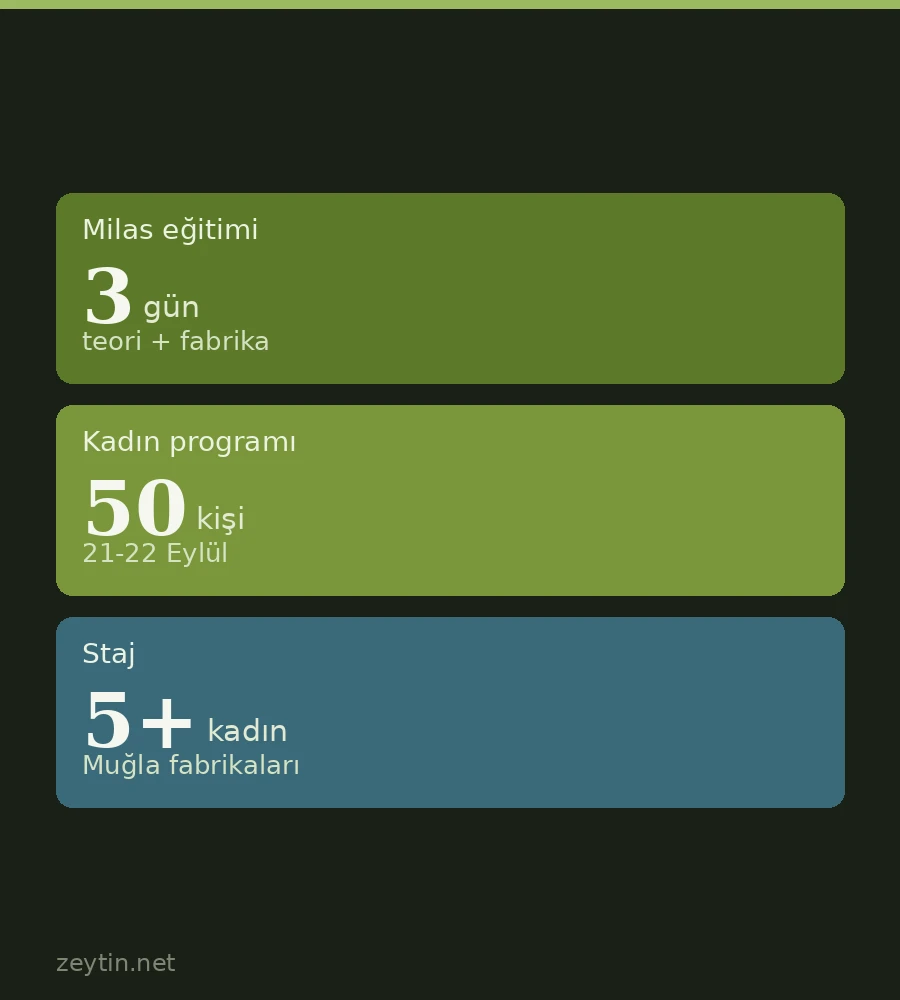
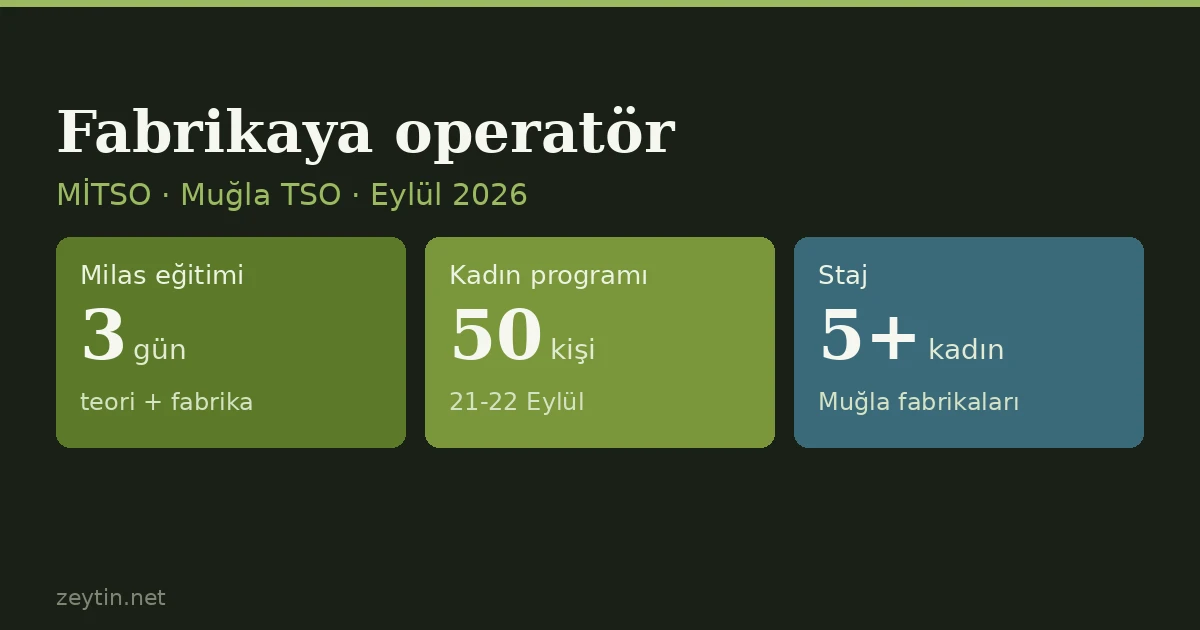
Ahead of the harvest, two training programmes in Muğla focus on operators, the most critical link in olive mills. A three-day operator course run by MİTSO, Milas Tariş and HAUS Makine has ended in Milas, and the Muğla Chamber of Commerce and Industry is launching a 50-place "Women's Hands in Industry" programme to train women as mill operators.
Olive oil quality begins in the grove but is settled in the mill. The same olives can become a very different oil if the paste is kneaded at a different temperature, if the decanter is badly adjusted or if the line is not kept clean. That is why one of the things mills need most before the harvest is skilled operators. Two separate programmes addressing that need have stood out in Muğla this month.
Milas: a three-day operator course has ended
The Olive Oil Operator Training organised by the Milas Chamber of Commerce and Industry (MİTSO), Milas Tariş and HAUS Makine Sanayi ended on 10 September after a three-day programme.
Participants received both theoretical and practical instruction on:
- olive oil production processes,
- machine operation and fine adjustments,
- maintenance,
- quality standards,
- improving production efficiency.
The last day took place at the Labranda Olive Oil Mill, owned by MİTSO member Levent Baydal. Participants reinforced what they had covered in theory by working at running machines on the mill floor. Certificates of participation were presented by MİTSO Board Chair Reşit Özer and MİTSO Assembly Chair Mustafa Yüksel. By highlighting the importance of skilled people alongside knowledge and technology, the programme aims to contribute to the development of Milas's olive oil sector.
Muğla: "Women's Hands in Industry"
The second programme is aimed directly at women. Coordinated by the Muğla Chamber of Commerce and Industry, with the TOBB Muğla Women Entrepreneurs Board and Polat Makina, the project "Women's Hands in Industry – Women Operators for Muğla's Olive Oil Industry" seeks to bring women into technical roles in olive mills.
| Item | Detail |
|---|---|
| Places | 50 |
| Application period | 2-15 September 2026 |
| Theory | 21 September, Muğla Chamber of Commerce and Industry |
| Practical training | 22 September, Polat Makina (Aydın) |
| Transport | Transport support between Muğla and Aydın |
| Internships | At least 5 successful participants placed in mills in Muğla |
The programme covers the process from the moment olives are received at the mill to the end of the production line. Alongside the core stages of crushing, malaxation (kneading), decanting and separation, it includes quality, hygiene and occupational safety. After training, practice and internships, the aim is to widen women's employment opportunities in the sector.
Why do operators matter so much?
A mill line broadly runs in this order: leaf removal and washing, crushing, malaxation, decanting (separating oil, water and pomace in a continuous system), separation (final cleaning of the oil) and storage. Each stage has settings, and all of them affect oil quality:
- Crushing: crusher speed and screen size set how fine the paste is; crushing too finely heats the paste and changes bitterness and aroma.
- Malaxation: the kneading temperature and time directly affect aroma and polyphenol content. EU rules allow the terms "cold pressed" and "cold extracted" only for oils whose paste stayed below 27 °C throughout. Raising the temperature increases yield but gives a flatter oil. We explain that balance in detail in what is a malaxer.
- Decanter and separator: the rate of added water and the speed settings decide both oil yield and how much oil is left in the pomace.
- Hygiene: a poorly cleaned line can cause defects such as musty, winey or vegetable-water notes that tasting panels pick up; we explain how to recognise them on our page on olive oil tasting defects.
You can follow the whole line step by step in our guide how cold-pressed olive oil is made.
What should growers look for at the mill?
Operator training benefits not only the mill but also the grower having olives pressed. A grower using a mill's toll-pressing service should not hesitate to ask:
- How many hours will the olives wait? The sooner picked olives are processed, the lower the acidity. Olives left in sacks or heaps for days will not give quality oil even on the best-adjusted line.
- At what temperature and for how long will the paste be kneaded? If the label is to say "cold pressed", the paste must stay below 27 °C.
- Is the line clean, and whose olives were processed before yours? Residue from the previous batch or a dirty line can pass into the oil as a defect.
- Where and in what containers will the oil wait? Stainless steel tanks that protect oil from light, heat and air are preferable.
- Can the oil be analysed? Knowing acidity and peroxide values decides which grade the oil can be sold under.
A skilled operator is someone who knows the answers to these questions and sets up the line accordingly.
A skills gap in seasonal work
Olive mills stand idle for most of the year and then run flat out for a few months at harvest. That makes it hard to find permanent, experienced operators; at the start of the season lines are often handed to people using the machines for the first time. Short, hands-on programmes are seen as the fastest way to close that gap.
The women's operator programme is meaningful in its own right. Women's labour has always carried a heavy share of picking, sorting and table olive processing in the groves, while the technical side of the mill has largely remained a male domain. We looked at women's work in olive growing in our story on the year of the woman farmer and olive oil labour, and at the problems caused by mill waste in olive mill waste water and pomace.
One rating per visitor; you can change yours at any time. Ratings are real reader votes — no seeded or default scores.
Related
 Article
"Jewels of the Adriatic": four countries choose to compete on quality, not volume
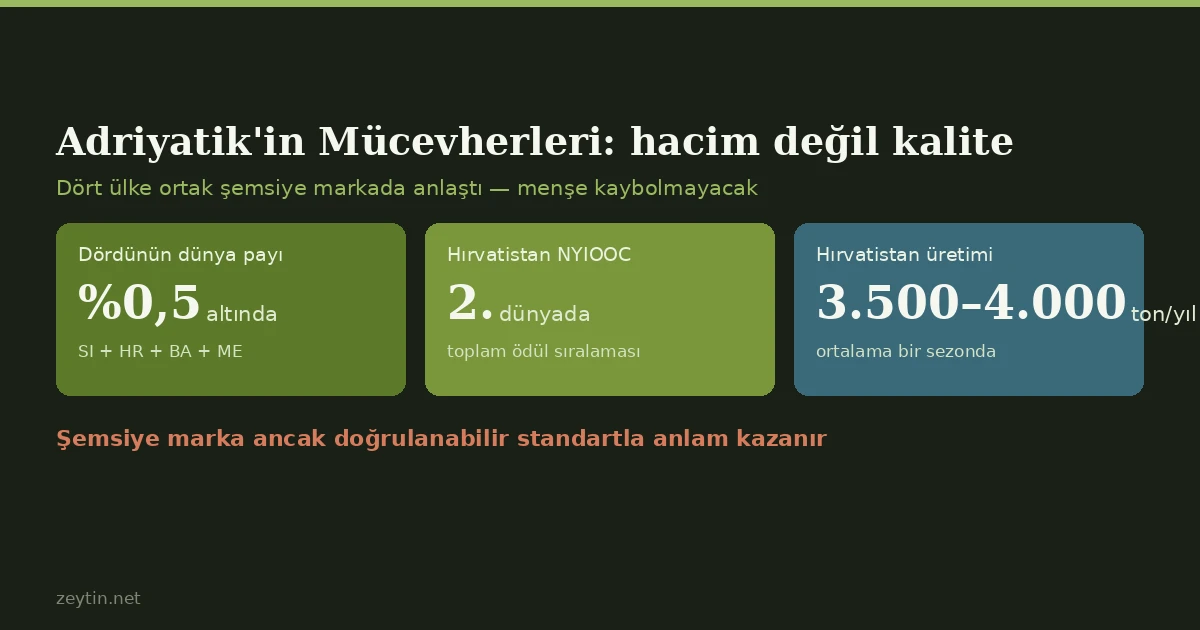
Slovenia, Croatia, Bosnia and Herzegovina and Montenegro together produce under 0.5% of the world's olive oil — yet Croatia finished second worldwide at the NYIOOC. A panel in Mostar proposed a shared umbrella brand: origin stays, common rules are the condition.
Article
"Jewels of the Adriatic": four countries choose to compete on quality, not volume
Slovenia, Croatia, Bosnia and Herzegovina and Montenegro together produce under 0.5% of the world's olive oil — yet Croatia finished second worldwide at the NYIOOC. A panel in Mostar proposed a shared umbrella brand: origin stays, common rules are the condition.
 Article
Olive fruit fly warning before harvest in Aydın: check groves, spray only above the threshold
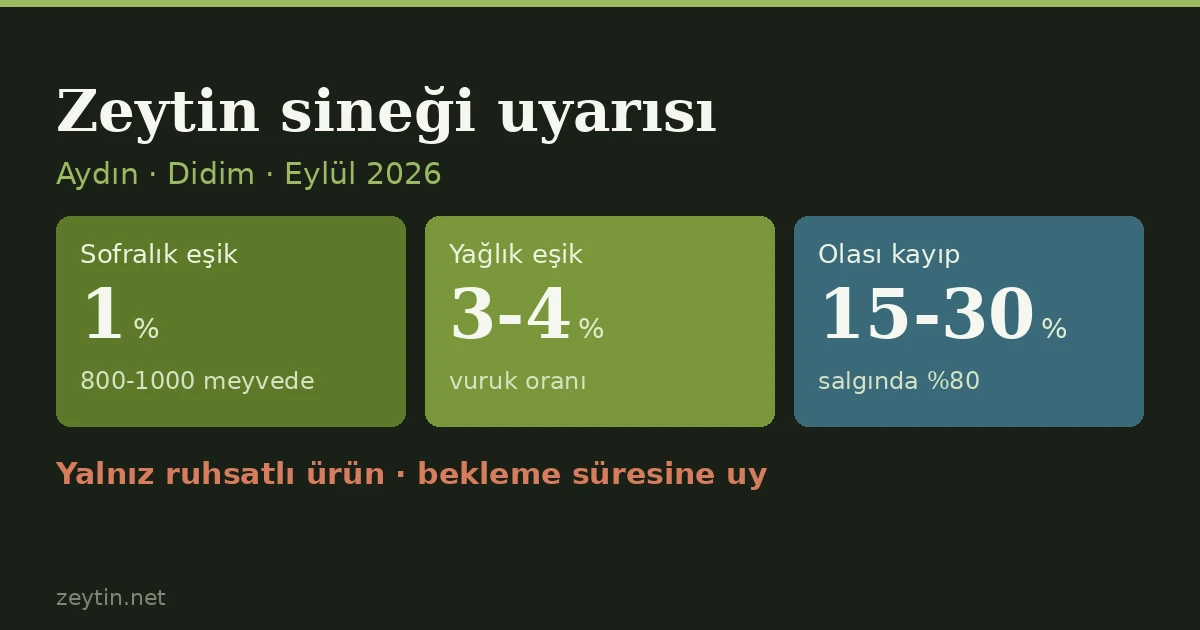
The Didim District Directorate of Agriculture and Forestry, together with the Aydın Provincial Directorate, has warned growers about the olive fruit fly ahead of the harvest. Growers were asked to check groves regularly, monitor pest density and, if needed, act only with products licensed for olives and at the right time. Fly pressure rising in autumn cuts both yield and oil quality.
Article
Olive fruit fly warning before harvest in Aydın: check groves, spray only above the threshold
The Didim District Directorate of Agriculture and Forestry, together with the Aydın Provincial Directorate, has warned growers about the olive fruit fly ahead of the harvest. Growers were asked to check groves regularly, monitor pest density and, if needed, act only with products licensed for olives and at the right time. Fly pressure rising in autumn cuts both yield and oil quality.
 Article
Edremit Chamber: olive oil needs at least 50 lira per litre in support
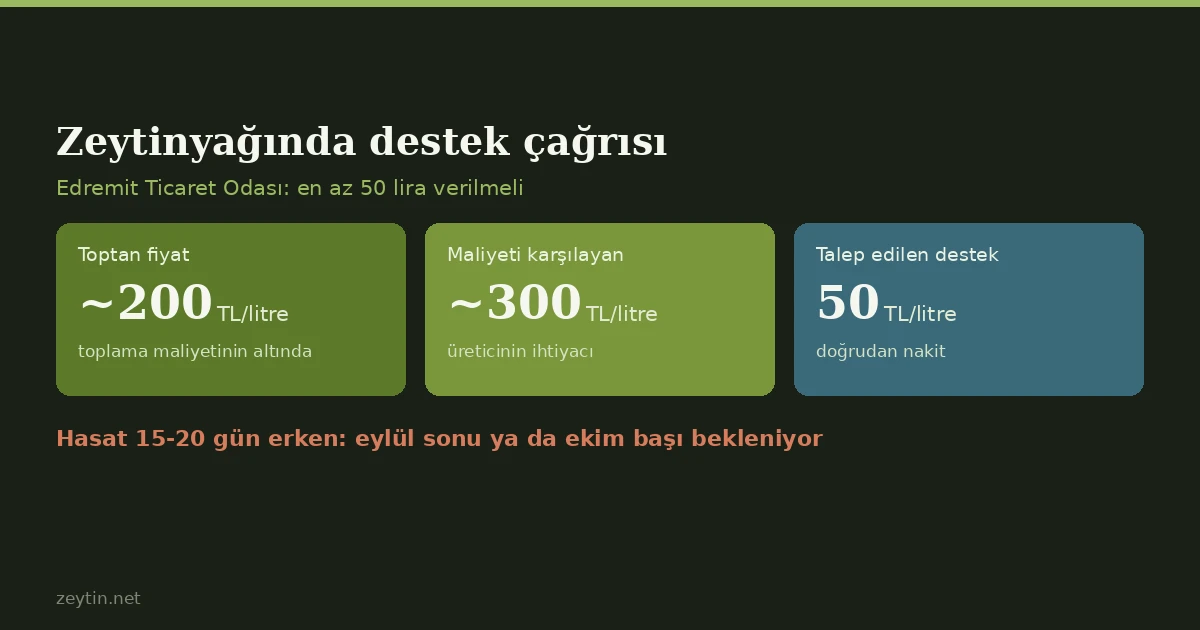
Chamber President Ahmet Çetin says the wholesale price has fallen to 200 lira, below the cost of picking. The level needed to cover costs is 300 lira. Harvest is expected 15-20 days early.
Article
Edremit Chamber: olive oil needs at least 50 lira per litre in support
Chamber President Ahmet Çetin says the wholesale price has fallen to 200 lira, below the cost of picking. The level needed to cover costs is 300 lira. Harvest is expected 15-20 days early.
 Article
A 282-member doctors' cooperative puts sensors in the olive grove
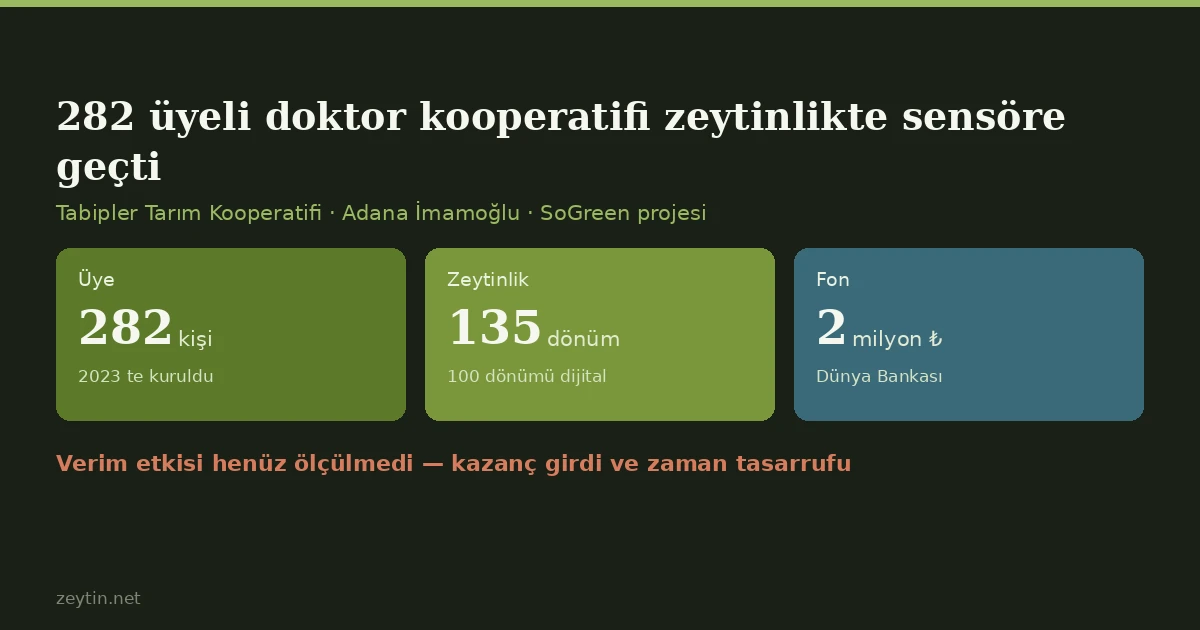
A cooperative founded by doctors in Adana is monitoring water and fertiliser with buried sensors across 100 of its 135 dönüm of bearing olive grove, funded with 2 million lira.
Article
A 282-member doctors' cooperative puts sensors in the olive grove
A cooperative founded by doctors in Adana is monitoring water and fertiliser with buried sensors across 100 of its 135 dönüm of bearing olive grove, funded with 2 million lira.