Italy's protest widens: thousands of growers in Bari, mills idle in Sicily, still no crisis status
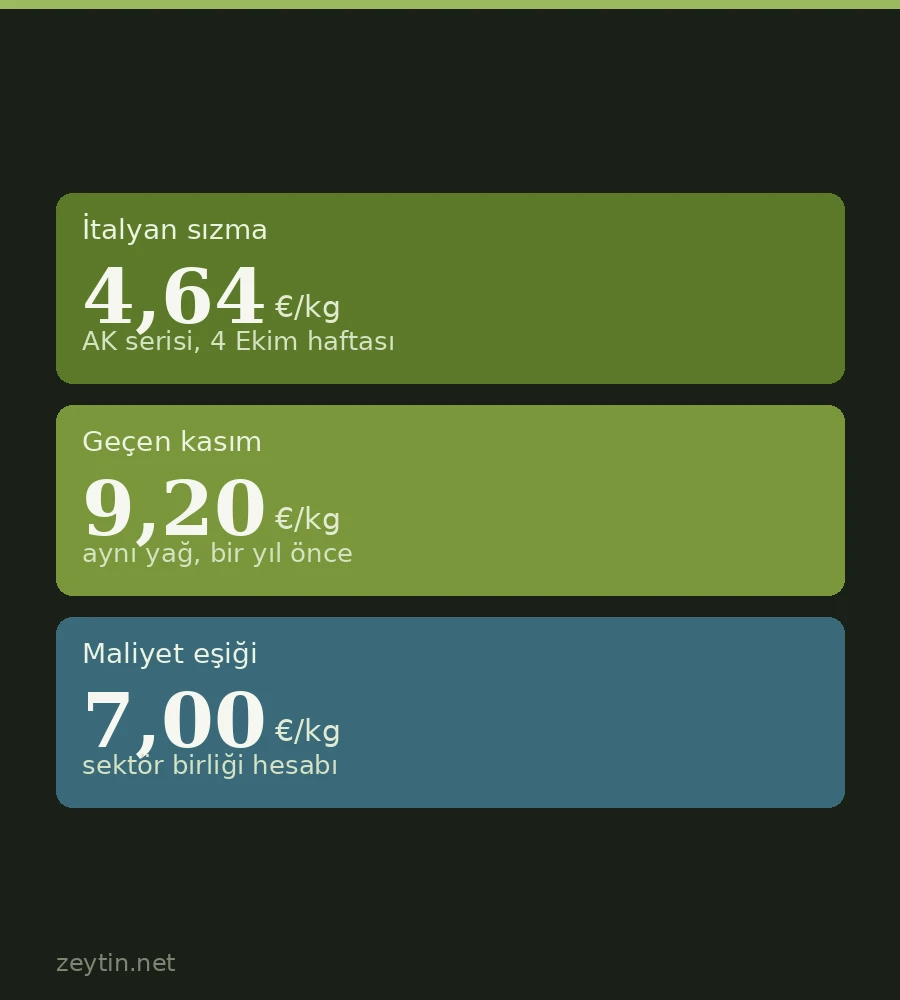
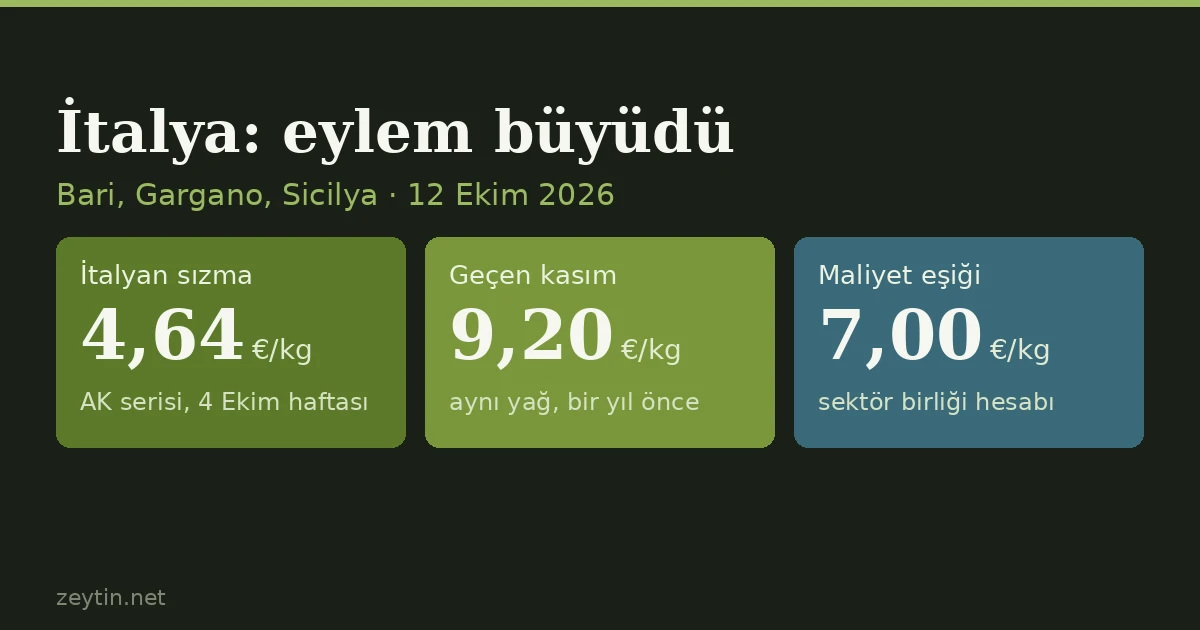
The deadline given in Puglia expired without crisis status being granted: on 12 October thousands of growers gathered in front of the Bari prefecture, hundreds of tractors blocked roads on the Gargano, and harvesting and milling have been suspended since 5 October across nine municipalities in Sicily. Two of the four demands concern anti-fraud controls and an electronic transport document for olives. In the European Commission series, Italian extra virgin stood at 4.64 €/kg in the week of 4 October; the figure quoted in the field is 4 euros, against 9.20 € last November. The next threshold is 15 October.
The price protest that began in the first days of Italy's harvest has spread to a second region within a week, and it has now run up against an institutional deadline. We reported that growers in Puglia gave the government until Monday noon. The deadline passed, crisis status was not granted, and instead of fading the protest grew.
What happened in Bari
On the morning of Monday 12 October, olive growers gathered in front of the prefecture building in Bari. The demonstration was organised by Orgoglio Olivicolo, a national committee that brings together different links of the olive chain, together with the Bari-BAT farmers' organisation. Tractors set out at dawn from the Bari metropolitan area, while growers from Taranto, Brindisi, Foggia and Barletta-Andria-Trani arrived by train, bus and car.
⚠ Attendance was reported at around 2,000 people. That figure is not independently verified; organisers and local sources put the range at "thousands".
The same evening, at 17:00, a meeting was convened at the regional agriculture department, bringing together the regional agriculture official Paolicelli, the banking association and committee representatives.
Four demands
The committee's four points are worth reproducing in full, because three of them concern Türkiye just as directly:
1. Recognition of a state of crisis in the sector, and activation of the support instruments that follow from it.
2. Full and immediate application of the olive transport and accompanying document (DAO) — extending to olives the electronic traceability document already in use for wine.
3. An extraordinary national plan of anti-fraud controls.
4. Withdrawal and storage of part of the new crop, plus financing for mills.
The second and third demands make one thing explicit: growers do not explain the price fall by abundant supply alone. They also point to adulteration and origin confusion as a cause.
Tractors on the Gargano, idle mills in Sicily
The same morning, hundreds of tractors blocked the access roads of Carpino, on the Gargano promontory. The mayor of Carpino, Rocco Di Brina, regional official Raffaele Piemontese and regional councillor Rossella Falcone joined the protest. Their message was that the region is ready to help and that it is now the central government's turn. According to growers, agricultural diesel alone accounts for more than 40% of harvesting costs, while higher electricity prices have pushed up milling tariffs as well.
In Sicily the action took a harder form. Since 5 October, harvesting and milling have been suspended across an area covering nine municipalities in the Belice, Sicani and Agrigento basins. The demand is explicit: at least 8 euros per litre. The official series cited in support puts the producer price in the Palermo and Trapani markets at 6.70 €/kg in September 2026, against close to 10 euros in the same month of 2025.
What the measured prices say
According to the European Commission's weekly producer prices, in the week of 4 October Italian extra virgin olive oil stood at 4.64 €/kg, and at 4.55 € in the Bari market. The number at the centre of the Puglian protest, however, comes from the field: the wholesale price paid to growers is around 4 euros, and in some transactions 3.80 €. Last November the same oil was changing hands at 9.20 €/kg.
Tommaso Loiodice, who heads one of the sector's producer organisations, said the price should not fall below 7 €/kg simply to cover costs. By that calculation, today's level is close to half of what production costs.
Seen as a band, Italy is not alone: in the same week Spanish extra virgin stood at 3.43 €/kg. In both of the Mediterranean's largest producers, in other words, the producer price is pinned in the 3-5 euro range. That is why the protest has taken up the demand for crisis status: the price has become a problem of the whole basin rather than of a single market.
⚠ The gap between the two figures is real: Sicily is talking about 6.70 €, Puglia about 4 €. Within the same country, producer prices change with the market and the quality band. There is no single "Italian price".
What the government has put on the table
For now, the Italian agriculture ministry's instrument is financing: zero-interest loans of between 3,500 and 50,000 euros through the state agricultural credit body. It continues the 40-million-euro credit line opened to mills last season. Committee spokesman Francesco Losito does not consider it sufficient, calling credit a palliative against a price that has fallen from above 9 euros to 4 euros in a single year.
The regional government formally requested recognition of a state of crisis on 21 May 2026; that request has gone unanswered. The next threshold is Thursday 15 October, when concrete answers are expected from the state-regions conference. If they do not come, organisers have announced that the protest will move to Rome.
Seen from Türkiye
This is not a distant story for us. Italy is both a trading hub that exports more than it produces and a buyer of Turkish bulk oil. An Italy whose producer price is pinned near 4 euros will press for lower prices in bulk purchasing.
The calendar overlaps as well. In the same days, in table olives, the sieves closed in Akhisar. The stated reason falls under the same heading: costs up, purchase prices down.
For scale, our own series: in the registration of 12 October, extra virgin olive oil stood at 273.60 TL/kg and oil-stock olives at 31.31 TL/kg. Current registrations can be followed on the market page, and we have explained separately how to read an exchange price.
Points of caution
⚠ Crowd figures in protest coverage vary by source; the "around 2,000" here is not a verified count.
⚠ Figures such as 4 euros and 3.80 euros are field statements, not exchange registrations. What is measured is the 4.64 €/kg in the Commission's weekly series.
⚠ Whether crisis status will be granted was still unresolved as of 13 October. The outcome of the 15 October conference was not known when this piece was written.
One rating per visitor; you can change yours at any time. Ratings are real reader votes — no seeded or default scores.
Related
 Article
Table olive tasting panel training in Aydın
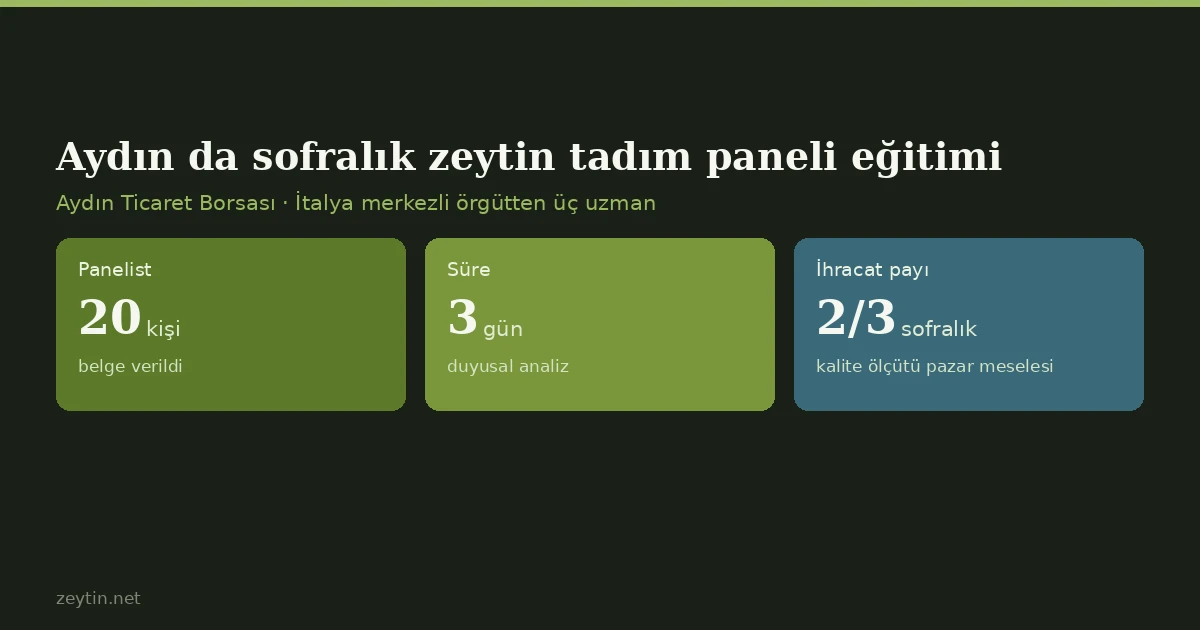
Aydın Commodity Exchange is extending its sensory analysis experience from olive oil to table olives, with 20 panellists trained over three days.
Article
Table olive tasting panel training in Aydın
Aydın Commodity Exchange is extending its sensory analysis experience from olive oil to table olives, with 20 panellists trained over three days.
 Article
Concordat in Akhisar: a one-year moratorium for Baktat Zeytin
A Turkish commercial court has granted a one-year definitive moratorium to Baktat Zeytin, a table-olive processor in Akhisar. We set out what the ruling means and why it matters for the sector.
Article
Concordat in Akhisar: a one-year moratorium for Baktat Zeytin
A Turkish commercial court has granted a one-year definitive moratorium to Baktat Zeytin, a table-olive processor in Akhisar. We set out what the ruling means and why it matters for the sector.
 Article
Spain decides in November: will part of a 1.6 million tonne crop be withdrawn from the market?
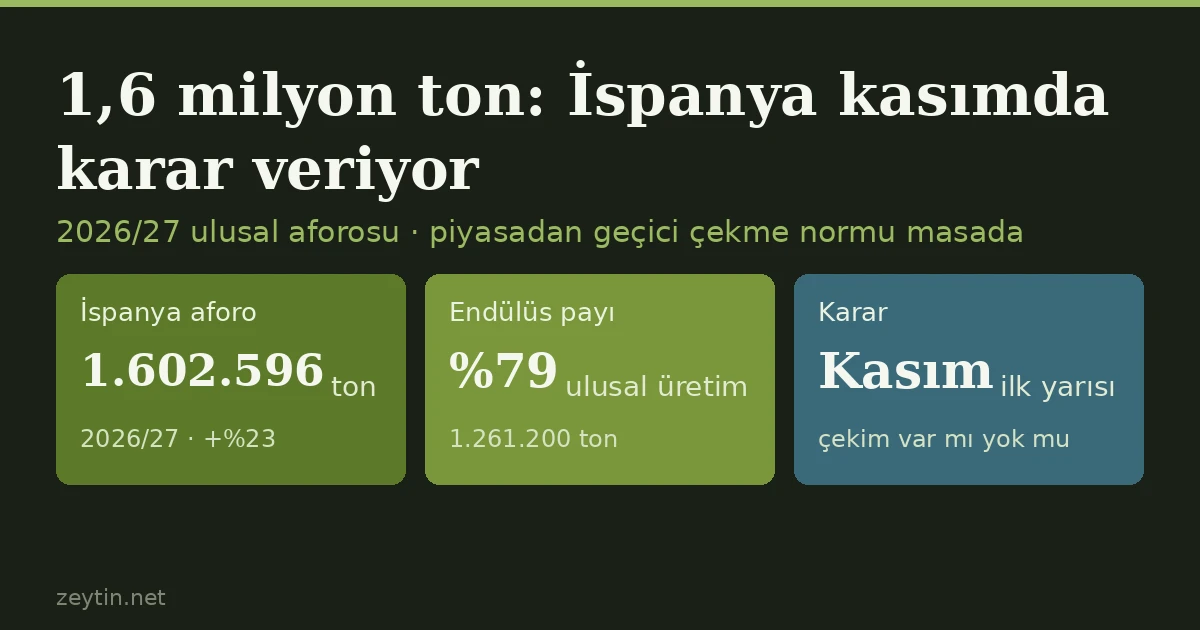
Spain's first national aforo for 2026/27 was presented in Jaén on 1 October: 1,602,596 tonnes of olive oil, 23% above last harvest. With carry-over stock, total availability approaches two million tonnes, and the Ministry of Agriculture will decide in the first half of November whether to activate a temporary withdrawal mechanism that has never been used. The ceiling on the world price Turkish exporters will face is being set here.
Article
Spain decides in November: will part of a 1.6 million tonne crop be withdrawn from the market?
Spain's first national aforo for 2026/27 was presented in Jaén on 1 October: 1,602,596 tonnes of olive oil, 23% above last harvest. With carry-over stock, total availability approaches two million tonnes, and the Ministry of Agriculture will decide in the first half of November whether to activate a temporary withdrawal mechanism that has never been used. The ceiling on the world price Turkish exporters will face is being set here.
 Article
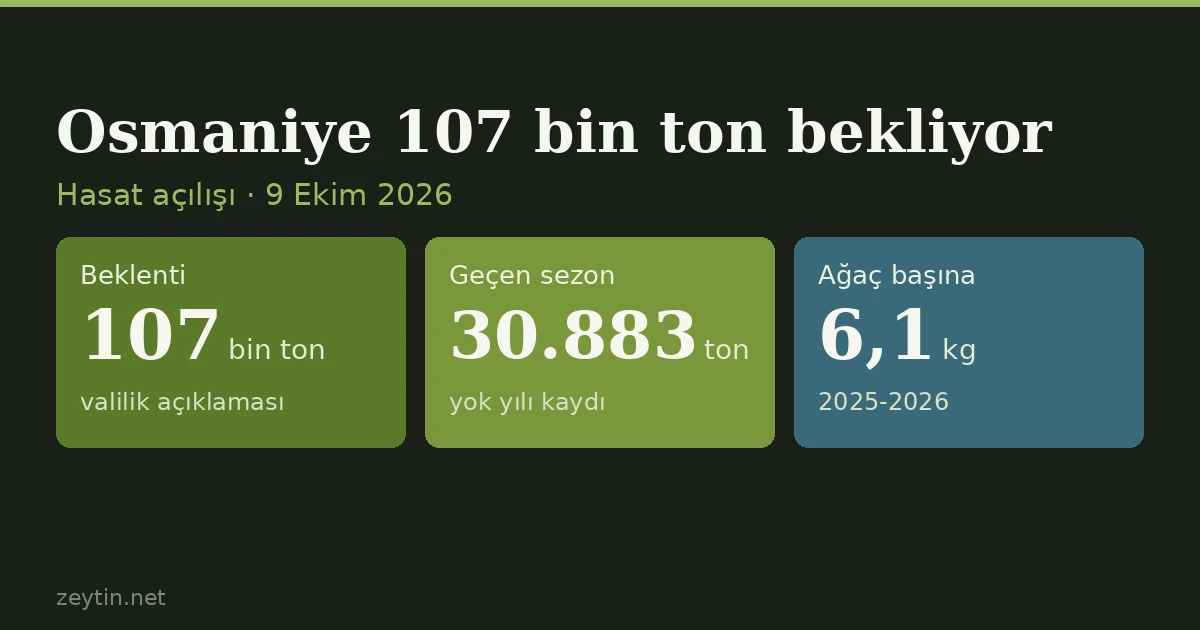
Osmaniye expects 107,000 tonnes: 3.5 times last season, in line with on-year averages
The governor's office in Osmaniye says the province's roughly 10 million olive trees are expected to yield more than 107,000 tonnes this year. That is 3.5 times last season — but 2025-2026 was an off year, and the forecast is consistent with on-year yields. Small discrepancies remain in tree counts and ranking.
Article
Osmaniye expects 107,000 tonnes: 3.5 times last season, in line with on-year averages
The governor's office in Osmaniye says the province's roughly 10 million olive trees are expected to yield more than 107,000 tonnes this year. That is 3.5 times last season — but 2025-2026 was an off year, and the forecast is consistent with on-year yields. Small discrepancies remain in tree counts and ranking.